Category | CLOUD and AWS
Last Updated On 15/04/2026
Your cloud bill arrived. It's higher than last month. Again. And when you dig into it, nobody can quite explain where the extra spending came from.
This is one of the most common problems engineering and finance teams face once cloud infrastructure reaches any meaningful scale. Resources get provisioned, projects change direction, and the billing keeps running quietly in the background, whether those resources are being used or not.
Cloud Cost Optimization is the ongoing practice of finding and eliminating wasted spend through rightsizing, automation, smarter discount models, and better architectural decisions. Organizations that approach it with structure achieve an average spend reduction of 32%. That means nearly a third of most cloud budgets are being wasted before any optimization work begins.
This guide covers the most effective Cloud Cost Optimization Strategies, leading tools by provider, best practices for sustainable cost governance, third-party services, and advanced techniques for deeper savings.
TL;DR — Quick Summary
| Topic | Key Takeaway |
| Core Strategies | Rightsizing, discount models, idle resource management, storage tiering |
| Potential Savings | Up to 90% on Spot Instances; 72% via Reserved Instances; 32% average overall reduction |
| Native Tools | AWS Cost Explorer, Azure Cost Management, Google Cloud Billing |
| Best Practices | 100% resource tagging, FinOps adoption, anomaly alerting, serverless migration |
| Third-Party Services | DoiT International and Ternary for ML-driven, multi-cloud optimization |
| Advanced Techniques | Autoscaling, Spot orchestration, architecture modernization, and cost visibility |
| FinOps Impact | Organizations using FinOps reduce cost overruns by 40% |
Before picking tools or writing policies, it helps to understand where cloud waste actually lives. Most of it comes from four sources, and each one has a specific fix.
This is the most immediate opportunity for most organizations. Rightsizing means matching your CPU and RAM allocation to what workloads actually use, not what someone estimated they might need when the instance was first provisioned.
Overprovisioned instances are extremely common. Engineers tend to provision generously to avoid performance issues, and those allocations rarely get reviewed after the fact. The result is instances running at 20% utilization while you pay for 100%.
Rightsizing delivers 30 to 50% savings on compute costs and requires no architectural changes.
Cloud providers offer significant discounts in exchange for usage commitments:
The tradeoff is flexibility. Spot Instances can be interrupted with short notice. Reserved Instances lock in a commitment for one to three years. The key is matching the right discount model to the right workload, not applying one approach across everything.
Every cloud environment accumulates idle resources over time. Unattached storage volumes, unused load balancers, orphaned snapshots, and development environments running through the weekend all add up.
Auto-shutdown policies for non-production environments outside business hours are one of the fastest wins available. Development and testing environments often represent 30 to 40% of total cloud spend, and a significant portion of that runs overnight and on weekends when nobody is using them.
Not all data needs to live on premium storage. Data that hasn't been accessed in 30 days doesn't need to sit on the same tier as your active production database.
Automated storage tiering policies move cold or infrequently accessed data to lower-cost storage tiers, paying premium rates only for data that's genuinely active. For data-heavy organizations, this compounds significantly as storage volumes grow.
These four Cloud Cost Optimization Strategies cover the majority of recoverable waste in most cloud environments. Rightsizing and idle management deliver the fastest wins. Discount models deliver the deepest long-term savings. Storage tiering works quietly in the background as data accumulates.
Every major cloud provider offers built-in Cloud Cost Optimization Tools. They're free, they're directly integrated with your billing data, and they're the right starting point before evaluating any third-party option.
Here's what each provider offers:
Provider | Tools | Primary Capability |
| AWS | Cost Explorer, Budgets, Trusted Advisor | Spend visualization, budget alerting, and rightsizing recommendations |
| Azure | Cost Management, Azure Migrate | Cost analysis, budget controls, migration assessment |
| GCP | Google Cloud Billing | Billing dashboards, budget alerts, and committed use discount tracking |
In multi-cloud training programs, over 70% of participants report initial reliance on native tools before adopting advanced third-party platforms for unified cost visibility.
The Cloud Cost Optimization Softwares built into each platform are only useful if you actually act on what they surface. A few principles that make a real difference:
The Cloud Cost Optimization Softwares from AWS, Azure, and GCP covers the basics well. Where they fall short is in multi-cloud visibility, predictive intelligence, and automated remediation, which is where third-party services add value.
Teams trained on cost governance frameworks respond to budget alerts 40% faster, reducing unplanned overages through predefined escalation and remediation workflows.
Tools give you visibility. Cloud Cost Optimization Best Practices are what turn that visibility into lasting change. Without governance and accountability built into how your teams work, savings from one quarter quietly disappear in the next.
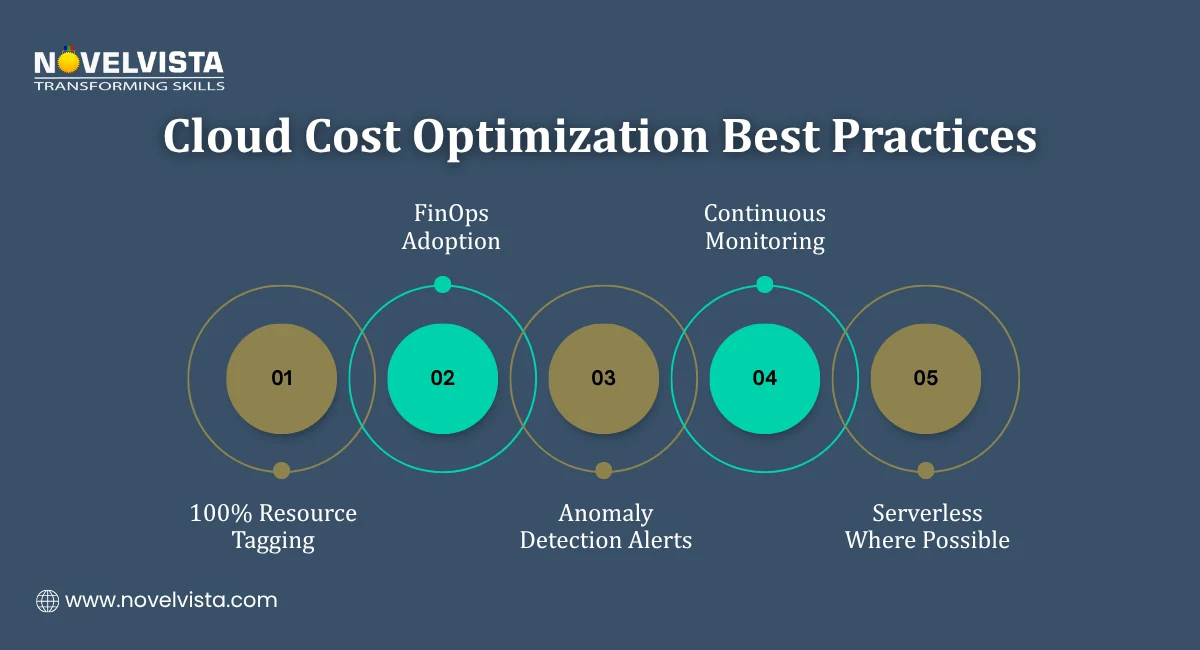
Tagging is the foundation of cost accountability. When every resource is tagged by team, project, environment, and business unit, cost reports become actionable at the team level, not just at the account level.
The target is 100% tagging coverage. Most organizations start with good intentions and end up at 60 to 70%, leaving a significant portion of spend invisible and unallocated.
Without complete tagging, even the best Cloud Cost Optimization Tools produce reports that nobody can act on because nobody knows who owns the spend.
FinOps brings engineering, finance, and business teams into a shared accountability model for cloud spending. Instead of treating cloud costs as a centralized IT expense, FinOps distributes ownership to the teams actually generating the spend.
The result: Organizations implementing FinOps practices reduce cost overruns by 40%. Visibility and ownership at the team level change behavior in ways that centralized cost management simply cannot. (Source: Tangoe Report)
Unexpected spend spikes happen. A misconfigured deployment or an auto-scaling policy that triggers incorrectly can add high cost within hours.
Set up automated anomaly alerts across all cloud accounts to catch these spikes early. Every major provider offers this built into their native tools. The difference between catching an anomaly in hours versus at the month-end billing review can be thousands of dollars.
Serverless architectures eliminate the cost of idle compute entirely. You pay only for execution time, not for instances sitting idle waiting for requests.
Where serverless delivers the biggest impact:
In serverless migration workshops, teams typically identify 20–30% of workloads suitable for transition, with measurable cost reduction visible within the first deployment cycle.
Cloud cost optimization is not a one-time project. Workloads change, new resources get provisioned, and usage patterns shift constantly.
Build continuous monitoring into your regular workflow:
To learn how to reduce cloud spending without compromising performance, explore our AWS Cloud Cost Optimization Guide and apply practical strategies for better cost control.
Native cloud tools handle visibility well. Cloud Cost Optimization Services from third-party providers add ML-driven intelligence, multi-cloud support, and automated remediation that goes beyond what provider dashboards offer.
Here's when and why to consider them:
DoiT provides ML-driven cost forecasting, automated commitment management, and spend anomaly detection across AWS, Azure, and GCP simultaneously.
Best suited for mid-to-large organizations managing significant multi-cloud spend who need recommendations that adapt automatically as usage patterns change, not static reports that require manual interpretation.
Ternary offers granular cost allocation, FinOps workflow automation, and forecasting specifically designed for engineering-led organizations.
Best suited for teams that want cost visibility at the squad or engineering team level. If you're running FinOps seriously, Ternary gives you the granularity to make it work.
This category of Cloud Cost Optimization Solutions focuses specifically on development, staging, and testing environments. The approach is simple:
For engineering organizations running large numbers of test environments around the clock, this is one of the highest-return Cloud Cost Optimization Solutions available with relatively low implementation effort.
When to bring in third-party services:
Across multi-cloud engagements, over 65% of organizations adopt third-party platforms after native tool maturity, primarily to address forecasting gaps and cross-cloud visibility challenges.
Once governance is in place and quick wins are captured, the deeper savings come from how workloads are built and deployed. These Cloud Cost Optimization Techniques require more effort but deliver proportionally larger and more durable returns.
Moving from monolithic VM-based workloads to containerized microservices or serverless functions increases resource utilization density. The same workload runs on less infrastructure, and the savings compound as the architecture scales.
This is the highest-effort, highest-return of all Cloud Cost Optimization Techniques, but it's also the one that changes your cost trajectory permanently rather than trimming around the edges.
During modernization programs, containerization initiatives typically improve infrastructure utilization by 25–40%, especially in legacy workloads previously running on fixed-capacity virtual machines.
Configure autoscaling based on actual demand signals rather than static instance counts:
The result is an infrastructure that scales down during off-peak hours automatically and scales up to handle demand without manual intervention. You stop paying for overnight capacity that nobody is using.
Batch processing, machine learning training runs, and data pipeline workloads are ideal Spot Instance candidates. They're interruptible, and the 90% cost discount on Spot pricing dramatically reduces the unit cost of computation.
The key to making this work reliably:
This one is easy to overlook because it doesn't involve any infrastructure changes. But 32% of cloud overspend is corrected simply by making costs visible to the teams generating them. Transparency changes behavior without requiring a single technical change. (Source: Flexera)
Practical ways to apply this:
Follow a week-by-week roadmap to cut cloud waste, rightsize resources,
reduce spend,and build long-term governance for smarter cloud cost control.
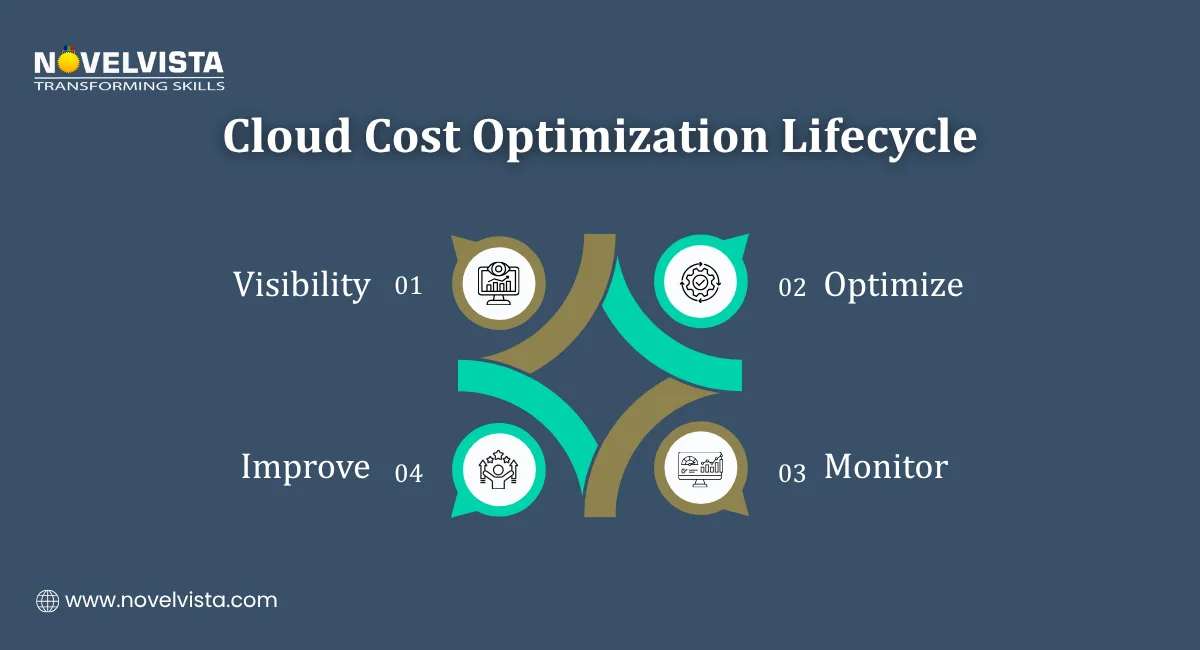
Individual tactics deliver individual wins. A sustainable program ties everything together into an ongoing discipline rather than a series of one-off projects.
Here's a practical sequencing that works:
Deploy tagging, configure native Cloud Cost Optimization Tools, and establish a baseline of current spend by team, service, and environment. You cannot optimize what you cannot see.
Rightsizing and idle resource cleanup deliver immediate savings with minimal risk. Use these early wins to build momentum and demonstrate ROI before pursuing more complex architectural changes.
Assign cloud cost ownership to engineering teams. Create a shared accountability model with finance. Build regular review cadences. Weekly for anomaly detection, monthly for trend analysis, quarterly for discount strategy review.
Once governance is established, move into discount model optimization, serverless migration, and architecture modernization. Each step requires more change management but delivers proportionally larger returns.
Cloud environments are never static. New resources get provisioned daily, workload patterns shift, and new discount options become available. The program has to evolve alongside the infrastructure it governs.
Organizations maintaining continuous optimization practices sustain savings levels within 10–15% variance, avoiding the rebound in cloud costs commonly seen after one-time initiatives.
Cloud waste doesn't announce itself. It builds quietly through overprovisioned instances, idle resources, untagged spend, and infrastructure that keeps running long after the project it served has ended.
The Cloud Cost Optimization Strategies, tools, best practices, and techniques covered in this guide address waste at every layer. From quick wins like rightsizing and idle management, to governance-level changes like FinOps adoption, to architecture-level improvements like serverless migration and Spot orchestration.
The numbers are worth repeating: 32% average spend reduction, 72% savings via Reserved Instance commitments, 40% reduction in cost overruns through FinOps, and 50 to 80% savings on non-production environments. These returns are available to any organization willing to treat Cloud Cost Optimization as an ongoing discipline rather than a periodic cost-cutting exercise.
Start with visibility. Build accountability. Layer in complexity progressively. The savings compound at every step.

If cloud cost optimization is a priority for your organization, having a FinOps certification behind you makes a measurable difference in how effectively you can lead that work.
NovelVista's FinOps Certified Practitioner Certification gives you a structured, practical foundation in cloud financial management, covering cost visibility, accountability frameworks, optimization strategies, and the FinOps operating model that reduces cost overruns by 40%.
Explore NovelVista's FinOps Certified Practitioner Certification today.
Author Details

Confused About Certification?
Get Free Consultation Call
Stay ahead of the curve by tapping into the latest emerging trends and transforming your subscription into a powerful resource. Maximize every feature, unlock exclusive benefits, and ensure you're always one step ahead in your journey to success.