Post Graduate Certification Program In Project Management (PGCPM)
Trusted by 1000s of global organizations, NovelVista is the leading Accredited Training Organization (ATO) to conduct Post Graduate Certification Program In Project Management (PGCPM) Training & Certification Course.
- Industry - Relevant Curriculum
- Online learning session with live instructor-led training
- Accredited Trainer
- Exam fee included

Post Graduate Certification Program In Project Management (PGCPM) Overview
A postgraduate program in project management is a higher education program designed to provide students with advanced knowledge and skills in the field of project management. This type of program is typically aimed at professionals who have already completed a bachelor's degree and are looking to further their education in order to advance their careers. The program typically covers a wide range of topics related to project management, including project planning, risk management, budgeting, stakeholder management, and project execution.Students may also have the opportunity to learn about specific industries or contexts in which project management principles are applied.
Postgraduate programs in project management may be offered as Master of Science (MSc) or Master of Business Administration (MBA) degrees and may be delivered through a variety of formats, including on-campus, online, or a combination of both. Upon completion of a postgraduate program in project management, students should be well-prepared to take on leadership roles in project management and apply their knowledge and skills in a variety of professional settings.
What You Will Get?
Learning Outcome
After the completion of the course, the participants would be able to:
Training Calendar
English
- Self paced videos, assessments, recall quizzes, more
- For more details, reach us at training@novelvista.com
Includes Training, Exam & Certification
Lifetime Access
- Self paced videos, assessments, recall quizzes, more
- For more details, reach us at training@novelvista.com
Includes Training, Exam & Certification
Course Structure
Project Management Workshop: 32 HrsLive Virtual Learning+
* What Will I Learn:
- Understand processes and terminology
- The most up-to-date global practices for PM
- Manage plan time resources for projects
- Manage projects in terms of delivery
- A clear understanding of - specifications, deliverables, and work breakdown
- Project Integration Management
- Project Scope Management
- Project Time Management
- Project Cost Management
- Project Quality Management
- Project Resource Management
- Project Communication Management
- Project Risk Management
- Project Procurement Management
* Training Course Curriculum:
- Integration management
- Scope management
- Time management
- Cost management
- Quality management
- HR management
- Communication management
- Risk management
- Procurement management
- Stakeholder management
PMO Professional Training: 10 HrsSelf Paced Training+
* Understanding the PMO framework:
- OPM to PMO
- OPM (organizational project management) framework
- Portfolio, Program, Projects, and OPM
- Aligning projects & strategy
- Knowledge management, talent management & opm
- OPM governance
- OPM implementation & OPM ongoing operations
- Overview & defining the PMO
* Assess PMO maturity, and culture and define an attainable PMO roadmap:
- Assessing PPP (project, program, portfolio) domains.
- Assessing OPM maturity.
- Assessing organizational culture.
- PMO best practices.
- The evolution from project to portfolio
- PPM in the strategic PMO
* PMO implementation path:
- Combining OPM maturity best practices
- The evolution from project to portfolio
- Change management for PMO
- A suitable organizational structure for the PMO
- Processes, standards & methodologies
- Role of the PMO in the maturity assessment process processes & standards
- Types of PMOs:
- Directive PMO's
- Supportive PMO's
- Controlling PMO's
* Project management methods/methodologies & PMO governance:
- What are the elements of a sound OPM/PMO methodology
- Project management best practices to create a methodology
- Overview of predictive and empirical methods (agile vs traditional?
- A governance framework
* Delivering business results via the PMO:
- Business intelligence
- Make trade-offs between many desirable opportunities
- Estimation of resources and capacity against resource demand
- A better understanding of project interdependence
- Handling requests of Project and functional managers for more time, money, and resources
- Evaluate the inherent value and risk of projects in the portfolio
- A PMO dashboard
* PMO Strategy:
- Developing the enterprise PMO
- staffing the strategic PMO
- Random Forests
- Developing and maturing the enterprise PMO
- Develop your PMO into an enterprise PMO
- Success factors and failure points in developing a PMO
- SVM
- Understanding the roles and responsibilities of the strategic PMO
- Identify the people
- Define the processes
- Making it happen
Devops practitioner Bootcamp: 10 HrsLive Virtual /Self Paced Training+
* Introduction to DevOps:
- History of DevOps
- What is DevOps?
- DevOps Ecosystem
- DevOps Objectives
- DevOps Market Trends
* Challenges with Current IT Practices:
- Development & Feedback Cycle
- Innovation & Collaboration
- Deployment Failures
- Recovery & Rollback Time
- Total Cost of Ownership
- Process Inefficiencies
* DevOps Principles:
- Understanding DevOps Guiding Principles
- Importance of Collaborative Culture
- Cross-Functional Team Structure
- Automation
* Organizational Considerations for DevOps Adoption:
- Embracing DevOps Mindset
- Iterative Adoption
- Business Goals
* Role of DevOps in Digital Transformation:
- Understanding Digital Transformation
- Why does digital transformation matter?
- Importance of DevOps in Digital Transformation
* DevOps Culture:
- Organizational Change
- Breaking the Silos
- Team Structure
* DevOps and Automation:
- Version Control
- Continuous Integration
- Continuous Testing
- Configuration Management
- Continuous Deployment
- Containerization
- Continuous Monitoring
* DevOps and Other Processes:
- ITSM
- Agile
- Scrum
- Lean
Agile Scrum Master Bootcamp: 24 HrsLive Virtual /Self Paced Training+
* Agile Scrum Foundation - Introduction:
- Introduction to Agile and Scrum Foundation Preview
- Agenda Preview
- Why Agile? Preview
- Course Objectives
- Target audience
- Traditional Development
- Problems with traditional software development
- Usage of features in a system
- Makings of a new approach
- Agile Manifesto
- Principles behind the Agile Manifesto
- Principles behind the Agile Manifesto Contd
- Authors of the Agile Manifesto
- Agile Project Management
- Agile Project Management Life cycle
- Agile Project Management Framework
- APM Framework
- What is Scrum?
- Certified Scrum Master
- Professional Scrum Master
- PMI-ACP
* Agile Scrum Methodologies:
- Agile methodologies
- Agenda
- Agile Methodologies
- Crystal
- Project Properties in Crystal
- Samples of Crystal
- Feature Driven Development
- Roles in FDD
- Processes in FDD
- Project tracking in FDD
- Project tracking methodology
- FDD usage guidelines
- Dynamic Systems Development Methodology DSDM
- Planning in DSDM Atern
- DSDM Principles and techniques
- eXtreme Programming
- XP Values
- XP Practices
- XP Benefits
- Agile Unified Process
- Agile Unified Process AUP
- Agile Unified Process System Development
- Scrum
- Scrum Life cycle
* Scrum Roles:
- Scrum Roles
- Agenda
- Stakeholders
- Chicken and Pig roles
- Management of stakeholders
- Scrum life cycle
- Product Owner
- Product Owners role
- Prioritization
- Cost Benefit Analysis
- Prioritization based on Value and Risk
- Prioritizing requirements MoSCoW
- Prioritizing requirements Kano model
- Prioritizing requirements Relative weighting method
- Scrum life cycle
- Scrum Master
- What does a Scrum Master Do
- What the Scrum Master Should NOT do
- Scrum life cycle
- The team aka Developers
- Building a Scrum team
- Building empowered teams
- Role of a Manager
- Manager 2.0: A new role for a Manager
- Some specialist roles you may want
* Agile Scrum Product Owner:
* Scrum Introduction:
- Scrum concepts
- Scrum Flow
- Scrum framework
- Scrum vocabulary
- Principles of process control
- Scrum work culture
* Introduction to Product management:
- Strategic Functions
- Product Management Terminology
- Roles and Responsibilities
- Strategic Analysis
- Product Lifecycle
- Product Adoption
- Marketing Mix
* Product planning and development:
- Agile methodology
- Scrum product development
- Sprint planning
- Writing effective product requirements
- Creating a product roadmap
- Creating a sprint backlog, a product backlog, and user stories
- Building a product requirement document
* Agile Product Delivery:
- Roadmap
- Release Plan
- Backlog
- Sprint
- Epics
- Features
- User Stories
- How to write effective agile requirements
- Feature Slicing Techniques
- User Story Writing
- Best Practices
* Prioritization:
- Prioritizing the product backlog
- Meaning of mandatory
- Prioritization decisions
- Formal approaches to prioritizing
- Sequence of work
* Market Segmentation and Personas:
- User Persona
- Buyer Persona
- Techniques to create a persona
- Lean persona
- Best Practices
- Market Needs
- Product Requirements
* How to Design an MVP:
- Design an MVP
* Product Market Fit:
- Value Proposition
- Customer Empathy
* Product Metrics that Matter in Fintech:
- Web and Data Analytics
- Use of AI and Augmented Reality
* Product Marketing:
- Introduction to Go To Market(GTM) Strategy & its Components
- Product - Market Fit
- Product Pricing
- Product Marketing & Sales Strategies
- Product Launch Plan
* Agile Scrum Ceremonies:
- Scrum Ceremonies
- Agenda
- Timeboxing
- Advantages of time boxing
- Release
- A high-level view of a release
- Sprints
- Factors in selecting a Sprint duration
- Intensity of work
- No changes in a Sprint
- Daily Scrum
- Sprint Review
- Also, check during a review
- Sprint Retrospective
- What is a Sprint Retrospective
- Making retrospectives effective
* Scrum Artifacts:
- Scrum Artifacts
- Agenda
- Product Backlog
- Product release and sprint backlog
- User story
- Example user story format
- Story card information
- Multiple stories may be required to complete a feature
- Epics
- Writing good stories
- Splitting user stories
- Splitting user stories (big picture)
- Splitting user stories (user experience)
- Splitting user stories (Others)
* Scrum Best Practices:
- Scrum Best Practices
- Agenda
- Refactoring
- Pair programming
- Continuous integration
- Practices of continuous integration
- Configuration management
- Quality in Agile
- Scrum Quality Home truths
- Planning for a Sprint
- Test-driven development
- Advantages of TDD
- Definition of Done
- Quiz
- End of this session
* Scrum Planning:
- Scrum Planning
- Agenda
- Principles behind Agile planning
- Iterations allow for mid-course corrections
- Multiple levels of planning
- Release planning
- Steps to planning a release
- Velocity
- An example with a velocity equal to 14
- Sprint planning
- Velocity-driven sprint planning
- Commitment-driven sprint planning
- Find out how much time is available
- For each story
- Keep this in mind before finalizing the plan
* Scrum Estimation:
- Scrum Estimation
- Agenda
- Principles behind Scrum estimation
- Estimation techniques
- Types of estimates
- Uncertainty in estimates
- Overestimation and underestimation
- What contributes to the size
- Measures of size
- Ideal days
- Converting ideal days to actual days
- Story points
- Story points example
- Using story points
- Comparing the approaches
- Estimation techniques Planning poker
- Planning poker an example
- Planning poker tips
- Advantages of planning poker
- Affinity estimation
- Affinity estimation process
* Monitoring Scrum Projects:
- Monitoring Scrum Projects
- Agenda
- Definition Metrics
- Types of metrics
- Metrics do's and don'ts
- Charts in Scrum
- Burn-down chart: Iteration level
- Burn-down chart Project level
- Burn-down chart Bar style
- Burn-up and Burn down-chart
- Cumulative Flow Diagram
- Parking lot diagram
- Escaped defects found
- Velocity chart
- Progress Chart
- Niko Niko calendar
- Information radiators
- Information radiators: Big visible chart
* Advanced Scrum Concepts:
- Scrum Advanced
- Agenda
- Scrum on large projects
- Look ahead planning Sample
- Scrum of Scrum
- Charts in Scrum
- Product coordination teams
- Scrum on maintenance projects
- Distributed scrum teams
- Best practices in the distributed scrum
- Structure 1 Team in India PO in the US
- Structure 2 Team split into two locations
- People practices in distributed Scrum
- Practices in the distributed scrum
- Scrum Contracting
- Fixed Price fixed scope
- Scrum in fixed-price projects
- Transitioning a team or project to Scrum
PM tools workshop: 16 HrsLive Virtual Training+
1. JiRA:
Jira is a powerful and flexible project management tool that is widely used by software development teams around the world. It can help teams stay organized, track progress, and deliver high-quality software on time.
Jira provides users with a centralized platform where they can create and assign projects, establish deadlines, monitor progress, and engage with other team members.
2. Microsoft Project Management App (MSP):
Another excellent powerful project management tool that helps teams to plan, track, and collaborate on projects from start to finish.
It provides a comprehensive suite of features and tools to help project managers and their teams stay organized and on track with their project tasks.
This app also provides a Gantt chart to help visualize project timelines, a task list to keep track of project tasks, and a resource management tool to ensure that projects are staffed properly.
Real Time Case Study De-briefing: 10+ HrsLive Virtual /Self Paced Training+
Every learner must submit 4 case studies based on the themes mentioned below
The learner must present the case studies before the evaluation panel
Case study feedback discussion:
- Case study 1 (Project portfolio management in the production industry - Bosch Diesel)
- Case study 2 (Project portfolio management using Easy Project in finance - AXA Group Czech Republic and Slovakia)
- Case study 3 (Smart Home solutions delivery improved by project management software - myComfort)
- Case study 4 (Complete project life-cycle management in the banking sector - PPF Banka)
- Case study 5 (Standardized Project Management in the IT Services Sector Seidor Consulting Case study)
- Case Study 6 (Hospital El Pilar: Improving Patient Care with Disciplined Agile®)
Project Report Submission: 10+ HrsLive Virtual /Self Paced Training+
Here are some guidelines and outlines that you can use for your project report submission:
* Project Report Guidelines:
- Reports must be written in an easy-to-understand format.
- Reports should include a summary of the project’s goals, objectives, and accomplishments.
- Reports must clearly state the project’s expected outcomes and how they were met.
- Reports should include a timeline of the project’s progress.
- Reports should include an analysis of the project’s financial performance.
- Reports should include any lessons learned during the project.
- Reports should include any risks or issues encountered during the project.
- Reports should include any recommendations for future projects.
* Project Report Outline:
- Introduction
- Project Overview
- Goals and Objectives
- Project Timeline
- Financial Performance
- Lessons Learned
- Risks and Issues
- Recommendations
- Conclusion
Tools knowledge evaluation by Mentor: 10+ HrsLive Virtual /Self Paced Training+
Case study Report Assessment: 10+ HrsLive Virtual /Self Paced Training+
Capstone Project report assessment: 10+ HrsLive Virtual /Self Paced Training+
Course Details
What will I Learn?+
- Plan, execute, and manage complex projects effectively
- Develop and implement project management processes and methodologies
- Analyze and mitigate risks to ensure project success
- Use project management tools and software to plan and track progress
- Communicate effectively with stakeholders to ensure project alignment with business goals
- Manage budgets and resources to ensure projects are delivered on time and within budget
- Understand and apply project management principles and best practices
- Lead and motivate project teams to achieve project objectives
- Facilitate decision-making and problem-solving within a project team
- Understand and apply project management principles in different industries and contexts.
Eligibility:+
- A Bachelor Degree in Any Discipline
- Aspirants of PMP
- Professionals with 3 Years of relevant experience
Benefits of Post Graduate Certification Program In Project Management (PGCPM):+
- Improved skills and knowledge:A postgraduate program in project management will provide you with advanced knowledge and skills in areas such as project planning, risk management, budgeting, and stakeholder management. This can make you more effective at managing projects and increase your value to employers.
- Professional recognition:Many postgraduate programs in project management are accredited by professional organizations, such as the Project Management Institute (PMI). This can help you to gain recognition as a qualified and competent project manager and may make you more competitive in the job market.
- Networking opportunities:Postgraduate programs often provide opportunities to network with other professionals in the field, which can be beneficial for building relationships and finding job opportunities.
- Career advancement:Completing a postgraduate program in project management may make you more competitive for higher-level positions within your organization or in other organizations. It can also help you to negotiate higher salaries or improve your chances of being promoted.
- Personal growth:A postgraduate program in project management can provide you with the opportunity to develop your leadership and communication skills, which can be beneficial for your personal and professional growth.
Training Faculty+
We recognize that as a learner, you want the best educational experience possible and that teachers and faculty frequently bear the weight of this responsibility.
So we are proud to tell you that our instructors for this certification are highly experienced professionals with 16+ years of industry experience who have educated over 7000 professionals.
He has delivered training for more than 10 years and trained more than 10000 professionals.
Prerequisites+
Training Delivery Style:+
If you participate, you may expect to be involved in fun group activities. This will allow you to put the theory into practice. This training will be unlike any other you've ever experienced. We employ a wide range of innovative approaches to wrack your gray matter and raise your enthusiasm to engage.
The key features of our training program would be:
- Storytelling-based training sessions
- Concept demonstration using professional examples
- Self-reflection and group conversations
- Case studies as an application of the ideas given
- Individual and group exercises, as well as live presentations
- Reading recommendations for after training
Examination:+
* PMO Certification Exam:
- This exam consists of 40 multiple-choice questions.
- Candidate needs to score a minimum of 65% of the total marks (i.e. minimum 26 out of 40) to pass this examination.
- The total duration of this examination is 90 minutes.
- There is no negative marking system applicable to this PMO certification exam.
- In case the Participant does not score passing % then they will be granted a 2nd attempt at no additional cost. Re-examination can be taken up to 30 days from the date of the 1st exam attempt.
* ASM Certification Exam:
- Exam Format - Objective Type, Multiple Choice
- Exam Duration - 1 hour and 30 minutes
- No. of Questions - 40 (multiple-choice questions)
- Passing Criteria - 26 out of 40 (65%)
- Certificate - Within 5 business days
- Result - Immediately after the exam - Training is mandatory
- Closed book
* DevOps Practitioner Exam:
- Exam Format - Objective Type, Multiple Choice
- Exam Duration - 1 Hour
- No. of Questions - 50 (multiple-choice questions)
- Passing Criteria - 35 out of 50 (70%)
- Certificate - Within 5 business days
- Result - Immediately after the exam
- Closed book
* ASPO Exam:
- Exam Format - Objective Type, Multiple Choice
- Exam Duration - 90 minutes
- No. of Questions - 40 (multiple-choice questions)
- Passing Criteria - 65%
- Certificate - Within 5 business days
- Result - Immediately after the exam
- Closed book
Post Graduate Certification Program In Project Management (PGCPM) Exam Format:+
- Exam Time: 1 hour
- Question type: Multiple-choice questions
- Number of questions: 40
- Passing marks: 26 out of 40 (65%)
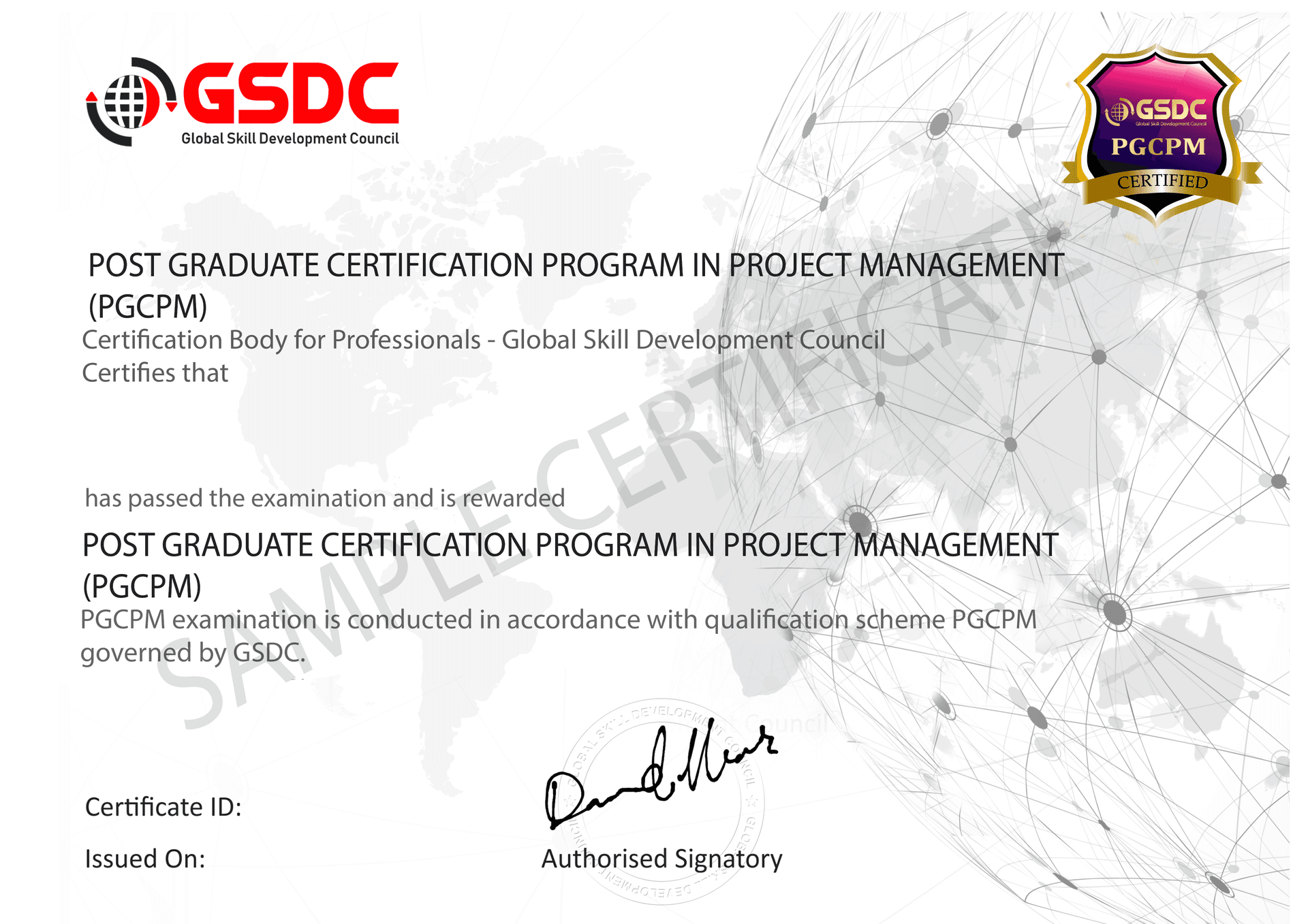
Post Graduate Certification Program In Project Management (PGCPM) Sample Certificate
Exam Format - Objective Type, Multiple Choice
Exam Duration - 1 Hour
No. of Questions - 40 (multiple-choice questions)
Passing marks: 26 out of 40 (65%)
Certificate - Within 5 business days
Result - Immediately after the exam
Closed book
PGC In Project Management Path