

Machine Learning Certification Course & Training Program
Certified Machine Learning Master Training Course from NovelVista is trusted by professionals worldwide to build strong expertise in data-driven decision-making. This practical and easy-to-follow machine learning course is designed to help you master core algorithms, apply real-world use cases, and confidently earn your machine learning certification.
- Industry Expert Trainers
- Online learning session
- Accredited Trainer
- Exam fee included

Certified Machine Learning Master Course Overview
The Certified Machine Learning Master program is designed to build strong practical and theoretical expertise in machine learning, enabling professionals to work with real-world data and solve complex business problems. This machine learning course covers essential concepts such as supervised and unsupervised learning, statistical modelling, and predictive analytics, forming a solid foundation for data-driven decision-making.
This machine learning training certification focuses on both fundamentals and hands-on application. Learners gain experience in data preprocessing, feature engineering, model building, and evaluation techniques. The course also introduces advanced areas like neural networks, deep learning, and reinforcement learning, helping professionals understand how modern AI systems are built and optimized.
Delivered by NovelVista, this program follows a structured, self-paced learning approach with practical case studies and real-world datasets. The training includes AI-based roleplay, hands-on projects, and certification-focused preparation to ensure learners can apply concepts confidently in real scenarios.
By completing this machine learning training, professionals will be equipped to develop, implement, and optimize machine learning models across industries. This machine learning certification helps validate practical skills and prepares learners for advanced roles in data science, AI, and analytics, making them industry-ready in a rapidly evolving technology landscape.

What You Will Get?
Learning Outcome
After the completion of the course, the participants would be able to:
Training Calendar
English
- Self paced videos, assessments, recall quizzes, more
- For more details, reach us at training@novelvista.com
Includes Training, Exam & Certification
Lifetime Access
- Self paced videos, assessments, recall quizzes, more
- For more details, reach us at training@novelvista.com
Includes Training, Exam & Certification
Course Curriculum
Module 1: Introduction to Python Programming+
This module builds the programming foundation required for machine learning. It introduces Python basics, data structures, and essential programming concepts used to develop and implement machine learning models.
- Python Fundamentals: Learn the basics of Python, including syntax, variables, identifiers, and indentation, forming the foundation required for writing efficient and structured machine learning programs.
- Data Structures: Understand Python data structures such as lists, dictionaries, tuples, and sets, enabling efficient data handling and manipulation for machine learning applications.
- Control Statements: Explore conditional, iterative, and jump statements in Python to control program flow and implement logic required in data processing and model development.
- OOPS Concepts: Learn object-oriented programming concepts in Python to create reusable, modular, and scalable code for machine learning solutions.
- Exception Handling & Regex: Understand exception handling and regular expressions to manage errors effectively and process structured and unstructured data efficiently.
Module 2: Python Libraries for Data Science+
This module introduces essential Python libraries widely used in machine learning and data analysis for handling, visualizing, and processing data effectively.
- NumPy Basics: Learn NumPy arrays and operations for numerical computations, enabling efficient data processing and mathematical operations required in machine learning models.
- Pandas Operations: Understand Pandas data structures like Series and DataFrames to manipulate, clean, and analyze structured datasets efficiently.
- Data Visualization: Learn how to visualize data using Matplotlib through charts, histograms, scatter plots, and heatmaps for better data insights.
- Statistical Plots: Explore box plots and other visual tools to identify patterns, distributions, and anomalies in datasets used for machine learning tasks.
Module 3: Data Wrangling and Preprocessing+
This module focuses on preparing raw data for machine learning by cleaning, transforming, and analyzing datasets to improve model performance.
- Data Operations: Learn operations such as selection, concatenation, and joins to manipulate datasets effectively and prepare them for analysis.
- Univariate Analysis: Understand how to analyze individual variables to identify trends, patterns, and distributions within datasets.
- Multivariate Analysis: Explore relationships between multiple variables to uncover correlations and insights that support better model building.
- Handling Missing Data: Learn techniques to manage missing values to ensure data quality and improve model accuracy.
- Outlier Treatment: Understand how to detect and handle outliers to prevent skewed model results and improve prediction performance.
Module 4: Introduction to Machine Learning+
This module introduces the core concepts of machine learning, including types, mathematical foundations, and real-world applications.
- Machine Learning Basics: Understand what machine learning is, its importance, and how it enables systems to learn from data without explicit programming.
- Types of Learning: Learn the differences between supervised, unsupervised, and reinforcement learning techniques used in various real-world scenarios.
- Probability Concepts: Understand basic probability concepts required for building and interpreting machine learning models.
- Linear Algebra Basics: Learn fundamental linear algebra concepts that support machine learning algorithms and computations.
Module 5: Supervised Learning – Regression+
This module focuses on regression techniques used to predict continuous outcomes and understand relationships between variables.
- Linear Regression: Learn simple and multiple linear regression techniques to model relationships between variables and make predictions.
- Regression Assumptions: Understand key assumptions of regression models to ensure accuracy and reliability of predictions.
- Polynomial Regression: Explore polynomial regression to capture non-linear relationships between variables in datasets.
- Model Evaluation Metrics: Learn evaluation techniques such as R-squared and RMSE to measure model performance and accuracy.
Module 6: Supervised Learning – Classification+
This module focuses on classification techniques used to categorize data into classes, helping in decision-making and predictive analysis across various business applications.
- Logistic Regression: Learn how logistic regression is used for binary classification problems, enabling prediction of categorical outcomes based on input features.
- Decision Trees: Understand how decision trees split data into branches to make predictions and support interpretable machine learning models.
- Random Forests: Explore ensemble learning using random forests to improve model accuracy and reduce overfitting in classification tasks.
- Support Vector Machines (SVM): Learn how SVM separates data using optimal hyperplanes for accurate classification in complex datasets.
- Naïve Bayes: Understand probabilistic classification using Naïve Bayes for fast and efficient predictions in real-world scenarios.
- Confusion Matrix: Learn how to evaluate classification models using confusion matrix metrics like accuracy, precision, recall, and F1-score.
Module 7: Dimensionality Reduction+
This module explains techniques used to reduce the number of features in a dataset while retaining important information for better model performance.
- Principal Component Analysis (PCA): Learn how PCA reduces dimensionality by transforming features into principal components while preserving maximum variance.
- Factor Analysis: Understand how factor analysis identifies underlying relationships between variables to simplify datasets.
- Linear Discriminant Analysis (LDA): Learn how LDA improves classification by maximizing separation between different classes in a dataset.
Module 8: Unsupervised Learning – Clustering+
This module focuses on grouping similar data points without predefined labels, enabling pattern discovery and segmentation.
- Clustering Concepts: Understand different types of clustering methods and how they are used to group similar data points effectively.
- K-Means Clustering: Learn how K-means partitions data into clusters based on similarity and distance measures.
- Agglomerative Clustering: Explore hierarchical clustering techniques to build nested clusters and analyze data relationships.
Module 9: Model Evaluation and Optimization+
This module covers techniques used to evaluate, validate, and improve machine learning models for better performance and reliability.
- ROC and AUC: Learn how ROC curves and AUC metrics evaluate classification model performance across different thresholds.
- Cross-Validation: Understand how cross-validation improves model reliability by testing performance on multiple data subsets.
- Bagging Techniques: Learn how bagging reduces variance and improves model stability using ensemble learning methods.
- Boosting Methods: Explore boosting techniques that improve model accuracy by focusing on misclassified data points.
- Bias vs Variance: Understand the trade-off between bias and variance to build balanced and well-generalized models.
Module 10: Recommendation Systems+
This module introduces recommendation engines used in real-world applications like e-commerce, streaming platforms, and personalized services.
- Recommendation Concepts: Understand the importance and working of recommendation systems in delivering personalized user experiences.
- Content-Based Filtering: Learn how content-based methods recommend items based on user preferences and item attributes.
- Collaborative Filtering: Explore collaborative filtering techniques that use user behavior and similarities to generate recommendations.
Module 11: Association Rule Mining+
This module introduces techniques used to discover relationships and patterns between variables in large datasets, commonly applied in retail and market analysis.
- Association Rules Basics: Learn the concept of association rules and how they identify relationships between items in transactional datasets for better decision-making.
- Key Parameters: Understand metrics like support, confidence, and lift to evaluate the strength and relevance of association rules.
- Apriori Algorithm: Explore the Apriori algorithm to generate frequent itemsets and uncover hidden patterns in data.
- Market Basket Analysis: Learn how association rules are applied in real-world scenarios like retail to analyze customer purchasing behavior.
Module 12: Time Series Analysis+
This module focuses on analyzing time-based data to identify trends, patterns, and forecast future values.
- Time Series Concepts: Understand what time series data is and how it differs from other types of data used in machine learning.
- Importance of Time Series: Learn how time series analysis helps in forecasting, trend analysis, and decision-making across industries.
- Time Series Components: Explore components like trend, seasonality, and noise to better understand data behavior over time.
- ARIMA Model: Learn how ARIMA models are used for forecasting time-dependent data and making accurate predictions.
Module 13: Reinforcement Learning+
This module introduces reinforcement learning techniques where systems learn optimal actions through rewards and interactions with environments.
- Reinforcement Learning Basics: Understand the concept of agents, environments, rewards, and actions in reinforcement learning models.
- RL Algorithms: Learn about key reinforcement learning algorithms used to solve decision-making problems.
- Q-Learning Model: Explore Q-learning as a model-free algorithm for learning optimal policies through experience.
- AI Integration Concepts: Understand how reinforcement learning connects with broader artificial intelligence applications.
Module 14: Neural Networks and Deep Learning+
This module introduces neural networks and deep learning concepts that power advanced AI systems and predictive models.
- Neural Network Basics: Learn the structure and working of neural networks, including neurons, layers, and weights.
- Perceptron Model: Understand the perceptron as the basic building block of neural networks.
- Forward Propagation: Learn how data flows through neural networks to generate outputs and predictions.
- Deep Learning Introduction: Explore deep learning concepts and how they enable complex pattern recognition and AI applications.
Module 15: Mentorship and Career Guidance+
This module provides personalized support and guidance to help learners strengthen their understanding and prepare for real-world applications and career growth.
- One-on-One Mentoring: Get personalized sessions with industry experts to clarify doubts and deepen your understanding of machine learning concepts.
- Expert Guidance: Learn directly from experienced AI/ML practitioners to improve your practical and theoretical knowledge.
- Project Feedback: Receive feedback on assignments and projects to improve implementation and coding practices.
- Career Planning Support: Gain insights into career paths, certifications, and opportunities in machine learning and data science.
Module 16: Tools, Projects, and Certification Preparation+
This module focuses on hands-on implementation, tools, and preparation required to apply machine learning concepts in real-world scenarios.
- Hands-on Projects: Work on real-world datasets to apply machine learning concepts and build practical solutions.
- ML Tools and Platforms: Learn tools like Jupyter Notebook, Scikit-learn, TensorFlow, and Git for developing machine learning models.
- Capstone Project Guidance: Understand how to build and present a capstone project showcasing your machine learning expertise.
- Interview Preparation: Prepare for job roles with sample interview questions and practical problem-solving approaches.
- Model Deployment Basics: Learn basic concepts of deploying machine learning models using frameworks like Flask and Streamlit.
Course Details
What Will You Get?+
This program is designed to give you a complete learning and certification experience, combining practical exposure with structured preparation.
- Engaging digital learning videos
- Comprehensive machine learning study materials
- Hands-on projects with real-world datasets
- AI-based roleplay and simulations
- Mock exams with unlimited practice attempts
- Certification exam voucher with 1 year validity
- Two attempts for the certification exam
- Downloadable resources and reference templates
- Access to expert-led sessions and case studies
- Lifetime access to course content
Eligibility+
This program is suitable for individuals looking to build or advance their skills in machine learning and data-driven decision-making.
- IT professionals and software developers
- Data analysts and aspiring data scientists
- AI and machine learning enthusiasts
- Students and fresh graduates in technical fields
- Professionals looking to transition into AI/ML roles
- Business analysts working with data-driven insights
- Anyone interested in learning machine learning concepts
Pre-requisites+
There are no strict mandatory requirements for this course. However, having the following basics will help you learn more effectively:
- Basic understanding of programming concepts
- Familiarity with mathematics and statistics fundamentals
- Awareness of data analysis concepts
- Interest in machine learning and AI technologies
Training Delivery Style+
This program is delivered in a flexible self-paced format, allowing learners to progress at their own pace with structured and accessible learning resources.
- Fully self-paced online learning
- Anytime, anywhere access
- Structured machine learning modules
- On-demand video sessions
- Hands-on projects and practice exercises
- Mock exams and assessment tests
- AI-based roleplay and simulations
- Lifetime access to course content
Key Benefits+
- Practical ML Skills: Build hands-on expertise in applying machine learning algorithms to real-world problems using structured learning and practical datasets.
- Strong Foundation: Develop a solid understanding of core machine learning concepts, including supervised, unsupervised, and advanced learning techniques.
- End-to-End Learning: Learn the complete machine learning workflow from data preprocessing to model building, evaluation, and basic deployment concepts.
- Industry-Relevant Tools: Gain experience with tools like Python, NumPy, Pandas, Scikit-learn, and TensorFlow used in real-world machine learning projects.
- Real-World Application: Work on practical projects and case studies to apply machine learning concepts in business and industry scenarios.
- Career Advancement: Strengthen your profile for roles in data science, machine learning, and AI across multiple industries.
- Certification Value: Validate your expertise with a globally recognized machine learning certification.
- Problem-Solving Ability: Enhance your ability to analyze data, identify patterns, and make data-driven decisions effectively.
- Expert Learning Support: Learn from experienced industry professionals and gain insights into real-world implementation strategies.
- Future-Ready Skills: Stay competitive in a rapidly evolving field where machine learning and AI are driving innovation across industries.
Certified Machine Learning Master Certification Exam Format
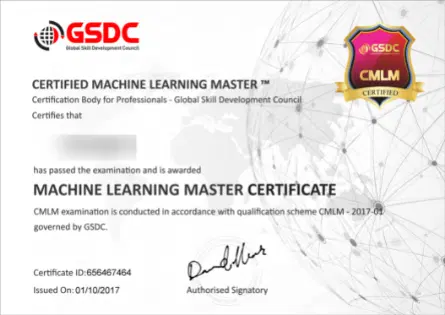
Exam Format - Objective Type, Multiple Choice
Exam Duration - 90 minutes
No. of Questions - 40 (multiple-choice questions)
Passing Criteria - You need to acquire 26+ marks to clear the exam.
Certificate - Within 5 business days
Exam will be moderated by our trainer
Closed Book