Category | CLOUD and AWS
Last Updated On 21/05/2026
Cloud bills keep climbing. Teams keep spinning up resources. And somewhere between engineering and finance, nobody has a clear picture of what is actually being spent or why.
That is the problem What is FinOps answers for thousands of organizations running cloud infrastructure today. It is a framework that brings engineering, finance, and business teams together to take shared ownership of cloud spending.
This guide covers the core benefits, key impact areas, implementation steps, and the framework behind FinOps, everything you need to understand how it works and whether your organization needs it.
| Topic | Key Point |
| What is FinOps | A framework that connects engineering, finance, and business teams to manage cloud costs |
| Cost savings | Organizations report 30 to 40% reduction in cloud spending after adopting FinOps |
| Forecasting impact | 76% of FinOps practitioners report improved cost forecasting accuracy |
| Adoption results | 68% of organizations achieved measurable cost savings after adopting FinOps |
| Three lifecycle phases | Inform, Optimize, Operate |
| Key benefit areas | Cost visibility, waste reduction, governance, forecasting, and collaboration |
| Who is involved | Engineering teams, finance departments, and business leaders |
| Pricing strategies | Reserved instances, savings plans, and spot instances |
Most organizations adopting cloud infrastructure run into the same problem eventually. Costs grow faster than expected. Different teams spin up resources independently. Finance has no visibility into what engineering is spending. And by the time anyone notices, the monthly bill is already a surprise.
What is FinOps in simple terms? It is an operational framework and cultural practice that helps organizations get maximum value from their cloud spending. It does this by making cloud cost management a shared responsibility rather than something that only the finance team worries about after the fact.
What is Cloud FinOps more specifically? It is the discipline that combines financial management with cloud operations. It gives teams the tools, processes, and mindset to track, analyze, and optimize cloud costs in real time rather than reacting to invoices at the end of the month.
The three teams that FinOps brings together are:
When these three groups work from the same data and share responsibility for cloud costs, spending becomes much easier to control and justify.
What is FinOps in Cloud environments practically? It means every team that uses cloud resources understands the cost of what they are building and deploying. It is not about restricting engineers. It is about giving everyone the visibility to make smarter decisions about how cloud resources are used.
In our FinOps training sessions, over 70% of participants identify unused or misallocated cloud resources within the first two weeks of structured cost visibility exercises.
Understanding the benefits of FinOps starts with looking at what unmanaged cloud spending actually costs organizations. Resources that nobody uses, oversized instances running at low utilization, duplicate services across teams, these are common and expensive.
Here is what organizations consistently report after putting a proper FinOps practice in place.
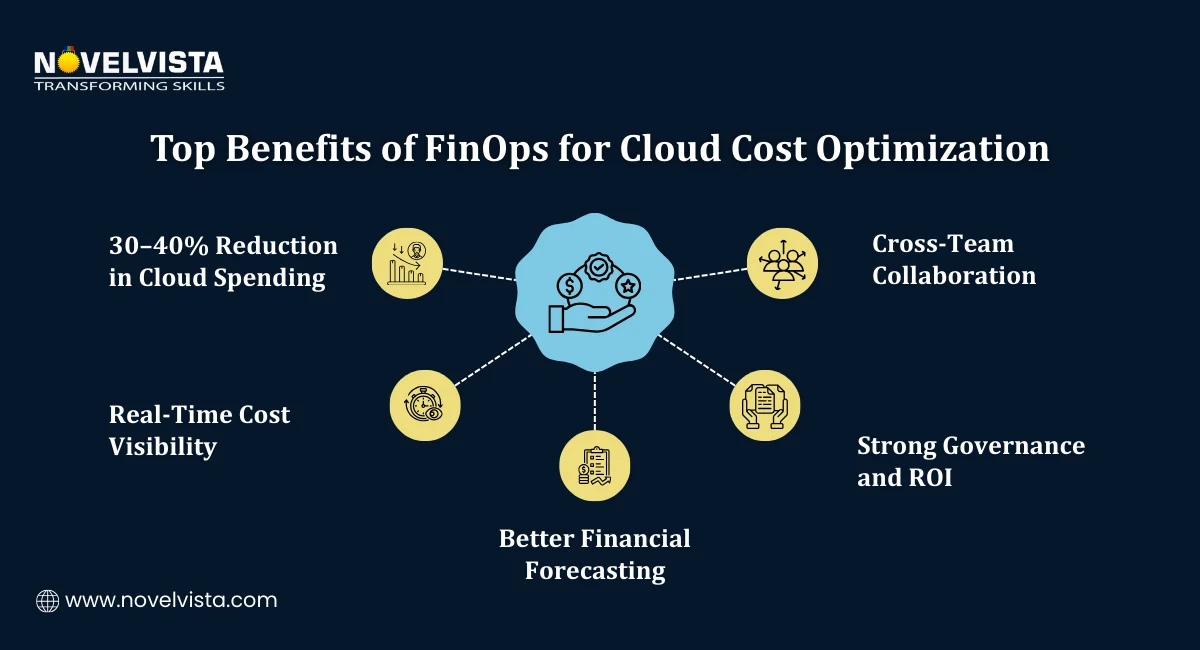
The most direct of all FinOps benefits is spending less on cloud without reducing capability. Organizations implementing FinOps practices regularly report 30 to 40% reduction in cloud spending. That reduction does not come from cutting services. It comes from identifying waste, rightsizing resources, and choosing the right pricing models for each workload.
In real-world audits practices we conduct, 20–25% of cloud spend is often tied to idle or underutilized resources before FinOps practices are applied.
To learn how to control and optimize cloud spending effectively, explore our blog on Advanced Strategies to Optimize Cloud Cost in FinOps and drive better financial efficiency.
Before FinOps, most organizations have a fragmented view of cloud costs. Different teams use different accounts, different services, and different regions, and there is no single source of truth.
Benefits of FinOps include real-time cost tracking and usage monitoring that gives every team visibility into what they are spending. Instead of discovering cost issues at the end of the billing cycle, teams can see trends as they develop and act before costs get out of hand.
Cloud costs are variable by nature. That makes accurate forecasting difficult. FinOps introduces structured processes that make forecasting more reliable.
Based on Flexera 2026 practitioner data, approximately 76% of FinOps practitioners report improved cost‑forecasting accuracy after adopting the framework. Similarly, Flexera 2025 survey data suggest that roughly 68% of organizations implementing FinOps achieve measurable cost savings. (Source: Flexera)
When finance and engineering share the same data, forecasts are grounded in actual usage patterns rather than estimates. Teams we train typically improve forecast variance from over 25% down to under 10% within one to two budgeting cycles after FinOps adoption.
One of the less obvious but genuinely valuable FinOps benefits is what it does for team collaboration.
Engineering teams typically focus on performance and delivery. Finance teams focus on budgets and reporting. These two groups often work in silos with little shared context. FinOps creates a common language and shared set of metrics that both teams can use to make decisions together.
That cross-team collaboration improves efficiency and removes the friction that comes from engineering and finance operating with different priorities and different data.
Cloud infrastructure without governance leads to sprawl. Resources get created, forgotten, and left running indefinitely. Benefits of FinOps include clear governance policies that define how cloud resources should be used, how budgets are set, and how compliance standards are maintained.
The variable cost model of cloud infrastructure is actually an advantage here. Because you only pay for what you use, strong governance policies directly translate into lower costs and better return on investment.
The benefits of FinOps show up most clearly in three specific areas of cloud operations. These are the places where unmanaged spending tends to accumulate the fastest.
Underutilized compute instances and storage that nobody is actively using are two of the biggest sources of unnecessary cloud spend. Rightsizing means matching the size of a resource to its actual workload requirements.
A virtual machine running at 10% CPU utilization most of the time does not need to be provisioned at full capacity. FinOps identifies these mismatches and provides a process for correcting them systematically across the entire infrastructure.
During infrastructure reviews, we consistently observe that rightsizing alone accounts for 15–20% of total achievable cloud cost reduction.
Most cloud providers offer multiple pricing options for the same resources. The difference in cost between them can be significant. FinOps helps organizations choose the right pricing model for each workload:
Teams without a FinOps practice often default to on-demand pricing for everything. That is the most expensive option and rarely the most appropriate one for stable or predictable workloads.
What is FinOps in Cloud governance terms? It is the set of policies and controls that determine how cloud resources can be created, used, and decommissioned.
FinOps frameworks establish clear rules around cloud usage, budget limits, tagging standards, and compliance requirements. These policies prevent unauthorized resource creation, enforce cost accountability at the team level, and make auditing cloud usage straightforward.
In compliance audits, organizations with enforced tagging and budget policies demonstrate significantly faster audit readiness, often reducing audit preparation time by over 35%.
Knowing the benefits is useful. Knowing how to actually put FinOps into practice is what makes the difference. A structured FinOps Implementation approach gives organizations a clear path from unmanaged cloud spending to a fully governed and optimized cost management practice.
The implementation follows three phases. Each one builds on the previous.
Before you can fix anything, you need to see everything clearly. The Inform phase is about gaining full visibility into your current cloud spending. This involves:
Most organizations are surprised by what this phase reveals. Unused resources, forgotten test environments, oversized instances running in production, these show up clearly once you have proper visibility in place.
The goal of this phase is not to cut anything yet. It is to make sure every team has accurate, real-time information about their cloud costs before any optimization decisions are made.
Once visibility is in place, the Optimize phase focuses on reducing waste and improving how resources are provisioned and priced.
Key actions in this phase include:
This phase is where the majority of the cost savings from FinOps Implementation are realized. The 30 to 40% spending reductions that organizations report typically come from the combination of rightsizing, waste removal, and smarter pricing choices made during this phase.
The Operate phase is where FinOps moves from a project into an ongoing practice. This phase focuses on:
FinOps Implementation does not end at certification or initial setup. The Operate phase is designed to run continuously, feeding new insights back into the Inform and Optimize phases as cloud usage evolves.
Organizations that establish monthly FinOps review cycles maintain cost stability within ±5–8% variance despite changing workloads and scaling demands.
Learn how to control cloud costs using FinOps practices, build visibility,
optimize usage, and implement a step-by-step roadmap for sustainable cost management.
The three phases above sit within a broader framework that defines how FinOps teams are structured, how decisions are made, and how maturity develops over time.
A FinOps practice only works when the right people are involved. The typical FinOps team brings together three groups:
Each group brings a different perspective. Engineering understands what resources are needed and why. Finance understands how costs fit into the broader budget. Business leaders understand which workloads are worth investing in and which are not.
Without all three groups working together, FinOps decisions tend to be incomplete. Engineering optimizes for performance without considering cost. Finance cuts budgets without understanding technical constraints. Business leaders make investment decisions without accurate cost data.
The lifecycle follows the same three stages as the implementation steps but frames them as an ongoing loop rather than a one-time project:
| Stage | Focus | Key Activity |
| Inform | Visibility | Real-time cost tracking and attribution |
| Optimize | Efficiency | Rightsizing, waste removal, pricing optimization |
| Operate | Governance | Automation, team accountability, continuous improvement |
The loop never fully stops. As cloud infrastructure changes, new workloads are added, and business priorities shift, the cycle runs again. Teams that reach a mature FinOps practice run through this loop continuously rather than as a periodic exercise.
Governance is what keeps a FinOps practice consistent as the organization grows. Without it, individual teams make independent decisions that add up to uncontrolled spending at the organizational level.
Many organizations establish a FinOps governance council that:
What is Cloud FinOps governance in practice? It is the combination of policies, processes, and people that ensures cloud spending decisions are always made with full visibility and shared accountability.
A mature governance setup does not slow teams down. It gives them clear boundaries within which they can move quickly and confidently, knowing that cost accountability is built into how they work rather than reviewed after the fact.
In structured DevOps and cloud maturity assessments, FinOps is consistently identified as a critical capability for organizations scaling beyond initial cloud adoption stages.
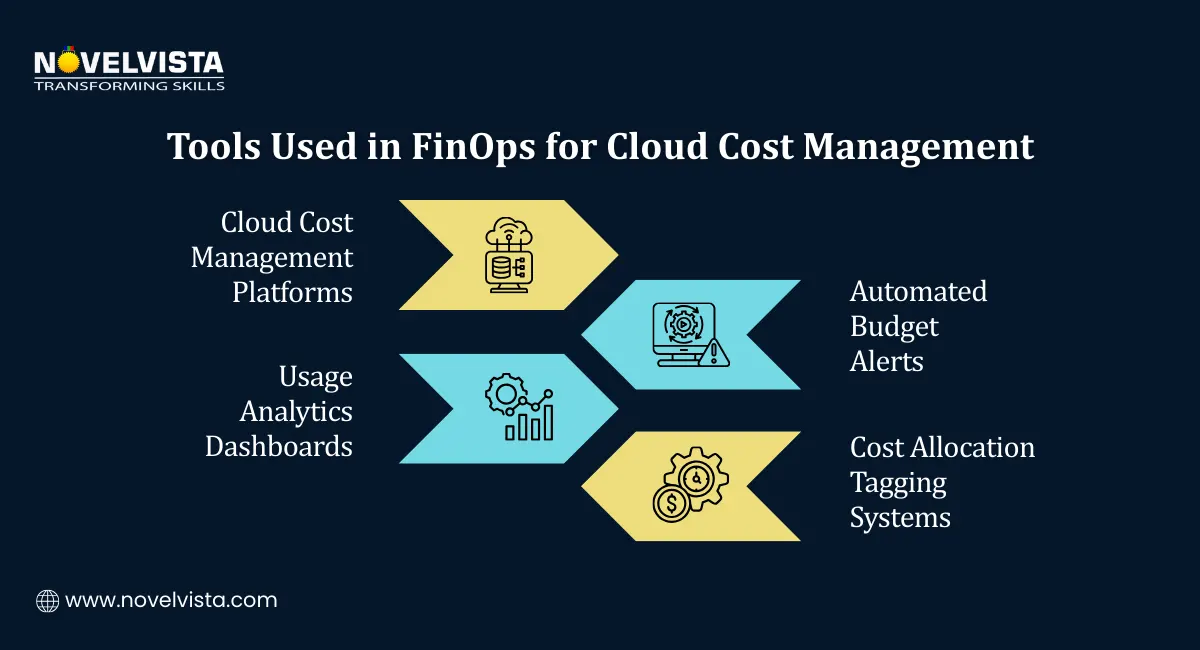
Cloud costs left unmanaged grow in ways that are hard to reverse. What is FinOps if not the structured answer to that problem. A framework that gives organizations the visibility, processes, and cross-team collaboration to make cloud spending a deliberate choice rather than an unpredictable outcome.
The benefits of FinOps are measurable. Spending reductions of 30 to 40%, improved forecasting accuracy, stronger governance, and better collaboration between engineering and finance are outcomes that organizations across industries are already reporting.
FinOps Implementation works best when it is treated as an ongoing practice rather than a one-time project. The Inform, Optimize, and Operate phases create a loop that keeps improving as cloud usage evolves and business priorities change.
For organizations serious about getting cloud costs under control without slowing down innovation, FinOps is not optional. It is the operating model that makes sustainable cloud growth possible.

Next Step
NovelVista's FinOps Certified Practitioner (FCP) certification training gives you the practical knowledge to implement and manage a FinOps practice inside your organization. You will learn how to track cloud costs, optimize spending, and build cross-team accountability using the FinOps framework. The course is built for engineers, finance professionals, and cloud practitioners who want to take real ownership of cloud cost management.
Explore NovelVista's FinOps Certified Practitioner Training and start building your cloud financial management expertise today.
Author Details

Confused About Certification?
Get Free Consultation Call
Stay ahead of the curve by tapping into the latest emerging trends and transforming your subscription into a powerful resource. Maximize every feature, unlock exclusive benefits, and ensure you're always one step ahead in your journey to success.