ISO 31000 Certification – Risk Manager Training Program
Build your risk management career with ISO 31000 Certification. This ISO 31000 Training Course teaches you to identify, assess, and manage risks using global standards. Trusted by 6,000+ professionals, NovelVista (ATP) helps you become a Certified Risk Manager and improve compliance and decision-making.
- Online Learning Session
- Experienced Trainer
- 2 Exam Attempts
- Globally Recognized ISO 31000 Certification
- Exam fee included
- Premium Learning Resources

ISO 31000 Certification Course Overview
As organizations in 2026 navigate increasingly complex regulatory, technological, and operational environments, the ISO 31000 Risk Manager Certification supports using globally accepted principles across governance, strategy, operations, and decision-making. The ISO 31000 Certification Training enables a consistent and systematic approach to embedding risk-based thinking into everyday business processes. Whether you are a risk manager, auditor, compliance officer, project manager, IT or cybersecurity professional, financial analyst, or organizational leader, this certification is applicable across industries including healthcare, construction, energy, manufacturing, banking, insurance, telecom, government, and more.
Our ISO 31000 certification course is delivered by experienced trainers and subject-matter experts with 27+ years of industry experience in risk management, information security, and compliance. As an accredited GSDC Training Partner (ATP), NovelVista provides official courseware and exam-aligned study materials to ensure full alignment with the global ISO 31000 Risk Manager Certification framework. The training emphasizes practical interpretation of the standard, enabling professionals to objectively assess complex situations, communicate risk effectively, and apply the ISO 31000 risk management process in real-world organizational contexts.
We offer a free exam re-attempt, providing learners with added confidence and exam readiness. With a 4.8 out of 5 learner rating and a 99.9% pass rate, this ISO 31000 Course supports professionals in building credible credentials and practical risk management capabilities. Upon successful completion, learners gain a globally recognized ISO 31000 Risk Manager Certification, helping them strengthen governance, support informed decision-making, and drive long-term organizational resilience and sustainable growth.
What You Will Get?

Learning Outcome: ISO 31000 Certification
After the completion of the course, the participants would be able to:
Training Calendar
English
- Self paced videos, assessments, recall quizzes, more
- For more details, reach us at training@novelvista.com
Includes Training, Exam & Certification
Lifetime Access
- Self paced videos, assessments, recall quizzes, more
- For more details, reach us at training@novelvista.com
Includes Training, Exam & Certification
Course Curriculum: ISO 31000 Certification
This ISO 31000 course curriculum is designed to help you understand how risk management works in real organizations—not just in theory. It covers the core principles, processes, and frameworks of ISO 31000, helping learners apply structured risk practices with confidence. Through this ISO 31000 training, you gain practical insight into evaluating risks, supporting informed decision-making, and strengthening governance.
Module 1: Introduction to ISO 31000:2018 Risk Management Architecture+
- Understanding Risk Management and ISO 31000:2018’s Focus on Objectives: Learn the core principles of risk management and how ISO 31000:2018 focuses on integrating risk management with organizational objectives to create a risk-aware culture that drives decision-making.
- The Importance of ISO 31000 Risk Management and Its Historical Development: Explore the evolution of risk management practices, from their origins to the modern frameworks. Understand why effective risk management is crucial in mitigating threats and capitalizing on opportunities.
- Applications of ISO 31000 Risk Management: Gain insight into how risk management is applied across various sectors and industries, ensuring the identification, assessment, and mitigation of risks to maintain business continuity and success.
- Contrasting Voluntary and Mandatory Frameworks: Understand the difference between voluntary and mandatory risk management frameworks. Learn how organizations can adopt frameworks like ISO 31000 on a voluntary basis, versus those mandated by regulators.
- Industry-Specific versus Generic Standards: Discover the distinction between industry-specific standards, which cater to unique sector needs, and generic standards like ISO 31000, which offer flexible guidelines applicable across all industries.
Module 2: Exploring the Standard+
- Engaging Employees in Goal-Focused Risk Management: Learn how to engage employees at all levels in goal-focused risk management, fostering a culture where everyone is aware of and responsible for managing risks in line with the organization’s strategic objectives.
- Introduction to ISO 31000:2018 Course: Get an overview of the ISO 31000:2018 standard, its principles, and how it provides a structured approach to risk management that can be applied universally across all types of organizations.
- Scope of the Standard: Understand the scope of ISO 31000:2018, including its broad applicability to any organization, regardless of size or industry, to implement risk management processes that enhance decision-making and resilience.
- Key Terms and Definitions: Familiarize yourself with essential ISO 31000:2018 terminology—such as risk, risk management framework, and risk treatment—to build a strong foundation for effective risk management and enhance your understanding while pursuing an ISO 31000 Certification.
- Defining Risk and Addressing Conflicting Objectives: Learn how risk is defined within the context of ISO 31000 training, and explore strategies for addressing conflicting objectives, balancing risk and opportunity to meet organizational goals.
- Comprehensive Breakdown of Risk: Dive into a detailed understanding of risk, exploring its various dimensions, including risk identification, assessment, treatment, and monitoring, and how to apply this knowledge in real-world scenarios.
Module 3: The Eight Principles+
- Examining the Eight Principles of Risk Management: Explore the eight principles that form the foundation of effective risk management according to ISO 31000 Certification. These principles ensure a systematic and proactive approach to managing risks in organizations.
- Identifying Internal Risk Factors: Learn how to identify internal risk factors, such as organizational structure, culture, and processes, that could impact risk management efforts and affect overall business performance.
- Analyzing the Eight Principles in Depth: Gain a deeper understanding of how each of the eight principles applies in practice, focusing on their relevance and application in real-world risk management scenarios and decision-making processes.
Module 4: Developing Your Risk Management Framework+
This module guides learners in designing and implementing a customized risk management framework aligned with ISO 31000:2018. It helps professionals pursuing the ISO 31000:2018 Risk Manager certification to integrate risk management processes into organizational strategy, enhance governance, and ensure consistent risk evaluation and improvement.
- Constructing Your Own Risk Management Framework: Learn how to design and implement a customized risk management framework tailored to your organization’s unique needs, ensuring comprehensive risk identification, assessment, and mitigation across all operations.
- Becoming a Change-Driven Leader: Understand the role of a change-driven leader in risk management, and how leading by example and fostering a culture of continuous improvement can enhance risk management processes and overall organizational resilience.
- Guidelines for Building the Framework: Gain practical insights into the key steps and best practices for building an effective risk management framework, covering areas such as risk appetite, governance, and alignment with strategic business objectives.
- Considering Internal and External Context: Explore how both internal (organizational structure, culture, and resources) and external (market trends, regulatory environment) factors influence the development of a robust risk management framework.
- Resource Allocation for Risk Management: Learn how to allocate the necessary resources, including personnel, tools, and technologies, to effectively implement and maintain a risk management framework that delivers tangible results.
- Implementation of the Framework: Understand how to execute the risk management framework within your organization, ensuring all stakeholders are aligned and committed to identifying, managing, and mitigating risks effectively.
- Evaluating the Effectiveness of Your Framework: Learn how to assess and monitor the effectiveness of your risk management framework, using key performance indicators (KPIs) and regular reviews to ensure it adapts to new risks and continues to add value.
Module 5: The Risk Management Process+
This module covers the complete risk management process as per ISO 31000:2018, including risk identification, assessment, treatment, and monitoring. It equips learners with practical skills and insights, making it ideal for professionals enrolling in an ISO 31000 Course or pursuing a Risk Manager Certification to enhance their overall risk management expertise.
Understanding Risk Management's Three Steps: Gain an overview of the three-step process of ISO 31000 risk management, which includes contextualizing risk, conducting risk assessments, and implementing risk treatments to address identified risks.
Step 1 – Contextualizing Risk Management: Learn how to establish the context for risk management by understanding the organization’s internal and external environment, objectives, and risk appetite, ensuring alignment with business goals.
Defining Methods for Measuring Risk Criteria: Explore different methods for measuring risk criteria, such as risk likelihood, impact, and exposure, to ensure consistent and objective assessment of potential risks.
Step 2 – Risk Assessment: Understand how to conduct a comprehensive risk assessment, including the identification, analysis, and evaluation of risks to determine their potential impact on the organization.
Identifying Risks: Learn techniques for identifying risks across various areas of an organization, from operational and financial risks to IT and compliance-related risks.
Analyzing Risks (Part 1 and Part 2): Delve into the analysis of risks by determining their likelihood and impact, utilizing qualitative and quantitative approaches to prioritize risks based on severity.
Utilizing Heat and Bowtie Charts for Risk Visualization: Learn how to use heat charts and bowtie diagrams to visually represent risks, their potential impact, and the effectiveness of mitigation strategies, making risk data easier to understand and communicate.
Evaluating Risks: Understand how to evaluate the significance of identified risks, ensuring that resources are focused on addressing the most critical threats and aligning with organizational priorities.
Step 3 – Risk Treatment: Explore the various risk treatment options, including risk avoidance, reduction, transfer, or acceptance, and how to select the most effective strategy to manage each identified risk.
Exploring Various Options for Risk Treatment: Learn how to evaluate different treatment options and determine the most appropriate approach based on the nature of the risk and the organization’s risk appetite.
Course Details
If you're ready to strengthen your expertise in risk management, this ISO 31000 certification course gives you the clarity, structure, and professional recognition you need. Built around globally accepted standards, this ISO 31000 certification training is designed for real-world impact and long-term career growth.
What I Will Learn?+
- Simplify the monitoring of complex situations – adopt a structured approach to identify, assess, and manage risks effectively.
- Strengthen organizational decision-making – leverage comprehensive guidelines to enhance governance and overall management.
- Develop and implement a robust risk management framework that continuously improves strategies for integrating risk management into organizational processes.
- Apply a standardized approach to risk processes – ensure consistency in handling specific risks in alignment with ISO 31000:2018 standards.
Who Should Attend?+
This ISO 31000 Certification is ideal for risk managers, auditors, compliance and governance professionals, project and program managers, IT and cybersecurity professionals, financial analysts, quality managers, and senior leaders responsible for managing uncertainty. The ISO 31000 Certification Training Course is also relevant for professionals across industries who want to understand and apply structured risk management principles to support strategy, operations, and informed decision-making.
- Risk leaders and managers responsible for strengthening enterprise risk governance and alignment with business objectives.
- Auditors and assurance professionals who need to perform structured, defensible, and standards-based risk evaluations.
- Project and program managers seeking to identify, assess, and control uncertainty across initiatives.
- IT, cybersecurity, and technology professionals involved in prioritizing and managing operational and digital risks.
- Senior leaders and decision-makers who rely on consistent risk insights to support strategic and governance decisions.
Pre Requisites+
- Management Systems (ISMS and BCMS)
- Understand the Plan-Do-Check-Act (PDCA) Cycle
- Process of Risk assessment
- Business Impact Analysis and Risk Assessment
- Approach to ISMS and BCMS
- Continual improvement of ISMS, BCMS, and the making of modifications as appropriate
- Knowledge on ISO/IEC 27001 standard
- Knowledge on ISO 22301 standard
Training Delivery Style+
This ISO 31000 Training focuses on experimental learning. The material of ISO 31000 course is divided into 60-90 minutes of interactive sessions.Not only this, if you are pursuing ISO 31000 Certification, you can expect engaging group activities that let you put theory into action and build real-world risk management skills.
ISO 31000 Training will be nothing like any ordinary training you imagine. We follow a vast range of creative methodology which will allow you to wrack your grey matter and boost your energy up to participate.
Key Features of Our ISO 31000 Certification Training Program
Our ISO 31000 Training is designed to provide an engaging and practical learning experience, helping participants prepare for ISO 31000 Certification and apply concepts effectively within their organizations:
- Storytelling-based training sessions – making complex risk management principles easy to understand.
- Professional examples and demonstrations – illustrating key concepts from the ISO 31000 Course in real-world scenarios.
- Self-analysis and group discussions – fostering collaborative learning and critical thinking.
- Case studies – enabling hands-on application of ISO 31000:2018 risk management concepts.
- Interactive presentations and team activities – enhancing engagement and retention of the training material.
- Post-training reading recommendations – supporting continuous learning and preparation for formal ISO 31000 Certification.
Training Faculty+
ISO 31000 Risk Manager training will be conveyed by certified coaches. Our trainers for ISO 31000 course are exceptionally experienced experts with 27+ long periods of industry encounter and have prepared in excess of 7000 IT professionals.
Core Expertise & Achievements
- 27+ years in Information Security, Data Privacy, Risk & BCP-DR
- Certified CISA, CDPSE & Lead Auditor (ISO 27001, 22301, 31000, 20000, 42001)
- Expert in ITSM & global compliance (GDPR, HIPAA, DPDP, SOC 1 & 2)
- Strong technical & business acumen (Electronics & IT)
- Specialist in audits, resilience & operational excellence
- International trainer & consultant (India, South Asia, Europe, Gulf, US, Australia)
Key accomplishments are:
- ISO 20000 Lead Auditor
- ISO 22301 Lead Auditor
- ISO 27001 Lead Auditor
- Six Sigma Green Belt
- Six Sigma Black Belt
- PRINCE2 Agile Practitioner
- PMP Professional
- Scrum Product Owner
- Lean Implementer
- GDPR Auditor
- ISO 31000 Risk Manager
Benefits of ISO 31000 Certification+
The ISO 31000 Certification Training Course enables professionals to apply structured, globally recognized risk management practices in real organizational settings. Participants gain the ability to assess and prioritize risks systematically, strengthen decision-making credibility, and embed risk thinking into governance, strategy, and operations.
- Enhances career credibility by positioning professionals as trusted risk advisors across the organization.
- Supports consistent, enterprise-wide risk governance through a standardized and repeatable risk management approach.
- Promotes the adoption of aligned risk management practices across industries and geographic regions.
- Demonstrates how organizations embed risk management into everyday business activities and leadership decisions.
- Explains the use of a structured ISO 31000 risk management framework to integrate risk considerations into strategy, governance, and operations.
- Enables participants to identify uncertainties, assess impacts, prioritize actions, and assign clear risk ownership.
- Improves decision quality and governance oversight while reducing unexpected disruptions.
- Builds resilient, risk-aware business processes that deliver measurable and sustainable organizational value.
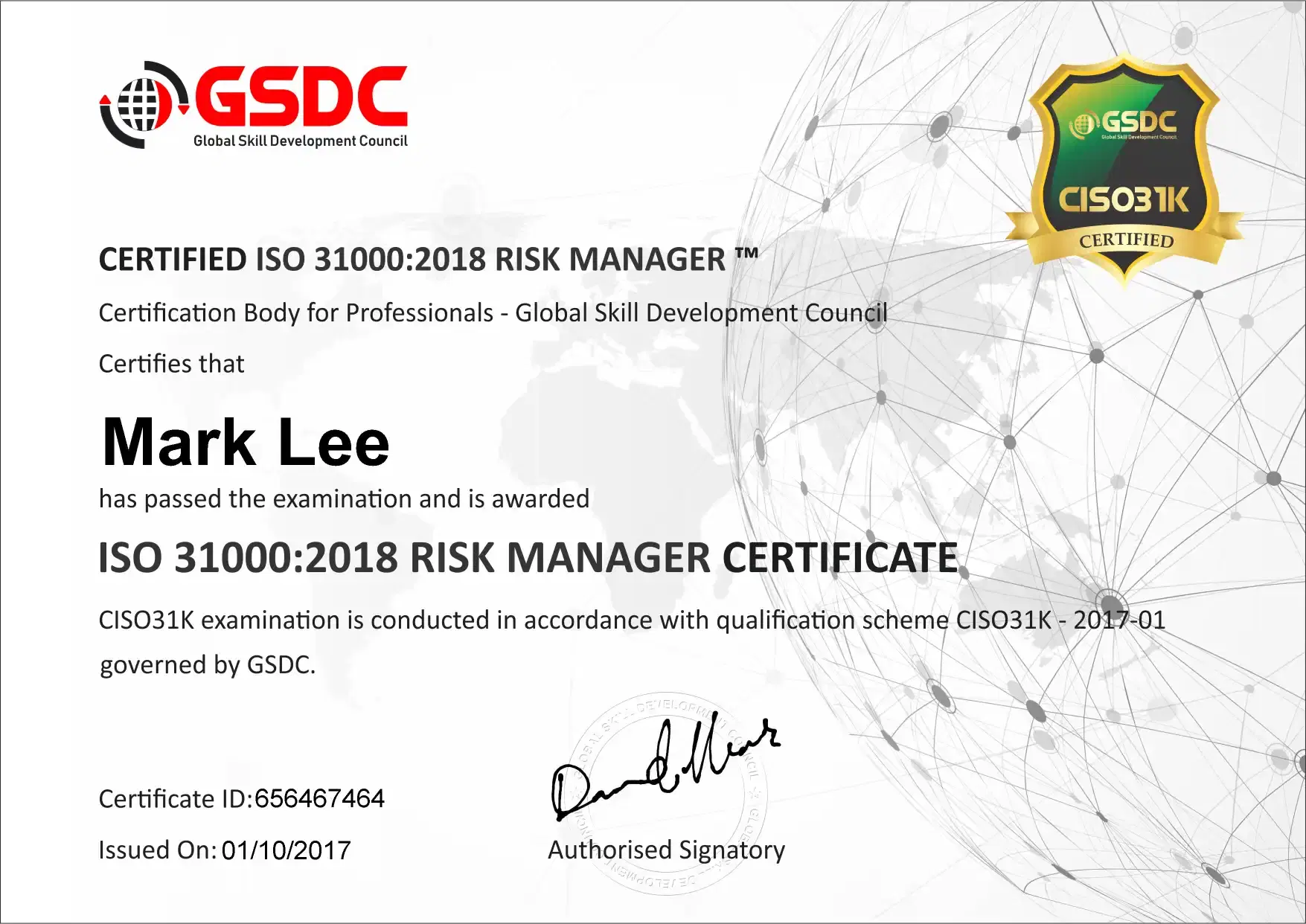
Certified ISO 31000:2018 Risk Manager Exam Format
Exam Format - Objective Type, Multiple Choice
Exam Duration - 90 Minutes
Free 2nd Attempt Within 30 Days
Passing Criteria - 26 Out of 40 Marks
Certificate - Within 5 Business Days
Result - Immediately After the Exam
No. of Questions - 40 (Multiple-Choice Questions)
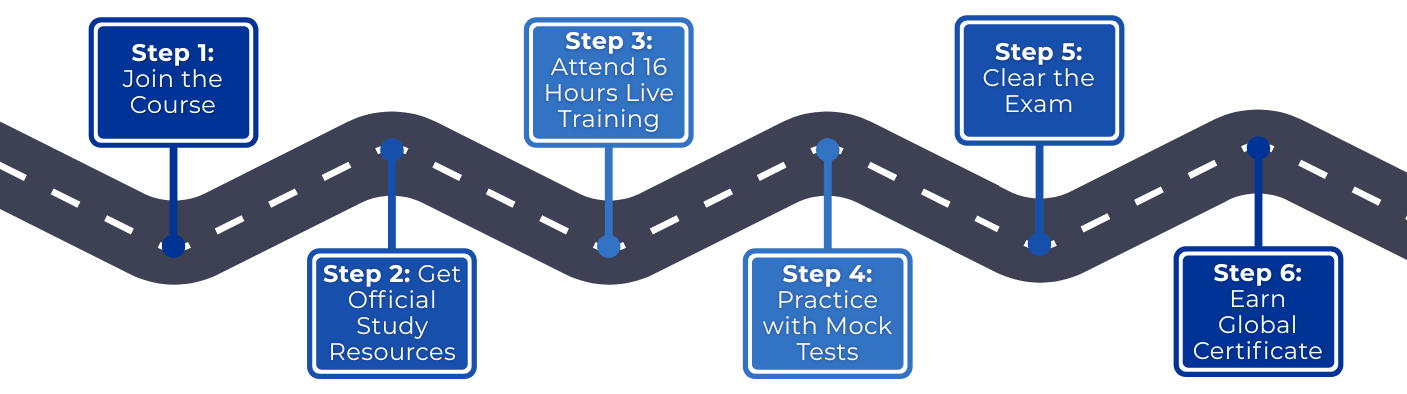
ISO 31000 Certification Learning Path