Category | IT Service Management
Last Updated On 14/07/2026
A lot of IT teams say they “follow ITIL,” but when you look closer, processes are inconsistent, tickets pile up, and service quality still suffers. That’s where ITIL implementation becomes important. Instead of scattered processes, organizations need a structured approach to service management that actually works.
This guide explains how to implement ITIL step by step, including practical ITIL implementation steps, a structured ITIL service desk implementation plan, and proven best practices organizations use to improve IT operations and service quality.
Area | Key Insight |
|---|---|
ITIL Implementation Goal | Align IT services with business outcomes and improve service quality |
First Step | Assess current IT operations and define improvement goals |
High-Impact Practices | Incident management, service desk, request management, change enablement |
Key Tools | ITSM platforms, automation, monitoring integrations |
Success Metrics | MTTR reduction, SLA compliance, ticket resolution rates |
Long-Term Value | Lower costs, better service reliability, improved user satisfaction |
Modern IT environments are more complex than ever. Businesses depend on digital services for almost everything, from internal collaboration tools to customer-facing applications.
Without structured service management, small technical issues can quickly become major disruptions.
This is where ITIL implementation plays an important role.
ITIL provides a framework that helps organizations:
Industry research shows that around 72% of organizations use ITIL practices in some form, making it one of the most widely adopted service management frameworks.
In many ITIL workshops delivered for mid-sized enterprises, teams often discover that 40–50% of service delays come from unclear ticket ownership and inconsistent escalation paths rather than tool limitations.
A structured approach helps avoid these problems and ensures the ITIL implementation steps lead to measurable improvements.
Before beginning ITIL implementation, organizations need to understand what ITIL actually represents.
ITIL 4 is not just a collection of processes, it is a framework designed to deliver value through services.
The framework connects IT operations with business outcomes by focusing on service value and continual improvement.
The global IT service management (ITSM) market is expected to reach about $22.1 billion by 2028, reflecting the growing demand for structured service management practices. Organizations planning ITIL implementation steps should first define their business objectives.
Common goals include:
Research also shows that about 60% of enterprises currently use ITIL 4 practices within their service management environments.
Understanding these objectives helps organizations design an ITIL service desk implementation plan that aligns with real business priorities instead of theoretical frameworks.
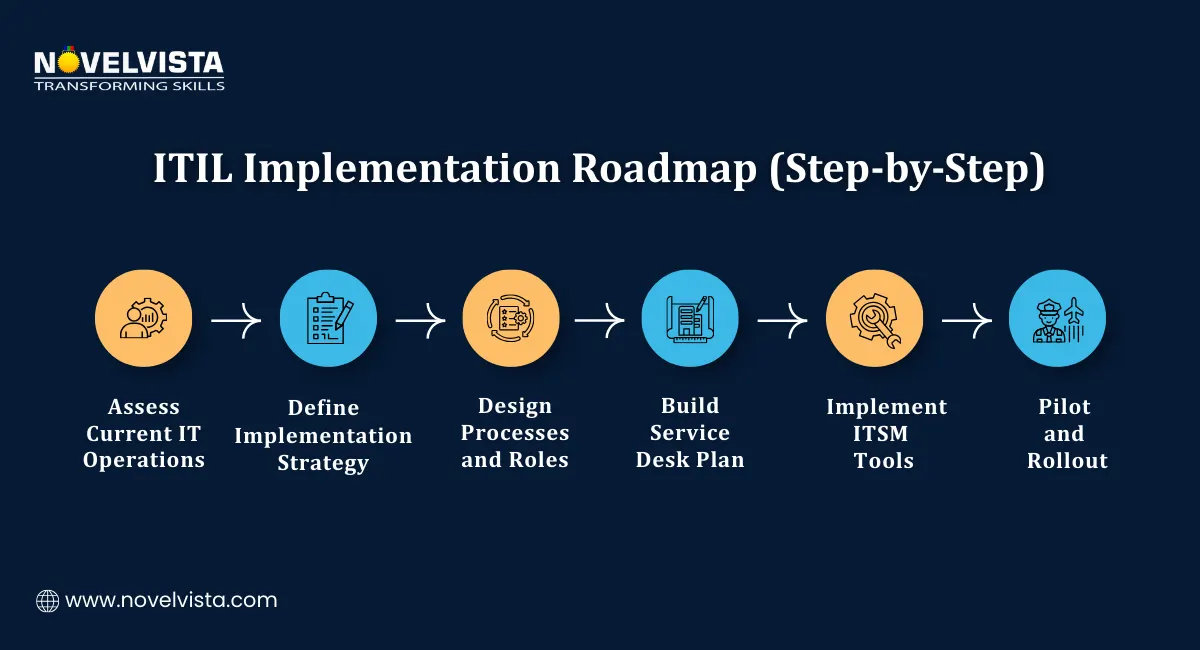
The first stage of ITIL implementation is understanding the current state of IT operations.
Organizations should evaluate:
This assessment helps identify gaps between current operations and the desired ITIL-based service model.
Common operational challenges include:
Industry reports show that 34% of support teams are experiencing increasing ticket volumes, with organizations handling an average of 10,675 tickets each month.
Without structured processes, managing these workloads becomes difficult. After identifying problems, organizations should define clear improvement targets.
Examples of measurable goals include:
Defining these goals early helps guide future ITIL implementation steps and ensures progress can be measured effectively.
A common mistake in ITIL implementation is trying to adopt the entire framework at once. ITIL includes many practices, but most organizations benefit from starting with a focused approach.
Instead of implementing everything simultaneously, organizations typically prioritize the most impactful practices first.
Common starting points include:
These practices have the most direct impact on service availability and user experience. A phased approach allows organizations to test improvements and refine processes before expanding further.
Research indicates that about 50% of organizations believe their ITSM capabilities still have significant room for improvement, which shows why structured ITIL implementation steps are necessary.
In implementation coaching sessions, organizations that begin with incident and request management often stabilize service operations within the first 60–90 days of structured ITIL practice adoption.
Once the implementation strategy is clear, organizations can start designing service management processes.
This stage focuses on defining how services will be delivered and supported.
Teams should document both:
Process documentation should include:
Clear documentation ensures teams understand how services should be delivered after ITIL implementation. Defining roles is equally important.
Common ITIL roles include:
Many organizations use RACI models to assign responsibilities and ensure accountability.
Process design should also integrate with:
Industry surveys show that 43% of ITSM teams consider advanced ITIL capabilities a priority for 2026, highlighting the growing importance of structured service management practices.
For a clear breakdown of core workflows, read our guide on ITIL Processes Explained and how they support effective IT service management.
The ITIL service desk implementation plan forms the operational core of IT service management.
The service desk acts as the single point of contact for users, ensuring incidents and requests are handled efficiently.
A well-designed service desk improves communication between users and IT teams.
Key components of an effective service desk include:
Modern service desks also support multiple communication channels.
Typical support channels include:
Organizations increasingly use AI-powered virtual agents and automation tools to handle routine tasks.
Research shows that 71% of organizations prioritize improving customer experience when investing in service management technologies.
A well-structured ITIL service desk implementation plan, therefore, plays a central role in improving service quality.
Learn how to define meaningful ITIL KPIs, assign metric ownership, set baselines,
and track service performance across the ITIL lifecycle with a practical implementation checklist.
After defining processes and roles, the next stage in ITIL implementation is selecting the right technology platform. Tools do not replace processes, but they help automate workflows, track service performance, and improve visibility across IT operations.
An ITSM platform should support the most important service management practices, such as:
These capabilities allow organizations to run the ITIL service desk implementation plan efficiently and maintain consistent service delivery.
Modern ITSM platforms also integrate with other enterprise systems such as monitoring tools, collaboration platforms, and DevOps pipelines. This integration ensures incidents detected by monitoring systems automatically generate tickets for support teams.
Automation plays a major role in improving ITSM efficiency. Many organizations automate tasks like:
Some AI-enabled ITSM tools can even analyze ticket patterns and suggest solutions from knowledge bases.
Studies show that AI-assisted service management tools can reduce ticket resolution time by up to 75% in some environments, making automation a valuable part of successful ITIL implementation steps.
Organizations should also configure dashboards that track service performance in real time.
Common metrics tracked include:
These dashboards help leaders monitor progress and measure the impact of ITIL implementation.
To explore the leading platforms shaping modern service management, read our guide on Top ITSM Tools in 2026 and how they support efficient IT operations.
Once processes and tools are ready, organizations should begin implementing ITIL practices in a controlled way.
Launching everything at once across the entire organization can create confusion. A pilot approach allows teams to test processes, gather feedback, and refine workflows before expanding further.
For example, an organization might start the ITIL service desk implementation plan within a single department or business unit.
During the pilot phase, organizations should monitor:
This early feedback helps identify adjustments needed before scaling the solution. After the pilot succeeds, the organization can gradually expand ITIL implementation steps across other teams or services.
Typical rollout strategies include:
Organizations that implement targeted ITIL improvements often report 20–30% reductions in incident resolution time (MTTR).
Also, Organizations piloting ITIL processes within a single department frequently identify operational adjustments within the first four weeks, helping refine workflows before broader rollout across IT services.
Technology and processes are important, but many ITIL implementation challenges are actually related to people and organizational culture.
Some teams resist new processes because they fear additional workload or loss of autonomy. Other common challenges include:
These issues can slow or even derail ITIL implementation if they are not addressed early. Organizations can overcome these challenges by focusing on communication and engagement.
Key actions include:
ITIL-certified professionals are also increasingly valuable in the ITSM job market because organizations want experts who can guide successful ITIL implementation steps.
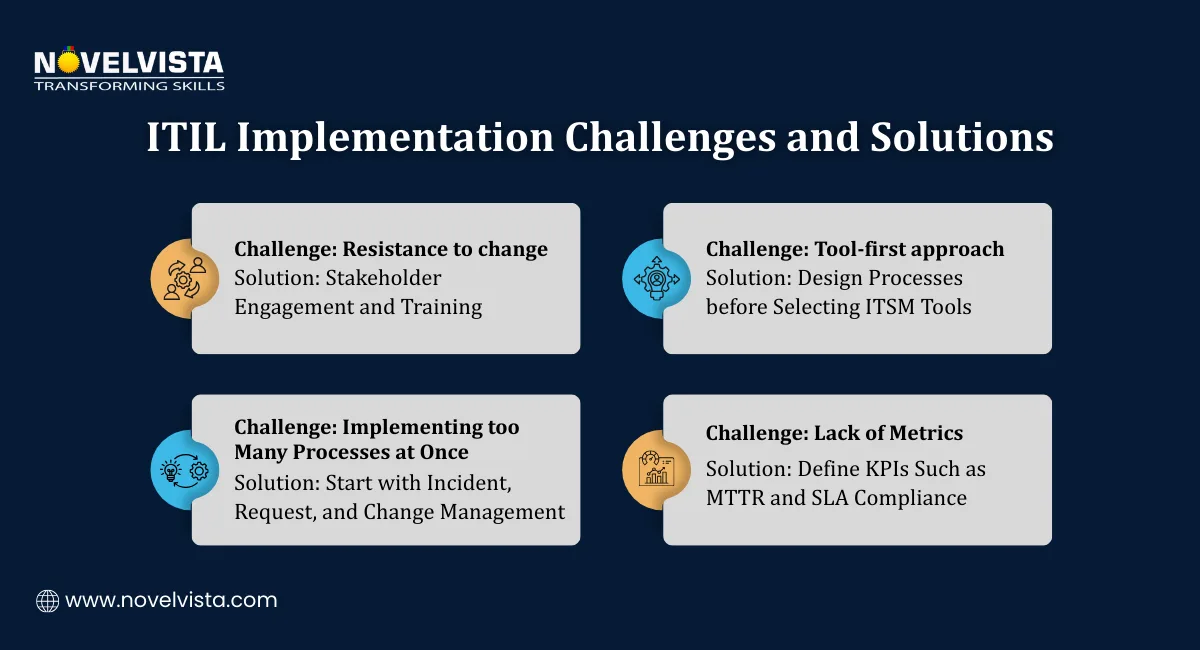
Many organizations encounter similar obstacles during implementation. Understanding these challenges helps teams prepare effective solutions.
Over-Scoping
Some organizations try to implement every ITIL practice simultaneously.
Solution: Start with high-value processes such as incident management and service desk operations, then expand gradually.
Tool-First Mindset
Buying an ITSM tool before defining processes often leads to confusion and inefficient workflows.
Solution: Design processes and define roles before selecting technology.
Lack of Performance Metrics
Without measurable indicators, it becomes difficult to prove whether ITIL implementation is delivering value.
Solution: Define KPIs early in the implementation process.
Important metrics include:
Skill Gaps
Teams unfamiliar with ITIL practices may struggle to follow new processes.
Solution: Invest in training programs and certification courses to build internal expertise.
Addressing these challenges early ensures smoother ITIL implementation steps and better long-term results.
Across several enterprise workshops, organizations that define operational KPIs before implementation phases report more consistent improvement tracking during the first six months of ITIL adoption.
Once processes are deployed, organizations must measure performance to confirm improvements.
Tracking operational metrics helps identify areas where service management is working well and where adjustments are needed.
Important KPIs include:
Organizations that successfully complete ITIL implementation often report over 10% reduction in operational costs along with improved service quality. Regular service reviews and continual improvement activities ensure these benefits continue over time.
Implementing ITIL is not a one-time project. It is an ongoing journey that evolves as organizations grow and technology changes.
After stabilizing the ITIL service desk implementation plan and core practices such as incident and change management, organizations can expand into additional practices such as:
Advanced analytics and automation tools also help organizations identify patterns in service performance.
For example, AI-based analytics can detect recurring incident patterns and suggest preventive actions.
Future ITSM trends expected to influence ITIL implementation include:
Based on observations from ITSM training programs and implementation reviews, organizations that maintain quarterly service improvement reviews tend to sustain ITIL process maturity over longer periods.
A structured ITIL implementation helps organizations move from reactive IT support to proactive service management. By assessing current operations, defining clear goals, designing processes, and deploying a strong ITIL service desk implementation plan, organizations can improve service reliability and user satisfaction.
Successful ITIL implementation steps also focus on people, culture, and measurable outcomes. When supported by the right tools and continual improvement practices, ITIL enables organizations to deliver consistent, business-aligned IT services.

Next Step: Build Your ITIL Expertise
If you want to understand ITIL practices deeply and lead successful service management initiatives, NovelVista’s ITIL (Version 5) Foundation Certification Training Program can help you get there. The training provides practical knowledge of ITIL processes, service desk operations, and real-world implementation strategies. It prepares professionals to improve IT services, align IT with business outcomes, and confidently apply ITIL frameworks inmodern IT environments.
Author Details

Course Related To This blog
ITIL4 Specialist Monitor Support and Fulfil Certification
ITIL 4 Specialist Sustainability in Digital & IT
ITIL® 4 Strategic Leader Digital And IT Strategy (DITS)
ITIL® 4 Specialist Drive Stakeholder Value
ITIL® 4 Specialist High Velocity IT
ITIL® 4 Strategist Direct, Plan & Improve
ITIL® 4 Specialist Create Deliver & Support
ITIL® 4 Foundation Certification
ITIL V5 Foundation
Confused About Certification?
Get Free Consultation Call
Stay ahead of the curve by tapping into the latest emerging trends and transforming your subscription into a powerful resource. Maximize every feature, unlock exclusive benefits, and ensure you're always one step ahead in your journey to success.