Category | IT Service Management
Last Updated On 13/04/2026
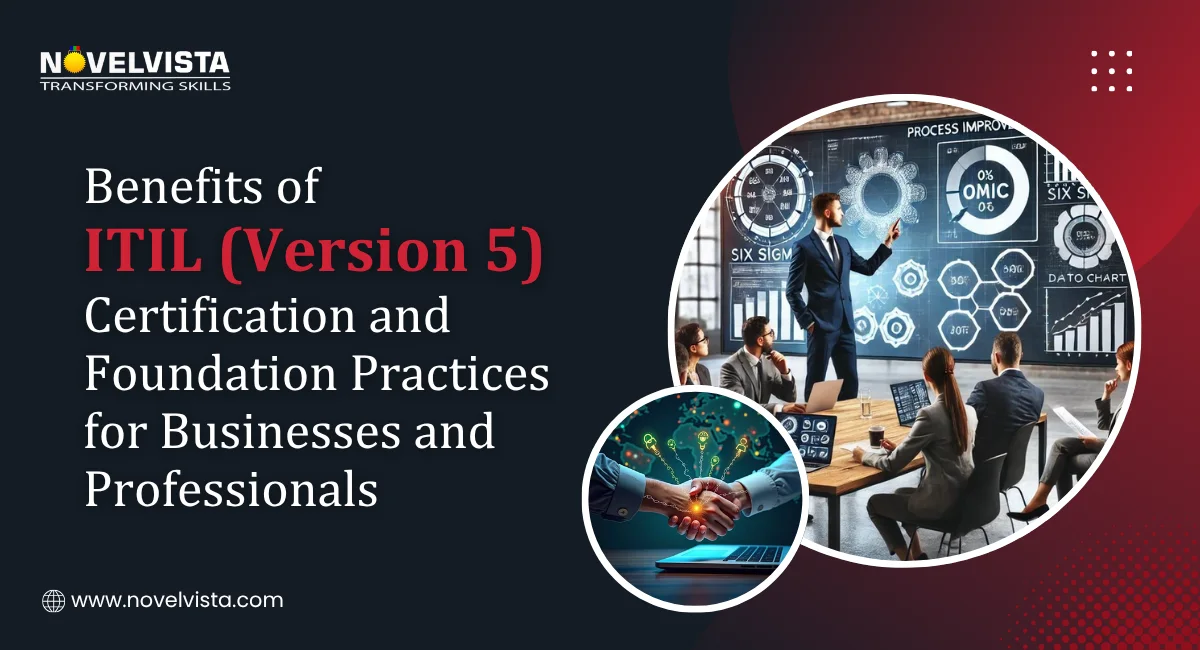
Your IT team is putting in the hours. Tickets are getting resolved. Projects are moving. But somehow, the business still feels like IT isn't delivering enough value and IT feels like the business doesn't understand what they're dealing with.
That gap between IT delivery and business expectations is exactly what the benefits of ITIL are designed to close. ITIL Version 5 gives organizations and professionals a shared framework for planning, delivering, and improving IT services and digital products in a way that actually connects to business outcomes.
This guide covers ten ITIL benefits for businesses, ten benefits of ITIL certification for professionals, a breakdown of Foundation practices, and a comparison with other ITSM frameworks, so you can make an informed decision about whether ITIL Version 5 is the right investment for your organization or career.
| Topic | Key Takeaway |
| What is ITIL V5 | Evolved ITSM framework covering digital products, AI integration, and full value systems |
| Business Benefits | Reduces incidents by 20-30%, improves efficiency, alignment, and resource utilization |
| Professional Benefits | 15-25% salary uplift, global recognition, career advancement to senior IT roles |
| Foundation Practices | 34 refined practices across general, service, and technical management categories |
| ITIL vs Other Frameworks | Complements COBIT, enables ISO 20000 compliance, integrates with Agile and DevOps |
| Who Should Pursue It | Service desk pros, IT leaders, project managers, and career changers into IT |
ITIL Version 5 is the latest evolution of the world's most widely adopted IT service management framework. It's built for how IT actually works in 2026, where organizations are running hybrid environments, deploying AI tools, managing digital products alongside traditional services, and trying to tie all of it back to measurable business value.
What makes it different from earlier versions is the scope. ITIL Version 5 moves beyond services alone to cover digital products across their full lifecycle. It's built around a value system that connects every IT activity. From the service desk to infrastructure management to the outcomes the business actually cares about.
The structural foundation includes guiding principles like value focus and holistic thinking, now extended to cover AI governance and sustainability. The 34 refined practices span general management, service management, and technical management, giving teams a common language and a consistent approach regardless of size, industry, or technology stack.
The key distinction from older ITIL versions is flexibility. This isn't a rigid process manual. It's an adaptable framework that works alongside Agile, DevOps, Lean, and AI practices rather than competing with them.
To understand what’s changed and what’s new, explore our blog on ITIL 4 vs ITIL (Version 5) and how the updates impact roles, practices, and certification paths.
What are the benefits of implementing ITIL? For organizations, the answer spans service quality, cost reduction, risk management, and the ability to move faster without breaking things. Here's what the framework delivers across ten dimensions:
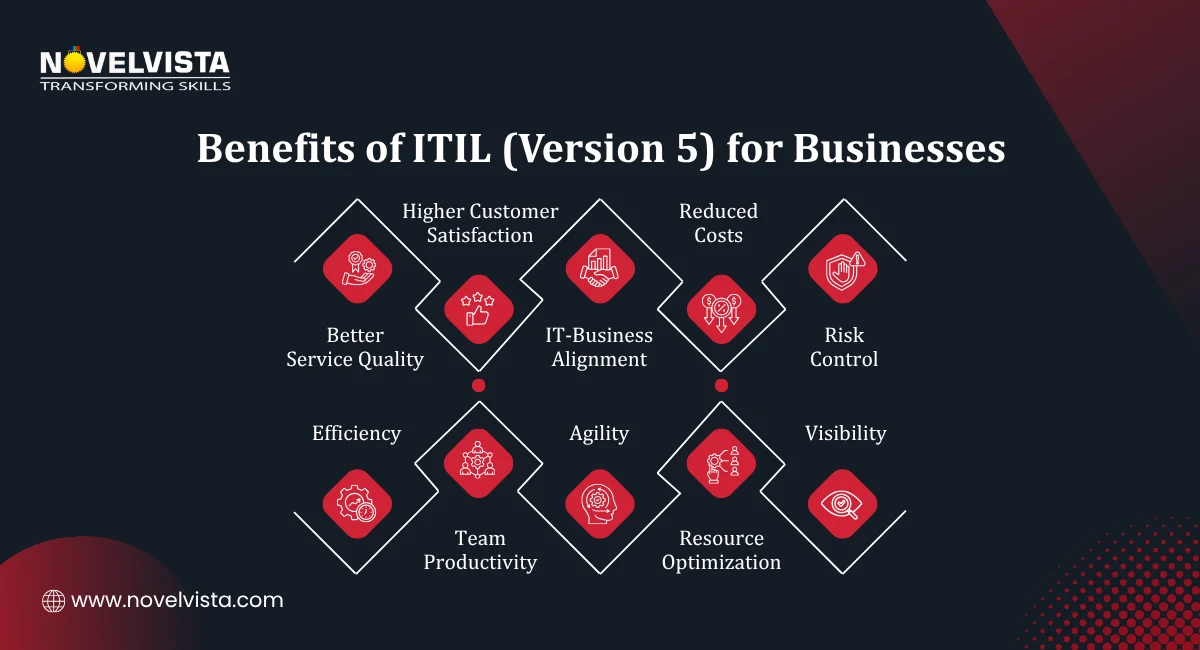
Standardized practices like incident and problem management reduce the variability that causes inconsistent service delivery. When teams follow a shared approach, reliability improves and users notice.
Audit assessments we conduct show incident resolution consistency improves by nearly 30% when standardized workflows are followed across service desk and operations teams.
The benefits of ITIL in this area are directly user-facing. ITIL Version 5 puts end-user experience at the center of service design, which means the processes your team follows are oriented toward outcomes users actually care about, not just internal metrics.
The ITIL value system connects every service and product your IT team delivers to specific business goals. This is one of the most consistent ITIL benefits organizations report. IT stops being a cost center and starts being a visible contributor to business outcomes.
Streamlined workflows cut rework, reduce repeat incidents, and eliminate the coordination waste that comes from unclear processes. Organizations implementing ITIL practices consistently report 20 to 30% reductions in incidents and rework costs.
Change enablement practices in ITIL Version 5 give teams a structured way to assess, approve, and implement changes with minimal disruption. Fewer unplanned outages, fewer emergency fixes, and fewer incidents traced back to poorly managed changes.
One of the practical advantages of ITIL Version 5 is its integration with AI and automation. Teams can use ITIL practices to identify where automation makes sense, implement it properly, and free up human capacity for higher-value work.
Clear role definitions reduce the coordination overhead that slows teams down. When everyone knows who owns what and how work flows between teams, less time gets spent on clarifying responsibilities and more gets spent on actual delivery.
ITIL Version 5 is designed to work with Agile and DevOps, not against them. Teams that want to move faster don't have to choose between speed and structure.
Demand and capacity management practices prevent the two most common resourcing mistakes: over-provisioning infrastructure that sits idle, and under-provisioning during peak demand. Both cost money. ITIL practices address both.
Real-time metrics and reporting built into ITIL practices give leadership the visibility to make proactive decisions rather than reactive ones. Problems get caught earlier, and the data to support decisions is already there when it's needed.
What are the benefits of implementing ITIL comes down to this: organizations that apply these practices consistently operate more reliably, spend less on fixing avoidable problems, and deliver IT services that actually support what the business is trying to do.
The benefits of ITIL don't stop at the organizational level. For individual professionals, certification opens up salary growth, career advancement, and access to roles that simply aren't available without a recognized ITSM credential.
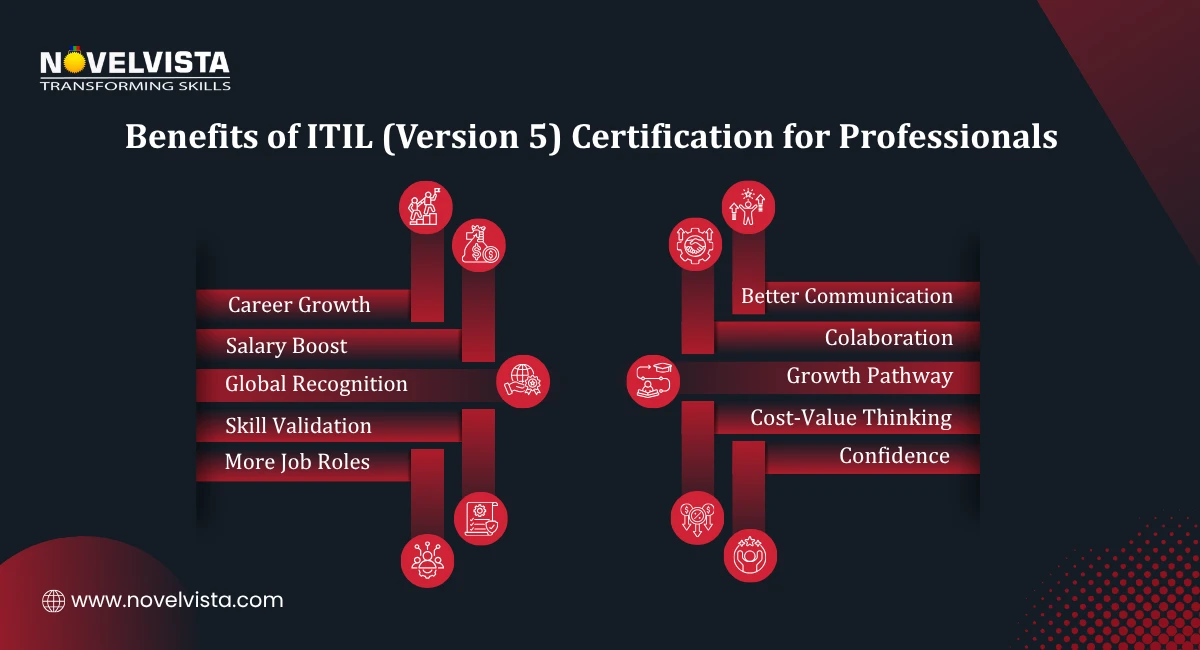
Here's what certification delivers across ten career dimensions:
ITIL Foundation certification is a prerequisite for roles like IT Service Manager and IT Operations Lead. It's also the entry point for advanced ITIL designations. Including, Managing Professional and Strategic Leader, that unlock senior leadership pathways. The ITIL certification benefits here show up quickly, often within the first year after certification.
Certified professionals report salary uplifts of 15 to 25% following certification. That range reflects the difference between entry-level service desk roles and mid-to-senior IT management positions, but the upward movement is consistent across both.
ITIL certification is recognized and respected across industries and geographies. Whether you're working in financial services in London, technology in Singapore, or healthcare in the United States, the credential carries the same weight. This is one of the most practical ITIL certification uses for professionals with international career ambitions.
A certification provides third-party proof of your ITSM knowledge. Employers know exactly what an ITIL-certified professional understands, which removes uncertainty from the hiring process.
The benefits of ITIL certification extend into roles that go well beyond traditional IT operations. IT Manager, ITSM Consultant, Service Delivery Lead, and Digital Transformation roles all list ITIL certification as a valued or required credential.
One of the less obvious but highly practical ITIL Foundation benefits is the ability to translate IT activity into business language. Certified professionals understand how to connect service delivery to business value, making them far more effective in conversations with non-technical stakeholders.
In training simulations, certified professionals demonstrate clearer articulation of service value, reducing stakeholder escalations and improving decision-making alignment during review meetings.
ITIL Version 5 bridges the gap between IT operations, DevOps teams, and the business. Certified professionals bring a shared language and a common framework to cross-functional work, which reduces friction and speeds up delivery across team boundaries.
ITIL Foundation is the starting point, not the finish line. It leads directly to the Managing Professional and Strategic Leader designations, each of which opens a higher tier of roles, responsibilities, and compensation. The ITIL certification benefits compound as you move up the certification ladder.
Certified professionals develop a structured way of evaluating IT services and digital products by their return on investment, not just their technical performance. This perspective makes them more valuable in budget conversations and strategic planning discussions.
One of the most practical ITIL Foundation benefits is simply knowing how to approach service improvement challenges with a structured method rather than instinct. Certified professionals walk into complex IT environments with a proven toolkit and the confidence to apply it.
The ITIL certification uses you'll get the most out of day-to-day come from the Foundation practices. ITIL Version 5 includes 34 refined practices across three categories:
If you're just getting started with ITIL, four practices are worth focusing on first:
These four practices alone cover the most common sources of IT service failure and they're the foundation that more advanced ITIL work builds on. Also, In workshops, we prioritize incident, problem, change, and service desk practices first, as these deliver the fastest measurable improvements in operational stability.
Explore global salary trends, role-based earnings, and top ITIL job opportunities to
plan your career growth and maximize earning potential in IT service management.
One of the practical advantages of ITIL is that it doesn't compete with other frameworks, it works alongside them. Here's how it compares to the alternatives organizations commonly evaluate:
COBIT focuses on IT governance and compliance. ITIL focuses on service delivery and operational excellence. They're complementary, many organizations use COBIT for governance oversight and ITIL for day-to-day service management. Using both together gives you governance and delivery in the same environment.
ISO 20000 is a formal standard for IT service management. ITIL practices are designed to support ISO 20000 compliance, implementing ITIL well essentially builds the foundation that ISO 20000 certification requires.
PRINCE2 governs project delivery. Agile governs development cycles. ITIL governs ongoing IT operations and service management. They operate at different layers and ITIL Version 5 is specifically designed to integrate with Agile and DevOps workflows rather than conflict with them.
The advantages of ITIL in 2026 come from its evolution. It's the only major ITSM framework that has actively integrated AI governance, sustainability thinking, and digital product management into its core structure, keeping it relevant as the technology landscape shifts.
To understand how these frameworks compare and where each fits best, explore our article on ITIL vs COBIT vs ISO 20000 and choose the right approach for your organization.
The short answer is: more people than most organizations realize.
The obvious candidates are IT professionals. Service desk staff, operations teams, IT managers, and project managers who work alongside IT delivery teams. For all of these roles, the benefits of ITIL certification are direct and immediate.
But the credential also makes sense for career changers moving into IT from adjacent fields, business stakeholders who need to work effectively with IT teams, and consultants who advise organizations on digital transformation or service improvement.
When to pursue each level:
The Foundation level is designed to be accessible. You don't need years of ITSM experience to benefit from it. The shared language and structured thinking it builds are valuable from day one.
The benefits of ITIL Version 5 are consistent across both the organizational and individual levels and that's what makes the framework worth investing in.
For organizations, the advantages of ITIL show up in reduced incidents, lower operational costs, better business alignment, and the ability to adopt AI and Agile practices without losing service reliability. For professionals, the ITIL benefits translate into salary growth, career advancement, global recognition, and the confidence to handle complex IT environments with a proven approach.
The evidence supports it: 20 to 30% reductions in incidents, 15 to 25% salary uplifts for certified professionals, and rapid adoption across industries in 2026. These aren't projections, they reflect what organizations and individuals are already experiencing.
Certification and implementation together deliver the most value. Understanding the framework without applying it leaves results on the table. Applying it without a certified team leaves the implementation inconsistent.
The starting point is straightforward: Foundation certification, no prerequisites required, and immediate practical value from day one.
If you’re looking to apply these concepts in real scenarios, NovelVista’s ITIL (Version 5) Foundation Certification Training is a practical starting point. The course covers key practices, real-world use cases, and exam-focused preparation to help you build a strong ITSM foundation. With expert guidance and structured learning, you’ll be ready to align IT services with business goals and confidently move forward in your ITIL journey.
Author Details

Confused About Certification?
Get Free Consultation Call
Stay ahead of the curve by tapping into the latest emerging trends and transforming your subscription into a powerful resource. Maximize every feature, unlock exclusive benefits, and ensure you're always one step ahead in your journey to success.