Category | IT Service Management
Last Updated On 18/05/2026

Startups move fast. New customers, new features, new priorities every single week. But with that speed often comes chaos. Tickets lost, outages handled in panic mode, communication gaps between tech and business, and firefighting becoming normal work. That’s where the ITIL Framework changes the story. Instead of slowing startups down, it helps them bring structure, stability, and smart scaling without adding heavy processes.
This blog explains what is ITIL Framework, why startups should care, how it actually works, and how it can be applied in a simple, lightweight way that supports growth instead of blocking it.
Let’s keep it very clear and startup-friendly.
When we talk about what is ITIL Framework, it simply means a best-practice ITIL service management framework that helps organizations manage IT services in a smart, consistent, and value-driven way. It is built to make IT services reliable, structured, and aligned with business needs instead of random or reactive.
The ITIL Framework is not only about paperwork or compliance. It focuses on making IT teams work better, reducing chaos, improving service delivery, and creating solid customer value. ITIL 4 introduces the Service Value System (SVS), which helps startups connect every IT effort to real business outcomes. So when someone asks, “Is ITIL only for big enterprises?” the real answer is no, it is actually one of the most powerful and flexible systems startups can use.
Before startups judge whether they need ITIL, it helps to understand a quick ITIL framework Overview:
✔ Focus on Value
✔ Start Where You Are
✔ Keep It Simple
✔ Progress Iteratively
✔ Collaborate and Be Transparent
✔ Optimize and Automate
This quick ITIL framework Overview already shows that it is not a boring theory book. Over the past few years of training various startup teams and fast-growing tech companies, we’ve seen how even simple ITIL adoption helps reduce chaos and improve service reliability. Startups that earlier struggled with scattered tickets, unclear responsibilities, and repeated outages began experiencing smoother operations once basic ITIL practices were applied correctly.
Many startups think ITIL is only for banks, telecom giants, and huge IT corporations. But that mindset is outdated. The ITIL Framework for Startups works beautifully when applied correctly.
Here’s the truth:
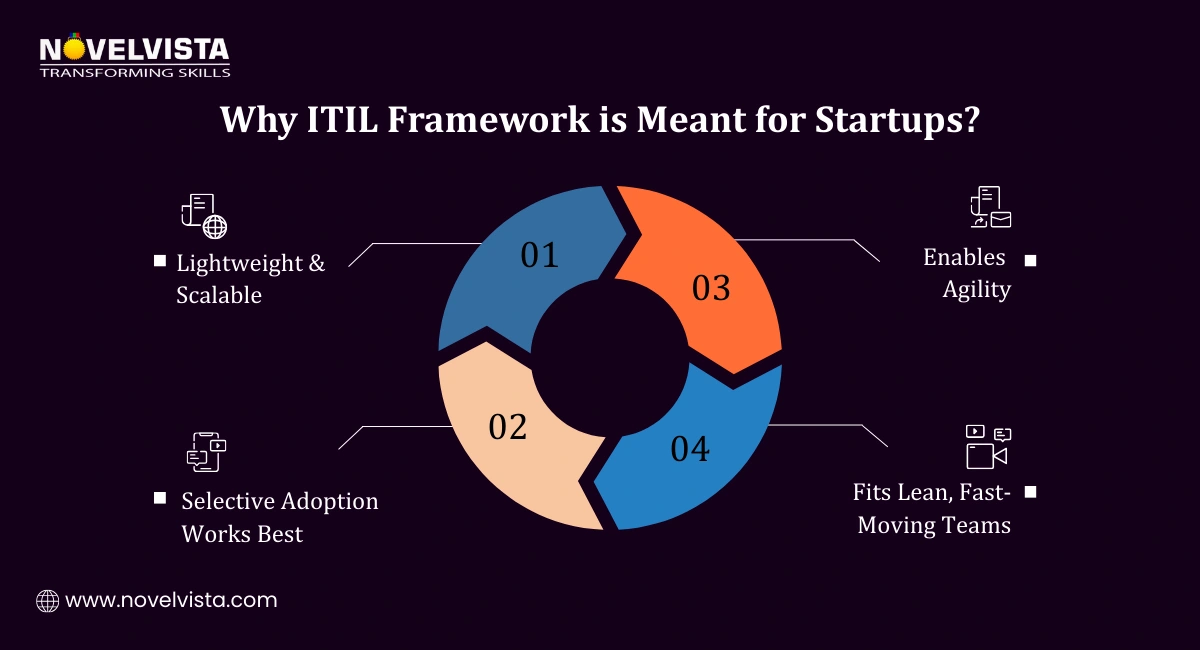
Startups don’t need huge processes. They need scalable, lightweight, and selective adoption. The ITIL Framework allows exactly that. You can adopt what you need now and grow as your company grows. No forced full rollout. No unnecessary complexity.
For startups, ITIL helps with:
From our experience delivering ITIL training to startup founders, IT teams, and product organizations, the most successful implementations are always selective and practical. Startups don’t need the entire framework; they need the right practices applied in the right way so they continue moving fast while building operational discipline.
So yes, the ITIL Framework for Startups is very practical when used smartly.
Get a structured, step-by-step checklist covering
Incident, Change, Problem, and Service Delivery.
Bring consistency, clarity, and control to your ITSM practices.
Let’s get into how the ITIL framework, explained for startups, actually works in real life. The system is designed to be modular, flexible, and supportive of speed-driven environments.
Startups don’t need everything at once. You can begin with the most useful practices, like:
This approach helps startups mature step-by-step instead of being overwhelmed.
Unlike rigid corporate systems, ITIL supports agility. The ITIL Framework tells startups to:
This is why the ITIL service management framework blends well with Agile and DevOps environments.
ITIL also talks about four key pillars that shape strong IT operations in startups:
These four dimensions make the ITIL framework very relatable to modern startup realities.
When a startup begins to grow, chaos slowly creeps in. Tickets pile up, response time stretches, and teams start reacting instead of managing. This is where the ITIL Framework quietly turns things around.
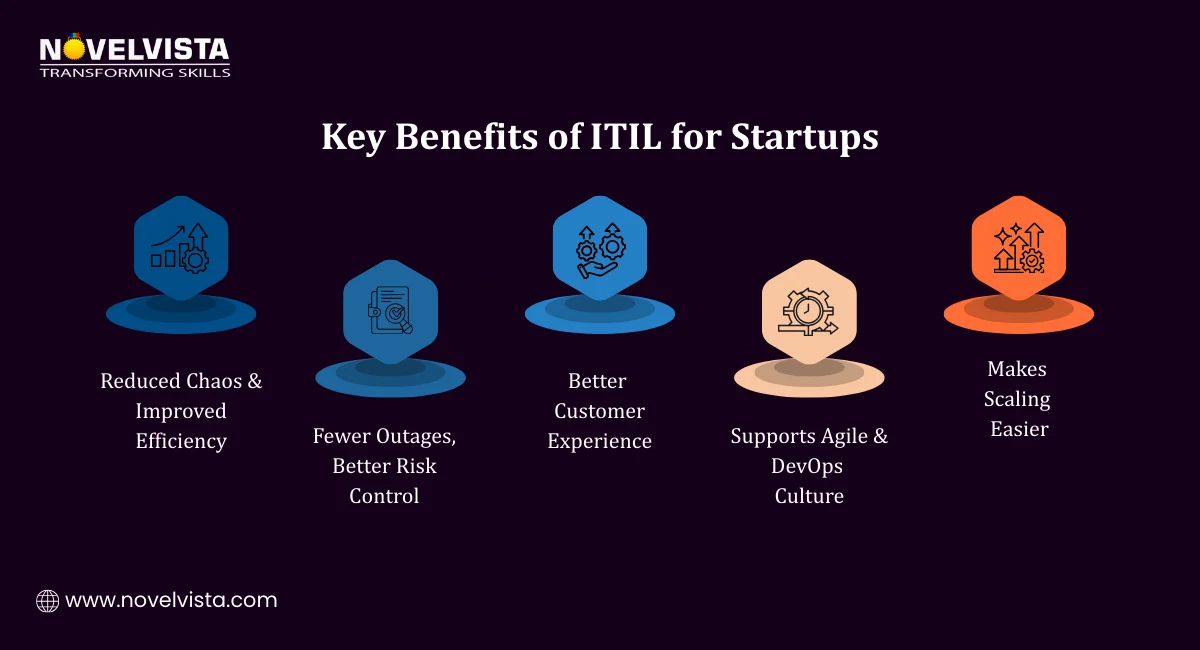
The biggest gain for startups is stability. The ITIL service management framework brings structure without killing speed. When incident handling, service requests, and change approvals follow simple and clear processes, teams spend less time firefighting and more time delivering value.
Downtime hurts startups more than large enterprises because every customer counts. ITIL helps reduce outages, strengthens change handling, and builds predictable service behavior. This means fewer surprises and smoother service continuity.
Startups survive on trust. The ITIL Framework simply means every IT action contributes to business value and customer experience. The Service Value System ensures services are meaningful, measurable, and customer-focused.
Good news for modern teams, ITIL doesn’t fight Agile and DevOps. It works alongside them. Startups can still build fast, but with better governance and fewer risks.
Want to understand the real value of adopting ITIL? Read our blog on the Benefits of ITIL to see how it improves service quality, stability, customer satisfaction, and business performance.
Even though the ITIL Framework for Startups works really well, startups still need realistic expectations.
This is where many founders and IT heads ask, “Where do we even begin?” Let’s keep it simple and startup-friendly.
Look at your current IT operations. Where are delays happening? Where are users unhappy? This gives clarity instead of guessing.
Do not implement everything. Start with:
This builds structure without stress.
Train your key team members. ITIL 4 Foundation builds a strong understanding and confidence. Later, teams can grow into advanced levels depending on maturity.
Use cloud ITSM tools, automation, and dashboards. The ITIL Framework works best when supported with the right platforms.
In our training and consulting experience, the most effective startup approach is to begin small, usually with Incident Management, basic Service Request handling, and Change Enablement. Once teams become comfortable and start seeing value, additional practices can be added gradually without overwhelming the organization.
Want to see how real teams put ITIL into action successfully? Read our blog on Implementing ITIL in IT Teams to learn practical steps, adoption strategies, and proven success tips.
Many small and mid-sized organizations adopt parts of the ITIL Framework and notice clear improvements.
Enterprises may implement huge governance layers. Startups don’t need that. The ITIL Framework for Startups focuses on lightweight, meaningful, and selective practices. That’s what makes it practical and useful. Many startups implement ITIL processes without defining the expected business impact. Learning the concept of ITIL Output vs Outcome can help organizations avoid process-heavy implementations that deliver little real value.
Based on multiple ITIL enablement programs we’ve supported, many startups report noticeable improvements in response time, incident handling, service visibility, and overall team coordination after adopting ITIL 4 principles. This aligns strongly with global ITSM best practices, where structured frameworks consistently help organizations scale more confidently and sustainably.
Yes, absolutely, when used smartly. The ITIL Framework gives startups structure without slowing innovation. It cuts chaos, improves service delivery, strengthens stability, and supports growth with confidence. When applied in a lightweight and selective way, the ITIL service management framework becomes a powerful growth partner rather than a burden. It helps build disciplined IT teams, better customer value, and a stronger operational backbone, which every growing startup needs.
Everything shared here is based on practical implementation experience, learner feedback, and real startup environments where ITIL has been applied successfully. The goal is not to push heavy frameworks on startups, but to help them use ITIL in a simple, meaningful, and scalable way that genuinely supports growth.

If your startup wants to build a strong ITSM capability, the best place to begin is with the ITIL 4 Foundation Certification. NovelVista’s training helps teams understand the ITIL Framework clearly, apply it practically, and build confidence to manage IT services better. With expert trainers, real-world examples, and engaging learning, it prepares startups to turn ITIL knowledge into real business impact.
Author Details

Course Related To This blog
ITIL4 Specialist Monitor Support and Fulfil Certification
ITIL4 Specialist Acquiring & Managing Cloud Services
ITIL 4 Specialist Sustainability in Digital & IT
ITIL® 4 Strategic Leader Digital And IT Strategy (DITS)
ITIL® 4 Specialist Drive Stakeholder Value
ITIL® 4 Specialist High Velocity IT
ITIL® 4 Strategist Direct, Plan & Improve
ITIL® 4 Specialist Create Deliver & Support
ITIL® 4 Foundation Certification
Confused About Certification?
Get Free Consultation Call
Stay ahead of the curve by tapping into the latest emerging trends and transforming your subscription into a powerful resource. Maximize every feature, unlock exclusive benefits, and ensure you're always one step ahead in your journey to success.