Category | CLOUD and AWS
Last Updated On 21/02/2026
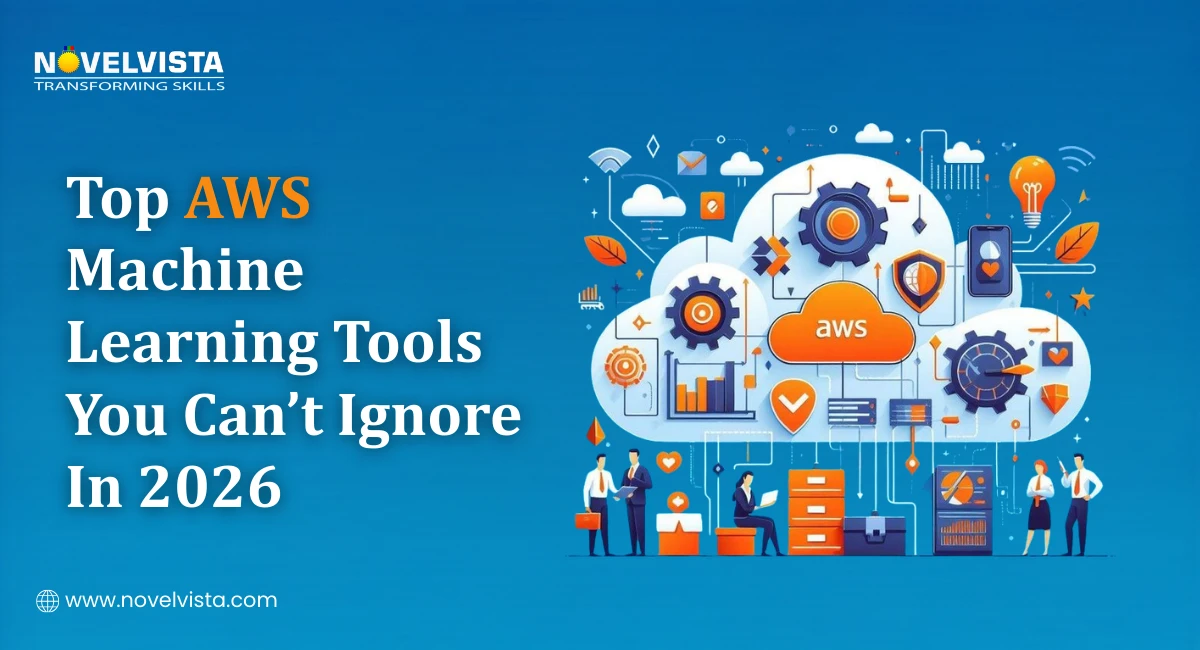
Today, over 75% of enterprises are investing in AI, and nearly 60% are moving AI workloads to the cloud to scale faster and innovate smarter. In 2026, the focus has shifted from simple “query-response” chatbots to Agentic AI — autonomous systems that can plan, reason, and execute tasks across enterprise data without human intervention. Generative AI alone is expected to add trillions to the global economy in the coming years.
But here’s the real challenge:
It’s not about adopting AI it’s about choosing the right tools.
Are you using the right AWS machine learning tools to stay competitive?
Do you know which services are built for developers versus data scientists?
Are you ready for Foundation Models, Generative AI, and scalable MLOps?
If you’re a developer, DevOps engineer, ML practitioner, AI architect, or IT leader this guide is for you.
In this blog, we’ll explore the 9 top AWS machine learning tools you should leverage this year to build smarter, faster, and more scalable AI systems.
Let’s dive in.
Cloud AI is evolving at an unprecedented pace. What once demanded massive infrastructure, specialized data science teams, and complex pipelines can now be built using low-code machine learning AWS services. In 2026, the landscape is being shaped by the rapid rise of AWS Generative AI Tools 2026, the growing adoption of Foundation Models (FMs) on AWS, and an enterprise-wide focus on governance, security, and Responsible AI. With a fully integrated ecosystem that spans data preparation, model development, deployment, monitoring, and automation, AWS has positioned itself at the center of this transformation. That’s why understanding AWS machine learning tools is no longer optional it’s a strategic advantage. An AWS Certification validates your cloud expertise, strengthens your credibility, and positions you for high-demand roles in today’s AI-driven technology landscape.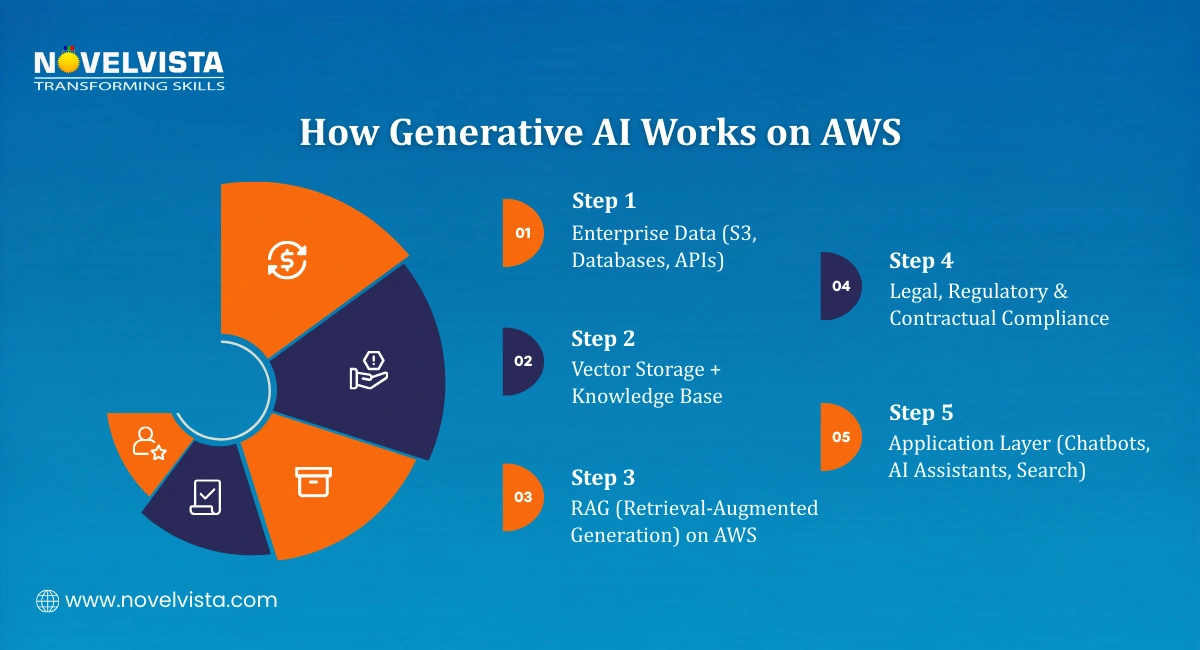
If there’s one service that defines AWS machine learning tools, it’s Amazon SageMaker.
SageMaker provides an end-to-end machine learning platform:
Data preparation
Model training
Hyperparameter tuning
Deployment
Monitoring
MLOps automation
With SageMaker Pipelines, you can automate model building, testing, and deployment workflows, enabling CI/CD for ML — a critical capability for scaling AI systems in production. Beyond pipelines, SageMaker continues to evolve with advanced capabilities like SageMaker HyperPod and SageMaker Unified Studio, designed to support enterprise-grade AI development. For massive-scale training, SageMaker HyperPod now offers checkpoint-less training, allowing clusters to self-heal and continue training even if hardware fails — a true game changer for 2026’s large language model (LLM) demands. Meanwhile, SageMaker Unified Studio brings data, analytics, and AI development into a centralized experience, improving collaboration across teams.
Many professionals ask: Amazon Bedrock vs SageMaker — what’s the difference?
SageMaker → Build, train, and deploy custom ML models with full lifecycle control.
Amazon Bedrock → Access and build applications using pre-trained Foundation Models without managing infrastructure.
Think of SageMaker as a full ML workshop, while Bedrock is your generative AI accelerator. If you're exploring the best AWS ML services for developers, SageMaker remains foundational for custom model development and large-scale ML operations.
Generative AI is transforming industries. At the center of AWS Generative AI Tools 2026 is Amazon Bedrock. Bedrock allows developers to access Foundation Models (FMs) on AWS without managing infrastructure, making it easier to build scalable, enterprise-ready AI applications.
Key Benefits:
API access to large language models
Secure enterprise integration
Scalable architecture
Built-in Responsible AI and Guardrails for Bedrock
Model customization through fine-tuning and model distillation
Enterprises now demand strong AI governance, especially when deploying Generative AI at scale. Amazon Bedrock addresses this need through built-in Responsible AI and Guardrails for Bedrock, enabling organizations to filter harmful content, control model outputs, and enforce compliance policies. These guardrails help ensure that Foundation Models operate within defined ethical, legal, and business boundaries while maintaining security and trust.
2026 is the year of the agent. Amazon Bedrock AgentCore introduces a powerful framework for building digital employees that don’t just generate responses — they perform actions. From processing refunds to updating CRM records or triggering workflows, AgentCore enables secure task execution within your VPC. This marks the shift from passive AI assistants to true Agentic AI systems that can plan, reason, and act autonomously across enterprise environments.
One powerful pattern gaining traction is RAG (Retrieval-Augmented Generation) on AWS. With Bedrock combined with vector databases and knowledge bases, organizations can connect LLMs to internal data, improve factual accuracy, and significantly reduce hallucinations.
Additionally, Bedrock supports advanced techniques like model distillation, allowing teams to create smaller, cost-efficient models derived from larger Foundation Models — optimizing performance while reducing inference costs.
For organizations entering the Generative AI space, Amazon Bedrock is one of the most strategic AWS machine learning tools to adopt in 2026.
Serverless architecture meets AI.
AWS Lambda enables lightweight ML inference without managing servers.
Use cases:
Real-time fraud detection
Image classification triggers
Event-driven AI pipelines
For developers seeking scalable and cost-efficient deployments, AWS Lambda integrates seamlessly with other AWS machine learning tools, enabling event-driven and serverless ML inference at scale. By 2026, leveraging Graviton4-based Lambda functions for inference has become the standard approach for optimizing performance while reducing cost-per-invocation by up to 40% compared to traditional x86 architectures making it a smart choice for high-volume AI workloads.
Computer vision no longer requires complex model development thanks to Amazon Rekognition, one of the best AWS ML services for developers building vision-based applications. It enables facial recognition, object detection, content moderation, and video analysis through simple APIs, eliminating heavy infrastructure management. Widely adopted across retail, security, and healthcare sectors, Rekognition allows teams to integrate intelligent image and video capabilities quickly and efficiently.
For NLP-based applications, Amazon Comprehend is powerful and easy to implement.
Capabilities:
Sentiment analysis
Entity recognition
Topic modeling
Language detection
It’s perfect for chatbots, customer insights, and automated document analysis.
Data quality defines model quality, and that’s where AWS Glue plays a critical role in the AWS ecosystem. It supports ETL pipelines, feature engineering, and data cataloging to ensure structured, reliable datasets for machine learning workflows. Since many ML projects fail due to weak data pipelines, AWS Glue helps ensure your AWS machine learning tools operate on clean, well-prepared data that drives accurate and scalable outcomes.
In 2026, Glue has also expanded into Vector Data Preparation, featuring built-in Vector Transformation pipelines that make it easier to ingest unstructured data directly into vector databases like Pinecone or Amazon OpenSearch for RAG workflows. This capability simplifies the preparation of embeddings and accelerates the deployment of Retrieval-Augmented Generation architectures on AWS.
Time-series forecasting simplified.
Amazon Forecast uses machine learning to predict:
Demand planning
Inventory optimization
Revenue projections
It’s ideal for businesses that need predictive insights without building complex models from scratch.
Recommendation engines are key to driving customer engagement, and Amazon Personalize enables businesses to build product recommendations, personalized content feeds, and targeted marketing campaigns with ease. As part of the growing ecosystem of low-code machine learning AWS solutions, it applies advanced ML techniques without requiring deep data science expertise, allowing teams to deliver intelligent personalization quickly and efficiently.
Document intelligence powered by AI becomes seamless with Amazon Textract, which automatically extracts printed text, handwritten text, tables, and forms from documents at scale. By eliminating manual data entry and accelerating document processing workflows, it plays a crucial role in automation strategies. Financial services and insurance sectors rely heavily on Amazon Textract to improve accuracy, compliance, and operational efficiency.
Choosing among AWS machine learning tools depends on your role and goal.
Bedrock (Generative AI apps)
Lambda (Inference APIs)
Comprehend (NLP apps)
Rekognition (Vision apps)
SageMaker
SageMaker Pipelines
Custom model training workflows
Personalize
Forecast
Rekognition
Bedrock with Responsible AI guardrails
MLOps automation with SageMaker Pipelines
The right combination creates a scalable AI ecosystem.
As AI demand continues to grow, certifications are becoming increasingly important for career advancement. The AWS Certified AI Practitioner validates foundational AI and ML knowledge on AWS, making it a strong starting point for professionals entering the AI domain. When reviewing AWS Certified AI Practitioner Study Resources, focus on Generative AI fundamentals, Foundation Models, the AWS machine learning tools ecosystem, and Responsible AI principles. Upskilling today ensures you stay relevant and competitive tomorrow. An AWS salary guide helps professionals understand earning potential across cloud roles, certifications, and experience levels in today’s competitive tech market.
While large models like GPT-4 and Claude 3 dominated conversations in 2024, 2026 is shaping up to be the year of efficiency. The focus is shifting from “bigger is better” to “smarter and leaner.” Through platforms like Amazon Bedrock, AWS is now prioritizing Small Language Models (SLMs) that deliver lightning-fast inference for targeted, domain-specific tasks at a fraction of the cost of massive Foundation Models.
SLMs are particularly effective for edge deployments, real-time automation, customer support workflows, and embedded enterprise applications where latency and cost-per-request matter more than broad general intelligence. For organizations optimizing their AWS machine learning tools stack in 2026, SLMs represent a powerful shift toward performance efficiency, scalability, and sustainable AI economics.
The AI race is no longer a future prediction; it’s a present reality. From Foundation Models (FMs) on AWS to RAG (Retrieval-Augmented Generation) on AWS, and from enterprise-grade MLOps automation to Responsible AI frameworks, the ecosystem is expanding at unprecedented speed. However, the organizations that succeed won’t be the ones that simply experiment with AI they will be the ones that execute strategically and align innovation with business outcomes. Leveraging the right AWS machine learning tools is no longer a technical choice; it’s a competitive decision.
Whether you're building custom ML pipelines with Amazon SageMaker, deploying Generative AI applications through Amazon Bedrock, or adopting low-code machine learning AWS solutions to accelerate delivery, the time to act is now. Start with clarity, automate with intention, and scale with confidence because in 2026, AI won’t be a differentiator. It will be the baseline expectation.
Ready to Become an AWS Architect Who Designs for AI at Scale?
Join NovelVista’s AWS Solutions Architect – Associate Certification Training and gain practical cloud architecture expertise, real-world AWS implementation insights, and globally recognized credentials. Designed for developers, architects, and IT professionals, this course helps you confidently design secure, scalable, and cost-optimized AWS environments, including AI and machine learning workloads.
If you’re serious about mastering AWS architecture and building future-ready AI systems, this is your next strategic step.
Start your AWS Solutions Architect journey today!
Author Details

Confused About Certification?
Get Free Consultation Call
Stay ahead of the curve by tapping into the latest emerging trends and transforming your subscription into a powerful resource. Maximize every feature, unlock exclusive benefits, and ensure you're always one step ahead in your journey to success.