

Master Cloud Operations with AWS SysOps Certification Training
Trusted by 1000s of global organizations, NovelVista is the lead AWS SysOps Training & Certification Course.
- Industry Expert Trainers
- Online learning session
- Accredited Trainer
- Exam fee included

AWS Sysops Certification Course Overview
What You Will Get?
Learning Outcome
After the completion of the course, the participants would be able to:
Training Calendar
English
- Self paced videos, assessments, recall quizzes, more
- For more details, reach us at training@novelvista.com
Includes Training, Exam & Certification
Lifetime Access
- Self paced videos, assessments, recall quizzes, more
- For more details, reach us at training@novelvista.com
Includes Training, Exam & Certification
Course Curriculum
Introduction+
- Course Introduction
- Walkthrough of Practice Labs
Monitoring and Metrics+
- Monitoring and Metrics
- Amazon CloudWatch
- Monitoring EC2 Service in AWS
- Demo: How to Create an Alarm for a Service
- Monitoring AWS EBS
- Monitoring Elastic Load Balancer in AWS
- Demo: Monitoring ELB and EBS volume in AWS CloudWatch
- Monitoring Relational Database (RDS) Service in AWS
- Demo: Monitor RDS instance in AWS through CloudWatch
- Monitoring ElastiCache Service in AWS
- Monitoring EFS in AWS
- Troubleshooting Common Monitoring Issues
- Demo: CloudWatch
- Features and Usage of CloudWatch Logs Filters and Alarms
- Demo: Set up CloudWatch alarm on log filter metrics
- Features and Usage of AWS CloudTrail
- Monitoring Pricing
- AWS Billing and Cost Management
- Demo: Set up billing metric alerts using CloudWatch
- Implementing Cost Optimization in AWS
- Demo: Set up Alarm that Will Automatically Stop EC2 Instance If CPU Utilization Is Less Than or Equal to Twenty
- Key Takeaways
Networking+
- Networking
- VPC
- VPC Sizing and IP Addresses
- Subnets
- IGW
- Route Tables
- NAT Gateway
- VPC Endpoints
- VPC Flow Logs
- VPC Peering
- Network Security Bastion Hosts and Security Groups
- Security Group
- Demo: VPC properties-subnet IGW Route NAT Security group
- Demo: VPC Peering connection
- Limitations and Disadvantages of Increasing Security Groups
- VPC Sizing and IP Addresses
- Demo: Configuring VPC
- Concepts of VPN
- Demo: VPN connection
- CloudFront
- Route 53
- Demo: Create a Hosted Zone in Route 53 and Test the Routing Policies
- Cloud Networking Direct Connect
- Demo: Launching EC2 instance and Private Subnet
- Key Takeaways
Analysis and Cost Effectiveness in AWS+
- Analysis and Cost Effectiveness in AWS
- Analysis in Cloud
- Demo: Troubleshoot the AutoScaling Issues
- Cost Management in Cloud
- Demo: Create Billing Alert
- Cost Explorer Tool, Consolidated Billing, and Trusted Advisor
- Demo: Walkthrough AWS cost and billing dashboard
- EC2 Pricing
- Cost Optimization
- Tagging in the Cloud
- Demo: Enable detailed billing on your account
- Demo: Create Billing Alert for Idle EC2 instance
- Key Takeaways
Security+
- Security
- Features and Uses of IAM
- AWS Identities and Access Management
- Demo: Create an IAM group with EC2 full access permission
- Demo: IAM Roles
- Demo: IAM Policy
- Overview of AWS Shared Responsibility Model
- Data Protection in Amazon S3
- Demo: Create an S3 bucket and add policy
- Account and Instance Security
- Security Assessment: An Overview
- Key Takeaways
Data Management+
- Data Management
- Key Concepts of Storage in AWS
- AWS Storage Services: EBS
- Elastic Block Storage (EBS)
- Amazon S3
- Storage Gateway02:28
- Data Life Cycle and Backups in AWS
- Amazon Elastic Block Storage (EBS) and Amazon S3
- Managing Amazon S3
- Amazon Read Replicas (RDS) and Amazon Glacier
- Demo: Creating an Amazon S3 Bucket and archiving it in Amazon Glacier
- Security and Troubleshooting Storage in AWS
- Storage Troubleshooting Storing Log Files
- Backup and Restore
- Demo: Synchronize the content of a directory with your Amazon S3 bucket
- AWS Pilot Light
- Compliance in AWS
- Disaster Recovery
- Warm Standby
- Multi-Site Setup
- Key Takeaways
High Availability+
- High Availability
- Scalability and Elasticity Essentials
- Elastic Load Balancing
- Configure Load Balancer
- High Avaialbility Mulit-AZ for Amazon RDS
- Auto Scaling
- Create and Update Auto Scaling
- Auto Scaling: Examples
- Capacity Thrashing, Life Cycle Hooks, and Scaling
- Configure an AutoScaling group
- SQS and SNS Scalability
- Amazon Route 53
- Troubleshooting Scalable Deployments
- Demo: Create an AutoScaling group and add a scheduled action for it
- Key Takeaways
Deployment and Provisioning+
- Deployment and Provisioning
- Elastic Load Balancing
- Demo: Working of ALB
- Lambda and ECS Deployments
- Demo: Deploy a Dockerized Application on an ECS Cluster
- RDS and DynamoDB Deployments
- S3 Provisioning and EFS Deployment
- Demo: Mount EFS to an instance
- LightSail and Batch
- Demo: Deploy an application using Elastic Beanstalk
- Deployment Automation
- AWS OpsWorks
- Demo: Deploy an application using OpsWork
- Demo: CloudFormation
- CloudFormation Using a Sample Template
- CloudFormation Template and Stacks
- Components of CloudFormation
- CloudFormation Errors and Template
- Demo: Debug a CloudFormation template
- Key Takeaways
Best Practices for AWS SysOps Administrator Associate+
- Best Practices for AWS SysOps Administrator - Associate
- Implementing Monitoring Plan
- Key Takeaways
Course Details
What I Will Learn+
- Migrate or switch current premises to AWS
- Ensuring about data security with AWS cloud platform
- How to select appropriate AWS service with a clear understanding of your need
- Learn to control AWS usage costs
Benefits of AWS SysOps Certification+
- Deploy, manage, and operate scalable, highly available, and fault-tolerant systems on AWS
- Implement and control the flow of data to and from AWS
- Migrate on-premises workloads to AWS
- Have vast career opportunities
- Get an amazing yearly salary package
Training Delivery Style+
This AWS SysOps Certification focuses on experiential learning. The material of this course is divided into 60-90 minutes of interactive sessions.
Not only this, if you are participating, expect yourself to get indulged with interesting group activities. By this, you will get a chance to put the theory into action.
This training will be nothing like any ordinary training you imagine. We follow a vast range of creative methodology which will allow you to wrack your grey matter and boost your energy up to participate.
The key features of our training program would be:
- Training sessions in a storytelling format
- Exhibition of concepts with the help of professional examples
- Self-analysis and group discussions
- Case studies as the application of the concepts which were taught
- Vibrant presentations along with individual and team activities
- Post-training reading suggestions.
Target Audience+
Eligibility+
Pre-requisites+
- Understanding of the AWS tenets – architecting for the cloud
- Hands-on experience with the AWS CLI and SDKs/API tools
- Understanding of network technologies as they relate to AWS
- Understanding of security concepts with hands-on experience in implementing security controls and compliance requirements
- Understanding of virtualization technology
- Monitoring and auditing systems experience
- Knowledge of networking concepts (e.g., DNS, TCP/IP, and firewalls)
- Ability to translate architectural requirements
AWS Sysops Certification Exam Format
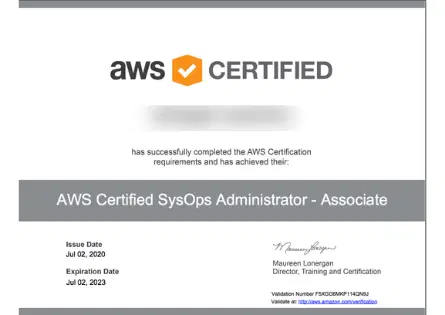
Exam Format - Objective Type, Multiple Choice
Exam Duration - 140 minutes
Passing Criteria - 65%
Certificate - Within 5 business days
Result - Immediately after the exam
Closed book