

CompTIA Security+ Training Course & Certification 2026
Trusted by 1000s of global organizations, NovelVista is the leading Accredited Training Organization (ATO) to conduct CompTIA Security+ Training & Certification Course.
- Industry Expert Trainers
- Online learning session
- Accredited Trainer
- Exam fee included

CompTIA Security+ Course Overview
What You Will Get?
Learning Outcome
After the completion of the course, the participants would be able to:
Training Calendar
English
- Self paced videos, assessments, recall quizzes, more
- For more details, reach us at training@novelvista.com
Includes Training, Exam & Certification
Lifetime Access
- Self paced videos, assessments, recall quizzes, more
- For more details, reach us at training@novelvista.com
Includes Training, Exam & Certification
Course Curriculum
Chapter 01 - Risk Management+
- Introduction
- The CIA of Security Threat Actors What is Risk Managing Risk
- Using Guides for Risk Assessment Security Controls
- Interesting Security Controls Defense in Depth
- IT Security Governance Security Policies Frameworks
- Quantitative Risk Calculations Business Impact Analysis Organizing Data
- Security Training
- Third-Party Agreements
Chapter 02 - Cryptography+
- Cryptography Basics Cryptographic Methods Symmetric Cryptosystems Symmetric Block Modes RSA Cryptosystems
- Diffie-Hellman PGP GPG
- Hashing HMAC
- Steganography Certificates and Trust Public Key Infrastructure Cryptographic Attacks
- Identification Authorization Concepts Access Control List Password Security Linux File Permissions
- Windows File Permissions User Account Management AAA
- Authentication Methods Single Sign-On
Chapter 03 - Identity and Access Management+
- Identification
- Authorization Concepts
- Access Control List
- Password Security
- Linux File Permissions
- Windows File Permissions
- User Account Management
- AAA
- Authentication Methods
- Single Sign-On
Chapter 04 - Tools of the Trade+
- OS Utilities
- OS Utility ipconfig
- Network Scanners
- Protocol Analyzers
- SNMP
- Logs
Chapter 05 - Securing Individual Systems+
- Denial of Service
- Host Threats
- Man in the Middle
- System Resiliency
- RAID
- NAS and SAN
- Physical Hardening
- RFI, EMI, and ESD
- Host Hardening
- Data and System Security
- Disk Encryption
- Hardware Firmware Security
- Secure OS Types
- Securing Peripherals
- Malware
- Analyzing Output
- IDS and IPS
- Automation Strategies
- Data Destruction
Chapter 06 - The Basic LAN+
- LAN Review
- Network Topologies Review
- Network Zone Review
- Network Access Controls
- The Network Firewall
- Proxy Servers Honeypots
- Virtual Private Networks IPSec
- NIDS NIPS SIEM
Chapter 07 - Beyond the Basic LAN+
- Wireless Review
- Living in Open Networks
- Vulnerabilities with Wireless Access Points
- Cracking WEP
- Cracking WPA
- Cracking WPS
- Wireless Hardening
- Wireless Access Points
- Virtualization Basics
- Virtual Security Containers
- IaaS PaaS SaaS
- Deployment Models Static Hosts
- Mobile Connectivity
- Deploying Mobile Devices
- Mobile Enforcement
- Mobile Device Management
- Physical Controls
- HVAC
- Fire Suppression
Chapter 08 - Secure+
- Secure Applications and Protocols Network Models
- Know Your Protocols
- TCP IP Know Your Protocols
- Applications Transport
- Layer Security
- Internet Service Hardening
- Protecting Your Servers
- Secure Code Development
- Secure Deployment Concepts
- Code Quality and Testing
Chapter 09 - Testing Your Infrastructure+
- Vulnerability Scanning Tools
- Vulnerability Scanning Assessment
- Social Engineering Principles
- Social Engineering Attacks
- Attacking Web Sites
- Attacking Applications
- Exploiting a Target
- Vulnerability Impact
Chapter 10 - Dealing with Incidents+
- Incident Response
- Digital Forensics
- Contingency
- Planning Backups
Course Details
What Will I Learn+
- Secure networks and applications
- Perform threat analysis
- Risk Management
- Cryptography
- Identity and Access Management
- LAN
- Secure Protocols
- Vulnerability Scanning Assessment
- Incident Response
Eligibility+
- System Administrator
- Security Administrator
- Security Specialist
- Security Engineer
- Network Administrator
- Junior IT Auditor
- Penetration Tester
- Security Consultant
Prerequisites+
Training Delivery Style+
This CompTIA Security+ Certification focuses on experimential learning. The material of this course is divided into 60-90 minutes of interactive sessions. Not only this, if you are participating, expect yourself to get indulged with interesting group activities. By this, you will get a chance to put the theory into action. This training will be nothing like any ordinary training you imagine. We follow a vast range of creative methodology which will allow you to wrack your grey matter and boost your energy up to participate.
The key features of our training program would be:
- Training sessions in a storytelling format
- Exhibition of concepts with the help of professional examples
- Self-analysis and group discussions
- Case studies as the application of the concepts which were taught
- Vibrant presentations along with individual and team activities
- Post-training reading suggestions
Faculty+
Key Benefits+
- Hands-on practical skills, ensuring the security professional is better prepared to problem solve a wider variety of issues.
- The latest trends and techniques in risk management, risk mitigation, threat management, and intrusion detection.
CompTIA Security+ Exam Format
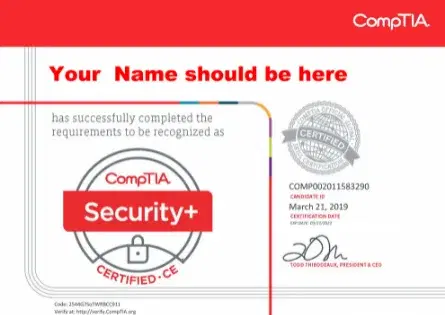
Exam Format - Objective Type, Multiple Choice
Exam Duration - 90 minutes
No. of Questions - 90 (multiple-choice questions)
Passing Criteria - 750 (on a scale of 100-900)
Certificate - Within 5 business days
Result - Immediately after the exam
Closed book