

Certified Generative AI in Cybersecurity Training Course for Professionals
This Generative AI Cybersecurity Certification Course by NovelVista is designed to help professionals build practical expertise in AI-driven threat detection, automated defense, security analytics, and modern cyber risk management. This Generative AI Cybersecurity Course helps you apply Generative AI in Cybersecurity through real-world use cases, hands-on learning, and future-ready security practices.
- Industry Expert Trainers
- Online learning session
- Interactive Sessions
- Exam fee included

Generative AI For Cybersecurity Certification Overview
The Generative AI Cybersecurity Certification is designed to help professionals build practical expertise in AI-powered security operations, threat intelligence, and automated defense strategies. This Generative AI Cybersecurity Training focuses on how modern organizations use artificial intelligence to strengthen detection, response, and cyber resilience.
This Generative AI Cybersecurity Course covers key areas such as Generative AI foundations, cybersecurity fundamentals, GANs, VAEs, reinforcement learning, ethical AI practices, threat detection, security automation, adversarial defense, and Agentic AI applications. Through this Generative AI in Cybersecurity program, learners gain the ability to apply advanced AI techniques to real security challenges with confidence.
Delivered by NovelVista, this Generative AI Cybersecurity Certification follows a practical learning approach with hands-on exercises, case studies, labs, and implementation-focused learning. By completing this program, professionals will be prepared to contribute confidently to SOC teams, security engineering, threat intelligence, and AI-driven cybersecurity initiatives while advancing their careers.

What You Will Get?
Learning Outcome of AI Cybersecurity Certification
After the completion of the course, the participants would be able to:
Training Calendar
English
- Self paced videos, assessments, recall quizzes, more
- For more details, reach us at training@novelvista.com
Includes Training, Exam & Certification
Lifetime Access
- Self paced videos, assessments, recall quizzes, more
- For more details, reach us at training@novelvista.com
Includes Training, Exam & Certification
Course Curriculum Of Generative AI in Cybersecurity
This Generative AI Cybersecurity Course is designed to help you build practical expertise in AI-powered defense, threat intelligence, security automation, and future-ready cyber operations.
Module 1: The Foundation of Generative AI+
Build a strong understanding of core generative models and their cybersecurity relevance.
- Exploring the Basics of Generative AI: Learn core Generative AI concepts, capabilities, workflows, and how intelligent systems create content, patterns, and security insights effectively.
- Types of Generative Models: Understand different model types, including transformers, GANs, VAEs, diffusion models, and their practical cybersecurity applications.
- Ethical Dimensions in AI and Cybersecurity: Learn how fairness, accountability, transparency, misuse prevention, and responsible deployment shape trustworthy AI security solutions.
Module 2: Cybersecurity Fundamentals+
Learn essential cybersecurity principles strengthened through AI-powered approaches.
- Grasping the Essentials of Cybersecurity: Learn confidentiality, integrity, availability, common threats, vulnerabilities, controls, and defense strategies used in modern organizations.
- AI's Role in Enhancing Cybersecurity: Understand how AI improves detection speed, alert triage, analytics, automation, and proactive security operations efficiency.
- Legal and Regulatory Frameworks in Cybersecurity: Learn key compliance concepts, privacy laws, governance expectations, and regulatory requirements affecting cybersecurity programs globally.
Module 3: The Power of Generative Adversarial Networks (GANs)+
Build knowledge of GAN models used in advanced cyber analytics.
- GAN Architecture and Its Key Components: Learn generator and discriminator models, training dynamics, and how GAN architectures produce realistic synthetic outputs.
- Training GANs for Data Generation: Understand how GANs learn data patterns to create synthetic datasets useful for security testing.
- Leveraging GANs for Anomaly Detection: Learn how GAN-based models identify unusual behaviors, suspicious patterns, and hidden anomalies within security environments.
- Advanced GAN Variants for Cybersecurity Applications: Explore StyleGAN, CycleGAN, and specialized variants supporting simulation, detection, and cyber defense innovation.
Module 4: Variational Autoencoders (VAEs) in Action+
Learn how VAEs support reconstruction, anomaly detection, and behavior modeling.
- Understanding VAE Architecture and Latent Space: Learn encoder-decoder structures, latent variables, and how VAEs represent meaningful hidden data patterns efficiently.
- VAEs for Data Reconstruction and Anomaly Detection: Understand how reconstruction errors reveal unusual activity, threats, and abnormal user or system behaviors.
- Integrating VAEs with Other AI Techniques: Learn how VAEs combine with classifiers, clustering, and deep learning for stronger security outcomes.
- VAE Applications in Threat Detection: Explore how VAEs support behavior analytics, anomaly monitoring, and suspicious activity identification effectively.
Module 5: Deep Reinforcement Learning in the Cybersecurity Context+
Learn how intelligent agents improve dynamic defense and automated response strategies.
- Core Principles of Reinforcement Learning: Learn agents, environments, rewards, policies, exploration, and optimization concepts used in adaptive decision-making systems.
- Applying Reinforcement Learning to Intrusion Detection: Understand how reinforcement learning improves detection accuracy, response timing, and adaptive defense against evolving threats.
- Challenges and Constraints in RL for Cybersecurity: Learn data limitations, reward design issues, false positives, safety risks, and deployment complexities in security environments.
- RL for Dynamic Attack Simulation: Explore how reinforcement learning simulates attacker behavior and strengthens defensive readiness through realistic scenarios.
- Automated Defense Systems with RL: Understand how RL-driven systems automate containment, prioritization, and response decisions during security incidents.
Module 6: Security and Ethical Considerations in AI and Cybersecurity+
Build awareness of responsible AI use, privacy, and adversarial resilience.
- Tackling AI Biases in Cybersecurity: Learn how biased data or models can create unfair, inaccurate, or ineffective security outcomes.
- Adversarial Attacks and Defenses: Understand how attackers manipulate AI systems and how defensive methods reduce model exploitation risks.
- Privacy Implications and Data Protection: Learn how sensitive data handling, minimization, and governance support trustworthy AI deployments securely.
- AI Governance in Cybersecurity: Explore policies, accountability models, controls, and regulatory frameworks guiding AI-based security solutions responsibly.
Module 7: Use Cases with Generative AI Tools and Hands-on Demos+
Learn practical business and cybersecurity use cases powered by Generative AI tools.
- AI-Enhanced Presentations, Images, and Charts: Learn how AI tools create visuals, presentations, and analytical charts for business and security communication needs.
- Automated Data Insights and Decision Support: Understand how AI transforms raw data into insights that support smarter operational and security decisions.
- Document Summarization with AI: Learn how AI condenses lengthy reports, alerts, and policies into concise, actionable summaries efficiently.
- Personalized Recommendation Systems: Explore AI assistants that deliver contextual recommendations using internal documents and enterprise knowledge sources.
- Content Generation with Prompt Engineering: Understand how prompts guide AI to create audio, video, images, and security-focused content outputs.
Module 8: Agentic AI Is the Next Step in Generative AI Evolution+
Explore autonomous AI systems transforming future cybersecurity operations.
- What Is Agentic Artificial Intelligence: Learn how Agentic AI uses goals, reasoning, planning, and autonomous actions to complete complex tasks.
- Generative AI vs Agentic AI: Understand differences between content-generating systems and autonomous agents capable of decision-making workflows.
- How Agentic AI Performs Tasks: Learn how agents observe environments, choose actions, execute workflows, and refine outputs continuously.
- Agentic AI for Threat Surveillance: Explore how autonomous agents monitor threats, correlate signals, and identify suspicious patterns proactively.
- Agentic AI in Incident Response and Security Orchestration: Understand how agents automate triage, containment, investigation, and coordinated security response actions.
Course Details
What Will You Get?+
This Generative AI Cybersecurity Certification provides a complete, practical learning experience designed to help you build AI-powered security expertise and achieve certification with confidence.
- Engaging digital learning videos
- Access to expert-led live sessions and case studies
- Downloadable resources and reference templates
- AI-powered capstone project experience
- Practice exams and mock tests
- Certification exam voucher
- Two exam attempts
- Hands-on labs and real-world scenarios
- Interview practice platform access
- Globally recognized certification
Eligibility+
This Generative AI Cybersecurity Certification is designed for professionals who want to build expertise in AI-powered security operations, threat detection, and cyber defense innovation.
- Cybersecurity analysts and SOC professionals
- Security engineers and incident response teams
- Threat intelligence and risk management professionals
- IT professionals transitioning into cybersecurity roles
- AI and machine learning enthusiasts interested in security use cases
- Developers working on secure AI solutions
- Students and fresh graduates interested in cybersecurity careers
- Anyone looking to build a career in Generative AI in Cybersecurity
Pre-requisites+
There are no strict mandatory requirements for this Generative AI Cybersecurity Course. However, having basic knowledge will help you learn more effectively.
- A basic understanding of cybersecurity concepts is helpful
- Familiarity with IT systems, networks, or security tools is beneficial
- Basic awareness of AI or machine learning concepts is an advantage
- Basic analytical and problem-solving skills
- Interest in AI-driven cybersecurity and emerging technologies
Training Delivery Style+
This Generative AI Cybersecurity Training is delivered in a flexible self-paced format, allowing you to learn at your own pace and convenience.
- Fully self-paced online learning
- Anytime, anywhere access
- Structured digital learning modules
- On-demand expert-led video sessions
- Daily live expert sessions access
- Practice tests and mock exams
- AI-powered labs, tools, and capstone projects
- Downloadable resources and templates
- Interview practice platform access
- Lifetime access to course content
Benefits of This Course+
This Generative AI Cybersecurity Certification helps you build future-ready security skills, apply AI-driven defense strategies, and strengthen your career in modern cybersecurity roles.
- Build Strong AI Security Foundations: Learn core concepts of Generative AI, cybersecurity principles, and how both domains work together effectively.
- Apply Generative AI in Cybersecurity: Gain practical knowledge of using AI for threat detection, security analytics, and automated defense workflows.
- Improve Threat Detection Capabilities: Learn how advanced models identify anomalies, suspicious patterns, and evolving cyber threats faster.
- Understand GANs, VAEs, and Reinforcement Learning: Build expertise in modern AI techniques used for security intelligence and adaptive defense strategies.
- Strengthen Security Automation Skills: Learn how AI improves alert triage, response prioritization, orchestration, and repetitive security tasks.
- Gain Ethical and Governance Awareness: Understand privacy, responsible AI use, bias reduction, and regulatory expectations in cybersecurity environments.
- Explore Agentic AI for Security Operations: Learn how autonomous AI agents support surveillance, incident response, and proactive risk management.
- Hands-On Practical Learning: Build confidence through labs, demos, case studies, capstone projects, and real-world scenarios.
- Increase Career Opportunities: Strengthen your professional profile for roles in SOC, security engineering, AI security, and threat intelligence teams.
- Earn a Globally Recognized Certification: Validate your expertise with a certification that demonstrates practical Generative AI cybersecurity knowledge.
Generative AI in Cybersecurity Exam Format
Exam Format - Objective Type, Multiple Choice
Exam Duration - 90 Minutes
No. of Questions - 40 (multiple-choice questions)
Passing Marks- 26 out of 40 (65%)
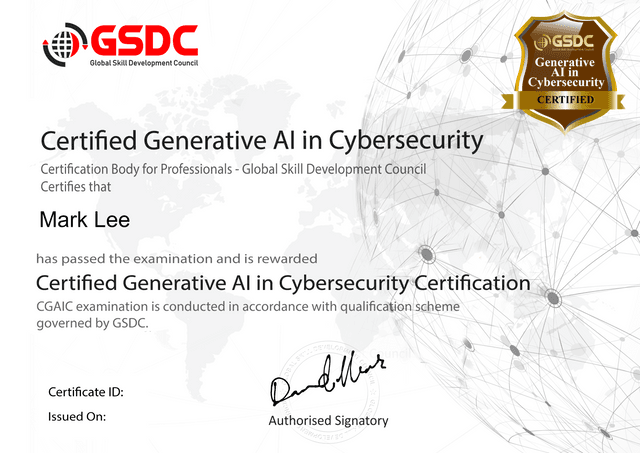
Certificate - Within 5 business days
Result - Immediately after the exam
Complimentary Retake - Yes
Close Book