Category | DevOps
Last Updated On 07/03/2026
Speed and security rarely move at the same pace in software development. Teams push for faster releases, while security teams worry about vulnerabilities and compliance gaps. That’s exactly where the discussion of DevSecops vs Agile becomes important.
Both approaches are widely used in modern development environments, but they serve different purposes. Agile focuses on delivering software quickly through iterative development, while DevSecOps ensures security is embedded throughout the development lifecycle. Understanding DevSecOps vs. Agile Development helps organizations balance speed, reliability, and security.
This guide explains the DevSecops vs Agile approach, their key differences, benefits, and how organizations use them together to build secure and scalable software systems.
TL;DR – DevSecOps vs Agile Overview
Area |
Agile |
DevSecOps |
|---|---|---|
Primary Focus |
Rapid development and customer feedback |
Secure and compliant software delivery |
Development Style |
Iterative sprint cycles |
Automated security integrated into pipelines |
Security Approach |
Often added after developme |
Built into development from the beginning |
Team Collaboration |
Developers, testers, product teams |
Developers, security teams, operation |
Best Use Case |
Rapid product development |
Secure and regulated environments |
Most modern organizations combine both approaches. Agile accelerates development while DevSecOps ensures that speed does not compromise security.
Software delivery expectations have changed dramatically. Businesses now release updates frequently, sometimes multiple times per day. Agile development made this possible by introducing short development cycles, continuous feedback, and collaborative teams.
However, rapid delivery created a new challenge, security vulnerabilities appearing later in the development process.
This is where DevSecops vs Agile becomes relevant.
Agile focuses on speed and adaptability. DevSecOps adds another layer by integrating security practices directly into the development workflow. When organizations understand the difference between Agile vs DevSecops, they can design development environments that deliver both fast releases and secure applications.
Agile is a project management and software development methodology designed to deliver value quickly through iterative development.
Instead of long development cycles, Agile breaks work into smaller increments called sprints, usually lasting two to four weeks.
During each sprint, teams build and deliver small pieces of working software. Several frameworks support Agile development, including:
Scrum
Kanban
Lean software development
These frameworks help teams organize work, prioritize tasks, and deliver features regularly.
Core Principles of Agile
Agile development is built on several key principles.
Continuous Feedback: Teams gather feedback from users and stakeholders regularly to improve the product.
Rapid Iteration: Development cycles are short, allowing teams to adapt quickly to changing requirements.
Cross-Functional Collaboration: Developers, testers, designers, and product owners work closely together.
Customer Value Focus: The primary goal is delivering features that create real value for users.
These principles make Agile ideal for environments where requirements change frequently. When discussing DevSecOps vs. Agile Development, Agile represents the methodology that prioritizes speed, flexibility, and user-focused development.
During Agile training sessions with product teams, most organizations report sprint cycles between 2–3 weeks, which consistently improves stakeholder feedback loops and shortens feature validation timelines.
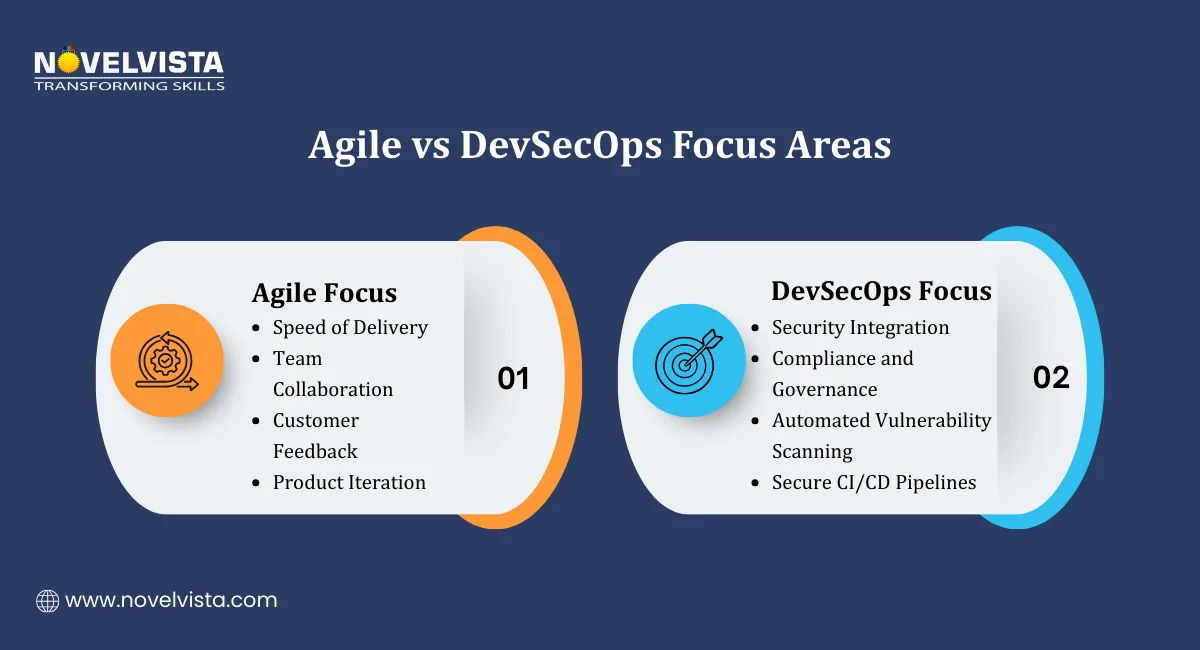
DevSecOps builds on DevOps principles by integrating security into every stage of the software development lifecycle.
Instead of adding security checks after development, DevSecOps applies a shift-left security approach. This means security testing begins early during development rather than at the end. Security tasks become part of the automated development pipeline.
Typical DevSecOps workflows include automated security scans such as:
Static code analysis
Dependency vulnerability scanning
Container security checks
Infrastructure security validation
By automating these tasks, DevSecOps ensures security checks occur continuously without slowing down development.
Key Principles of DevSecOps
DevSecOps focuses on several important practices.
Security Integration: Security becomes part of the development workflow rather than a separate stage.
Automation: Security tests run automatically within CI/CD pipelines.
Shared Responsibility: Security is not only the responsibility of security teams. Developers and operations teams also contribute.
Continuous Monitoring: Applications are monitored for vulnerabilities even after deployment.
Because of these practices, DevSecOps vs. Agile Development highlights a shift in how organizations approach security in modern software pipelines.
DevSecOps ensures applications remain secure while still supporting rapid release cycles.
Although both approaches support modern software delivery, their focus areas differ. Understanding the DevSecops vs Agile comparison helps organizations choose the right strategy for their development environment.
Aspect |
Agile |
DevSecOps |
|---|---|---|
Primary Goal |
Deliver value quickly |
Deliver secure and reliable software |
Security Integration |
Often handled later in development |
Built directly into development pipelines |
Scope |
Development and testing |
Development, security, and operations |
Workflow |
Sprint-based development cycles |
Continuous automation and security validation |
In simple terms:
This distinction explains why many organizations no longer see Agile vs DevSecops as competing approaches.
Across enterprise training engagements, most organizations adopt Agile for sprint management while introducing DevSecOps controls within pipelines, especially when preparing teams for regulated environment deployments.
Also Read: The core difference between DevOps and DevSecOps
Understanding DevSecops vs Agile becomes easier when we compare the strengths and limitations of both approaches. Each method solves a different problem in the development lifecycle.
Agile Advantages
Agile became popular because it helped teams deliver software faster and respond to changing requirements.
Key advantages include:
Faster delivery cycles: Agile breaks development into short sprints, allowing teams to release updates frequently.
High flexibility: Teams can quickly adjust priorities based on user feedback or market changes.
Strong collaboration: Agile encourages continuous communication between developers, testers, product owners, and stakeholders.
Customer-focused development: Regular feedback ensures the product evolves according to user needs.
These advantages make Agile effective for dynamic projects where requirements change frequently.
Agile Limitations
Despite its benefits, Agile does have some limitations.
Common challenges include:
Security is often addressed later: Security checks may occur after development phases, increasing vulnerability risks.
Hidden vulnerabilities: If security testing is delayed, vulnerabilities can remain unnoticed until late stages.
Compliance gaps: Agile alone may not provide the structured governance required for regulated environments.
These limitations are one reason organizations explore DevSecOps vs. Agile Development to strengthen security practices.
DevSecOps Advantages
DevSecOps addresses many of the security challenges found in traditional development models.
Key advantages include:
Early vulnerability detection: Security scans occur early in the development pipeline.
Automated security testing: Tools automatically analyze code and infrastructure for vulnerabilities.
Improved compliance and governance: DevSecOps helps organizations meet regulatory requirements more consistently.
Continuous monitoring: Security checks continue even after applications are deployed.
These benefits make DevSecOps especially valuable for organizations handling sensitive data.
DevSecOps Challenges
Although DevSecOps improves security, it also introduces new challenges.
Common challenges include:
Additional tools and processes: Implementing DevSecOps often requires new automation tools and security integrations.
Higher implementation complexity: Teams must redesign pipelines to include automated security checks.
Skill gaps: Developers may need training to understand security testing and vulnerability management.
This challenges highlights why many organizations combine Agile vs DevSecops practices instead of relying on Agile alone.
Organizations often ask when to choose Agile and when to adopt DevSecOps. The answer depends on the project type, industry requirements, and risk level.
When Agile Works Best
Agile works well for projects focused on rapid innovation and frequent feedback.
Examples include:
Startups building early-stage products
Low-risk applications such as internal tools
Consumer apps requiring rapid feature development
Products driven by user feedback
In these environments, development speed is often the top priority.
When DevSecOps Is Essential
DevSecOps becomes important when applications handle sensitive data or operate in regulated industries.
Examples include:
Financial systems requiring strict compliance
Healthcare platforms managing patient data
Government applications with high security requirements
Enterprise systems operating at a large scale
In these situations, security must be integrated directly into development pipelines. In regulated industry workshops, particularly with finance and healthcare teams, security validation checkpoints are typically mapped directly to sprint workflows to ensure audit readiness during every release cycle.
Curious why many experts now prefer this approach? Read our blog on Why Experts Are Saying DevSecOps Works Better and what it means for modern development teams.
Learn how to integrate security into Agile sprints and CI/CD pipelines with
practical DevSecOps workflows, automated testing stages, and secure coding checklists.
In modern software environments, organizations rarely choose between Agile and DevSecOps.
Instead, DevSecOps builds on Agile principles.
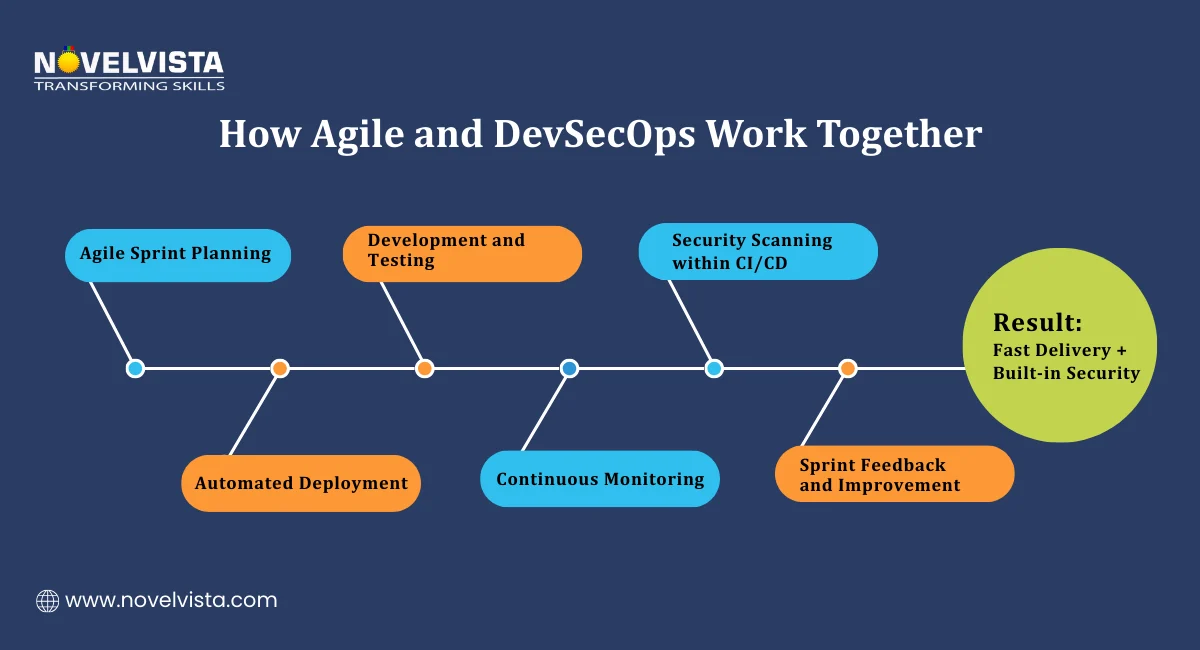
Agile manages development workflows through sprint cycles, while DevSecOps introduces automated security practices within those cycles. This integration helps development teams maintain speed while strengthening security.
Typical integrations include:
Security Testing During Sprints
Security tasks can be included as part of sprint planning and development activities.
Examples include:
Secure coding practices
Static code analysis
Security review checkpoints
Automated Security in CI/CD Pipelines
DevSecOps introduces automated security testing into CI/CD pipelines.
These pipelines can run:
Dependency vulnerability scans
Container security checks
Infrastructure configuration validation
Automation ensures security testing does not slow development workflows.
Continuous Monitoring After Deployment
DevSecOps also extends security beyond development.
Applications are monitored continuously for:
New vulnerabilities
Misconfigurations
Threat activity
By embedding security into Agile workflows, organizations achieve both speed and protection. This combination demonstrates how DevSecOps vs. Agile Development is not about choosing one approach over the other.
Organizations that combine both methodologies report measurable improvements in development and security outcomes.
Benefits include:
Automated testing allows teams to release updates quickly while ensuring vulnerabilities are detected early.
Continuous scanning helps identify security issues before they reach production environments.
DevSecOps encourages collaboration between development, operations, and security teams.
Automated testing and monitoring improve overall system stability. Research highlights the benefits of this integrated approach.
According to the Cloudaware Survey 2026, teams adopting DevSecOps alongside Agile report 40% fewer software vulnerabilities.
This improvement demonstrates the real value of combining both practices. Organizations no longer view Agile vs DevSecops as competing methodologies. Instead, they use Agile to accelerate development and DevSecOps to secure the entire lifecycle.
The discussion around DevSecops vs Agile often creates the impression that organizations must choose between speed and security. In reality, both approaches serve different but complementary purposes.
Agile enables rapid development and continuous user feedback, helping teams deliver value quickly. DevSecOps ensures that security, compliance, and reliability are embedded into every stage of development.
By combining both approaches, organizations create development environments that support innovation while protecting applications from security risks.
This integrated approach allows teams to build secure, scalable, and reliable software systems.

Next Step: Build Your DevSecOps and Agile Skills
If you want to build expertise in modern software delivery practices, NovelVista offers both DevSecOps Engineering Certification Training and Agile Scrum Master Certification Training. These programs help professionals understand secure development pipelines, automation, Agile workflows, and team collaboration practices. With hands-on learning and real-world scenarios, the training prepares professionals to implement DevSecOps and Agile methodologies effectively in modern software development environments.
Author Details

Course Related To This blog
Certified DevOps Engineer
Certified DevOps Developer
Confused About Certification?
Get Free Consultation Call
Stay ahead of the curve by tapping into the latest emerging trends and transforming your subscription into a powerful resource. Maximize every feature, unlock exclusive benefits, and ensure you're always one step ahead in your journey to success.