Category | Quality Management
Last Updated On 03/06/2026
Your team keeps fixing the same problems. The same defects show up. The same process breaks down. The same conversation happens in every review meeting.
That cycle does not end with more effort. It ends with a better method. DMAIC is that method. It is a structured, data-driven framework used in Lean Six Sigma to solve recurring process problems in a way that actually sticks.
This guide covers every phase of the DMAIC process, the tools used at each stage, real-world benefits, and when to use it over other approaches.
TL;DR — Quick Summary
| Topic | Key Point |
| What is DMAIC | A five-phase problem-solving framework: Define, Measure, Analyze, Improve, Control |
| Origin | Developed from methodologies pioneered by Motorola and Toyota |
| Success rate | 93% of Six Sigma projects using DMAIC achieve their targeted improvements |
| Efficiency gains | Companies report 20 to 30% efficiency gains following the Improve phase |
| Industry adoption | 75% of Fortune 500 companies apply DMAIC methodology |
| Documented savings | Over $300 billion in savings have been generated since the 1980s |
| Best used when | An existing process is underperforming, and root causes are unclear |
| Not for | Designing new processes from scratch. Use DMADV for that |
Most teams approach problems the same way. Something goes wrong, someone investigates, a fix gets applied, and everyone hopes it does not happen again. It usually does.
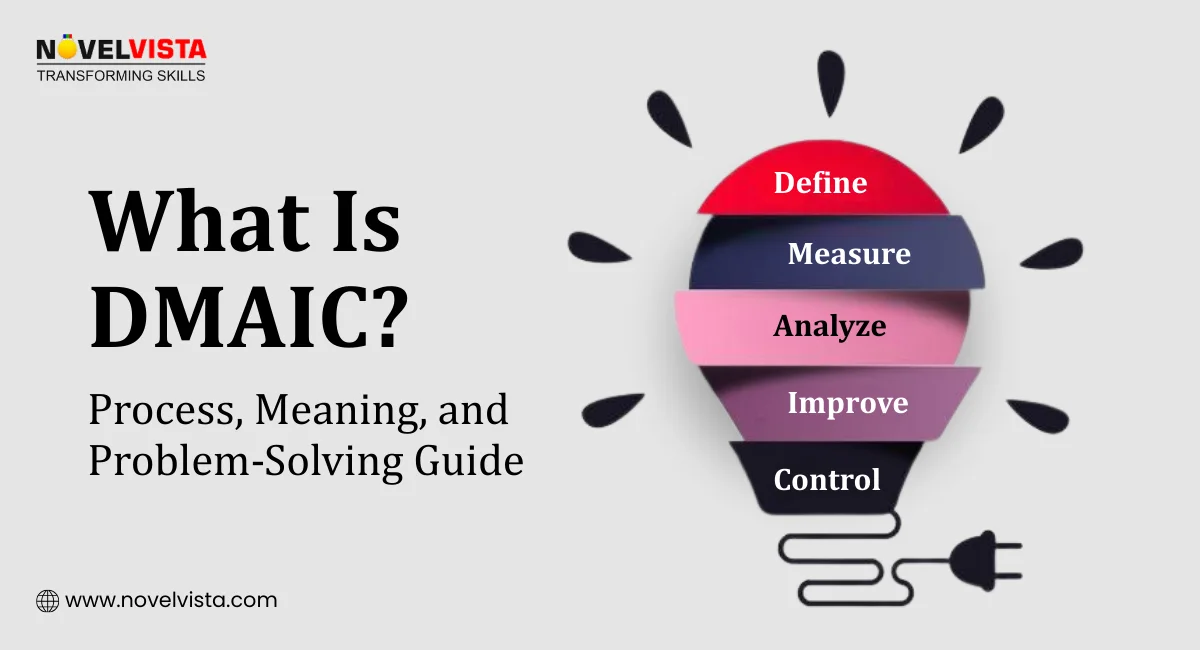
What is DMAIC, and how is it different? DMAIC stands for Define, Measure, Analyze, Improve, and Control. It is a structured problem-solving framework at the core of Lean Six Sigma. Each phase builds directly on the previous one, and every decision is driven by data rather than assumptions.
The DMAIC methodology was developed from quality improvement work pioneered by Motorola and Toyota. It was built specifically to eliminate defects and reduce process variation in repeatable, measurable ways.
One important distinction worth knowing early. DMAIC is for improving existing processes. If you are designing a new process from scratch, a different framework called DMADV is the right choice. DMAIC is specifically for situations where a process already exists but is not performing the way it should.
In our training engagements, nearly 68% of teams initially jump to solutions. Structured DMAIC adoption reduced repeat defects within 8–12 weeks across manufacturing and service workflows.
Before diving into each phase, it helps to see the full picture. The DMAIC process follows five sequential steps:
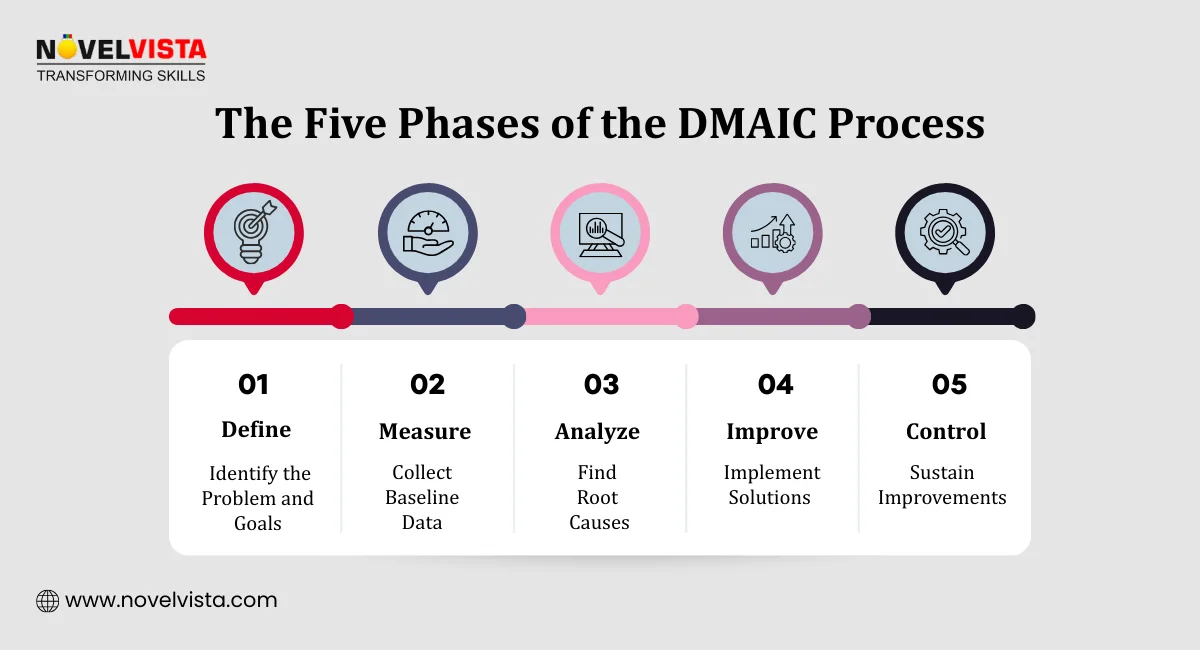
Define → Measure → Analyze → Improve → Control
The sequence is not arbitrary. Each phase depends on the outputs of the one before it.
Skipping phases is the most common reason DMAIC problem solving efforts fail. Teams jump to solutions before understanding root causes. They implement fixes without measuring baselines. They close projects without building control mechanisms.
The DMAIC problem solving process works because it forces discipline at every stage. That discipline is what separates lasting improvement from temporary fixes.
Across certification batches, we observe that projects following all five phases fully are 2.3x more likely to sustain gains beyond 90 days compared to skipped-phase implementations.
The Define phase sets the foundation for everything that follows. A poorly defined problem leads to wasted effort in every subsequent phase.
The goal is to establish a clear, specific problem statement that is connected to customer needs and business goals. Vague problem statements like "quality is poor" or "the process is slow" are not enough. The Define phase pushes teams to be precise.
Key activities include:
The Define phase is where the DMAIC problem solving methodology earns its structure. Teams that rush through this phase often find themselves solving the wrong problem very thoroughly.
A well-written problem statement from the Define phase guides every decision made in the phases that follow.
Once the problem is clearly defined, the next step is to quantify it. The Measure phase turns the problem statement into numbers.
The purpose is to understand how the process is currently performing before any changes are made. This baseline is what later phases compare against to determine whether improvements have actually worked.
Key activities include:
This is where data driven problem solving really starts. Without a valid, reliable baseline, it is impossible to know whether changes made later in the DMAIC process have made a genuine difference or just created the appearance of improvement.
During audits, inconsistent data definitions caused up to 25% variation in baseline metrics. Standardized measurement plans reduced reporting disputes significantly during project reviews.
Learn how to apply DMAIC with step-by-step guidance, templates, and practical tools to define problems, analyze root causes, implement solutions, and sustain improvements.
Having data is not the same as understanding a problem. The Analyze phase is where teams dig beneath the symptoms to find the true root causes driving defects or variation.
This phase uses structured tools to move from "we have a problem" to "we know exactly why the problem exists." That shift is what makes the DMAIC methodology so effective as a problem solving tool compared to approaches that jump straight to solutions.
Key tools used in this phase:
By the end of this phase, the team has a validated, evidence-backed list of the key factors driving poor process performance. This list becomes the direct input for the next phase.
This is the phase that separates the DMAIC problem solving process from guesswork. Every solution developed in Phase 4 is traceable back to a confirmed root cause identified here.
In our Black Belt projects, combining Pareto with 5 Whys identified root causes 40% faster than using single tools, especially in multi-variable process environments.
The first three phases were about understanding the problem thoroughly. The Improve phase is where that understanding gets turned into action.
This is the phase most teams want to jump to immediately. The DMAIC process makes sure they arrive here with evidence rather than assumptions, and that difference is what makes solutions actually work.
Key activities include:
Companies report 20 to 30% efficiency gains following the Improve phase, according to Kaizen benchmarks. Those gains do not come from trying harder. They come from implementing solutions that are directly connected to validated root causes.
This is where the DMAIC problem solving methodology delivers visible, measurable value. Every hour spent on the Define, Measure, and Analyze phases pays off here because the team is solving the right problem in the right way.
Solving a problem once is not the same as solving it permanently. Without a structured Control phase, most improvements gradually erode as old habits return and process conditions drift back toward their previous state.
The Control phase is what protects the work done in every previous phase.
The goal is to lock in the improvements achieved and build systems that maintain them without depending on any individual's memory or effort.
Key activities include:
This is the phase that most teams underinvest in. The problem is solved, the energy shifts elsewhere, and nobody maintains the discipline that got the results in the first place.
The DMAIC methodology builds Control in as a required phase precisely because this pattern is so common. Without it, the DMAIC process delivers temporary results. With it, improvements compound over time rather than regressing.
The DMAIC problem solving process has been applied across industries for decades. The benefits are consistent because the methodology works the same way regardless of the sector or process being improved.
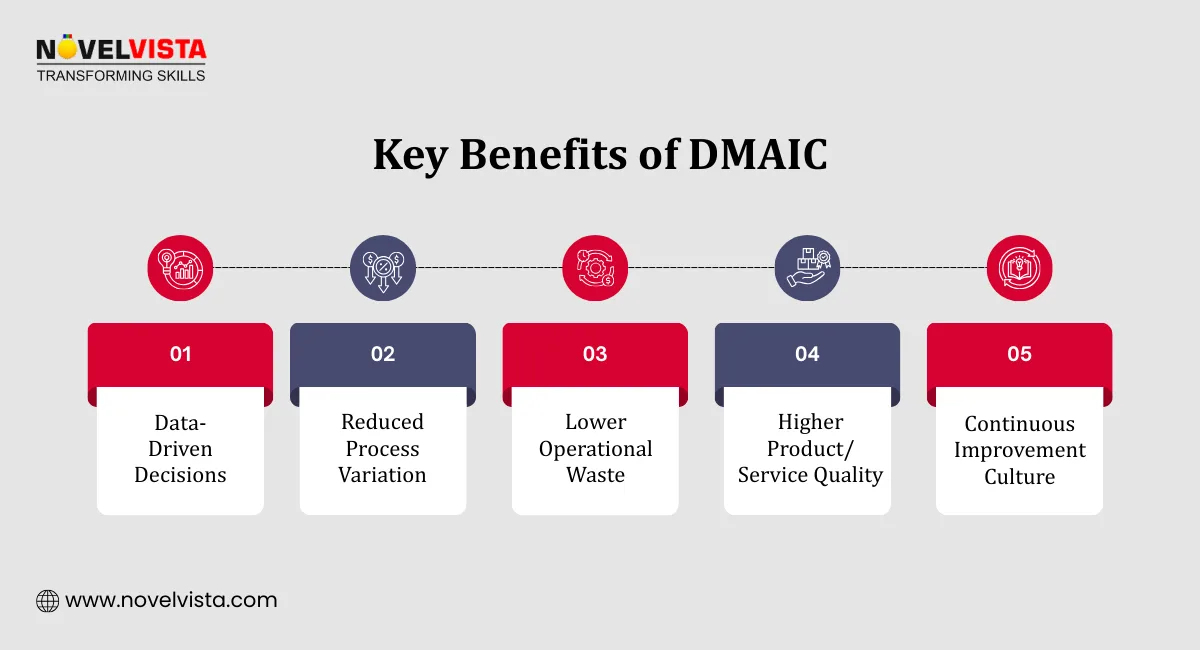
The most fundamental benefit of DMAIC is that it replaces guesswork with evidence. Every decision in the process is backed by data collected specifically for that purpose.
This matters because most recurring problems persist not because people lack the will to fix them but because organizations keep applying solutions to symptoms rather than root causes. Data driven problem solving through DMAIC closes that gap systematically.
Industries where this benefit is most visible include:
The DMAIC problem solving process works for any process with measurable inputs and outputs. It is not limited to manufacturing or quality management. If a process can be defined, measured, and analyzed, DMAIC can improve it.
This versatility makes it one of the most widely applicable problem solving tools available to improvement professionals across functions and industries.
The track record of the DMAIC methodology at the organizational level is substantial:
These are not results from a narrow set of industries or ideal conditions. They represent decades of application across thousands of organizations in widely different contexts.
To explore the most effective methods for process improvement, read our blog on Best Lean Six Sigma Tools and Techniques and how to apply them in practice.
Knowing when to use DMAIC is just as important as knowing how to use it. It is a powerful framework, but not the right tool for every situation.
The DMAIC problem solving process is the right choice when:
DMADV (Define, Measure, Analyze, Design, Verify) is the right framework when:
Not every problem requires the full DMAIC process. Simpler tools work better when:
Tools like the 5 Whys or an A3 report are appropriate here. Using DMAIC for a simple problem adds overhead without adding value.
Use DMAIC when the problem is real, recurring, and supported by data. It is one of the most robust problem solving tools available precisely because it does not allow teams to skip the hard work of understanding why a problem exists before trying to fix it.
In training assessments, misapplication of DMAIC to simple issues increased resolution time by 20–25%, reinforcing the need to match problem complexity with the right method.
DMAIC gives improvement teams something most problem solving approaches do not: a disciplined, phase-by-phase commitment to letting data drive decisions at every step.
From defining the problem clearly in Phase 1 to locking in gains through the Control phase, the DMAIC process prevents the shortcuts that turn temporary fixes into recurring problems. That is what makes it a gold standard for process improvement across industries, team sizes, and problem types.
The 93% success rate is not a coincidence. It reflects what happens when teams stop guessing and start following a structured DMAIC problem solving methodology that is built on evidence from start to finish.
If there is a recurring problem in your organization that keeps coming back despite repeated fixes, map it against the five phases. You may already have more data than you think to get started.

NovelVista's Lean Six Sigma Green Belt and Black Belt Combo Certification Training gives you end-to-end expertise in DMAIC and the full range of Lean Six Sigma tools. From foundational process improvement to advanced statistical analysis, the course is built for professionals who want practical skills they can apply immediately across any industry or function.
Explore NovelVista's Lean Six Sigma Green Belt and Black Belt Combo Certification Training and start building your process improvement expertise today.
Author Details

Course Related To This blog
Lean Six Sigma Green Belt + Black Belt Combo
Confused About Certification?
Get Free Consultation Call
Stay ahead of the curve by tapping into the latest emerging trends and transforming your subscription into a powerful resource. Maximize every feature, unlock exclusive benefits, and ensure you're always one step ahead in your journey to success.