Category | IT Service Management
Last Updated On 02/02/2026
One system crash. One delayed service request. One missed SLA.
These moments can feel like failures, but what if they were your biggest opportunities to grow?
That’s the heart of Continual Service Improvement (CSI) in ITIL. It’s not just about fixing what’s broken; it’s about constantly evolving how your IT services deliver value. Through the lens of ITIL Continual Service Improvement, every setback becomes a lesson, every issue becomes a step toward better performance, and every improvement strengthens your organization’s resilience.
In this blog, we’ll break down how CSI works, explore the 7 Steps of Continual Service Improvement, understand the PDCA model, look at real Continual Service Improvement examples, and see how businesses turn day-to-day IT challenges into lasting progress.
In ITIL, Continual Service Improvement is the heartbeat of ongoing growth. It ensures that IT services stay aligned with business needs while becoming more efficient and reliable over time.
Think of CSI as your “always-on” improvement engine. It doesn’t wait for major failures or annual reviews; it continuously looks for ways to enhance performance, reduce waste, and boost customer satisfaction.
Organizations that follow ITIL Continual Service Improvement don’t see downtime or incidents as setbacks; they see them as signals for change. The goal is to transform insights from real operations into measurable improvements that keep your services ahead of expectations.
So, instead of asking “What went wrong?”, CSI encourages teams to ask “What can we learn?” and that mindset is where real progress begins.
The Plan-Do-Check-Act (PDCA) cycle, also known as Deming’s Cycle, forms the backbone of Continual Service Improvement ITIL. It’s a simple yet powerful loop that keeps teams improving in a structured way.
Here’s how each stage helps build a culture of progress:
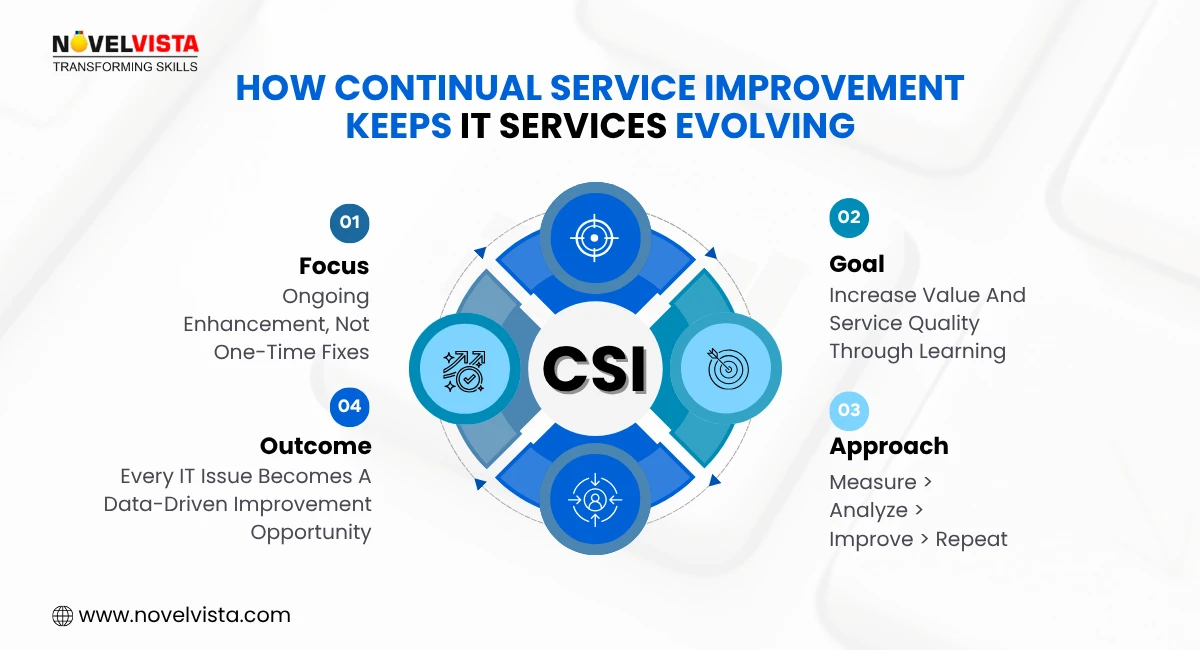
When combined with the 7 Steps of Continual Service Improvement, PDCA becomes the structure that helps teams turn insights into sustainable action.
This explanation of Continual Service Improvement is shaped by ITIL-certified trainers and service management consultants who have implemented CSI frameworks across global enterprises. Every concept, from PDCA to the 7 Steps of Continual Service Improvement, is drawn from proven ITIL 4 practices and verified implementation case studies.
The 7 Steps of Continual Service Improvement offer a structured way to manage and measure every improvement effort. Each step plays a role in ensuring that decisions are backed by data and improvements are clearly visible.
The 7 Steps and PDCA model outlined here follow ITIL 4 guidelines published by PeopleCert and globally recognized service management standards. By staying aligned with official ITIL publications, the content ensures that every best practice shared here reflects the latest industry framework and terminology.
Here’s how they work:
Following these 7 Steps of Continual Service Improvement builds a data-driven culture where actions are not based on guesses but on facts. It’s a methodical way to ensure that your IT improvements actually move the needle.
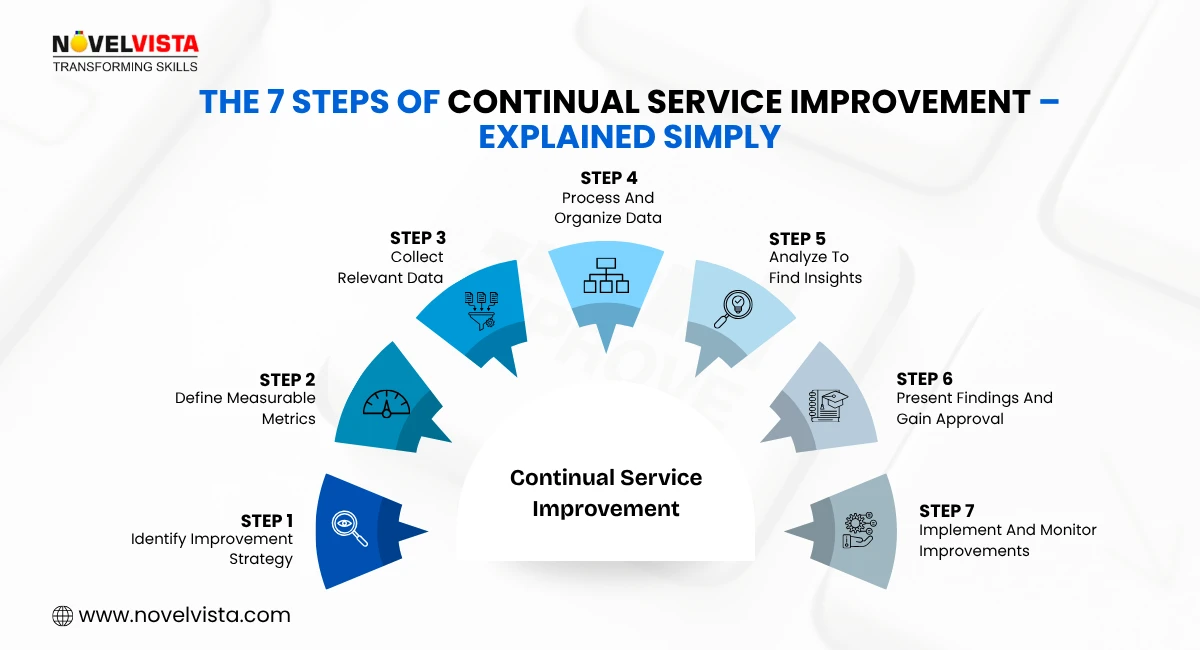
Each time your team completes this cycle, your organization becomes stronger, smarter, and more agile, because progress is now part of your everyday workflow.
Metrics make or break your Continual Service Improvement ITIL initiatives. Without the right KPIs, it’s impossible to tell if your efforts are paying off or not.
Effective KPIs for CSI track how well services are performing and how much value they bring to the business. Some common examples include:
These KPIs help teams stay focused on what really matters: improving service quality, maintaining reliability, and ensuring customer happiness.
When used correctly, KPIs act as a mirror reflecting how close you are to your improvement goals and how effectively your ITIL Continual Service Improvement plan is working.
Track what truly matters in service improvement.
Use this quick guide to measure, analyze, and improve IT performance with real ITIL-aligned KPIs.
For Continual Service Improvement ITIL to truly succeed, everyone needs to know their role in the process. It’s not a one-person job; it’s teamwork with shared accountability.
Here’s how the main roles contribute to the cycle:
The magic happens when these roles collaborate seamlessly. Technical teams provide operational insights, business units define value, and leaders make sure improvements are supported with the right resources.
With everyone clear on their part, ITIL Continual Service Improvement stops being a theory; it becomes a living process that keeps your IT ecosystem evolving.
The real strength of Continual Service Improvement lies in how adaptable it is across industries. Let’s look at a few examples that show its power in action.
These Continual Service Improvement examples show that consistent progress doesn’t always come from major overhauls; it comes from steady, focused improvements driven by data and collaboration.
Implementing Continual Service Improvement ITIL isn’t always smooth sailing. Many organizations face challenges that slow down or derail their improvement efforts.
Here are a few common hurdles, and how to tackle them:
The best solution is building a CSI mindset, where improvement becomes part of your culture, not just an annual activity. When everyone understands the “why,” change becomes far easier to embrace.
You can’t manage what you can’t measure, and that’s where technology steps in. Modern ITSM tools are the backbone of successful Continual Service Improvement ITIL practices.
Here are some tools that help automate, track, and analyze your CSI efforts:
These platforms simplify the collection and analysis steps from the 7 Steps of Continual Service Improvement, making it easier for teams to act quickly and confidently.
Automation tools, real-time dashboards, and analytics engines help teams visualize trends, identify bottlenecks, and make smarter improvement decisions. That’s how technology becomes an enabler, not just a tracker, in your CSI journey.
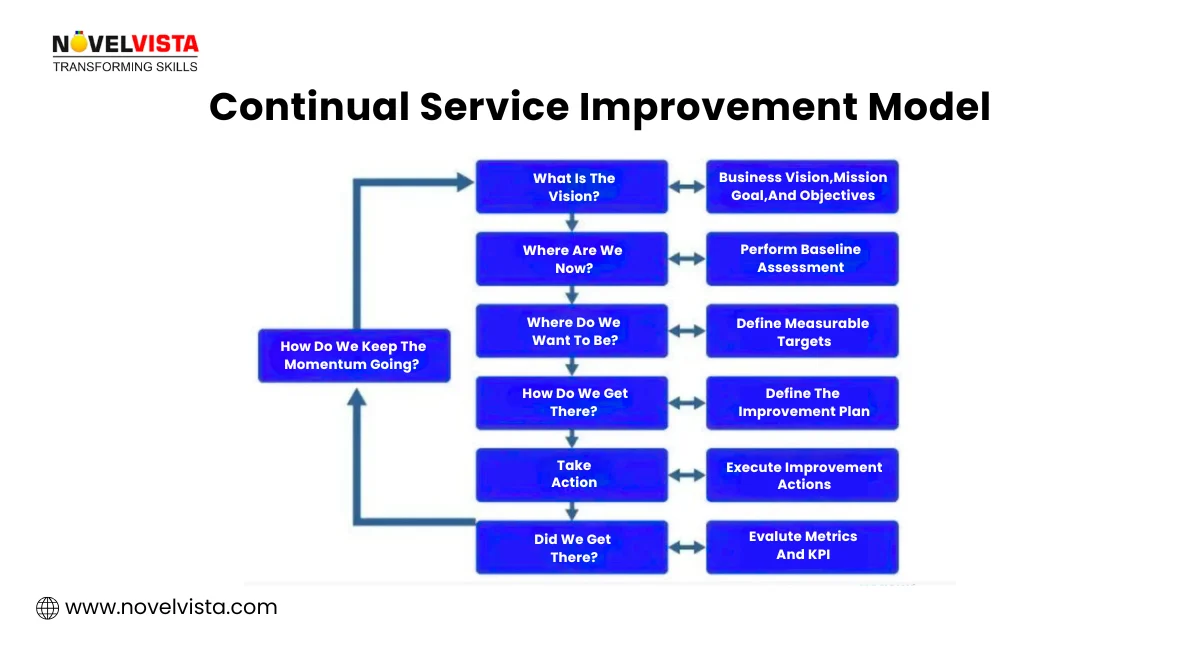
Picture the Continual Service Improvement model as a loop that never ends, combining the PDCA cycle and the 7 Steps of Continual Service Improvement into one powerful framework.
It starts with identifying what needs to improve, cycles through planning, execution, and measurement, and ends with new insights that fuel the next round of progress. This approach keeps improvement continuous, not reactive.
By aligning with business goals, the CSI model ensures that every enhancement delivers real value. Whether you’re improving service uptime, refining processes, or enhancing customer experience, this model helps you sustain quality improvement over time.
The key is flexibility; no two organizations are the same. Adapt the Continual Service Improvement ITIL model to your business structure, tools, and culture for maximum impact.
Continual Service Improvement isn’t a one-time project; it’s a mindset that keeps IT services evolving. Instead of treating issues as failures, it helps teams see them as opportunities to enhance performance and deliver more value. Through structured methods like the 7 Steps of Continual Service Improvement and the PDCA cycle, organizations learn to measure, analyze, and improve with purpose.
When applied consistently, ITIL Continual Service Improvement builds stronger alignment between IT and business goals, boosts service reliability, and nurtures a culture of learning. Over time, it turns every challenge into progress, making improvement a continuous part of how the organization operates.
Ready to apply the power of continual improvement to your IT career? Build your foundation with NovelVista’s ITIL 4 Foundation Certification Training, designed to help you master ITSM practices and understand how Continual Service Improvement (CSI) drives business success.
NovelVista is a PeopleCert-accredited ITIL training Partner that has helped thousands of professionals master ITSM and CSI implementation. Every concept shared here aligns with globally accepted ITIL 4 principles and real business use cases, ensuring reliability, transparency, and actionable learning for readers.
Learn from industry experts, gain hands-on insights, and prepare to lead service excellence initiatives confidently.
Author Details

Course Related To This blog
ITIL4 Specialist Monitor Support and Fulfil Certification
ITIL4 Specialist Acquiring & Managing Cloud Services
ITIL® 4 Strategic Leader Digital And IT Strategy (DITS)
ITIL® 4 Specialist High Velocity IT
ITIL® 4 Strategist Direct, Plan & Improve
ITIL® 4 Specialist Create Deliver & Support
ITIL® 4 Foundation Certification
Confused About Certification?
Get Free Consultation Call
Stay ahead of the curve by tapping into the latest emerging trends and transforming your subscription into a powerful resource. Maximize every feature, unlock exclusive benefits, and ensure you're always one step ahead in your journey to success.