Category | IT Service Management
Last Updated On 06/01/2026

Interviews today are no longer about just technical skills. Employers want professionals who understand how IT services are delivered, supported, and improved. That’s why ITIL Interview Questions have become common across support, operations, service management, and leadership roles.
This guide covers the top 10 ITIL Interview Questions with sample answers to help you prepare confidently, speak clearly, and show real-world ITSM understanding during your ITIL job interview.
Hiring managers look for candidates who can keep services stable while supporting business goals. ITIL provides that common language. When you understand ITIL concepts, you show that you can work with processes, teams, and customers, not just tools.
Knowing how to answer ITIL Interview Questions also shows that you can think beyond theory and apply ITIL in practical service environments.
New to ITIL or need a refresher? Read our blog on What Is ITIL to understand its practices, purpose, and how it helps organizations deliver better, more reliable IT services.
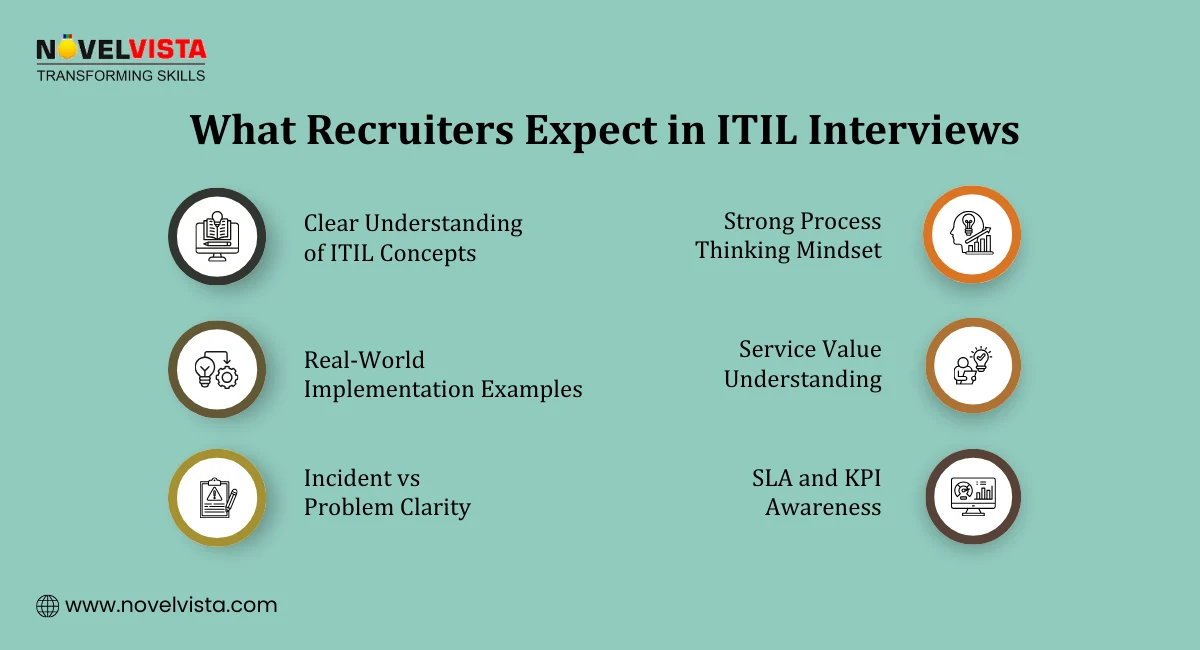
Before jumping into questions, it helps to know what interviewers are actually testing.
Recruiters usually look for:
Keeping this in mind helps you answer ITIL Interview Questions and Answers in a way that sounds practical and confident. From an instructor's perspective, recruiters don’t expect candidates to recite all 34 ITIL practices. What they expect is clarity, how incidents are handled, how changes are controlled, and how services improve over time. This is why ITIL training focuses heavily on practical application, not theory alone.
Why interviewers ask this:
They want to check if you understand ITIL basics and its real purpose in IT service management. In many ITIL interview preparation workshops, we see that this question decides the tone of the entire interview. Candidates who explain ITIL using service outcomes and business value rather than textbook language immediately stand out to recruiters.
Sample Answer
ITIL is a best-practice framework for IT service management that helps organizations deliver value through reliable and efficient IT services. It’s important because it aligns IT services with business needs, improves service quality, and supports continual improvement across IT operations.
Why interviewers ask this:
This checks whether you understand the evolution of ITIL and modern ITSM thinking.
Sample Answer
ITIL v3 focused on the service lifecycle with defined processes, while ITIL 4 focuses on value co-creation using practices and the Service Value System. ITIL 4 is more flexible and supports Agile, DevOps, and digital transformation better than ITIL v3.
Why interviewers ask this:
They want to test your understanding of ITIL 4 structure and value delivery.
Sample Answer
The Service Value System explains how all ITIL components work together to create value. It includes guiding principles, governance, practices, continual improvement, and the service value chain, which helps turn demand into value for customers.
Why interviewers ask this:
This checks your conceptual understanding and decision-making mindset.
Sample Answer
ITIL guiding principles are recommendations that guide organizations in all situations. Examples include focusing on value, starting where you are, progressing iteratively with feedback, collaborating, and keeping things simple and practical.
Why interviewers ask this:
Incident Management is a core practice and commonly discussed in every ITIL job interview.
Sample Answer
Incident Management focuses on restoring normal service operation as quickly as possible after an interruption. The goal is to minimize business impact, even if the root cause is not immediately fixed.
Why interviewers ask this:
They want to see if you understand operational clarity within ITSM.
Sample Answer
Incident Management restores service quickly, while Problem Management focuses on identifying and removing the root cause of incidents. Incident Management is reactive, whereas Problem Management is more proactive and long-term.
Why interviewers ask this:
Change Enablement is one of the most audited and discussed ITIL practices today. Organizations rely on it to balance speed and stability, especially in Agile and DevOps environments. Interviewers often use this question to test risk awareness and decision-making maturity. This question checks whether you understand modern change management and how ITIL 4 supports speed without increasing risk.
Sample Answer
Change Enablement in ITIL 4 ensures that changes are assessed, approved, and implemented in a controlled way. The goal is to maximize successful changes while reducing service disruption, delays, and risks to the business.
This question appears frequently in ITIL Interview Questions because change failures directly impact service stability.
Interviewers want to see how well you understand customer expectations and service value alignment.
Sample Answer
An SLA is a documented agreement between a service provider and a customer that defines service expectations, responsibilities, and performance targets. It helps ensure transparency, accountability, and consistent service delivery.
In an ITIL Job Interview, this answer shows that you understand both service performance and customer value.
Want to see how ITIL connects strategy, operations, and improvement? Read our blog on the ITIL Service Value Chain to understand how value flows across IT services end-to-end.
Why interviewers ask this:
This evaluates your understanding of how ITIL 4 delivers value from demand to outcomes.
Sample Answer
The Service Value Chain is the operating model of ITIL 4. It includes activities like plan, engage, design and transition, obtain/build, deliver and support, and improve, all working together to create value.
This concept is central to many ITIL Interview Questions and Answers in ITIL 4–focused roles.
Why interviewers ask this:
They want to test practical thinking and how ITIL fits into modern IT environments.
Sample Answer
ITIL practices support digital transformation by improving service reliability, enabling faster changes, supporting automation, and aligning IT services with evolving business needs. ITIL 4 also works well with Agile and DevOps approaches.
This question often separates theoretical knowledge from real-world understanding in an ITIL Job Interview.
Get access to real interview questions asked by top MNCs
ike IBM, Accenture, HP, Deloitte, and Capgemini.
Knowing answers is important, but how you present them matters just as much. These tips help explain how to crack ITIL Interview confidently.
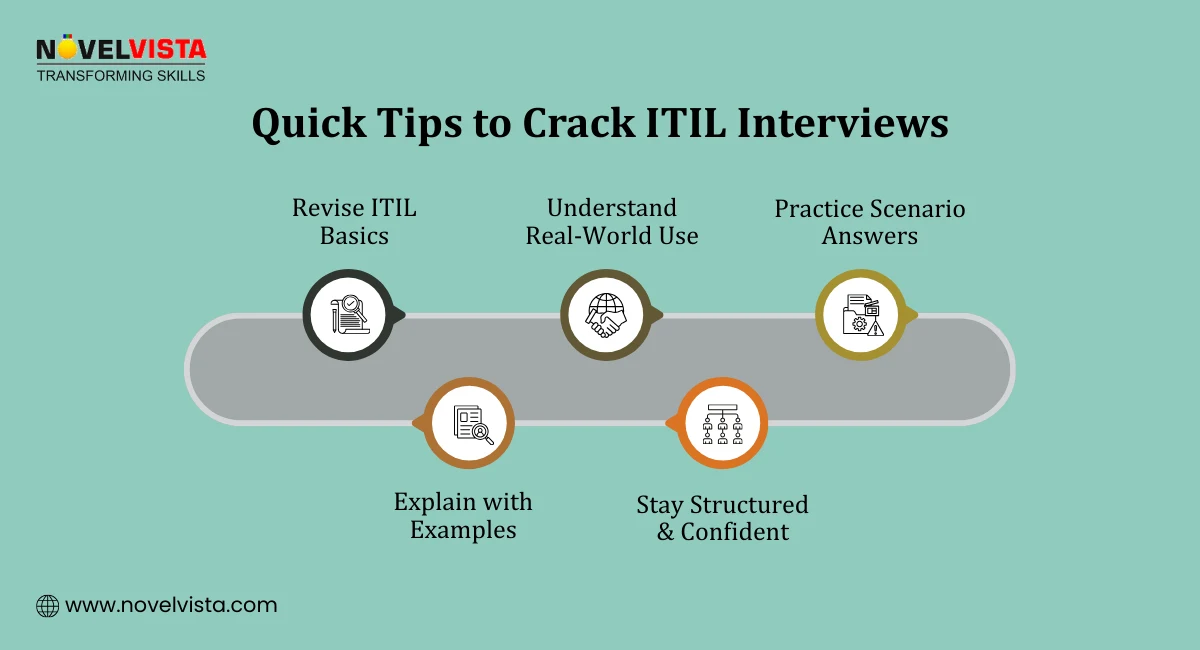
Following these tips will strengthen your confidence in answering ITIL Interview Questions naturally.
Preparing for ITIL Interview Questions is not about memorizing definitions. It’s about understanding how ITIL works in real service environments. When you combine ITIL structure, practical thinking, and clear communication, you stand out in any ITIL Job Interview.
These ITIL Interview Questions and Answers are designed to help you build that confidence. With the right preparation and mindset, knowing how to crack ITIL Interview becomes far simpler than it seems.
This guide reflects common interview patterns observed across global organizations that follow ITIL 4 practices. The answers shared here are aligned with how ITIL is applied in real service environments, not just how it appears in certification material.
Author Details

Course Related To This blog
ITIL4 Specialist Monitor Support and Fulfil Certification
ITIL4 Specialist Acquiring & Managing Cloud Services
ITIL 4 Specialist Sustainability in Digital & IT
ITIL® 4 Strategic Leader Digital And IT Strategy (DITS)
ITIL® 4 Specialist Drive Stakeholder Value
ITIL® 4 Specialist High Velocity IT
ITIL® 4 Strategist Direct, Plan & Improve
ITIL® 4 Specialist Create Deliver & Support
ITIL® 4 Foundation Certification
Confused About Certification?
Get Free Consultation Call
Stay ahead of the curve by tapping into the latest emerging trends and transforming your subscription into a powerful resource. Maximize every feature, unlock exclusive benefits, and ensure you're always one step ahead in your journey to success.