Category | IT Service Management
Last Updated On 02/02/2026
When teams deal with slow systems, security gaps, or sudden outages, the real issue usually traces back to weak IT Infrastructure Management. Most businesses depend on a mix of apps, cloud platforms, networks, and devices running at the same time. When even one part slips, the entire setup starts creating trouble. That’s why strong IT Infrastructure Management has become a basic need today. It keeps every layer of your tech environment stable, safe, and ready to support business growth.
In this blog, we’ll walk through how good management works, what it includes, and how to build an IT setup that runs smoothly without constant firefighting.
Think of IT Infrastructure Management as everything needed to keep your company’s technology running without problems. It covers hardware, operating systems, networks, cloud platforms, data storage, and enterprise apps.
This also includes essential parts such as:
The goal is simple: make sure all these pieces work together, stay healthy, and are ready to support business needs anytime. When this foundation is strong, it becomes easier to deliver stable and responsive services.
Modern IT teams rely on IT Infrastructure Management to avoid downtime and keep users happy. Here are the core pieces that hold everything together:
Keeping servers updated, patched, organized, and ready to handle load, whether on-prem or cloud.
Tracking how apps behave so issues like delays or errors are caught before users feel them.
Managing firewalls, routers, switches, VPNs, and connectivity between locations or cloud regions.
Handling virtual machines, containers, Kubernetes clusters, and SaaS platforms in different clouds.
Ensuring data safety through scheduled backups, quick recovery options, and secure storage rules.
A strong grip on these elements helps avoid hidden bottlenecks, improves performance, and keeps operations predictable. Without proper IT Infrastructure Management, these areas often work in silos and create more problems than solutions.
While infrastructure focuses on the foundation, IT Operation Management handles the daily work needed to keep things running well. This includes:
To support this, teams manage tasks like capacity planning, system tuning, asset lifecycle tasks, and incident response.
IT Operation Management makes sure the entire environment stays functional day after day, even when systems scale or business needs change. Good operations act like the heartbeat of the whole ecosystem.
This is where IT Operation Management ITIL brings real value. ITIL gives teams a clear structure to manage tasks in a predictable and repeatable way. It includes proven practices such as:
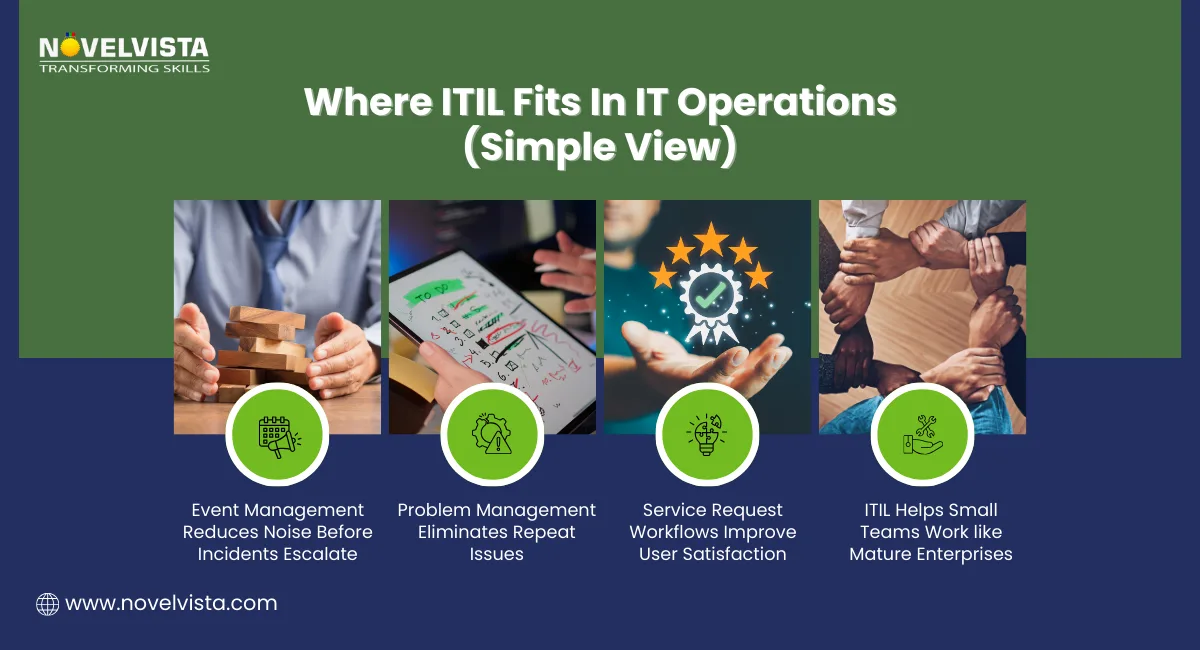
These practices are widely adopted across industries because they bring consistency to everyday work. Research from well-known ITSM studies highlights that teams using ITIL see better response times and fewer escalations.
With IT Operation Management ITIL, teams follow uniform steps instead of trying random fixes during pressure. This helps avoid confusion, reduces delays, and ensures every issue gets handled in the right order.
Cloud teams often struggle when every task depends on a different tool. A simple and connected setup gives better visibility and control. Most organizations rely on a mix of monitoring, automation, and service tools to keep their cloud stable.
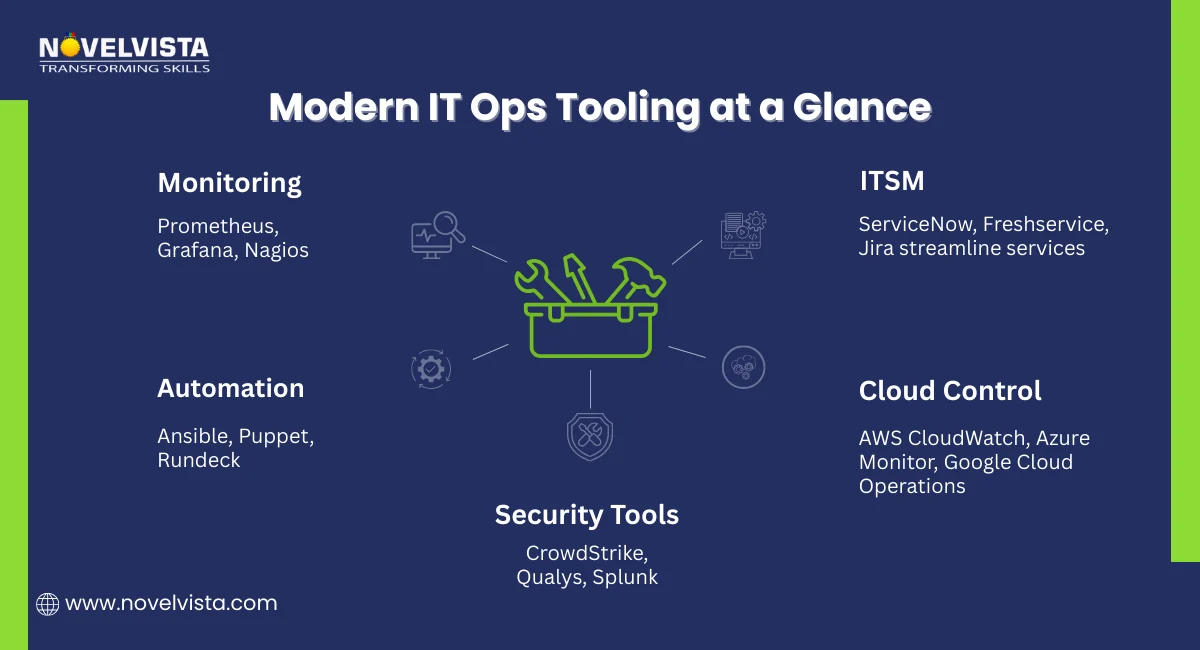
Here are the tools that usually fit well inside IT Infrastructure Management:
1. Cloud Monitoring Tools – AWS CloudWatch, Azure Monitor, Datadog
They track usage, performance, and unusual behaviour in real time.
2. Configuration & Deployment Tools – Terraform, Ansible, Jenkins
These tools help teams manage cloud resources the same way across all environments.
3. Log & Incident Tools – Splunk, ELK, ServiceNow
They help teams investigate issues faster and keep response steps simple.
4. IT Operation Management Software: ServiceNow, SolarWinds, Splunk, ManageEngine, and Datadog
These platforms bring together incidents, changes, automation, and reporting into one place.
These tools appear in most cloud and enterprise environments our learners and clients work with. When teams combine monitoring, logging, and automation platforms, the visibility improves instantly. This unified view helps reduce troubleshooting time and makes cloud operations far easier to manage.
Automation removes the need for manual checks and repeated work. It brings consistency, speed, and accuracy, especially when working with large or multi-cloud setups.
Areas where automation fits naturally:
Automation cuts daily noise and gives teams more time to plan, improve, and innovate.
Security becomes easier when it becomes a built-in part of IT Infrastructure Management instead of an afterthought. Cloud environments change quickly, and every new resource can open a gap if it’s not configured correctly.
Key areas teams focus on:
Cloud teams feel more confident when security is not a separate task but part of everyday operations.
Learn how to build a clean, stable, and stress-free
IT environment. Follow clear steps to manage servers,
networks, storage, and cloud without chaos.
Cost usually becomes a concern when cloud environments grow faster than expected. With a few simple habits, teams can control budgets without slowing the business.
Helpful steps include:
These habits turn cost control into a steady part of IT Infrastructure Management, not a last-minute panic exercise. Also, these steps reflect what successful cloud teams rely on to control budgets without affecting performance. Insights shared during training and case discussions show that straightforward habits like rightsizing and scheduling non-production systems often deliver better cost savings than advanced optimization projects.
A strong cloud setup works best when teams follow clear, simple habits. These practices help remove confusion and build consistency across workloads.
Small improvements add up to a more stable and predictable cloud environment.
Cloud environments become much easier to handle when teams follow a clear structure. That’s what IT Infrastructure Management brings to the table. It keeps daily work organized, reduces confusion, and helps teams respond faster when things break or change. With the right tools, simple practices, and support from IT Operation Management ITIL, cloud setups feel more predictable and far less stressful. As teams grow, this approach keeps everything steady without slowing progress.

If you want to grow in IT operations and handle modern infrastructure with more confidence, the ITIL 4 Foundation Certification Training by NovelVista is a solid place to begin. The program is beginner-friendly, packed with real examples, and helps you understand how ITIL fits into everyday work. It also prepares you for the global certification so you can move ahead in your IT career with ease.
Author Details

Course Related To This blog
ITIL4 Specialist Monitor Support and Fulfil Certification
ITIL4 Specialist Acquiring & Managing Cloud Services
ITIL 4 Specialist Sustainability in Digital & IT
ITIL® 4 Strategic Leader Digital And IT Strategy (DITS)
ITIL® 4 Specialist Drive Stakeholder Value
ITIL® 4 Specialist High Velocity IT
ITIL® 4 Specialist Create Deliver & Support
ITIL® 4 Foundation Certification
Confused About Certification?
Get Free Consultation Call
Stay ahead of the curve by tapping into the latest emerging trends and transforming your subscription into a powerful resource. Maximize every feature, unlock exclusive benefits, and ensure you're always one step ahead in your journey to success.