Category | IT Service Management
Last Updated On 13/07/2026
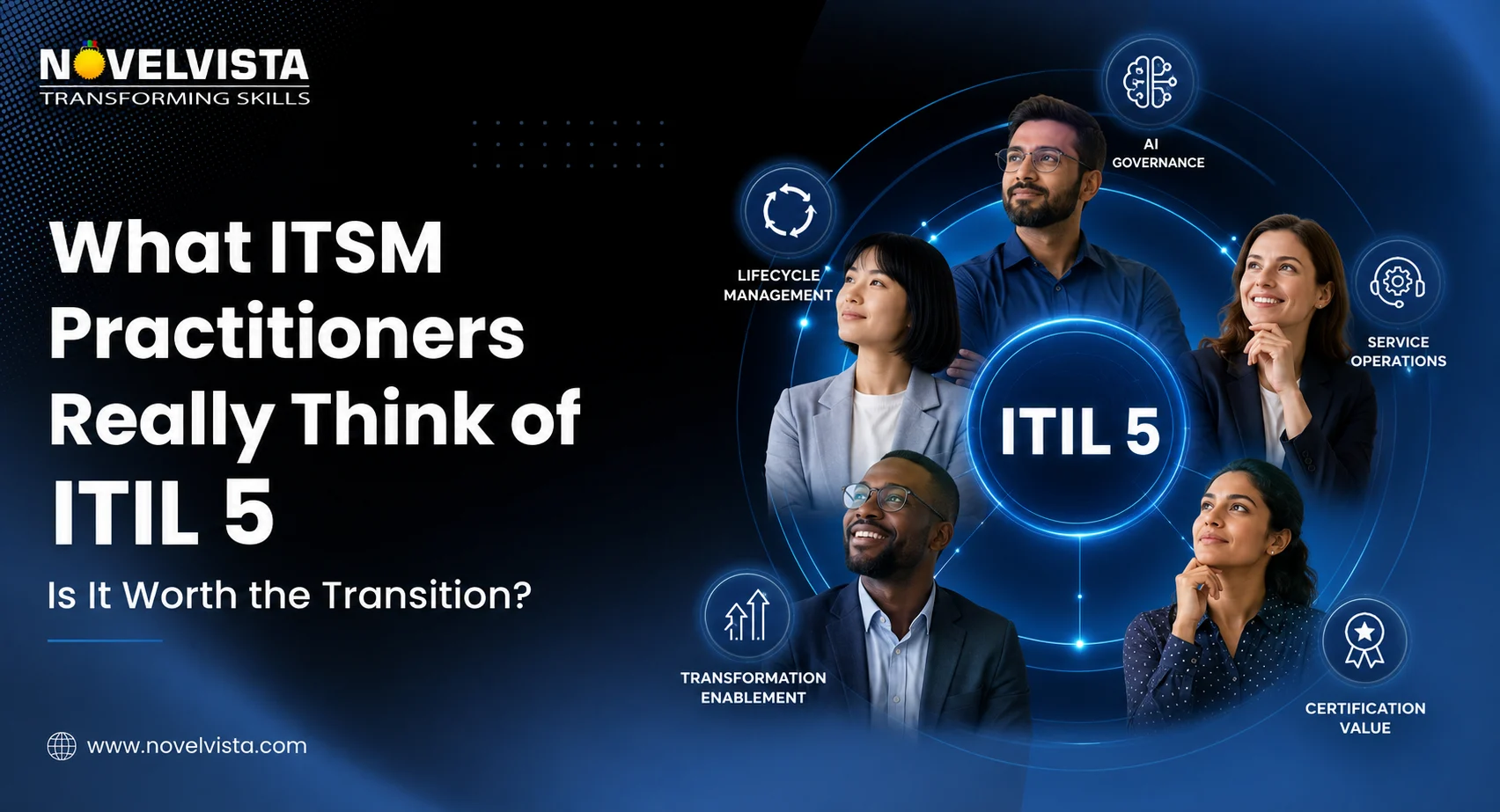
The arrival of ITIL 5 has created a mix of curiosity, optimism, and suspicion. Some practitioners see a timely update that brings product management, experience, transformation, and AI governance closer to daily service management. Others question whether the certification path, transition effort, and cost are justified. These ITIL 5 practitioner reviews examine what changed, what working professionals value, where they remain unconvinced, how the framework compares with ITIL 4, and who is most likely to benefit.
We evaluated five recurring perspectives against practical questions: Does the update make ITSM work easier to perform? Does it address real changes in digital product and service management? Can ITIL 4 professionals reuse existing knowledge? Is the learning effort proportionate to career or business value?
Practitioner reactions are interpreted alongside official framework information. PeopleCert and ITIL describe the intended structure and benefits. Community discussions reveal what professionals worry about before those benefits are proven inside their organizations.
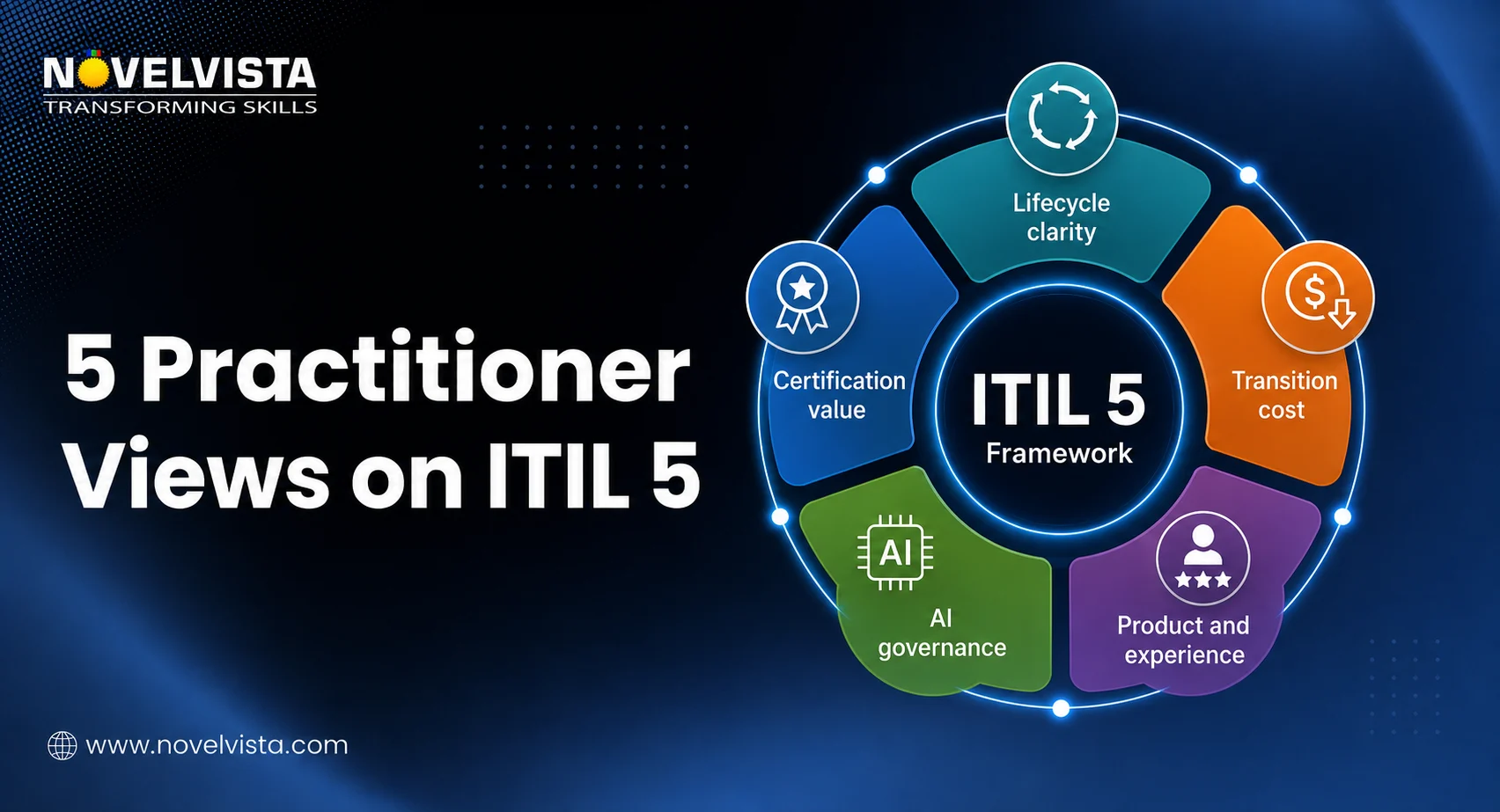
ITIL 5 retains value-focused thinking, guiding principles, practices, and a systems view of service management. The major change is emphasis. The framework presents digital products and services as connected parts of the same value system, with stronger lifecycle guidance.
Official ITIL materials position Version 5 as an AI-native framework for digital product and service management. The current structure includes Foundation and advanced modules such as Product, Service, Experience, Strategy, and Transformation. PeopleCert also provides a Foundation Bridge route for eligible ITIL 4 Foundation holders, so existing learners do not necessarily have to repeat everything.
The ITIL 5 Product Service Lifecycle is central to understanding the update. It connects strategy, product decisions, service delivery, experience, and continual improvement more directly than a service-only interpretation would.
The first perspective is broadly positive. A framework may be logically sound yet difficult for teams to translate into daily work. ITIL 4 improved flexibility, but many learners still found the relationships among value streams, practices, products, services, and governance difficult to explain consistently.
ITIL 5 makes those relationships more explicit. The Product module covers unified value streams, roadmaps, design, build, transition, operational readiness, and cross-team collaboration. The Service module addresses resilient services, service relationships, service levels, reliability, and outcomes. Transformation also has a central role across designations.
Consider a digital banking app. Product teams own roadmap decisions, developers handle releases, service teams manage reliability, and experience teams track customer friction. Customers experience one outcome, even when internal ownership is fragmented. A shared lifecycle can make handoffs, measures, and accountability easier to discuss.
The positive verdict is not that ITIL 5 reinvents management. It may simply be easier to apply because the lifecycle better reflects how digital services are built and operated. Clearer terminology creates value only when teams also change decisions, roles, measures, and collaboration habits.
The second perspective comes from professionals who have already invested in ITIL 4. Their first question is whether they must pay again to remain credible.
That concern is reasonable. Certification costs can include training, official materials, exams, retakes, membership, and time away from work. For someone who completed ITIL 4 recently, an immediate upgrade may deliver limited value if employers have not changed role requirements.
PeopleCert's Foundation Bridge updates existing ITIL 4 Foundation holders without making them repeat previously covered content. A Managing Professional Transition route is also available to specified experienced credential holders, including ITIL 4 Managing Professionals and Masters.
Timing matters. A service manager moving into product leadership may have a reason to transition early. A support analyst whose employer still uses ITIL 4 terminology may gain more by applying current knowledge first. The ITIL 5 Transition Guide can help candidates compare routes instead of assuming everyone needs the same upgrade.
Many ITIL 5 opinions are therefore more nuanced than simple approval or rejection. Learning the updated guidance and purchasing a new credential do not always need to happen together.
The third perspective matters to ITSM leaders working with DevOps, product management, customer experience, platform engineering, and transformation teams.
Service management language can create a boundary between the people who build a product and those who operate the service around it. Yet customers do not care which team owns the application backlog, cloud platform, support queue, supplier relationship, or service-level target.
ITIL 5 gives Product and Experience greater visibility. Official materials describe Product as a way to manage digital products as unified value streams and align roadmaps with strategy. Experience is part of the Managing Professional pathway alongside Product, Service, and Transformation.
This can improve trade-off decisions. A product team may want faster feature delivery, a service team may prioritize stability, and an experience team may identify customer frustration that neither release velocity nor uptime explains.
The risk is duplication. Organizations already use Agile methods, SRE practices, customer journey tools, and governance processes. ITIL 5 will help only if it connects those activities without creating overlapping roles, extra meetings, or another reporting layer.
Service teams already use AI for ticket classification, knowledge retrieval, incident correlation, virtual agents, coding support, forecasting, and automation. The management challenge is how to control it without blocking useful experimentation.
Official ITIL content frames Version 5 as AI-native and emphasizes governance, trust, responsible scaling, ownership, and measurable impact. It also argues that AI-enabled products should be managed within the wider product and service lifecycle rather than as isolated pilots.
Practitioners will judge this guidance by the questions it helps answer:
This perspective is cautiously optimistic. AI governance belongs in modern ITSM, but principles alone are insufficient. Teams need decision rights, escalation paths, evidence requirements, and examples that work in real operating environments.
The fifth perspective is openly skeptical. Community discussions question certification complexity, the cost of maintaining credentials, and whether a new version was necessary while ITIL 4 remains established. Other practitioners welcome the stronger product, experience, transformation, and AI focus. The supplied Reddit discussion contains both reactions, which is more useful than pretending the community has reached one conclusion.
The strongest criticism is that certification can become disconnected from implementation. A professional may pass an exam without improving incident outcomes, customer experience, product decisions, or change success. An organization may train employees without changing authority, incentives, tooling, or measures.
ITIL 5 should therefore be evaluated in two ways:
Someone can find the framework useful and still decide that immediate certification is poor value. A new entrant may reach the opposite conclusion because Foundation provides structure and recognized terminology.
The skeptical verdict is simple: case studies, employer demand, course quality, and operational improvements will matter more than launch messaging.
Several points unite the positive, cautious, and skeptical positions.
Among ITSM professionals, ITIL 5 will have different value for a service desk analyst, product owner, transformation lead, consultant, and AI governance specialist. A role-based decision is more credible than a universal recommendation.
• Master the core ITSM and ITIL concepts in one practical guide.
• Learn best practices to improve service delivery and operational efficiency.
• Build the knowledge needed to support modern, business-driven IT.
The ITIL 5 vs ITIL 4 practitioner experience is likely to feel familiar at Foundation level but broader in application. The value focus remains, while product, experience, AI, and transformation receive more visible positions.
| Decision area | ITIL 4 practitioner experience | Expected ITIL 5 practitioner experience |
|---|---|---|
| Primary orientation | Service management and value co-creation | Integrated digital product and service management |
| Lifecycle view | Service Value System and Service Value Chain | More explicit product and service lifecycle |
| Product management | Compatible, but less central | Directly represented through dedicated guidance |
| Experience | Addressed across value and relationship concepts | More visible through a dedicated module |
| AI | Limited by the publication period | Embedded across current guidance and governance |
| Transformation | Distributed across modules and practices | Elevated through a dedicated module |
| Transition effort | Established learning ecosystem | Selective updating rather than automatic restarting |
| Market recognition | Mature and widely understood | Growing with adoption |
For a deeper structural comparison, see ITIL 4 vs ITIL 5.
The answer depends on your role, existing credentials, and next career step.
| Professional profile | Likely value | Recommended action |
|---|---|---|
| New ITSM learner | High | Pursue Foundation |
| IT professional with no ITIL credential | High if service or digital operations are relevant | Learn the current framework |
| Recent ITIL 4 Foundation holder | Moderate and timing-dependent | Compare the bridge route with employer needs |
| ITIL 4 Managing Professional or Master | Potentially high for leadership or consulting | Evaluate the transition pathway |
| Service desk or operations analyst | Moderate | Prioritize practical role value |
| Product or digital service leader | High | Consider role-relevant advanced modules |
| AI governance, risk, or automation professional | Potentially high | Review role alignment |
| Organization planning a major rollout | High with sponsorship | Pilot before scaling |
| Professional whose employer does not recognize ITIL | Low to moderate | Confirm demand before paying |
So, is ITIL 5 worth it for everyone? No. It is most compelling when the new emphasis maps directly to decisions you make at work.
Waiting can be sensible when:
The answer becomes conditional: ITIL 5 can be worthwhile when it solves a capability or career problem, but not when it only updates a badge.
Before choosing a provider or booking an exam, verify:
Review the ITIL 5 Exam Syllabus before paying. Your previous ITIL experience also matters: experienced candidates may need targeted updating, while beginners may benefit from a complete Foundation journey.
Taken together, these ITIL 5 practitioner reviews support a balanced conclusion. The framework addresses real changes in how organizations design, build, operate, govern, and improve digital products and services. Product management, experience, transformation, and AI governance are relevant additions. Continuity with ITIL 4 also means previous learning has not become useless.
Relevance, however, does not justify every certification purchase. Existing practitioners should compare transition options, employer demand, role requirements, and practical outcomes. New entrants have a clearer case for starting with the current version. Product leaders, service owners, transformation professionals, consultants, and AI governance specialists may gain earlier value than people whose work remains narrowly operational.
The most credible ITIL 5 opinions avoid both extremes. ITIL 5 is neither a guaranteed career breakthrough nor merely a commercial relaunch. Its value depends on whether the guidance improves decisions, collaboration, resilience, experience, and measurable outcomes.
For ITSM professionals ITIL 5 offers the strongest return when training is connected to a defined responsibility or career goal. NovelVista's ITIL 5 Foundation Certification provides a structured route to understand the updated framework, prepare for the exam, and connect its concepts with practical digital product and service management.
The final verdict from these ITIL 5 practitioner reviews is conditional but positive: learn what changed, compare it with your role, and invest when the framework supports work you are expected to perform.
Author Details

Course Related To This blog
ITIL4 Specialist Monitor Support and Fulfil Certification
ITIL 4 Specialist Sustainability in Digital & IT
ITIL® 4 Strategic Leader Digital And IT Strategy (DITS)
ITIL® 4 Specialist High Velocity IT
ITIL® 4 Specialist Create Deliver & Support
ITIL® Practitioner
ITIL® Intermediate Service Strategy
ITIL® Intermediate Service Design
ITIL® 4 Foundation Certification
ITIL V5 Foundation
Confused About Certification?
Get Free Consultation Call
Stay ahead of the curve by tapping into the latest emerging trends and transforming your subscription into a powerful resource. Maximize every feature, unlock exclusive benefits, and ensure you're always one step ahead in your journey to success.