Category | IT Service Management
Last Updated On 22/07/2026
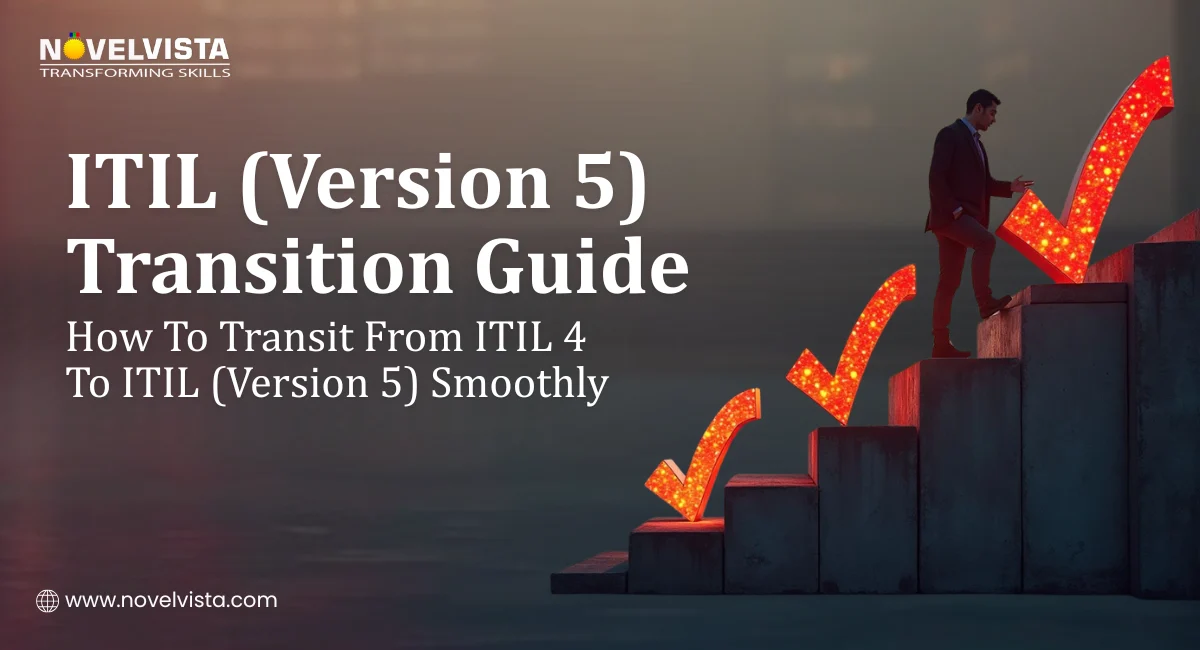
The release of ITIL (Version 5) has triggered a familiar concern among professionals who are already certified. The questions are simple, but the anxiety behind them is real.
These doubts don’t come from a lack of interest. They come from experience. Many professionals have already invested years in ITIL v3 or ITIL 4 and don’t want to see that effort erased.
The reality is calmer than the noise around it. ITIL (Version 5) is not a reset. It is designed to respect existing certifications and real-world experience. The framework has evolved to match how service management is practiced today, but it does not discard what came before.
The aim is not speed. It is understanding.
ITIL 5 builds on ITIL v3 and ITIL 4 rather than replacing them. Existing certifications remain valid, and the transition is handled through defined entry points and short transition modules. What you study next depends entirely on your current qualification.
This phased rollout allows professionals to plan training and exams without repeating earlier learning or rushing into unnecessary certifications.
ITIL 5 follows a clear and thoughtful approach when it comes to transition. Instead of forcing everyone to restart, it builds on what professionals already know.
At a high level, the ITIL (Version 5) transition is guided by three ideas:
This is why ITIL 5 uses entry points instead of resets. Your starting position depends on what you already hold, not on when you started your ITIL journey.
Another key concept is the use of transition modules rather than full re-certification. These modules exist to bridge gaps, not to replace entire qualification paths.
Before thinking about “what to study next,” one thing needs to be clear:
Your ITIL 5 transition depends entirely on your current qualification.
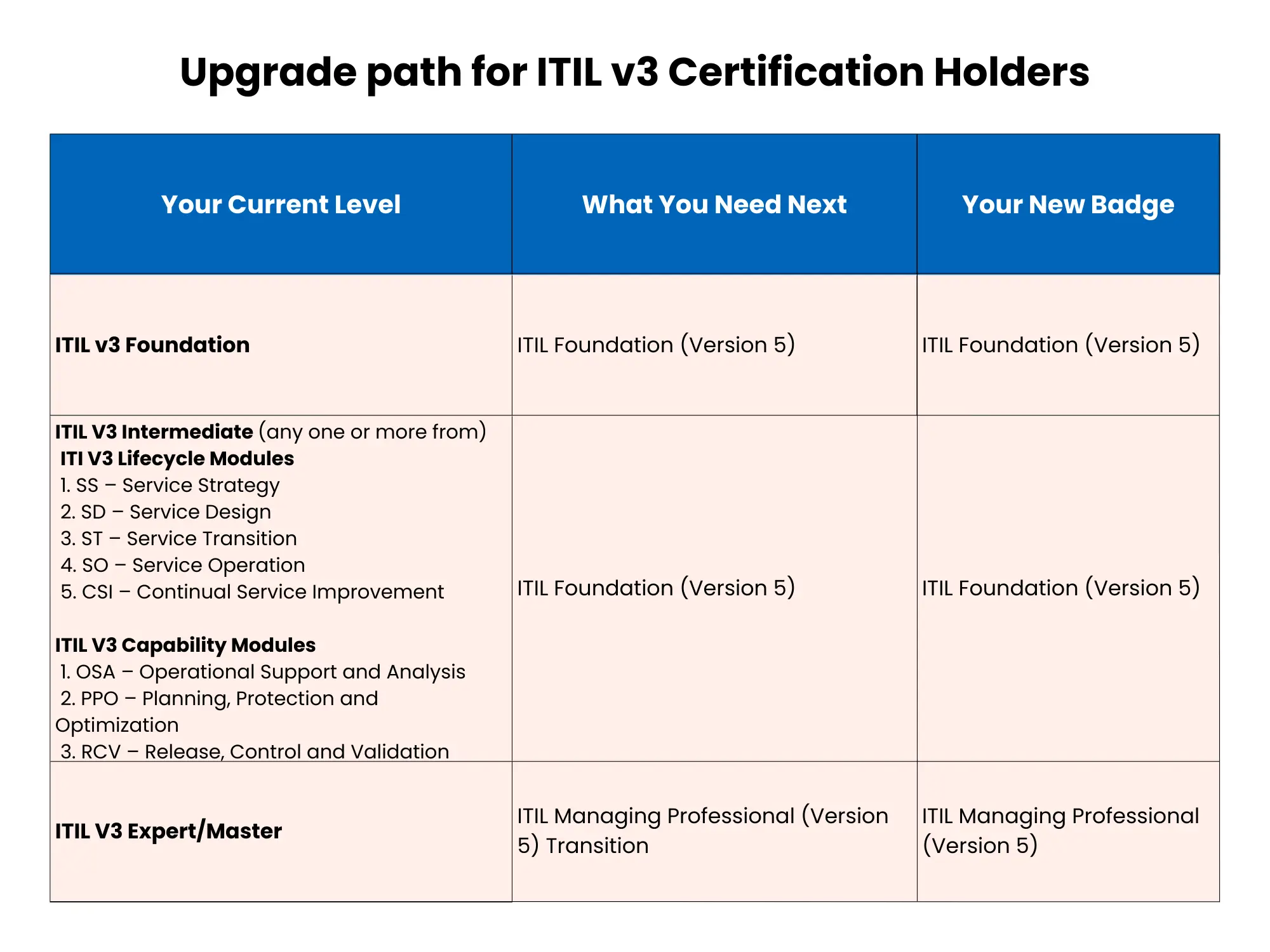
Professionals certified in ITIL v3 often worry the most, mainly because the framework has gone through visible structural changes since v3. The transition paths, however, are straightforward once broken down.
If you hold ITIL v3 Foundation, the recommended starting point is ITIL Foundation (Version 5).
This recommendation exists for a practical reason. ITIL (Version 5) introduces:
Starting with ITIL Foundation (Version 5) helps align earlier learning with how ITIL is positioned today.
This does not mean your previous learning is lost. It simply updates the context and shared language so you can move forward with clarity.
Even if you have completed one to four ITIL v3 Intermediate or Capability modules, the entry point into ITIL (Version 5) remains ITIL Foundation (Version 5).
This can feel surprising at first, but the reason is simple. ITIL (Version 5) is organized around role-based paths, not around the older lifecycle structure.
Foundation helps by:
Your experience and depth still count. The foundation just ensures that everyone moves forward using the same structure and terminology.
For professionals holding ITIL v3 Expert or ITIL v3 Master, the transition is more direct.
You are eligible for ITIL (Version 5) Managing Professional, but this eligibility is subject to review. In simple terms, this means:
To support this transition, a Managing Professional Transition (MPT) module is defined. Its purpose is to:
Note: The MPT module is currently under review, but the intent is clear: no restart is required. Your expertise is respected and carried forward.
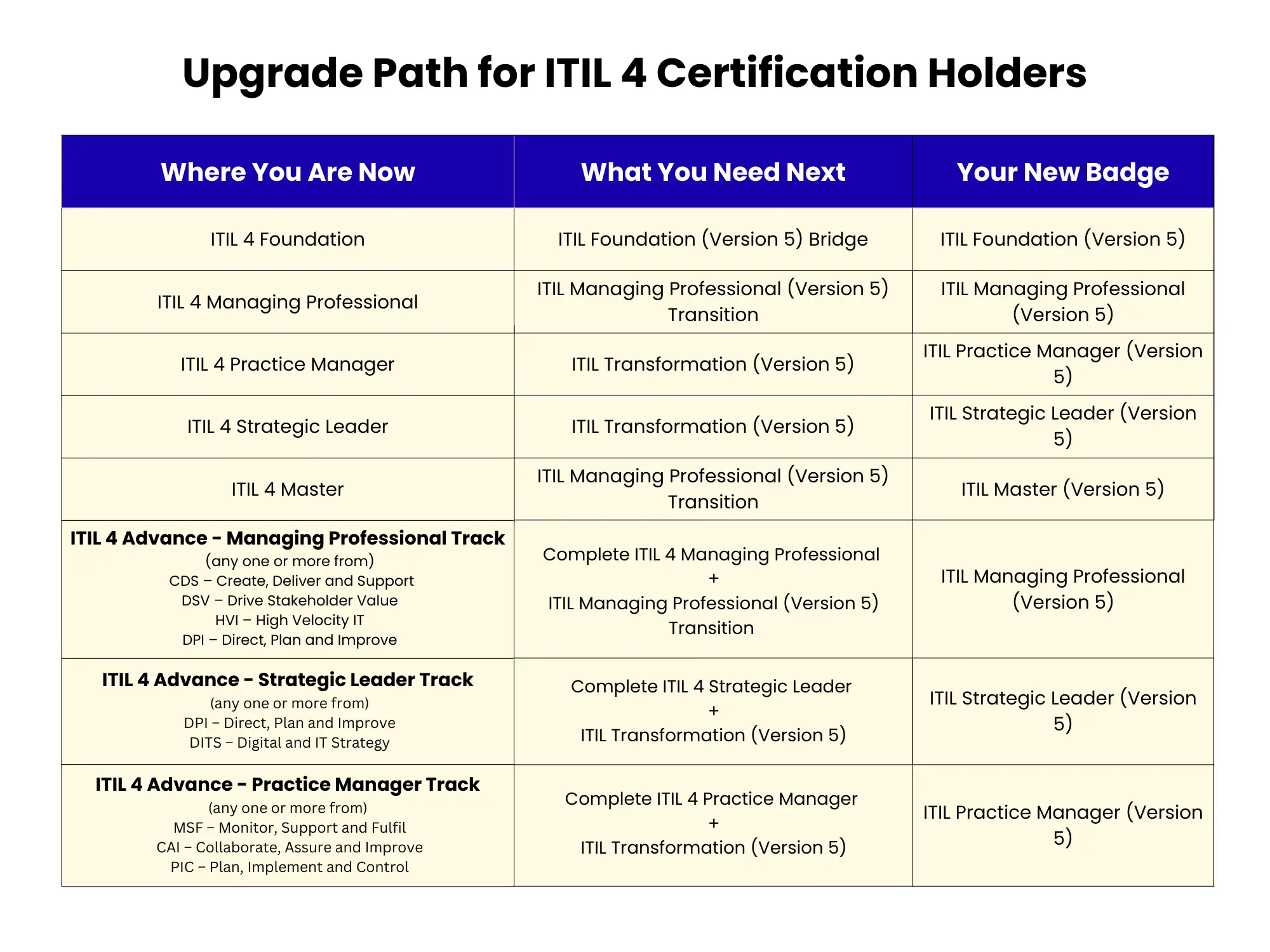
For professionals already certified in ITIL 4, the transition to ITIL (Version 5) is more about extension than adjustment. Many concepts remain familiar, and existing certifications continue to hold value.
If you hold ITIL 4 Foundation, you are not required to repeat ITIL Foundation (version 5) from the beginning. However, moving forward does require completing an official bridge course designed to cover what is new and updated in ITIL (Version 5).
The bridge course focuses on:
After completing the bridge training, candidates must also pass a dedicated bridge exam. Once cleared, ITIL 4 Foundation holders become eligible to move directly into advanced ITIL 5 streams based on their role.
This approach ensures your previous learning is respected while still aligning your knowledge with the latest version, without repeating the full Foundation certification.
If you have completed ITIL 4 Practice Manager, the transition to ITIL 5 is handled through ITIL Transformation.
The process works as follows:
This approach works because your practice-level understanding remains relevant. Transformation focuses on applying that knowledge in environments shaped by ongoing change, rather than replacing what you already know.
For ITIL 4 Managing Professional holders, the transition is handled through the Managing Professional Transition (MPT) course and exam.
The MPT transition:
This structure ensures continuity. Instead of retaking multiple certifications, you update your knowledge in a focused and structured way.
If you hold ITIL 4 Strategic Leader, the transition path is direct.
By completing ITIL Transformation, you become an ITIL Strategic Leader
This makes sense because:
The emphasis is on aligning direction with real-world delivery, not relearning fundamentals.
For professionals holding the ITIL 4 Master, the transition is handled through the MPT course and exam.
The purpose here is alignment, not repetition. The transition:
This approach respects the depth of experience already achieved.
Also Read: The Latest ITIL (Version 5) Exam Syllabus
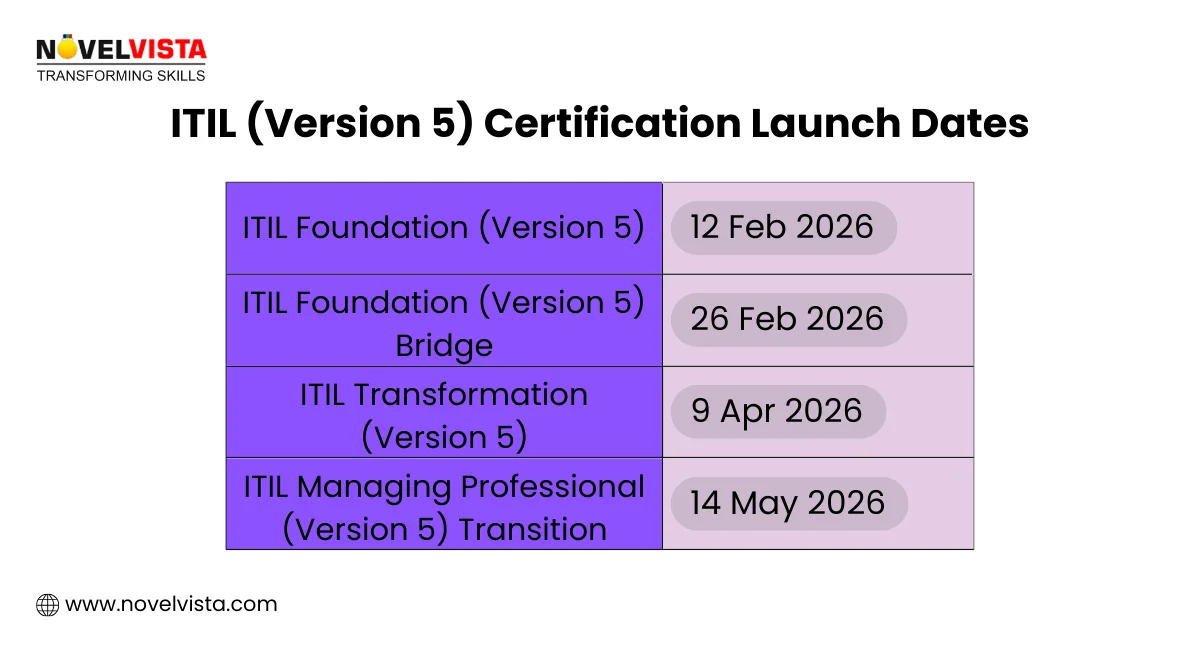
The official launch of ITIL (Version 5) certifications follows a phased schedule. This step-by-step rollout helps candidates plan their preparation and transition without rushing or repeating unnecessary learning.
Here’s how the release timeline is structured:
This phased approach keeps the transition practical and predictable. Whether you are new to ITIL or upgrading from ITIL 4, these dates allow you to schedule training, exams, and career progression with clarity and confidence.
Moving to ITIL (Version 5) is not about keeping up with a version number. It is about staying aligned with how service management is actually practiced today. The transition makes sense for both individuals and organizations, but for different reasons.
For professionals, ITIL (Version 5) offers clarity and direction. Instead of a one-size-fits-all certification ladder, ITIL (Version 5) introduces role-based paths. This helps people invest time and effort where it actually supports their career.
Some key benefits include:
For many professionals, the biggest value of ITIL (Version 5) is confidence. It provides a clear way forward without forcing unnecessary repetition.
Organizations face a different challenge. They need frameworks that support stability while allowing change. ITIL (Version 5) is designed with that balance in mind.
Key organizational benefits include:
For organizations, ITIL (Version 5) is less about change for its own sake and more about staying effective as services and delivery models continue to evolve.
Get clear answers before you commit. Understand how ITIL 5 affects your existing ITIL certifications, what really changes, and how to decide your next step with confidence, not confusion.
A smooth transition to ITIL (Version 5) does not require rushing or over-planning. In most cases, a measured, step-by-step approach works best.
A practical transition plan looks like this:
This approach reduces risk, protects prior investment, and keeps learning closely tied to real work.
Want to know what it takes to budget for your exam and training? Read our guide on ITIL (Version 5) Certification Cost in 2026 to see current pricing trends, typical packages, and what’s included.
The transition to ITIL (Version 5) does not require urgency. It requires understanding. That’s why this ITIL (Version 5) Transition Guide exists.
ITIL (Version 5) respects the learning and experience built through ITIL v3 and ITIL 4. Its transition paths are structured, practical, and designed to help professionals move forward without disruption. Whether you are updating skills, supporting organizational change, or planning long-term growth, the framework provides clear options rather than forcing a restart.
A smooth transition comes from knowing where you stand and choosing the next step with purpose. With that clarity, ITIL (Version 5) becomes a continuation of your journey, not a break from it.

If ITIL Foundation (Version 5) is part of your transition plan, having the right guidance matters. NovelVista’s ITIL Foundation (Version 5) certification training course is designed to help professionals update their understanding without confusion or repetition. The course focuses on clear explanations, exam-aligned content, and practical context, so you know how ITIL (Version 5) builds on what you already know. It’s a structured way to move forward with confidence and clarity.
Author Details

Course Related To This blog
ITIL® 4 Foundation Certification
ITIL V5 Foundation
Confused About Certification?
Get Free Consultation Call
Stay ahead of the curve by tapping into the latest emerging trends and transforming your subscription into a powerful resource. Maximize every feature, unlock exclusive benefits, and ensure you're always one step ahead in your journey to success.