ITIL 5 Certification Training Course | ITIL 5 Foundation Certification
NovelVista's PeopleCert-accredited ITIL 5 Certification Training Course covers the complete ITIL Foundation Version 5 curriculum, including the Service Value System, Four Dimensions, AI integration, and modern ITSM practices, with official courseware, mock exams, and post-training support included. Whether you are new to ITSM or upgrading from ITIL 4, this expert-led training equips you to pass your ITIL 5 Foundation exam on the first attempt and align IT services with real business outcomes.
- In-detailed Learning Materials
- Important IT Service Management Practices
- Real World Application Via Case Studies
- Global Recognition For IT

Course Overview: ITIL 5 Certification
The ITIL 5 Foundation Certification introduces professionals to the next evolution of IT Service Management, focusing on how organizations can deliver value through efficient, resilient, and customer-centric IT services. This ITIL 5 Certification provides a structured understanding of core ITIL 5 Foundation concepts, guiding principles, the service value system, and modern service management approaches aligned with today’s digital and business needs.
The ITIL Foundation (Version 5) Training covers essential ITIL elements such as service relationships, value streams, governance, continual improvement, and the integration of emerging technologies and working practices. Through this ITIL 5 Certification, learners gain clarity on how IT services support business outcomes, improve operational efficiency, and enhance user experience across the entire service lifecycle.
Designed for IT professionals, service desk managers, project managers, and anyone looking to build a career in IT service management, the ITIL v5 Foundation certification is equally valuable for beginners entering the ITSM space and experienced professionals holding ITIL 4 credentials who want to stay current. This certification bridges traditional IT service management with modern ways of working, including agility, automation, and collaboration, making it directly applicable to real organizational contexts.
By completing this ITIL 5 Certification, participants are well prepared to confidently attempt the ITIL Foundation (Version 5) exam and establish a strong base for advanced ITIL learning. Whether you work in IT operations, service delivery, support, or management, this certification helps align IT services with business goals and adapt to evolving service management challenges. Unlike theory-heavy programs, this ITIL 5 training emphasizes practical understanding, helping learners apply ITIL concepts directly in their day-to-day roles and strengthening their profile for positions such as IT Service Manager, ITSM Consultant, and Service Delivery Manager.
If you are already ITIL 4 Foundation certified, you can enroll in the ITIL (Version 5) Bridge Course instead of the full ITIL 5 Foundation course to upgrade to the latest version efficiently.

What You Will Get?
Learning Outcome: ITIL 5 Certification
After the completion of the course, the participants would be able to:
Training Calendar
English
- Self paced videos, assessments, recall quizzes, more
- For more details, reach us at training@novelvista.com
Includes Training, Exam & Certification
Lifetime Access
- Self paced videos, assessments, recall quizzes, more
- For more details, reach us at training@novelvista.com
Includes Training, Exam & Certification
Course Curriculum: ITIL 5 Foundation Course
The ITIL 5 Course provides a complete understanding of modern IT service management, covering key ITIL concepts, service value systems, value streams, AI integration, and continual improvement. Through expert-led ITIL 5 Training, learners gain practical knowledge of how services create business value, improve operational efficiency, and support digital transformation. The course also explains how ITIL works alongside frameworks like DevOps and PRINCE2, helping professionals build future-ready service management skills.
Key ITIL Terms and Definitions+
This category builds the foundational language of ITIL 5 course. Most Foundation exam questions rely on recognizing correct definitions rather than deep explanations, making this a high-scoring area for candidates who focus on terminology.
- Service, Product, Value: Understand what constitutes a service and a product, and how value is co-created through outcomes that matter to customers rather than just technical delivery.
- Outcome and Output: Learn the distinction between outputs (what is delivered) and outcomes (the results achieved), a key concept tested frequently in ITIL Foundation exams.
- Utility and Warranty: Understand how utility describes what a service does, while warranty explains how reliably and securely the service performs under agreed conditions.
- Customer, User, Sponsor: Learn the different roles involved in service consumption, funding, and usage, and how each contributes to value creation.
- Risk, Cost, Resources: Understand foundational concepts that influence decision-making, investment, and service sustainability within IT service management.
Four Dimensions of Product and Service Management+
This section tests awareness of ITIL’s balanced approach to service management. Candidates must understand that services are shaped by people, technology, partners, and workflows, not technology alone.
- Organizations and People: Learn how roles, responsibilities, skills, leadership, and organizational culture directly affect service performance and value delivery.
- Information and Technology: Understand how data, tools, platforms, and systems enable services, with emphasis on supporting value rather than technical detail.
- Partners and Suppliers: Learn why external providers matter, how dependencies are managed, and how collaboration impacts service outcomes.
- Value Streams and Processes: Understand how work flows from demand to value, reinforcing outcome-focused thinking over isolated tasks.
Product and Service Lifecycle+
This category reflects ITIL’s shift away from rigid process stages toward lifecycle thinking, emphasizing that services evolve over time and decisions should consider long-term value.
- Planning and Design: Understand the importance of thoughtful planning and design before services are introduced or changed.
- Operation and Improvement: Learn how services are operated, supported, and continually improved while actively delivering value.
- Service Retirement: Understand when and why services should be retired once they no longer deliver sufficient value.
- Ongoing Value Creation: Learn how value continues to be co-created with stakeholders throughout the service lifecycle.
Service Value System (SVS)+
The Service Value System explains how all ITIL components work together to enable value creation. It is a unifying model, not a rigid framework or checklist.
- Guiding Principles: Understand high-level recommendations that guide decisions and actions across all service management activities.
- Governance: Learn how governance provides direction and oversight without unnecessary control or bureaucracy.
- Service Value Chain: Understand how flexible activities transform demand into value through coordinated effort.
- Continual Improvement: Learn how ongoing improvement keeps services aligned with changing business needs.
Value Streams: Identification and Management+
This category introduces flow-based thinking and explains how value streams represent real work moving from demand to outcome, rather than isolated process steps.
- Value Stream Definition: Understand what defines a value stream and how it represents end-to-end value delivery.
- Value Streams vs Processes: Learn how value streams differ from traditional processes by focusing on flow and outcomes.
- Flow and Bottlenecks: Understand how mapping value streams helps identify delays, handoffs, and inefficiencies.
- Improved Delivery Outcomes: Learn how managing flow leads to smoother delivery and better service results.
ITIL and Artificial Intelligence+
AI is included at an awareness level in the ITIL 5 Certification to reflect how service management is evolving. This section focuses on understanding AI as a supporting capability, not a replacement for people.
- AI in Monitoring: Learn how AI supports monitoring, event correlation, and operational awareness.
- Decision Support: Understand how AI assists prioritization and decision-making in service management.
- Governance and Ethics: Learn why responsible use, oversight, and governance of AI are essential.
ITIL and Other Frameworks+
- ITIL and DevOps: Understand how ITIL supports collaboration, flow, and faster delivery in DevOps environments.
- ITIL and PRINCE2: Learn how ITIL complements project management by supporting services beyond project completion.
- Framework Compatibility: Understand ITIL’s role as an integrator across multiple practices and frameworks.
Course Details: ITIL 5 Course
The ITIL 5 Course is ideal for IT professionals, service managers, support teams, and beginners looking to build a strong foundation in modern IT service management. This ITIL v5 Training covers core ITIL concepts, value streams, guiding principles, and the Service Value System through live instructor-led sessions and exam-focused learning. With no mandatory prerequisites, the course helps professionals improve service delivery, align IT with business goals, and prepare for the globally recognized ITIL v5 Certification.
What Will You Get?+
This ITIL 5 Certification Training is designed to provide complete IT service management learning support, practical understanding, certification preparation, and flexible access to help professionals confidently build modern ITSM and service management expertise.
1. Comprehensive ITIL 5 Training
Live Instructor-Led Sessions: Attend expert-led live virtual ITIL 5 training sessions with certified trainers for interactive learning and practical service management insights.
Flexible Learning Options: Choose between live online ITIL 5 training or self-paced learning based on your professional schedule.
Structured ITIL 5 Learning: Learn modern IT service management concepts including incident management, change enablement, service delivery, value streams, digital transformation, and AI-enabled service operations.
2. Access Details
Recorded Session Access: Revisit recorded training sessions anytime for revision and better exam preparation.
Multi-Device Learning Access: Learn seamlessly from desktop, laptop, tablet, or mobile devices.
Flexible Anytime Learning: Access study resources and learning content according to your preferred learning pace.
3. Course Kit Includes
Mock Exams & Practice Tests: Practice with exam-oriented mock tests designed around the latest ITIL 5 certification format.
Study Materials: Access downloadable study guides, revision notes, quick reference materials, and certification preparation resources.
Real-World Scenarios: Learn through practical IT service management examples and modern workplace scenarios.
4. Learning Support
Expert Trainer Guidance: Learn from experienced ITIL-certified professionals with real-world ITSM expertise.
Doubt Resolution Support: Get support for certification questions, ITIL concepts, and exam preparation guidance.
Interactive Learning Experience: Benefit from mentor-led learning sessions instead of only recorded content.
5. Certification Value
Globally Recognized ITIL 5 Certification: Earn one of the most recognized IT service management certifications accepted worldwide.
Industry-Relevant Credential: Strengthen your profile for ITSM, service delivery, operations, support, governance, and digital transformation roles.
Professional Recognition: Showcase your ITIL 5 certification on your resume and professional profiles including LinkedIn.
6. After Course Support
Career Growth Support: Build practical IT service management and operational excellence skills for long-term career growth.
Continuous Learning Access: Continue revising with recordings and study resources even after training completion.
Professional Learning Community: Join a network of IT professionals and ITIL-certified learners for discussion and knowledge sharing.
Eligibility+
This ITIL 5 Course is designed for beginners, IT professionals, service management teams, and working professionals looking to build structured IT service management skills and grow their careers in modern IT operations.
- Freshers and graduates looking to build foundational IT service management knowledge and globally recognized certification credentials.
- IT support and service desk professionals aiming to improve operational efficiency and service delivery practices.
- IT operations and infrastructure teams looking to standardize processes using ITIL best practices.
- Service delivery managers and team leads responsible for IT services, incident management, and customer experience.
- Project managers, business analysts, and consultants working closely with IT service teams.
- Working professionals seeking flexible live virtual or self-paced learning options alongside their jobs.
- Professionals planning career growth in ITSM, governance, operations, digital transformation, and enterprise service management.
- Organizations looking to build structured, scalable, and business-aligned IT service management capabilities.
Pre-requisites+
There are no strict mandatory prerequisites for this ITIL 5 Certification program, making it suitable for both beginners and experienced professionals.
If you are already ITIL 4 Foundation certified, you do not need to enroll in the full ITIL (Version 5) Foundation course. Instead, you can opt for the ITIL (Version 5) Bridge Course, which is specifically designed to help ITIL 4 certified professionals upgrade to the latest version by focusing only on the key updates and changes.
However, the following knowledge can help learners understand concepts faster:
- Basic understanding of IT services and business processes
- Familiarity with IT support, operations, or service desk environments
- Interest in IT service management and digital transformation practices
- Understanding of workflows, ticketing systems, or operational processes
- Problem-solving and process improvement mindset
Training Delivery Style+
This ITIL 5 Training is delivered through a flexible and practical learning approach, allowing professionals to choose between instructor-led live training and self-paced learning options.
- Live virtual instructor-led ITIL 5 training sessions
- Self-paced digital learning modules
- Structured IT service management learning paths
- Real-world ITSM scenario-based learning
- Certification-focused preparation approach
- Mock exams and revision support
- Recorded session access for revision
- Flexible anytime, anywhere learning access
Key Benefits+
High-Demand ITSM Skill Development
Build in-demand IT service management skills including incident management, change enablement, service delivery, problem management, continual improvement, governance, and digital service operations valued across industries worldwide.
Strong Career Growth Opportunities
ITIL-certified professionals are highly valued across IT operations, service management, consulting, support, infrastructure, and enterprise transformation roles.
Improved Salary & Career Potential
Professionals with ITIL certifications often gain stronger career opportunities, leadership responsibilities, and higher earning potential in IT service and operations domains.
Practical Real-World Learning
Gain practical exposure through ITSM scenarios, operational workflows, service management use cases, and exam-focused preparation instead of only theoretical learning.
Globally Recognized ITIL 5 Certification
Earn a globally accepted ITIL 5 certification recognized by enterprises, consulting firms, IT organizations, and service-driven businesses worldwide.
Flexible Learning for Working Professionals
Learn through live virtual training or self-paced learning with access to recordings, study resources, mock exams, and revision materials.
Future-Ready IT Service Management Skills
As organizations continue adopting AI-driven operations, automation, and digital transformation, ITIL 5 helps professionals stay relevant with modern ITSM and service lifecycle practices.
Exam & Certification+
About the Examination
The ITIL 5 Certification exam follows a scenario-based approach designed to test practical understanding rather than simple memorization. Questions are based on real-world workplace situations where candidates must identify the most appropriate ITIL-aligned solution, service management practice, or operational response.
NovelVista’s ITIL 5 Training includes exam-oriented mock tests and practice scenarios designed to closely match the latest certification pattern, helping learners prepare confidently for the final examination.
About the Certification
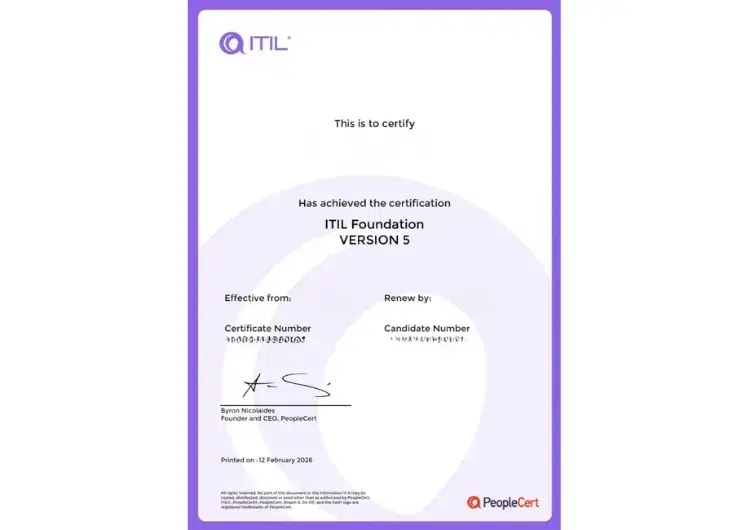
- Official ITIL 5 Certification issued by PeopleCert, the authorized global examination body for ITIL certifications.
- Certification can be verified online through the official PeopleCert Successful Candidates Register.
- Valid for 3 years with renewal options through CPD credits via PeopleCert Plus or progression to advanced ITIL certification levels.
- Listed on the official ITIL Candidate Register, accessible to employers and organizations globally.
- Serves as the foundational entry point for advanced ITIL certifications across service management, transformation, strategy, experience, and operational excellence pathways.
- Strengthens professional credibility for ITSM, service delivery, support, governance, and digital transformation roles worldwide.
Support & After-Training Resources+
Your learning journey continues even after completing the ITIL 5 Course. NovelVista provides structured post-training support, revision assistance, and certification guidance to help learners confidently prepare for the ITIL 5 Certification exam and apply practical ITSM concepts effectively.
- 30-day doubt resolution support through email and scheduled mentoring sessions for ITIL concepts, service management topics, and certification-related queries.
- Exam scheduling assistance to help learners register for the official PeopleCert examination, select suitable exam slots, and understand the online examination process.
- 90-day access to recorded ITIL 5 Training sessions for revision, concept reinforcement, and exam preparation.
- Access to a professional learning community for peer discussions, collaborative revision, knowledge sharing, and industry networking.
- PDU Certificate upon course completion that supports professional development requirements for certifications such as PMP and other industry-recognized credentials.
- Structured revision support designed around the common learner timeline, as many professionals attempt the ITIL 5 Certification exam within 2–3 weeks after completing the training.
This structured ITIL 5 Training approach helps professionals build practical service management expertise, improve certification readiness, and strengthen long-term career growth in modern IT operations and digital service management.
ITIL Foundation (Version 5) Exam – Key Details
ITIL Foundation (Version 5 )Exam format - Closed book
ITIL Foundation (Version 5) Exam Duration - 60 minutes
Extended time - 75 minutes (if the exam language is not your working language)
Number of questions - 40
Marks per question - 1 mark
Negative marking - None
Passing score - 26 out of 40 (65%)
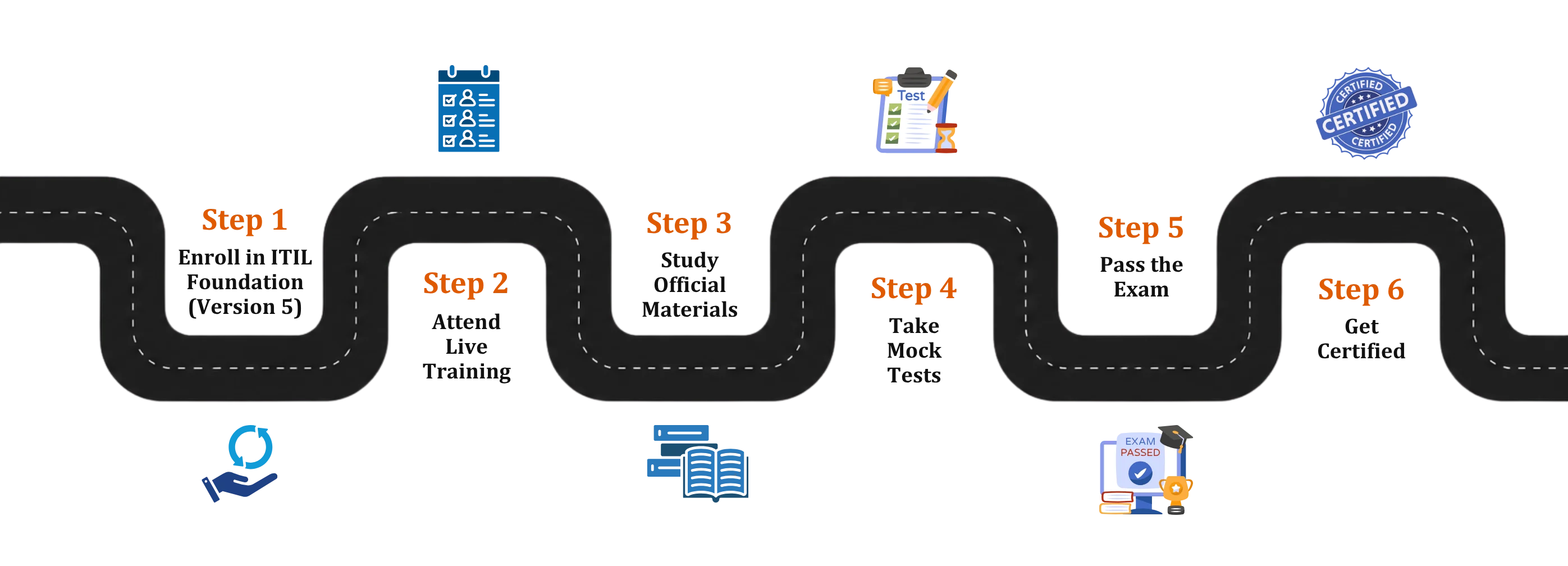
ITIL 5 Certification Roadmap