Category | IT Service Management
Last Updated On 01/09/2026

The ITIL Foundation (Version 5) exam has created a mix of curiosity and hesitation. Not because it is considered difficult, but because many people are unsure what the exam is actually trying to assess.
This is not a technical exam, and it is not a test of how much framework content you can memorize. The focus is more practical. The exam checks whether you understand how service management is expected to work as organizations gradually move toward product-based delivery, better use of data, and clearer value-focused decisions.
This article explains the exam in a straightforward way. It covers the syllabus, explains the ITIL (Version 5) exam pattern, and breaks down the passing score so you know what to expect before you begin your preparation.
Before getting into the syllabus, it helps to understand how the exam is structured. Once the format is clear, most of the uncertainty tends to fade.
| ITIL 5 Exam Component | Details |
| ITIL 5 Exam format | Closed book |
| ITIL 5 Exam Duration | 60 minutes |
| Extended time | 75 minutes (if the exam language is not your working language) |
| Number of questions | 40 |
| Marks per question | 1 mark |
| Negative marking | None |
| Passing score | 26 out of 40 (65%) |
The structure is predictable. There are no hidden rules around scoring or timing. The exam rewards steady understanding and careful reading rather than speed or guesswork.
All questions in the ITIL 5 Foundation exam are multiple-choice. What changes is how those questions are framed to test understanding instead of recall alone.
Across all question types, the intent remains the same. The ITIL 5 exam checks whether you understand ITIL terms, core ideas, and how they relate to each other. There are no long scenarios, calculations, or advanced problem-solving questions. The level stays firmly foundational.
Once the question style feels familiar, the focus naturally moves to what the ITIL 5 exam syllabus actually covers.
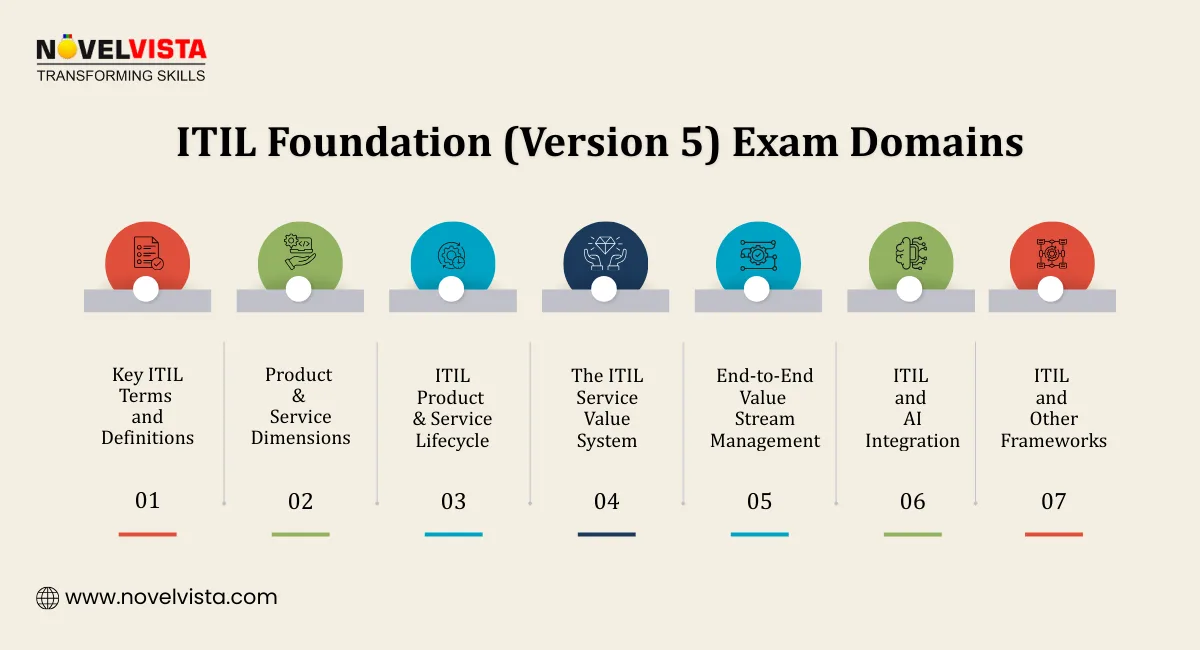
The ITIL 5 Foundation syllabus is organized into seven categories. Together, they are designed to give a clear and balanced view of how service management thinking is being refined, without overwhelming those who are new to ITIL.
This section is where most preparation time should be spent.
This area establishes the shared language used throughout ITIL. Many exam questions depend on recognizing the correct meaning of terms rather than explaining them in detail.
Key areas include:
Core definitions
Utility and warranty
Roles
Foundational concepts
Questions from this category are usually direct. With a clear understanding of definitions, these marks are generally easier to secure.
This category checks whether candidates understand ITIL’s balanced view of service management. Services are not treated as purely technical outputs. Instead, ITIL expects awareness of different factors that influence how value is created and maintained.
The four dimensions are:
The ITIL 5 exam emphasizes balance. Overlooking any one dimension can introduce risk, even if the others are strong.
This section reflects the move away from rigid, step-by-step processes toward lifecycle thinking. Candidates are expected to understand that products and services evolve over time rather than following a straight path.
Key ideas include:
Questions focus on continuity and perspective. The aim is to recognize that service management decisions should consider the full lifespan of a product or service.
The Service Value System explains how ITIL components work together to support value creation. It acts as a unifying model rather than a checklist to follow.
Core components include:
The exam checks recognition and understanding of purpose. Candidates are not expected to design systems, only to understand how these elements fit together.
Value streams receive focused attention in the ITIL 5 Foundation syllabus because they help explain how work actually moves from demand to outcome.
This category checks whether candidates understand flow-based thinking, rather than task-by-task execution.
Key areas include:
ITIL 5 exam questions here are usually conceptual. The focus is on why value streams matter and what they help improve, not on drawing detailed diagrams or using specific tools.
AI is included in the syllabus to reflect how service management is gradually changing. At the Foundation level, this topic stays intentionally light and awareness-focused.
Coverage includes:
The exam does not expect technical knowledge of AI. Instead, it checks whether candidates understand AI as a supporting capability that can improve how services are managed, rather than something that replaces people or processes.
This category reinforces ITIL’s place alongside other well-known frameworks. ITIL is not positioned as a replacement, but as something that works alongside existing approaches.
Awareness-level alignment includes:
Questions in this area test whether candidates understand compatibility. The emphasis is on recognizing that ITIL provides shared concepts and language that can support other ways of working
Questions in this area test whether candidates understand compatibility. The emphasis is on recognizing that ITIL provides shared concepts and language that can support other ways of working.
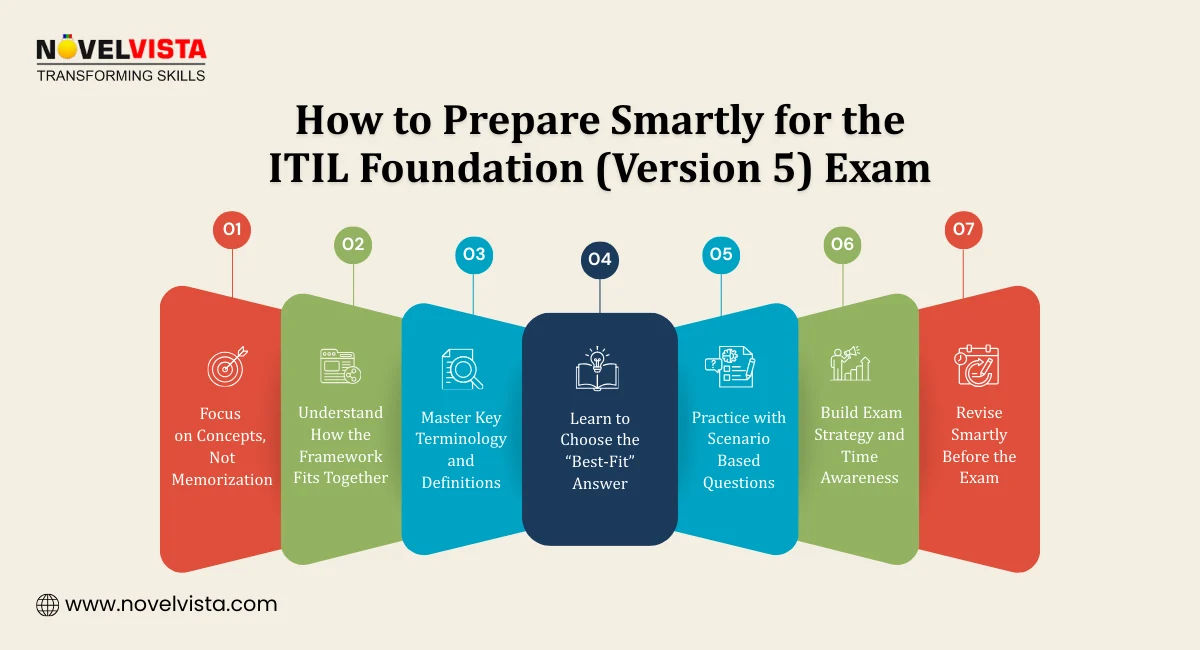
Prepare with clarity, not overload. Learn how the ITIL (Version 5) exam really tests concepts, what to prioritize, and how to avoid common mistakes, so your first attempt can be your last.
One reason the ITIL 5 Foundation exam feels manageable is the way it is assessed. The questions focus on basic knowledge and understanding, not complex applications.
The exam aligns with Bloom’s Level 1 and Level 2, which means:
What the exam does not assess:
If you understand the purpose behind the concepts, you are already covering most of what the exam expects.
Want to understand how ITIL (Version 5) can advance your career and improve service delivery? Read our report on ITIL (Version 5) Certification Benefits to see the real value it brings to professionals and organizations.
The ITIL 5 Foundation exam consists of 40 questions. PeopleCert assigns a specific percentage weighting to each syllabus category, which directly determines how many questions appear from that topic in the exam. Understanding this distribution is one of the most practical steps a candidate can take before starting preparation. It removes guesswork and helps focus study time where it has the most impact on the final score.
| Syllabus Category | Weightage | Approximate Questions (out of 40) |
| Key ITIL Terms and Definitions | 30% | 12 questions |
| The ITIL Four Dimensions of Product and Service Management | 10% | 4 questions |
| The ITIL Product and Service Lifecycle | 10% | 4 questions |
| The ITIL Value System | 40% | 16 questions |
| Value Stream Identification, Mapping, and Management | 5% | 2 questions |
| ITIL and AI | 2.5% | 1 question |
| ITIL and Other Frameworks | 2.5% | 1 question |
| Total | 100% | 40 questions |
Category 1 (Key ITIL Terms and Definitions) and Category 4 (The ITIL Value System) together account for 70% of the exam. Candidates who build a strong understanding of these two areas are already covering the majority of what the exam tests. The remaining 30% is distributed across five categories, each of which carries fewer questions, but every category appears in the exam and should not be ignored during preparation.
Both exams share the same format: 40 questions, 60 minutes, a 65% passing score, closed book, and Bloom's Level 1 and 2 assessment. However, the syllabus structure, topic categories, and what the exam actually tests have changed significantly in ITIL 5. Understanding these differences helps candidates, especially those upgrading from ITIL 4, identify exactly where to focus their preparation.
| Factor | ITIL 4 Foundation | ITIL 5 Foundation |
| Number of Questions | 40 | 40 |
| Exam Duration | 60 minutes | 60 minutes |
| Passing Score | 26/40 (65%) | 26/40 (65%) |
| Bloom's Level | BL 1 and 2 | BL 1 and 2 |
| Exam Format | Closed book | Closed book |
| Syllabus Categories | 7 Learning Outcomes | 7 Categories |
| AI Coverage | Not included | Included (Category 6) |
| Framework Comparisons | Not included | DevOps and PRINCE2 (Category 7) |
| Product and Service Lifecycle | Not covered | Fully covered (Category 3) |
| Value Stream Mapping | Basic mention | Dedicated category (Category 5) |
| Heaviest Weighted Area | ITIL Practices (17 marks) | ITIL Value System (40%) |
| ITIL Practices | 15 practices tested | Not individually tested |
The most significant structural shift is in what carries the most exam weight. In ITIL 4, named ITIL practices such as incident management, problem management, and service desk accounted for the majority of the marks. In ITIL 5, the emphasis moves to the ITIL value system and core terminology, with no individual practices named or tested at the foundation level. Candidates upgrading from ITIL 4 should pay particular attention to this shift, as preparation strategies that worked for ITIL 4 will not directly translate to ITIL 5.
Clearing the ITIL 5 Foundation exam signals something practical and straightforward. It demonstrates that a candidate understands how service management is evolving toward product-based delivery, value stream thinking, data-driven decisions, and AI-supported operations.
The syllabus is structured to build clarity rather than test memorization. With the right understanding of how each category is weighted and what each topic actually assesses, preparation becomes focused and manageable rather than overwhelming.
For professionals already holding ITIL 4, the Foundation exam represents a natural and well-defined step forward. For those new to ITIL, it provides a solid entry point into a framework that is increasingly relevant across IT service delivery, operations, and management roles.
The exam does not demand deep specialization. It demands clear thinking, accurate recall, and a genuine understanding of how modern service management creates value, which is precisely what the ITIL 5 framework is designed to support.
If you want to prepare for the ITIL 5 Foundation exam with clarity instead of guesswork, guided learning makes a real difference. NovelVista’s ITIL Foundation (Version 5) certification training course is built around the actual syllabus, exam pattern, and intent behind the questions. The program focuses on concepts, terminology, and real-world understanding, helping you prepare confidently, avoid common mistakes, and approach the exam with a clear, structured mindset rather than last-minute memorization.
Author Details

Course Related To This blog
ITIL® 4 Foundation Certification
ITIL V5 Foundation
Confused About Certification?
Get Free Consultation Call
Stay ahead of the curve by tapping into the latest emerging trends and transforming your subscription into a powerful resource. Maximize every feature, unlock exclusive benefits, and ensure you're always one step ahead in your journey to success.