Category | IT Service Management
Last Updated On 24/07/2026
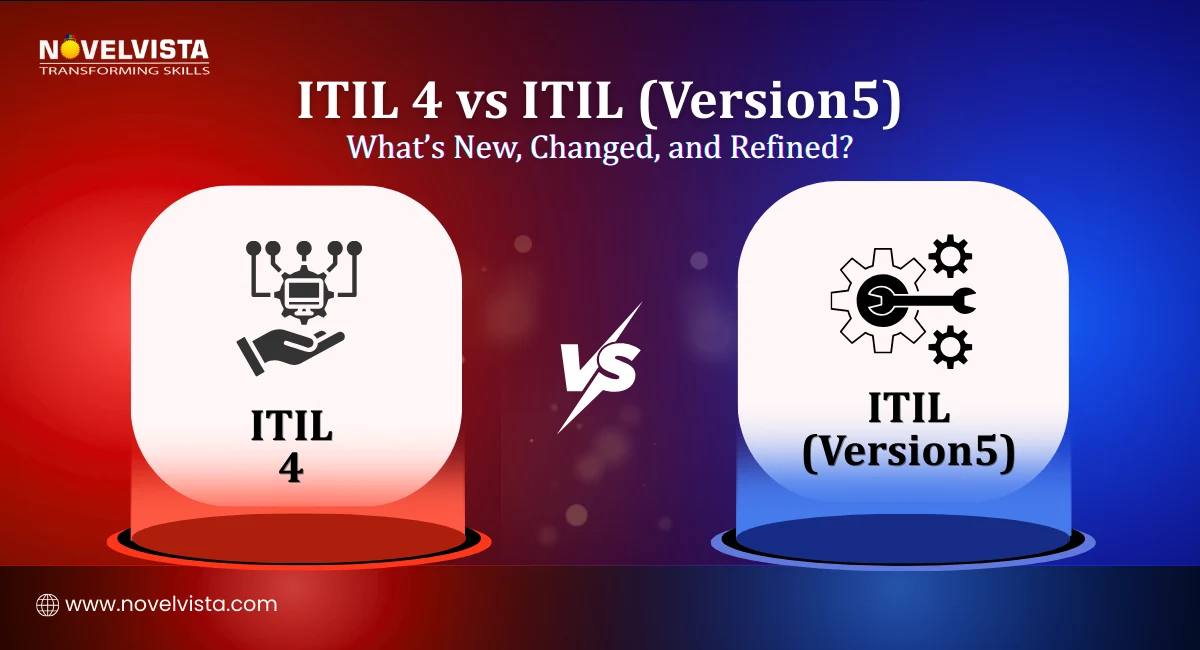
A new ITIL version doesn’t usually raise many questions. This one has.ITIL 4 helped many organizations move away from rigid, process-heavy ways of working. It shifted attention from following fixed steps to focusing on value and outcomes. For many teams, that change was necessary and long overdue.
However, the way organizations operate today looks different from when ITIL 4 was first put into practice. Cloud platforms are standard, teams work around products rather than isolated services, and value is often delivered across suppliers, partners, and internal functions. Not all of this was clearly reflected in how ITIL 4 was applied day to day.
That brings up a question many leaders and practitioners are now considering:
Is ITIL (Version 5) a real step forward, or is it mainly a refinement of what ITIL 4 already introduced?
Basically, ITIL (Version 5) is the latest evolution of ITIL, providing a role-based framework for managing products and services, combining value creation, governance, transformation, and continual improvement.
This article explores that question further in a practical way. It dive deeping into ITIL 4 vs ITIL (Version 5) differences, looking at what ITIL (Version 5) adds, how it adjusts ideas from ITIL 4, and why those changes matter in real working environments.
When ITIL 4 was introduced, it marked a clear change from earlier versions. The focus moved away from strict process control toward a broader view of how value is created and delivered.
At its core, ITIL 4 introduced three key ideas:
This was a meaningful improvement. Teams were no longer expected to follow rigid flows that didn’t match how work actually happened. There was room to adapt based on context.
Where Limitations Appeared
In practice, some gaps became visible:
ITIL 5 responds by refining how service management is positioned:
The shift is not dramatic, but it is meaningful. Service management starts to look less like a support function and more like a way organizations coordinate work and decisions.
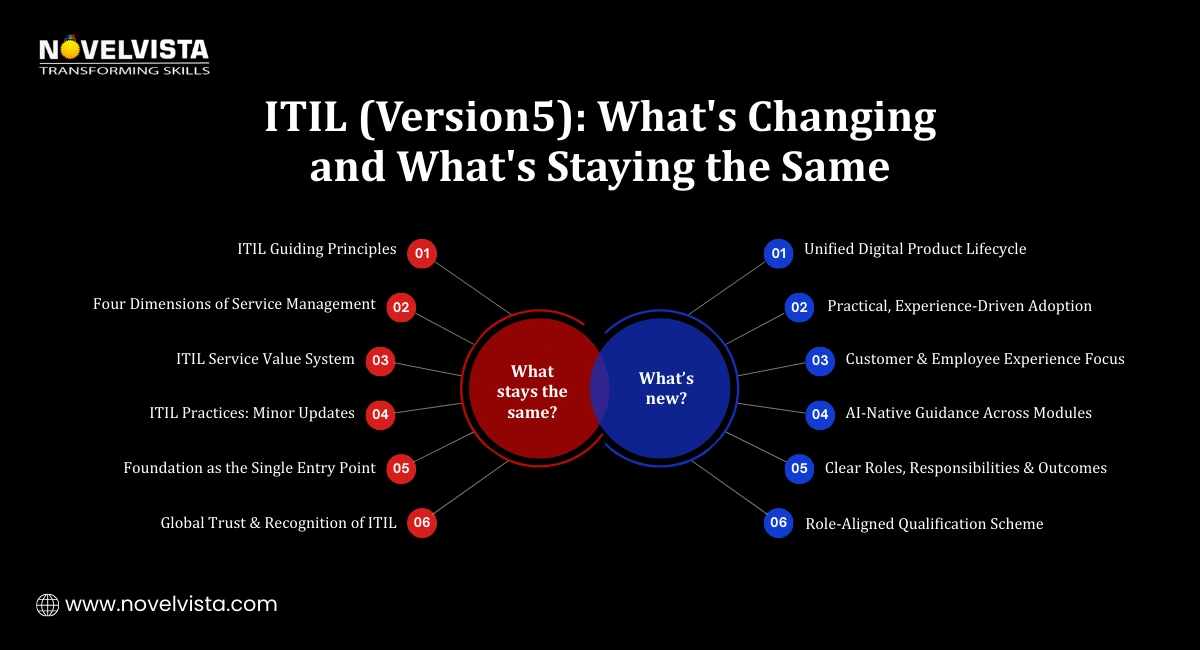
The debate of ITIL 4 vs ITIL 5 differences doesn’t end with the conclusion of the replacement of ITIL 4. Instead, it builds on it by extending ideas that were already present but not always fully developed. The changes focus on areas that have become more important in everyday operations.
ITIL 4 focused mainly on services. ITIL 5 expands this view to include products alongside services.
This reflects how value is delivered today. Most users interact with a combination of:
ITIL 5 encourages teams to think about ownership over time, rather than handling work as isolated requests. For organizations working with digital products or platforms, this approach aligns better with reality than traditional service catalogs.
ITIL 5 recognizes that manual ways of working do not scale well.
Automation and data are treated as normal parts of how work is managed, not optional add-ons. This supports:
The overall direction moves from reacting to problems toward preventing them where possible.
ITIL 5 looks beyond traditional IT boundaries. Service management naturally involves coordination with:
This reflects how outcomes are delivered in practice. Value rarely depends on one team working in isolation. ITIL (Version 5) treats cross-functional coordination as part of normal service management.
Another visible refinement in ITIL 5 is how success is measured.
Rather than focusing heavily on activity-based metrics such as ticket volume or utilization, attention shifts toward outcomes. The Importance is on whether services are supporting business needs, not just whether work is being completed.
This does not remove structure or control. It reduces unnecessary reporting and encourages accountability for results.
For a clear breakdown of what you’ll study and how the exam is structured, explore our detailed guide on the ITIL Foundation (Version 5) certification syllabus and preparation focus.
See what has actually changed from ITIL 4 to ITIL 5. Understand new focus areas, expanded concepts, and what stays the same, so you know what to learn, update, or keep.
ITIL 5 does not introduce a new set of rules. The main change is how existing ideas are applied. The differences show up more in day-to-day decisions than in formal definitions.
In many ITIL 4 implementations, governance often sat above the work. Reviews and approval steps were added to reduce risk, but they frequently slowed progress.
ITIL 5 brings governance closer to where work actually happens. Instead of acting as a gate, governance provides boundaries within which teams can operate.
This shift leads to:
Control is still present. It is applied through guidance rather than constant intervention.
ITIL 4 already moved away from strict process maps. ITIL 5 continues this direction by focusing more on how teams work in context, rather than prescribing detailed steps.
Key adjustments include:
The focus shifts from following a predefined flow to making informed choices based on the situation.
While ITIL 4 introduced value streams, they were often applied only within IT.
ITIL 5 encourages value streams to be viewed across:
This broader view helps organizations:
Value streams move from being diagrams to becoming tools for managing work.
Another noticeable change is how closely service management connects with organizational goals.
In ITIL 5:
Pro Tip: To fully understand how ITIL 4 improves service management efficiency, it’s important to learn concepts like ITIL Output vs Outcome, which play a major role in value-driven service delivery.
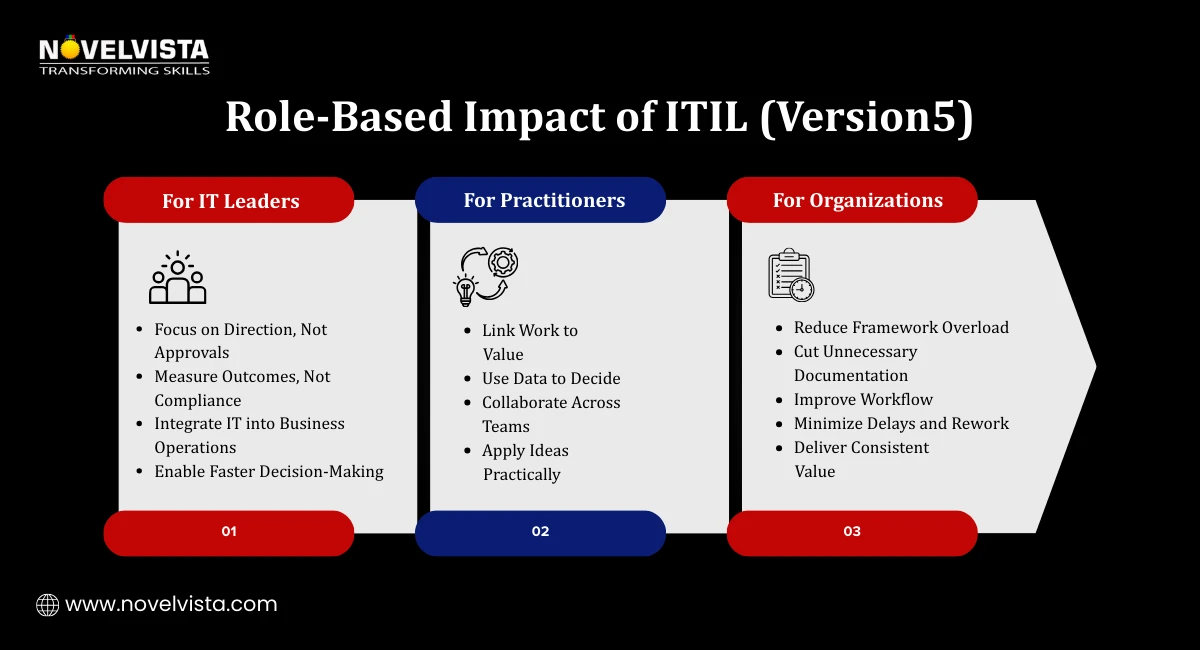
ITIL 5 affects people differently depending on where they sit in the organization. The changes are more about expectations than responsibilities.
Leaders are expected to:
This supports faster decision-making without losing control.
For practitioners, the shift is more practical than theoretical. The focus moves toward:
Certifications matter less on their own. What matters is how well ideas are applied.
To understand the exam fees, what’s included, and how costs may vary by region, read our complete guide on the ITIL (Version 5) exam cost and fee structure.
At the organizational level, the biggest change is where effort and attention are placed.
There is less significance on:
And more significance on:
Organizations that adapt their thinking tend to see more benefit than those that only update terminology.
ITIL 5 does not discard ITIL 4. The foundation remains the same. What changes is the importance.
The framework reflects how service management is gradually adjusting to products, automation, shared ownership, and outcome-focused decisions. It is still taking shape, and that makes understanding its direction more important than rushing to adopt everything at once.
For most teams and professionals, the value of ITIL 5 lies in clarity. It helps make sense of how service management is expected to support modern ways of working, without forcing a complete reset.
That understanding is usually the first step before any bigger change.
If you want to move beyond theory and understand how these ITIL 4 vs ITIL 5 changes apply in real roles, structured guidance helps. NovelVista’s ITIL Foundation (Version 5) certification training course focuses on practical interpretation, modern service scenarios, and exam clarity, helping you connect the framework to day-to-day decisions, responsibilities, and career growth with confidence.

Author Details

Course Related To This blog
ITIL® 4 Foundation Certification
ITIL V5 Foundation
Confused About Certification?
Get Free Consultation Call
Stay ahead of the curve by tapping into the latest emerging trends and transforming your subscription into a powerful resource. Maximize every feature, unlock exclusive benefits, and ensure you're always one step ahead in your journey to success.