Category | IT Service Management
Last Updated On 23/12/2025
In today’s digital-first world, IT is no longer just a support function—it is a strategic business driver. Yet, according to industry studies, nearly 60% of organizations struggle to clearly track the cost and value of their IT services, and a significant portion of IT budgets is still spent without clear visibility into return on investment. Cloud adoption, subscription-based tools, and hybrid infrastructures have only added to this complexity.
So, how do organizations ensure that IT spending is controlled, transparent, and aligned with business goals?
How do IT leaders justify budgets, prioritize investments, and demonstrate real value to stakeholders?
This is where ITIL Financial Management comes into play.
If you are an IT service manager trying to optimize costs, a CIO under pressure to prove IT’s value, or a finance professional working closely with IT teams, ITIL Financial Management for IT Services provides a structured, proven approach to managing IT finances effectively. In this blog, we’ll explore what it is, how it works, and why it has become essential for modern IT organizations.
ITIL Financial Management is a core ITIL practice that ensures IT services are delivered in a cost-effective, transparent, and value-driven way. Its primary objective is to help organizations understand, control, and optimize the financial aspects of IT services across their entire lifecycle. Within the ITIL framework, Financial Management ITIL makes IT costs visible and predictable, ensures investments are justified by clear business value, and helps manage financial risks proactively. Instead of treating IT as a black box of expenses, ITIL Financial Management for IT Services enables organizations to manage IT like a business function that consistently delivers measurable value.
Modern IT environments are dynamic and complex. Cloud services, SaaS subscriptions, and on-demand infrastructure have shifted IT spending from fixed to variable models. While this offers flexibility, it also increases financial uncertainty.
Key reasons why ITIL Financial Management matters today include:
Without a structured ITIL Financial Management Process, organizations risk overspending, poor decision-making, and misalignment between IT and business goals. Understanding the costs of ITIL 4 Certification also helps professionals evaluate the long-term value it brings through stronger financial control, smarter decision-making, and better alignment between IT and business goals.
At its heart, ITIL Financial Management focuses on a few critical objectives:
These objectives ensure that IT services are not only technically effective but also financially sustainable.
The ITIL Financial Management Process is built around three key activities that work together to manage IT service finances effectively.
Budgeting in ITIL Financial Management involves forecasting and planning the costs required to deliver IT services over a defined period, including infrastructure, software, staffing, and operational expenses. Effective budgeting enables organizations to predict future spending accurately, allocate resources based on service demand, and avoid unexpected cost overruns. Within ITIL Financial Management for IT Services, budgeting is not a one-time exercise but a continuous activity that is regularly reviewed and adjusted as business needs and priorities evolve.
Accounting in Financial Management ITIL focuses on tracking and reporting the actual costs incurred while delivering IT services. It involves collecting financial data, categorizing expenses, and generating meaningful reports that provide clear visibility into service-level costs, enable accurate cost allocation across departments, and improve financial reporting and compliance. This level of transparency strengthens trust and collaboration between IT teams and business stakeholders. Effective ITIL demand management works hand-in-hand with ITIL Financial Management to help organizations forecast service demand, allocate resources efficiently, and control IT costs.
Charging in ITIL Financial Management for IT Services involves billing or showing costs to business units for the IT services they consume. While not mandatory, charging is a powerful mechanism that encourages responsible use of IT services, improves demand management, and reinforces the perceived value of IT across the organization.
Even when actual billing is not implemented, “showback” models aligned with ITIL Financial Management for IT Services can drive better financial awareness.
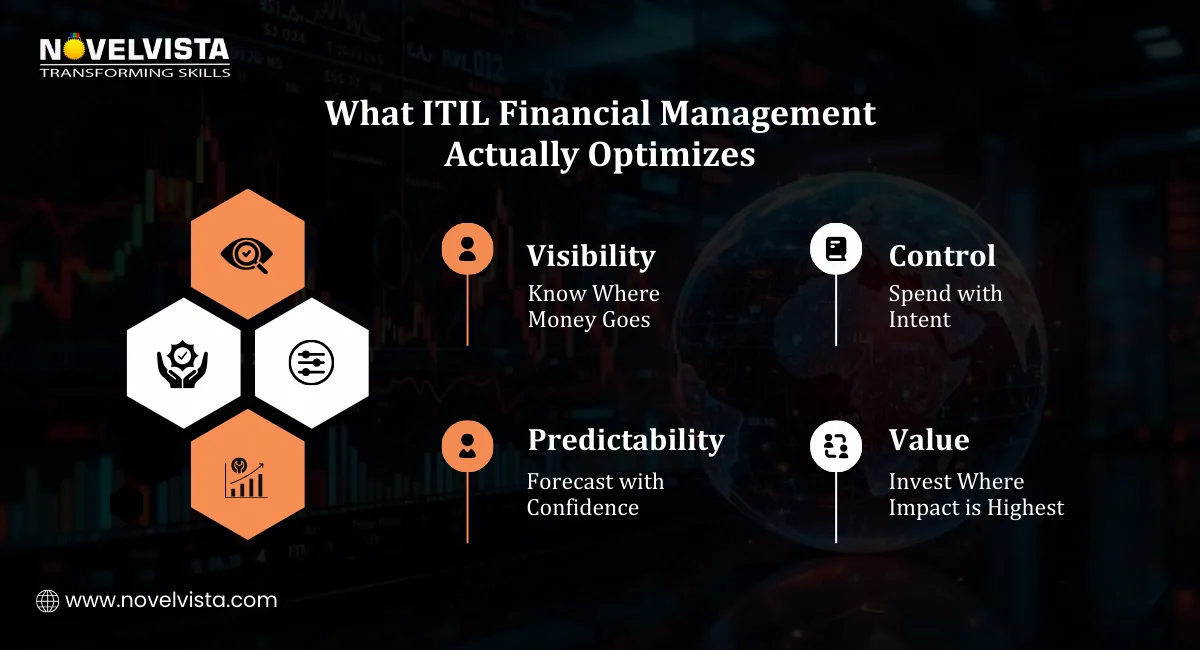
Organizations that adopt ITIL Financial Management experience tangible and strategic benefits:
These benefits make Financial Management ITIL a cornerstone of mature IT service management.
Despite its advantages, implementing ITIL Financial Management for IT Services is not without challenges:
The key to overcoming these challenges lies in starting simple, improving data quality, and fostering collaboration between IT and finance teams.
To maximize the value of the ITIL Financial Management Process, consider these best practices:
These practices help organizations move from reactive cost control to proactive financial planning.
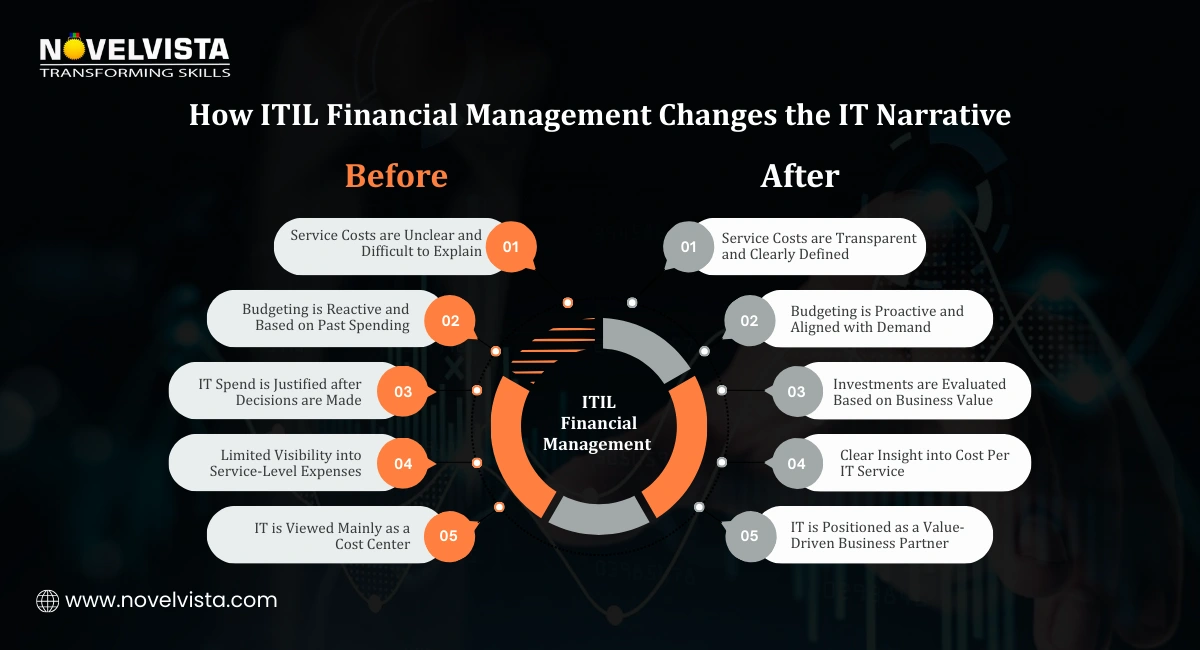
When implemented effectively, ITIL Financial Management for IT Services becomes a strategic enabler for the organization. It helps prioritize services based on business impact, supports digital transformation initiatives, optimizes investment portfolios, and enables data-driven decision-making. By linking financial insights with service performance, IT shifts from being viewed as a cost center to becoming a trusted business partner. Implementing service request management alongside ITIL Financial Management ensures that IT services are delivered efficiently while keeping costs transparent and aligned with business priorities.
In an era of rising IT complexity and spending, organizations can no longer afford to manage IT finances informally. ITIL Financial Management provides a structured, practical approach to controlling costs, improving transparency, and maximizing value.
By adopting the ITIL Financial Management Process, organizations can transform how they plan, track, and justify IT investments. Instead of viewing IT as an expense, businesses can see it as a strategic asset—one that delivers measurable outcomes and long-term value.

To build a strong foundation in practices like ITIL Financial Management for IT Services and apply them effectively in real-world environments, the right training makes all the difference. Join NovelVista’s ITIL® 4 Foundation Certification Training to gain a clear understanding of core ITIL concepts, modern service management practices, and value-driven decision-making. Designed for IT professionals, service managers, and aspiring IT leaders, this course equips you with globally recognized credentials and practical insights to manage IT services with confidence in today’s digital landscape.
Start your ITIL 4 journey today.
Author Details

Course Related To This blog
ITIL4 Specialist Monitor Support and Fulfil Certification
ITIL4 Specialist Acquiring & Managing Cloud Services
ITIL 4 Specialist Sustainability in Digital & IT
ITIL® 4 Strategic Leader Digital And IT Strategy (DITS)
ITIL® 4 Specialist Drive Stakeholder Value
ITIL® 4 Specialist High Velocity IT
ITIL® 4 Strategist Direct, Plan & Improve
ITIL® 4 Specialist Create Deliver & Support
ITIL® 4 Foundation Certification
Confused About Certification?
Get Free Consultation Call
Stay ahead of the curve by tapping into the latest emerging trends and transforming your subscription into a powerful resource. Maximize every feature, unlock exclusive benefits, and ensure you're always one step ahead in your journey to success.