Category | IT Service Management
Last Updated On 29/08/2026
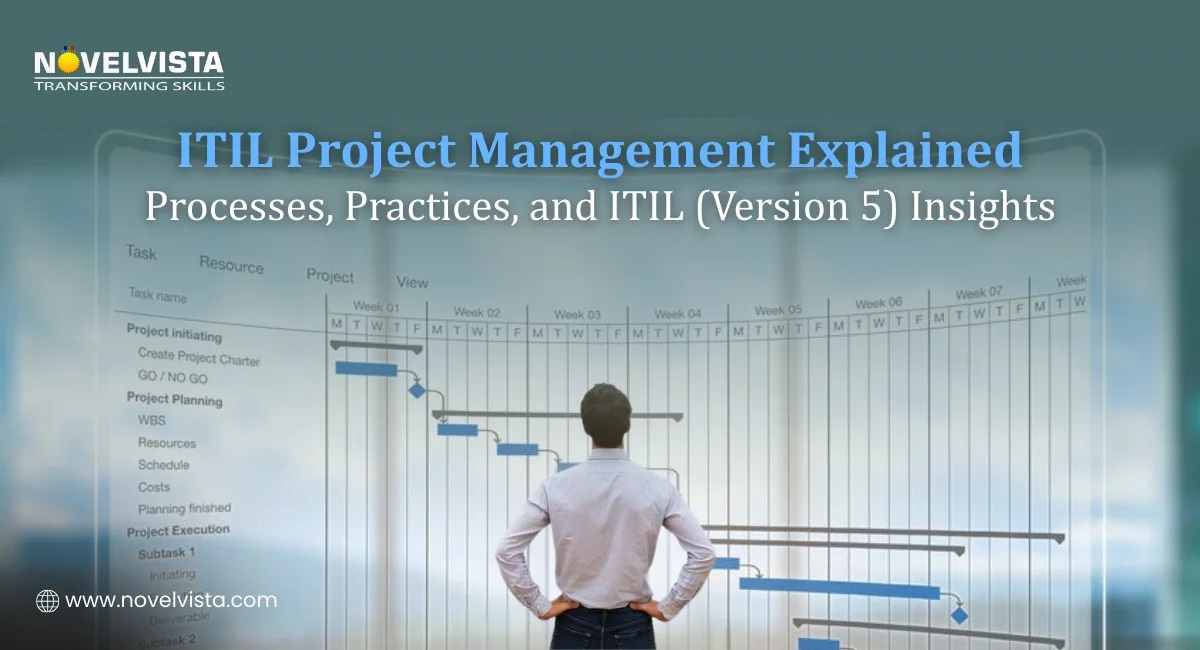
Digital transformation isn’t failing because of weak ideas, it’s failing because of poor alignment.
According to Gartner, nearly 70% of digital initiatives don’t fully achieve their intended outcomes. Meanwhile, research from PMI shows organizations waste around 11% of their investment due to poor project performance.
The issue isn’t technology. It’s the disconnect between projects and services.
Projects move fast. Services demand stability. Businesses expect value. IT teams are left balancing agility with governance, and that’s where things break down.
This is where ITIL Project Management becomes critical. It ensures projects don’t just go live, they deliver sustained service value.
Are you:
An IT professional trying to align projects with service goals?
A project manager working within IT service environments?
Transitioning toward ITIL (Version 5) Project Management?
Preparing for certification and wondering how projects fit into ITIL?
If yes, this guide is for you.
Let’s explore ITIL Project Management, the ITIL Project Management Process, and how ITIL (Version 5) Project Management transforms modern project delivery.
If you’re asking What is ITIL Project Management, you’re not alone. Unlike traditional approaches that focus mainly on delivering scope, timelines, and budgets, ITIL Project Management ensures that projects align with IT service management (ITSM) principles and drive long-term business value. In simple terms, ITIL Project Management integrates structured project delivery practices with ITIL’s service lifecycle so that projects create measurable service outcomes, not just completed tasks. Although ITIL, developed by PeopleCert, does not define a separate project management process, it provides governance, value streams, and best practices that guide how projects operate within IT environments. Instead of asking, “Was the project delivered?” ITIL asks, “Did this project enhance service value?” and that mindset shift makes all the difference.
Today’s IT projects don’t exist in isolation. They impact:
Infrastructure
Applications
Cloud environments
Service desk operations
Customer experience
Without structured ITIL Project Management, organizations often face:
Service disruptions after project go-live
Poor change control
Lack of stakeholder alignment
Ineffective risk management
Weak post-implementation reviews
The ITIL Project Management Process ensures that projects are embedded into the broader Service Value System (SVS). This means every initiative is linked to value creation, governance, and continual improvement.
Let’s explore the key pillars that define the ITIL Project Management Process.
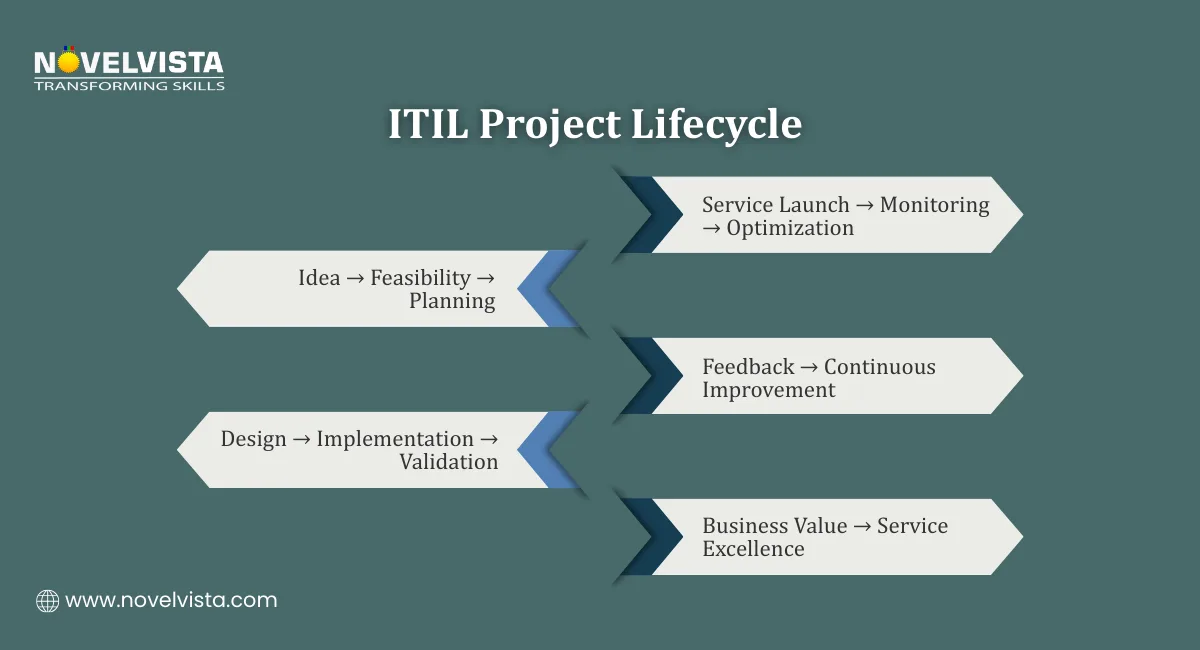
ITIL 4 and ITIL (Version 5) emphasize the Service Value System (SVS), ensuring that every project aligns with:
Organizational strategy
Governance frameworks
Risk policies
Compliance requirements
Projects are no longer standalone events they are contributors to service value chains.
Risk management in Project Management ITIL is tightly integrated with:
Change enablement
Incident prevention
Capacity planning
Information security
Instead of reacting to risks, ITIL encourages proactive assessment during planning stages.
This reduces post-implementation failures significantly.
One of the most critical practices linked to ITIL Project Management is change enablement.
Projects introduce change new systems, upgraded platforms, and process redesigns. Without structured change management:
Downtime increases
Users resist adoption
Service quality declines
ITIL ensures that every project-driven change is evaluated, authorized, and monitored.
Traditional projects often end at “delivery.”
In ITIL (Version 5) Project Management, delivery is just the beginning.
Post-implementation reviews feed into continual improvement practices, ensuring:
Performance optimization
Lessons learned documentation
Service maturity enhancement
Let’s compare.
Aspect |
Traditional Project Management |
Project Management ITIL |
| Focus | Deliver Scope On Time & Budget | Deliver Service Value |
| Governance | Pmo-Driven | Service Value System-Driven |
| Risk Handling | Project-Level | Service + Business-Level |
| Closure | Ends At Handover | Continual Improvement Continues |
| Change Control | Often Separate | Integrated With ITIL Change Enablement |
Traditional frameworks like PMBOK focus heavily on scope, cost, and schedule. ITIL integrates those elements into service strategy and operational stability.
The key difference?
ITIL Project Management prioritizes sustainable service performance over short-term project completion.
With ITIL 5 Project Management, the emphasis shifts strongly toward digital transformation alignment, Agile and DevOps integration, value stream mapping, cross-functional collaboration, and AI and automation enablement. This modern approach recognizes that projects today are increasingly iterative rather than strictly waterfall-based. Instead of operating in silos, ITIL (Version 5) Project Management supports dynamic delivery models that adapt to rapid business change. It integrates seamlessly with Agile frameworks, DevOps pipelines, cloud-native deployments, and automation-driven service models, ensuring that innovation does not compromise governance or service stability. This alignment with modern delivery ecosystems makes ITIL (Version 5) Project Management highly relevant in 2026 and beyond. Explore our comprehensive ITIL foundation (Version 5) certification cost guide to understand exam fees, training expenses, and overall investment requirements.
Imagine an enterprise launching a new customer portal.
Without ITIL alignment:
Development finishes successfully
Deployment causes service desk overload
Incident rates spike
Customers complain
With ITIL Project Management Process in place:
Risks assessed early
Change evaluated
Capacity planning done
Support teams trained
Monitoring activated
Result?
Smooth transition. Minimal disruption. High adoption.
That’s the power of integrating projects into IT service management.
Organizations implementing structured ITIL Project Management experience:
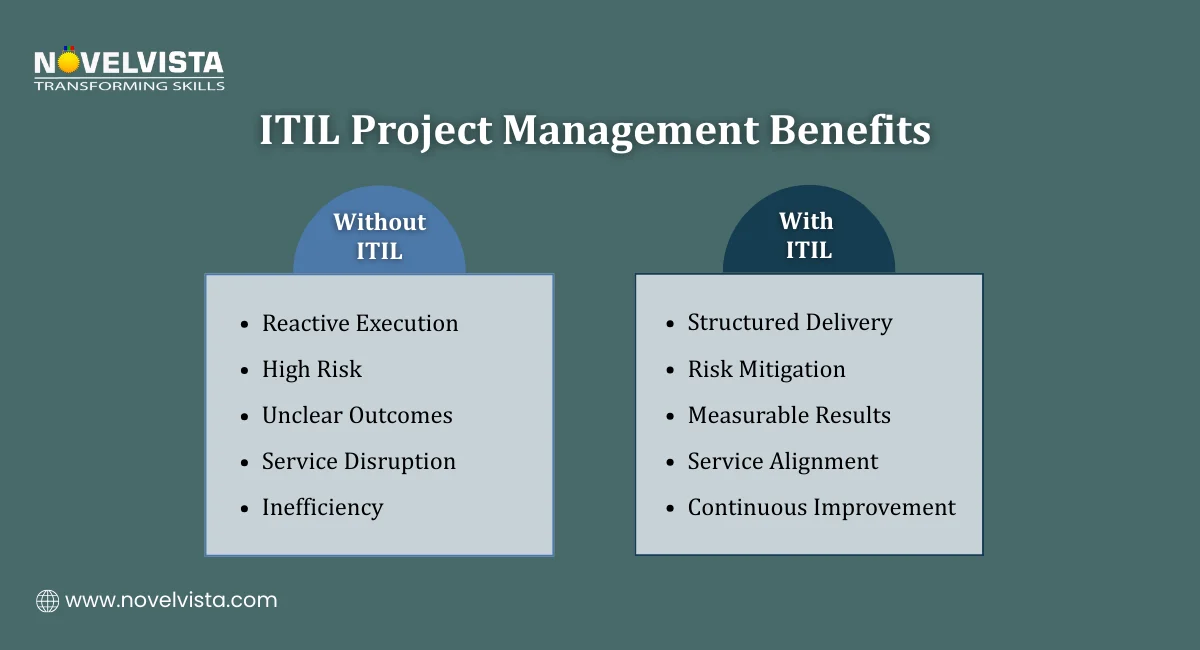
Projects are mapped directly to business outcomes.
Integrated risk and change control reduce failures.
No more chaotic go-lives.
Clear governance improves executive trust.
Projects contribute to long-term service maturity.
In competitive markets, this structured approach becomes a strategic advantage.
Even with the right framework, organizations struggle with:
Resistance to process formalization
Misalignment between PMO and ITSM teams
Lack of training
Poor documentation discipline
The solution?
Cross-functional workshops
Strong leadership sponsorship
Clear RACI models
ITIL certification training
Continual improvement culture
When implemented correctly, ITIL Project Management becomes a powerful enabler, not a bureaucratic burden.
In today’s hyper-digital economy, projects don’t just build systems, they build experiences. ITIL Project Management ensures that every initiative strengthens service reliability, enhances measurable business value, and aligns with long-term strategic goals. If you’ve ever asked, What is ITIL Project Management, and questioned its relevance to your organization, the answer is simple: it bridges the critical gap between project execution and service excellence. With ITIL (Version 5) Project Management, enterprises achieve agility without chaos, governance without rigidity, and innovation without instability. In 2026 and beyond, maintaining that balance isn’t a competitive advantage, it’s a necessity.
If you’re serious about mastering ITIL Project Management and building strong IT service management capabilities, the right training makes all the difference.
Join NovelVista’s ITIL (Version 5) Foundation Certification Training and gain practical ITSM knowledge, real-world service management insights, and globally recognized credentials. Designed for IT professionals, project managers, and service leaders, this course equips you with the expertise needed to align projects with service value and confidently navigate modern digital environments.
Take the next step in your ITIL journey today!
Author Details

Course Related To This blog
ITIL® 4 Foundation Certification
ITIL V5 Foundation
Confused About Certification?
Get Free Consultation Call
Stay ahead of the curve by tapping into the latest emerging trends and transforming your subscription into a powerful resource. Maximize every feature, unlock exclusive benefits, and ensure you're always one step ahead in your journey to success.