Category | IT Service Management
Last Updated On 02/02/2026

If you’ve ever worked in an IT team—or even interacted with one—you know this scenario:
Employees constantly request new laptops, access to tools, permission changes, shared folder access, software installations, or simple password resets.
Now multiply that by hundreds of employees, scattered across hybrid workplaces.
It’s no surprise that 60–70% of service desk interactions today fall under “service requests,” not incidents. This shift is exactly why Service Request Management has become one of the most important practices in modern IT operations.
But here’s the real problem:
Most organizations still treat service requests as mini-incidents… which slows everything down, frustrates employees, and wastes valuable IT resources.
That’s where ITIL 4’s modern approach to Service Request Management truly shines.
In this blog, you will get to know more, so let’s get started.
Service Request Management is the process of handling user requests for information, services, resources, or small changes—typically standard, low-risk, and repeatable activities that follow a predefined workflow. Unlike incidents, which are about “fix something,” service requests focus on “give me something,” such as new laptop or hardware requests, software installations, access permissions, onboarding setups, password resets, or simple guidance. Managing these predictable, structured tasks efficiently is the core of a strong IT Service Request Management practice and forms a key capability within Service Request Management ITIL 4.
In most organizations, employees depend on digital tools more than ever before.
Every new tool, role, or project generates fresh service requests.
But here’s the catch:
Many service desks still process requests manually—leading to long queues, unpredictable turnaround times, and poor user experience.
A strong Service Request Management practice:
In short, it turns “IT bottlenecks” into efficient, scalable workflows.
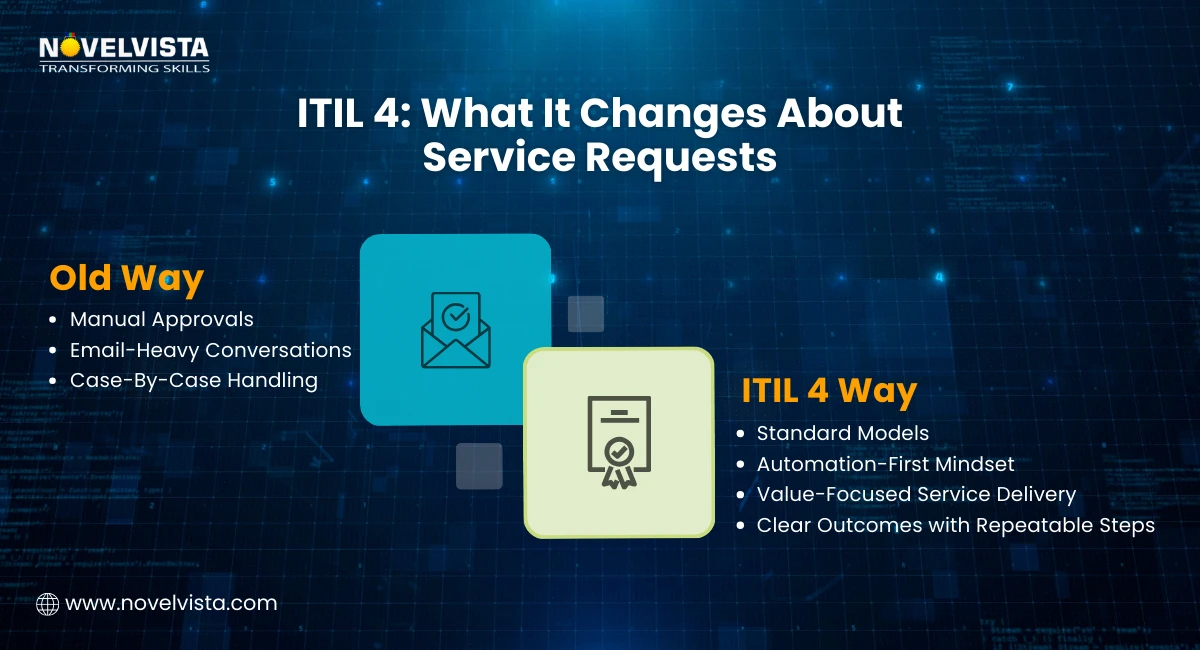
With ITIL 4, Service Request Management is treated as a dedicated practice, emphasizing:
1. User Experience as a Priority
In Service Request Management ITIL 4, the fulfillment journey must be smooth, intuitive, and consistent. Clear communication, easy-to-use portals, and predictable steps ensure users feel supported throughout the request lifecycle.
2. Value Co-Creation
Modern ITIL 4 Service Request Management emphasizes shared outcomes—users and IT teams collaborate to achieve value together. It’s not just about fulfilling and closing tickets but ensuring every request genuinely improves the user’s experience.
3. Simplicity and Standardization
Standard request models, templates, and workflows help streamline IT Service Request Management and eliminate unnecessary delays. By reducing complexity, IT teams can deliver faster, error-free fulfillment.
4. Automation First
An automation-first mindset boosts efficiency across Service Request Management systems. Automated approvals, routing, and fulfillment reduce manual effort and accelerate response times, especially for high-volume requests.
5. Reusable, Repeatable Processes
A strong Service Request Management practice relies on repeatable processes that are not reinvented for every new request. Reusable workflows ensure consistency, reliability, and continuous improvement across IT services.
ITIL 4’s biggest shift?
It moves Service Request Management from a ticket-by-ticket mindset to a structured, repeatable, and automated service practice.
This modern approach improves visibility, enables self-service, and builds a more predictable user experience. By aligning your service workflows with the ITIL 4 framework, you ensure that every request is managed with modern best practices, stronger governance, and a more user-centric approach.
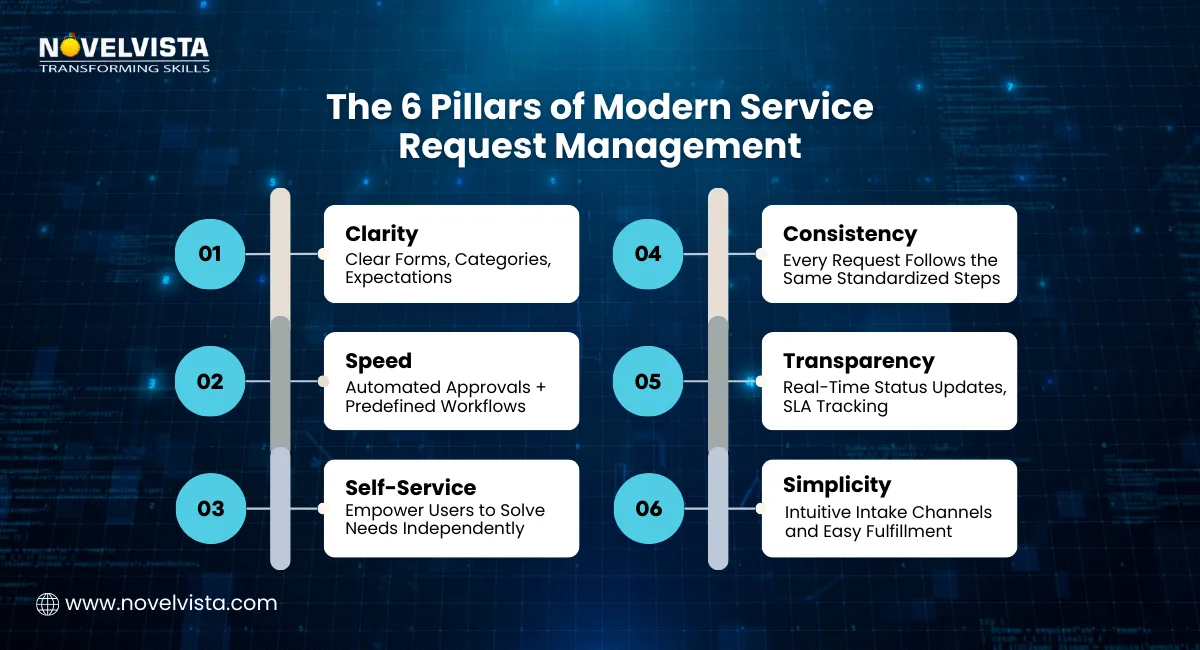
A Service Request Management System is the backbone of how an organization handles requests end-to-end.
It typically includes:
1. Request Intake Channels
2. Categorization & Prioritization
Clear categories and priority levels streamline Service Request Management by ensuring each request is routed to the right team quickly. This improves response times and supports a smoother IT Service Request Management workflow.
3. Request Models / Templates
Predefined request models make Service Request Management ITIL 4 more efficient by giving teams ready-made workflows for common, repeatable tasks. This reduces errors and delivers faster fulfillment.
4. Approval Automation
In modern ITIL Service Request Management, low-risk, standard requests should move through automated approvals. This cuts manual overhead, reduces bottlenecks, and accelerates service delivery.
5. Knowledge Base Articles
A strong knowledge base supports self-service, one of the pillars of ITIL 4 Service Request Management. Users can resolve simple needs independently, reducing ticket volume and improving overall service quality.
6. Fulfillment Workflows
Well-defined, step-by-step workflows ensure every request in the Service Request Management system is handled consistently. Clear roles and responsibilities help teams deliver predictable, high-quality outcomes.
7. SLAs & Metrics
8. Integrations
IAM, HR systems, asset management, cloud platforms.
A well-designed system reduces friction and ensures every request follows a predictable, repeatable path. When your Service Request Management strategy aligns with core ITIL processes, it becomes easier to deliver consistent, efficient, and repeatable service experiences across the organization.
To get the most from ITIL Service Request Management, follow these proven practices:
✔ Standardize common requests
Create templates, forms, and workflows.
✔ Prioritize a self-service portal
Let users submit, track, and resolve simple requests independently.
✔ Build strong knowledge articles
Reduce dependency on the IT team.
✔ Automate approvals and fulfillment
Especially for predictable, low-risk requests.
✔ Track SLAs and improve bottlenecks
Use metrics to constantly refine.
✔ Adopt a shift-left strategy
Empower users first → service desk second → specialists last.
These practices align directly with ITIL 4 Service Request Management principles.
1. Too many request types
2. Poor portal adoption
3. Manual approvals causing delays
4. No clear SLAs
5. Fragmented tools
Fixing these issues dramatically boosts operational efficiency.
Faster Fulfillment Times
With standardized workflows, Service Request Management minimizes delays and ensures users get what they need quickly. Predictable steps and automated routing significantly speed up the entire lifecycle.
Lower IT Workload
Automation plays a major role in IT Service Request Management, taking over repetitive approvals, notifications, and fulfillment tasks. This frees IT teams to focus on higher-value, strategic work.
Higher Employee Satisfaction
Consistent, predictable experiences improve trust in IT services. When Service Request Management ITIL 4 is implemented well, users feel supported and confident that their requests will be handled seamlessly.
Better Governance & Compliance
A structured Service Request Management system ensures every request has the right approvals, documentation, and audit trails. This strengthens governance and reduces compliance risks.
Visibility Into Service Performance
Tracking request volumes, fulfillment times, and bottlenecks provides data-driven insights. Strong ITIL Service Request Management helps IT identify improvement opportunities and optimize operations.
Supports Digital Transformation
Modern organizations rely on digital-first experiences and self-service portals. Effective ITIL 4 Service Request Management enables scalable, automated service delivery—essential for digital transformation.
Popular platforms include:
Plus integrations with:
IAM tools, HRMS systems, workflow automation, and AI chatbots.
These amplify the effectiveness of Service Management ITIL 4 processes.
Effective Service Request Management is no longer just an operational necessity—it’s a strategic pillar that shapes employee experience, service efficiency, and organizational agility. As businesses accelerate their digital adoption, the ability to deliver fast, predictable, and scalable services becomes a competitive advantage. By applying ITIL 4 principles, leveraging a well-designed Service Request Management System, and embracing automation-driven workflows, IT teams can transform routine requests into seamless, high-value interactions. The result is lower workloads, higher satisfaction, improved governance, and greater visibility across the service lifecycle.
In today’s digital-first environment, strengthening your IT Service Request Management practice isn’t optional, it’s essential for building a modern, resilient, and user-centric IT ecosystem.

Join NovelVista’s ITIL® 4 Foundation Certification Training and build practical, job-ready ITIL capabilities. As a PeopleCert Accredited Training Organization (ATO), NovelVista is trusted by leading global companies for high-quality, accurate, and up-to-date ITIL content. Every course and resource is carefully reviewed and designed to help professionals apply ITIL in real-world environments. Train with industry experts and take your IT career to the next level.
Author Details

Course Related To This blog
ITIL4 Specialist Monitor Support and Fulfil Certification
ITIL4 Specialist Acquiring & Managing Cloud Services
ITIL 4 Specialist Sustainability in Digital & IT
ITIL® 4 Strategic Leader Digital And IT Strategy (DITS)
ITIL® 4 Specialist Drive Stakeholder Value
ITIL® 4 Specialist High Velocity IT
ITIL® 4 Strategist Direct, Plan & Improve
ITIL® 4 Specialist Create Deliver & Support
ITIL® 4 Foundation Certification
Confused About Certification?
Get Free Consultation Call
Stay ahead of the curve by tapping into the latest emerging trends and transforming your subscription into a powerful resource. Maximize every feature, unlock exclusive benefits, and ensure you're always one step ahead in your journey to success.