Category | IT Service Management
Last Updated On 22/12/2025
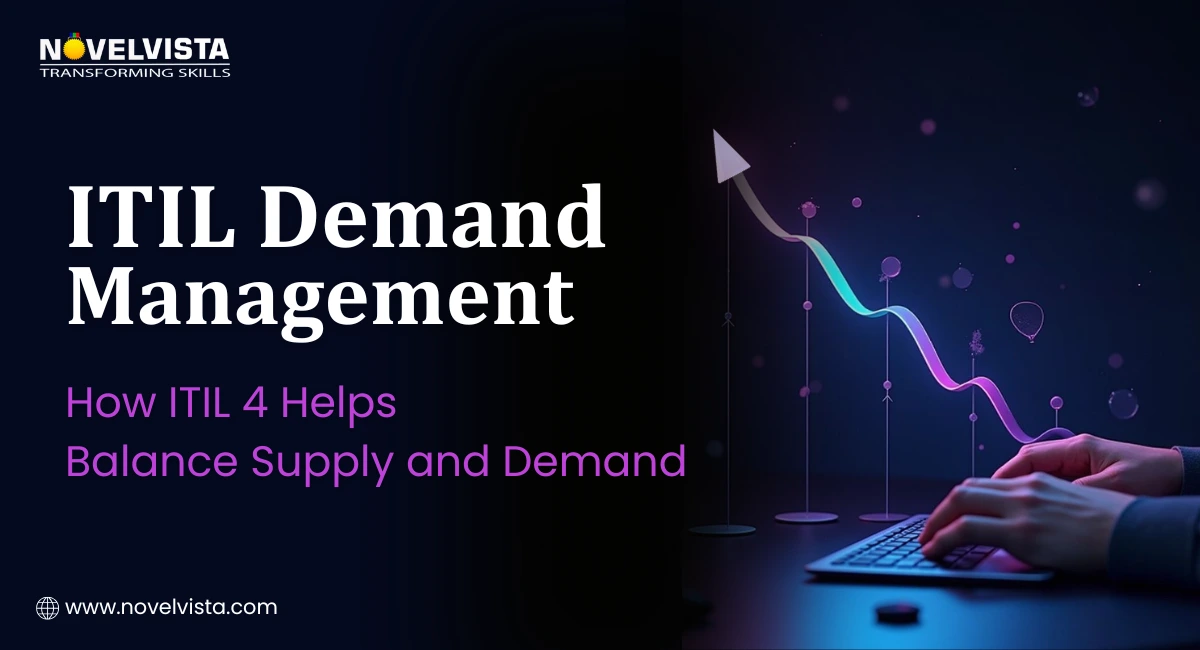
In today’s always-on digital economy, IT services are no longer supporting actors—they are the backbone of business operations. Cloud adoption, remote work, AI-driven applications, and global digital customers have pushed IT usage to unpredictable levels. According to industry studies, enterprise IT service demand has increased by over 35% in the last five years, while unplanned demand spikes remain one of the top causes of service outages and cost overruns.
So why do so many organizations still struggle to balance service availability with cost efficiency?
The answer often lies in poor demand visibility. Many IT teams react to problems only after systems slow down or budgets spiral. This is exactly where Demand Management ITIL becomes critical. Instead of reacting to demand, ITIL encourages organizations to understand, forecast, and influence it.
With the introduction of ITIL 4, demand management has evolved from a technical forecasting activity into a strategic business practice. The ITIL 4 Demand Management Practice focuses on aligning IT services with real business needs—without over-engineering solutions or wasting resources.
Before diving deeper, let’s ask a few basic questions:
Let’s explore.
ITIL Demand Management is the practice of understanding, predicting, and influencing the demand for IT services. Its goal is to ensure that IT resources are available when needed—without maintaining expensive excess capacity.
In simple terms, it answers three key questions:
Rather than treating all demand equally, the ITIL Demand Management Process recognizes that different users and business activities generate different usage patterns. By analyzing these patterns, IT teams can design services that are both cost-effective and reliable.
At its core, Demand Management ITIL supports value creation by aligning service supply with actual business demand.
The ITIL Demand Management Process focuses on enabling smarter consumption of IT services rather than limiting users. It emphasizes proactive planning so organizations can anticipate demand instead of reacting to performance issues. A core objective of it is understanding what drives demand for services by analyzing business activities and usage patterns. This insight helps IT teams anticipate future demand based on business plans, seasonal trends, and upcoming initiatives.
It also aims to influence user behavior to optimize resource usage and balance supply and demand without compromising service quality. By working closely with Capacity and Performance Management, the ITIL Demand Management Process ensures IT infrastructure supports business priorities efficiently. Gaining expertise in ITIL can advance your ITSM career, making it important to consider the costs of ITIL 4 certification when planning your professional development.
To manage demand effectively, ITIL relies on a few foundational concepts.
Patterns of Business Activity (PBAs) describe how business processes use IT services over time. They help organizations understand when, how often, and how intensely services are consumed, providing valuable insight into demand behavior. PBAs typically reveal transaction volumes, peak and off-peak usage, and seasonal or event-driven demand. These usage patterns highlight how business operations directly influence IT service consumption.
For example, an e-commerce platform may experience demand spikes during festive sales, while a payroll system often peaks at month-end. Understanding PBAs enables Demand Management ITIL to forecast service needs more accurately and plan resources effectively.
User Profiles (UPs) categorize users based on how they consume services. Instead of treating all users the same, ITIL Demand Management groups them by factors such as:
This approach improves demand forecasting and helps design services tailored to different user needs.
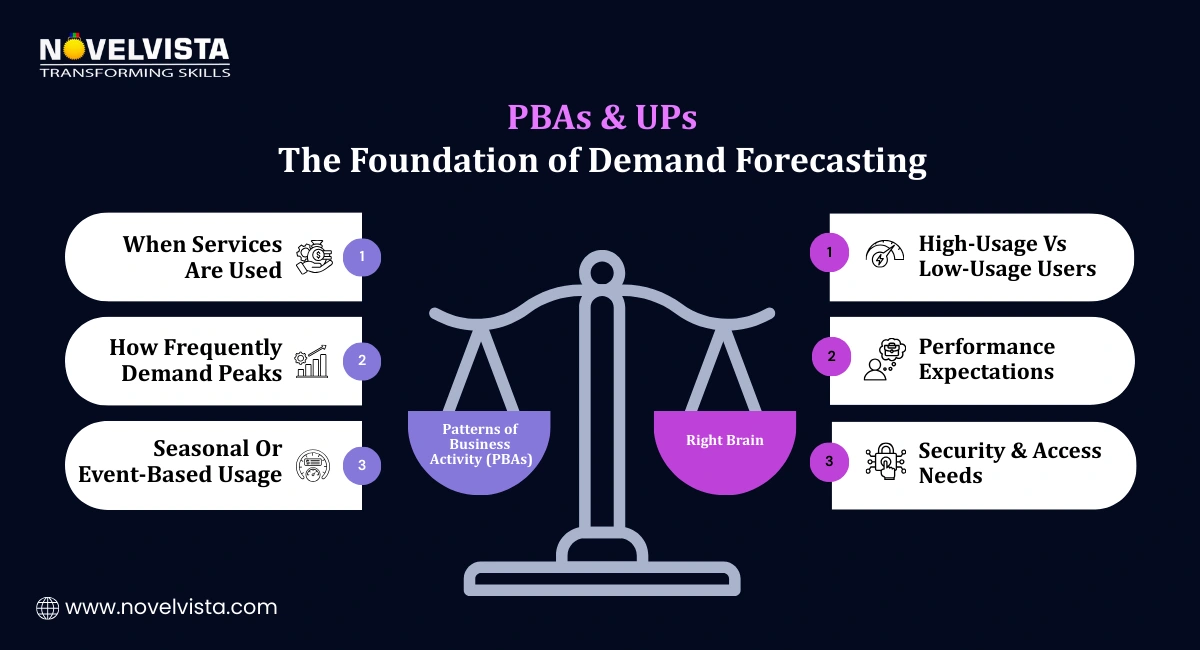
Demand Management ITIL operates within the service relationship model, where business processes create demand and IT services are designed to fulfill that demand. This direct relationship ensures that service usage reflects real business needs rather than assumptions.
Because demand originates from business activities, this model highlights why demand management is not just an IT function. Instead, it is a business-driven activity that aligns IT services closely with organizational objectives.
In ITIL 4, Demand Management is classified as a General Management Practice, highlighting its strategic importance across the organization. Unlike earlier versions, ITIL 4 integrates demand management more closely with business planning and ongoing stakeholder engagement.
The ITIL 4 Demand Management Practice works alongside Relationship Management to understand business priorities, Capacity and Performance Management to plan resources effectively, and Service Financial Management to control costs and optimize investments.
By shifting the focus from rigid processes to value streams, ITIL 4 makes Demand Management ITIL more flexible, collaborative, and outcome-driven.
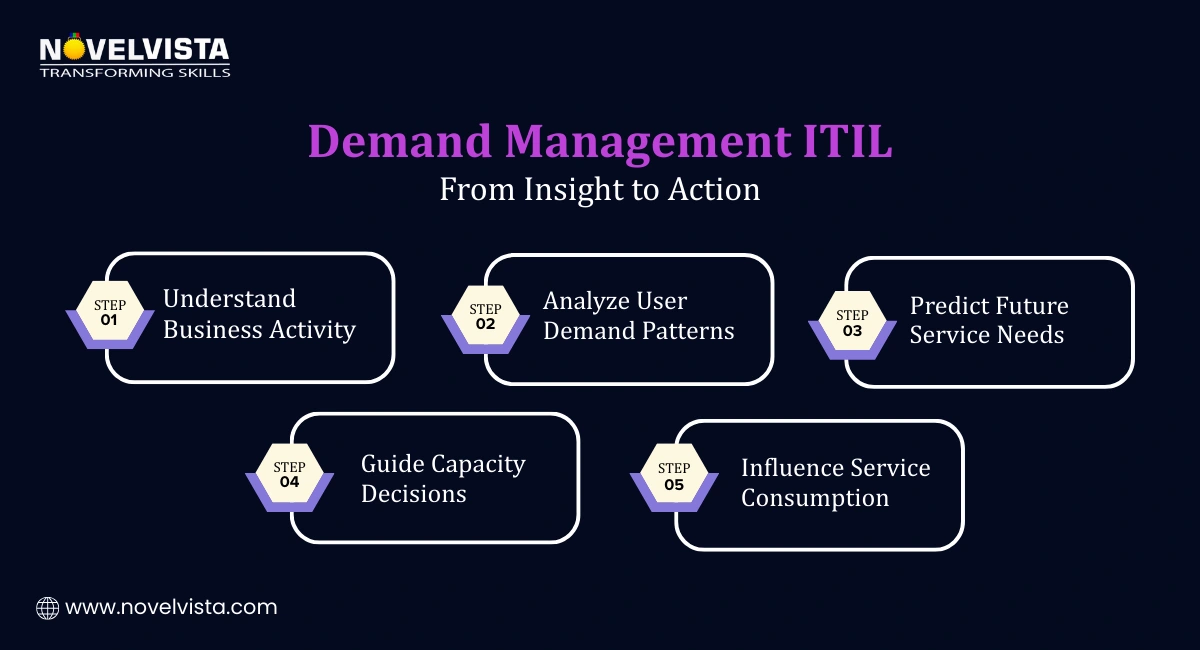
Here’s a simplified view of how it operates in real organizations:
The first step in Demand Management ITIL is analyzing how business processes use IT services during normal and peak periods. By identifying Patterns of Business Activity (PBAs), organizations gain visibility into transaction volumes, peak usage times, and recurring demand trends.
User Profiles (UPs) group users based on their usage patterns, performance expectations, and service requirements. This helps ITIL Demand Management understand how different user groups consume services and tailor demand forecasts more accurately.
Demand forecasting uses insights from PBAs and UPs to predict future service demand. In ITIL 4 Demand Management, forecasts consider seasonal trends, business growth, and upcoming initiatives to reduce uncertainty and improve planning.
Accurate demand forecasts are shared with Capacity and Performance Management teams. This collaboration ensures infrastructure and resources are planned based on real business demand, not assumptions.
Demand Management ITIL influences consumption through measures such as tiered services, automation, and usage policies. These actions help manage peak demand efficiently while maintaining service quality and cost control.
This structured approach ensures IT can meet demand without over-investing.
Implementing Demand Management ITIL delivers measurable business and IT benefits:
These benefits make a critical enabler of modern digital services.
Aspect |
Demand Management ITIL |
Capacity Management |
Primary Focus |
Understanding and Influencing Demand |
Ensuring Infrastructure can Meet Demand |
Key Question |
Why and When are Services Used? |
Do we have Enough Resources? |
Perspective |
Business-Driven |
Technical and Operational |
Main Output |
Demand Forecasts and Usage Insights |
Capacity Plans and Performance Targets |
Role in ITIL 4 |
Informs Capacity and Service Planning |
Implements Resource Planning Decisions |
Despite its benefits, organizations face challenges when implementing ITIL Demand Management:
ITIL 4 addresses these challenges by promoting collaboration, continual improvement, and value-focused practices.
To succeed with it, organizations should focus on business outcomes rather than only technical metrics. Combining historical data with business forecasts improves the accuracy of demand planning.
Engaging stakeholders early and reviewing demand patterns regularly helps teams stay aligned with changing business needs. Integrating Demand Management ITIL into service design and strategy ensures it becomes a sustainable, ongoing capability rather than a one-time effort. Effective It relies on clearly defined ITIL Roles and Responsibilities to ensure demand insights translate into consistent service outcomes.
In a world of unpredictable digital demand, reactive IT is no longer enough. Demand Management ITIL provides a structured, business-aligned approach to understanding and managing service demand.
By leveraging the ITIL 4 Demand Management Practice, organizations can balance supply and demand effectively—delivering reliable services without unnecessary costs. When demand becomes predictable, IT transforms from a cost center into a strategic partner.
If you want to apply Demand Management ITIL concepts with confidence and understand how ITIL 4 helps balance supply and demand in real-world environments, building a strong ITIL foundation is essential. NovelVista’s ITIL® 4 Foundation Certification Training is designed for IT professionals, service managers, and aspiring ITSM practitioners who want practical, business-aligned knowledge—not just theory.
This course helps you understand core ITIL 4 practices, including ITIL 4 Demand Management, capacity planning, service value streams, and continual improvement. With expert-led sessions, real-world examples, and exam-focused preparation, you’ll gain the skills needed to support reliable services, prevent outages, and align IT with business goals in modern digital organizations.
Start your ITIL 4 journey today
Author Details

Course Related To This blog
ITIL4 Specialist Monitor Support and Fulfil Certification
ITIL4 Specialist Acquiring & Managing Cloud Services
ITIL 4 Specialist Sustainability in Digital & IT
ITIL® 4 Strategic Leader Digital And IT Strategy (DITS)
ITIL® 4 Specialist Drive Stakeholder Value
ITIL® 4 Specialist High Velocity IT
ITIL® 4 Strategist Direct, Plan & Improve
ITIL® 4 Specialist Create Deliver & Support
ITIL® 4 Foundation Certification
Confused About Certification?
Get Free Consultation Call
Stay ahead of the curve by tapping into the latest emerging trends and transforming your subscription into a powerful resource. Maximize every feature, unlock exclusive benefits, and ensure you're always one step ahead in your journey to success.