Category | IT Service Management
Last Updated On 10/01/2026
Despite massive investments in technology, nearly 70% of digital transformation initiatives fail, not because of poor technology, but due to misalignment between IT and business goals. Organizations often ask: Why doesn’t IT understand what the business really needs? Or Why do IT services fail to deliver measurable value?
This is exactly where ITIL Business Relationship Management plays a critical role.
As businesses become more customer-centric and outcome-driven, IT can no longer operate as a back-office support function. It must act as a strategic partner. Business Relationship Management ITIL provides the structured approach needed to bridge this gap.
In this blog, we’ll smoothly walk through what ITIL Business Relationship Management is, why it matters, how it works in ITIL 4, and how it helps organizations align IT with real business goals.
It is a practice focused on establishing, maintaining, and strengthening effective relationships between IT service providers and business stakeholders. The primary objective of Business Relationship Management in ITIL is to ensure that IT services consistently meet both current and future business needs while delivering clear, measurable value. At its core, ITIL emphasizes understanding business objectives, managing stakeholder expectations, and ensuring ongoing satisfaction with IT services. Unlike reactive approaches that concentrate only on incidents or service requests, ITIL 4 Business Relationship Management adopts a proactive mindset, anticipating business demands, influencing service design, and shaping IT offerings to support strategic business outcomes.
Modern businesses operate in fast-changing environments where customer expectations evolve rapidly, and without strong relationship management, IT teams risk delivering services that are technically sound but misaligned with real business needs. Business Relationship Management ITIL plays a critical role in preventing this disconnect by improving trust between IT and business units, reducing conflicts caused by unclear or mismanaged expectations, and helping organizations prioritize IT investments based on true business value. Without effective ITIL Business Relationship Management, IT often becomes isolated from strategic decision-making, resulting in misdirected budgets, poorly aligned services, and lower overall stakeholder satisfaction.
The ITIL Business Relationship Management practice is built around clear objectives that support long-term value creation.
ITIL Business Relationship Management ensures that IT teams develop a deep and continuous understanding of business goals, challenges, and growth opportunities. Through ongoing engagement and structured communication, ITIL helps translate business requirements into meaningful IT services. This alignment enables ITIL 4 Business Relationship Management to support informed decision-making and deliver services that directly contribute to business outcomes.
By setting clear and realistic expectations, ITIL helps align what the business expects with what IT can consistently deliver. Regular communication and shared understanding reduce misunderstandings, prevent dissatisfaction, and improve transparency across stakeholders. Through ITIL, IT and business teams build trust by agreeing on service outcomes, priorities, and performance measures upfront.
In ITIL, perception plays a critical role in how IT services are valued by the business. Even high-quality services can be underestimated or overlooked when communication is ineffective or inconsistent. Business Relationship Management ITIL focuses on continuous engagement and feedback, ensuring stakeholders clearly understand service value, which directly improves satisfaction and long-term relationships
It ensures that IT services continually evolve in line with changing business priorities, market conditions, and organizational goals. By maintaining ongoing relationships and feedback loops, Business Relationship Management ITIL helps identify new opportunities for improvement and innovation. This proactive approach enables ITIL 4 Business Relationship Management to consistently co-create and deliver sustained business value over time.
With the introduction of ITIL 4, ITIL 4 Business Relationship Management evolved from a standalone process into a value-focused practice aligned with modern service management principles. It is now closely integrated with the Service Value System (SVS), places a strong emphasis on value co-creation, and works in coordination with related practices such as Service Level Management and Continual Improvement. Unlike earlier versions, it clearly recognizes that value is not delivered by IT in isolation but is co-created through ongoing collaboration between IT service providers and business stakeholders.
A successful implementation depends on clearly defined roles.
Business Relationship Manager (BRM)
The Business Relationship Manager (BRM) serves as the single point of contact between IT service providers and business stakeholders, ensuring clear, consistent, and strategic communication. Within ITIL, the BRM plays a critical role in understanding business needs, conveying expectations, and representing stakeholder interests within IT. By maintaining strong relationships, the Business Relationship Manager helps align IT services with business objectives and supports value co-creation under ITIL 4.
Key responsibilities include:
Strong communication, negotiation, and strategic thinking skills are essential for this role.
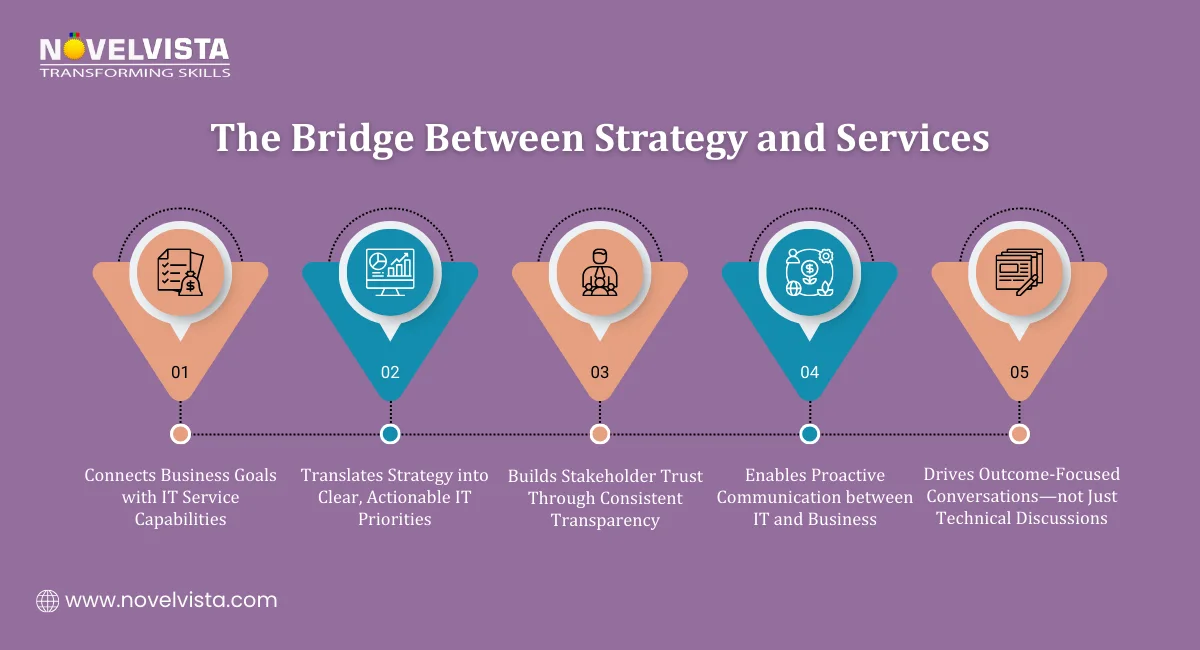
Alignment doesn’t happen by chance; it requires structure, clear communication, and meaningful measurement, all of which are provided. Through Business Relationship Management ITIL, business goals are translated into well-defined IT service requirements, IT initiatives are prioritized based on their business impact, and success is measured using outcome-based metrics rather than purely technical KPIs. This structured approach enables IT to shift’s role from a reactive “order taker” to a proactive, trusted business advisor. Understanding ITIL Business Relationship Management also helps you confidently answer ITIL interview questions, as this practice is key to aligning IT services with business goals.
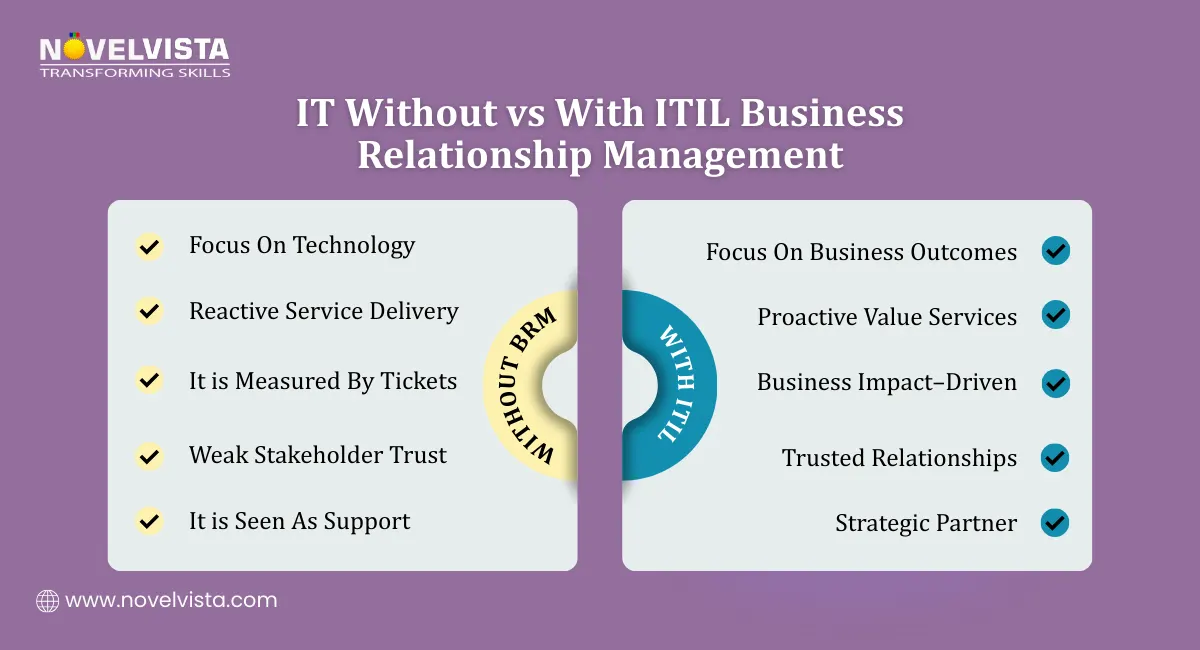
To get real value from ITIL Business Relationship Management, organizations should follow proven best practices:
Consistency and communication are key to sustaining strong relationships.
Even with ITIL guidance, organizations often make avoidable mistakes:
Avoiding these pitfalls ensures long-term strategic benefits.
In today’s value-driven digital landscape, aligning IT with business goals is no longer optional; it is essential for sustained success. ITIL Business Relationship Management provides a structured framework that helps organizations build trust, strengthen collaboration, and ensure IT services consistently deliver meaningful business outcomes. By adopting ITIL 4 Business Relationship Management, organizations move beyond traditional service delivery toward continuous value co-creation, positioning IT as a strategic partner that actively supports innovation, growth, and long-term business success.

Enroll in NovelVista’s ITIL® 4 Foundation Certification Training and build a solid understanding of modern ITIL practices, including ITIL Business Relationship Management, the Service Value System, and value co-creation principles. Designed for IT professionals, managers, and aspiring ITSM leaders, this course equips you with practical insights, real-world scenarios, and globally recognized credentials to help you become a trusted business partner, not just a service provider.
👉 Start your ITIL 4 Foundation journey today
Author Details

Course Related To This blog
ITIL4 Specialist Monitor Support and Fulfil Certification
ITIL4 Specialist Acquiring & Managing Cloud Services
ITIL 4 Specialist Sustainability in Digital & IT
ITIL® 4 Strategic Leader Digital And IT Strategy (DITS)
ITIL® 4 Specialist Drive Stakeholder Value
ITIL® 4 Specialist High Velocity IT
ITIL® 4 Strategist Direct, Plan & Improve
ITIL® 4 Specialist Create Deliver & Support
ITIL® 4 Foundation Certification
Confused About Certification?
Get Free Consultation Call
Stay ahead of the curve by tapping into the latest emerging trends and transforming your subscription into a powerful resource. Maximize every feature, unlock exclusive benefits, and ensure you're always one step ahead in your journey to success.