Category | IT Service Management
Last Updated On 08/01/2026
According to industry studies, nearly 30% of IT assets remain underutilized or completely unused, while organizations overspend millions annually on redundant hardware, expired licenses, and poorly tracked software. At the same time, data breaches caused by unmanaged or forgotten IT assets continue to rise, exposing businesses to serious security and compliance risks.
This is where the ITIL Asset Management Lifecycle becomes critical.
Many organizations still treat asset management as a basic inventory exercise, tracking laptops, servers, or licenses in spreadsheets. But modern IT environments are far more complex. Cloud services, remote work, SaaS subscriptions, and rapid scaling demand a structured and disciplined approach to managing assets from acquisition to disposal.
So who is this guide for?
In this guide, we’ll break down the ITIL Asset Management Lifecycle, explain each stage of the asset journey, share ITIL Asset Management Best Practices, highlight optimization strategies, and expose common mistakes that silently drain IT budgets.
The ITIL Asset Management Process is a structured approach to managing IT assets throughout their entire lifecycle to maximize value, control risks, and support business objectives. Unlike traditional asset tracking, which focuses mainly on listing assets, ITIL emphasizes how assets actively contribute to IT services, influence costs, and impact business outcomes across the organization. In Asset Management ITIL, an asset is defined as anything that delivers value. This includes hardware, software, licenses, cloud resources, and even knowledge assets. The objective is not simply to know what assets exist, but to clearly understand who owns them, how they are being used, what they cost over time, and what risks they carry throughout their lifecycle. This approach plays a vital role in ITIL Asset Management Lifecycle IT Management, ensuring assets are governed consistently across planning, service delivery, and continual improvement. By aligning asset decisions with business strategy, the ITIL Asset Management Process helps organizations move away from reactive, ad-hoc asset handling and toward a more controlled, value-driven model of IT management.
The ITIL Asset Lifecycle represents the journey an asset takes from its initial planning stage to final disposal. This lifecycle approach ensures accountability, transparency, and value realization at every step.
Instead of viewing assets as one-time purchases, ITIL Asset Lifecycle Management treats them as evolving components of IT services. Each stage adds, protects, or extracts value while minimizing risk and waste.
Lifecycle thinking also supports better decision-making. When teams understand where assets sit in their lifecycle, they can forecast costs accurately, avoid service disruptions, and plan replacements proactively, key principles in ITIL’s service value system and continual improvement model. The ITIL Asset Management Lifecycle works closely with ITIL Service Level Management to ensure assets consistently support agreed service performance and business outcomes.
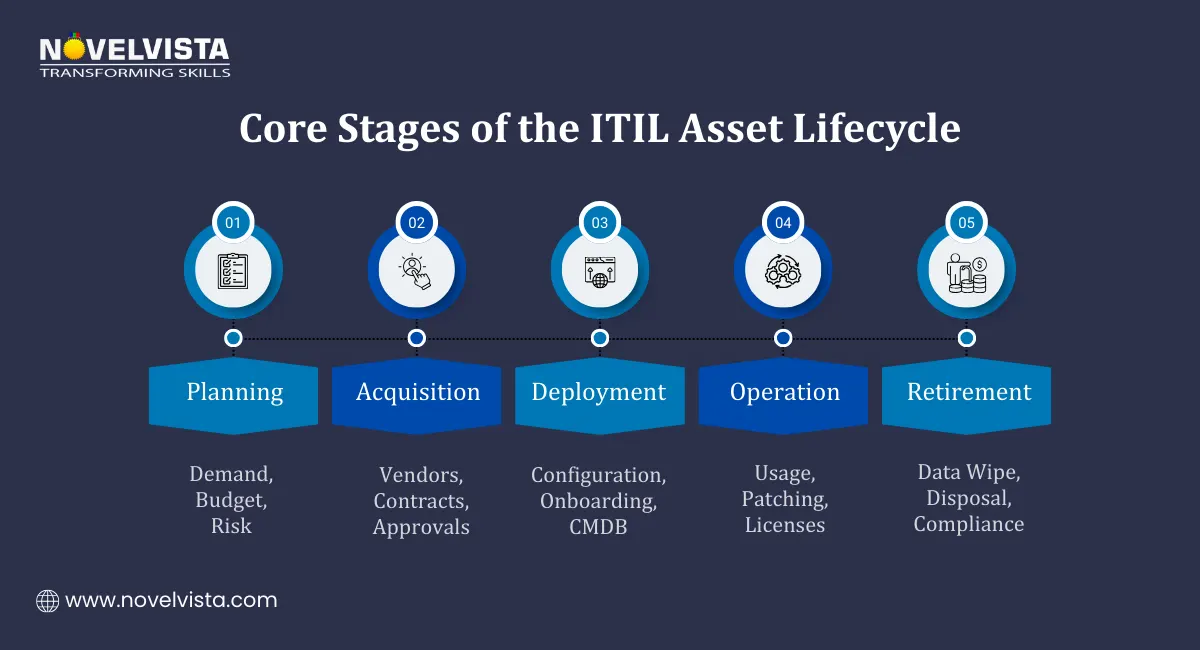
Planning is the foundation of the ITIL Asset Management Lifecycle, focusing on understanding business demand, service requirements, and future growth. This stage involves forecasting asset needs based on service demand, defining budgets and total cost of ownership (TCO), and identifying risks, dependencies, and compliance requirements early on. Strong planning ensures that assets support business goals rather than becoming financial liabilities. In ITIL Asset Management Lifecycle IT Management, weak planning often results in overspending, asset sprawl, and reactive purchasing that undermines long-term value.
Acquisition is the stage where assets are sourced and formally brought into the organization, covering vendor selection, procurement approvals, and contract management. Effective ITIL Asset Management ensures that suppliers meet technical and compliance standards, contracts clearly define ownership, licensing, and renewal terms, and assets are registered and documented from day one. By aligning procurement decisions with lifecycle planning, organizations avoid mismatched purchases and ensure assets deliver value throughout the ITIL Asset Lifecycle. It also enables efficient Service Request Management by ensuring assets are available and ready for use.
Deployment moves assets into active use and includes installation, configuration, testing, and assigning assets to users or services. Successful deployment relies on accurate configuration records in the CMDB, clear ownership and responsibility, and seamless integration with existing IT services. Tracking assets early strengthens ITIL Asset Lifecycle Management, ensuring visibility and traceability before assets begin impacting live operations.
Operation and Maintenance is the longest and most value-driven phase of the ITIL Asset Management Lifecycle, where assets actively support business services and require consistent oversight. This stage includes monitoring performance and utilization, applying patches, updates, and upgrades, managing licenses and warranties, and conducting repairs and maintenance. Effective operation prevents service outages, ensures compliance, and maximizes ROI, while poor management often leads to unused licenses, security vulnerabilities, and escalating costs.
Retirement and Disposal mark the final stage of the asset journey, as all assets eventually reach the end of their useful life. This stage is critical for security, compliance, and cost control, and includes secure decommissioning and access removal, data sanitization to prevent breaches, and recycling, resale, or compliant disposal. Neglecting this phase creates serious risks, as forgotten assets often become entry points for cyberattacks and audit failures, ultimately undermining the entire ITIL Asset Management Process.
Implementing the ITIL Asset Management Lifecycle successfully requires more than theory. Practical execution matters.
Key ITIL Asset Management Best Practices include:
These practices reduce waste, improve governance, and support informed decision-making across IT operations.
Optimization ensures assets deliver maximum value throughout their lifecycle.
Effective strategies include:
Optimized ITIL Asset Lifecycle Management transforms asset management from a cost center into a strategic capability that supports business growth.
Despite good intentions, many organizations struggle with asset management due to recurring mistakes.
Common pitfalls include:
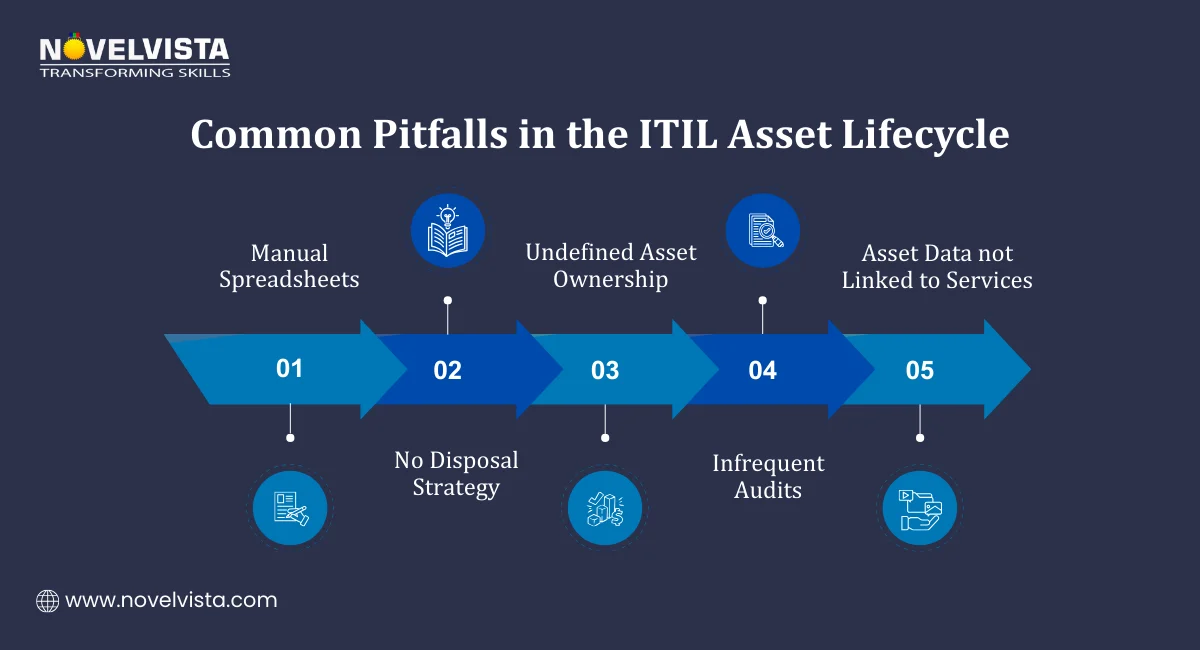
Avoiding these issues requires discipline, automation, and strong governance aligned with ITIL principles.
Lifecycle Stage |
Key Actions |
Tools / Metrics |
Planning |
Demand Forecasting |
Budget Models |
Acquisition |
Supplier Evaluation |
Contract Templates |
Deployment |
User Onboarding |
CMDB Updates |
Operation & Maintenance |
Patch and License Tracking |
Utilization KPIs |
Disposal |
Secure Data Wipe |
Compliance Audits |
This checklist helps teams implement the ITIL Asset Management Lifecycle in a structured and measurable way.
The ITIL Asset Management Lifecycle provides a proven framework to manage IT assets with clarity, control, and purpose. By treating assets as lifecycle-driven investments rather than one-time purchases, organizations gain better visibility, reduce risk, and optimize costs.
Strong ITIL Asset Lifecycle Management is no longer optional. In today’s fast-moving digital environments, it is essential for scalability, security, and sustainable IT operations.
Teams that move beyond simple tracking and embrace lifecycle thinking unlock the true value of their IT assets, today and in the future.

To truly apply the ITIL Asset Management Lifecycle in real-world environments, a strong understanding of ITIL principles is essential. For professionals looking to build that foundation, NovelVista’s ITIL® 4 Foundation Certification Training is a practical and well-structured choice. Designed for IT professionals and service management teams, the course offers hands-on insights into ITIL concepts, lifecycle thinking, and service value creation. It equips learners with globally recognized credentials and the confidence to manage IT assets and services more effectively in modern, fast-evolving IT environments, making it a strong starting point for anyone serious about ITIL-driven asset and service management.
Author Details

Course Related To This blog
ITIL4 Specialist Monitor Support and Fulfil Certification
ITIL4 Specialist Acquiring & Managing Cloud Services
ITIL 4 Specialist Sustainability in Digital & IT
ITIL® 4 Strategic Leader Digital And IT Strategy (DITS)
ITIL® 4 Specialist Drive Stakeholder Value
ITIL® 4 Specialist High Velocity IT
ITIL® 4 Strategist Direct, Plan & Improve
ITIL® 4 Specialist Create Deliver & Support
ITIL® 4 Foundation Certification
Confused About Certification?
Get Free Consultation Call
Stay ahead of the curve by tapping into the latest emerging trends and transforming your subscription into a powerful resource. Maximize every feature, unlock exclusive benefits, and ensure you're always one step ahead in your journey to success.