Category | IT Service Management
Last Updated On 12/12/2025
Let’s start with something most teams quietly admit but rarely say out loud — service expectations have jumped, but processes didn’t keep up. Users want quick fixes, stable services, and clear communication, yet many IT teams still struggle to show how well they’re performing. That’s where ITIL Service Level Management steps in and changes the entire game.
This blog gives you a simple, friendly walkthrough of what this practice does, how it works, the agreements you need, the roles involved, the processes behind it, and the best practices that actually improve service performance.
The easiest way to understand this practice is that it keeps services aligned with what customers expect. The ITIL Service Level Management Definition says it ensures services meet agreed performance targets through clear commitments, tracking, and reviews.
Earlier, in ITIL v3, it was treated mostly as a process. In ITIL 4 Service Level Management, it becomes a wider “practice” that connects to value creation, customer experience, and the entire Service Value System. This shift helps teams look beyond paperwork and focus on actual service delivery and user experience.
Why does this matter? Because without proper service commitments, performance tracking becomes messy, and customers never know what they’re getting. With a strong SLM setup, transparency improves, issues become more predictable, and trust grows quickly.
The ITIL 4 approach puts customer experience right at the center. It’s no longer about meeting a number on a dashboard; it’s about understanding what people actually feel when they use your services. That’s why terms like XLAs (Experience Level Agreements) are becoming more common.
ITIL 4 Service Level Management connects deeply with the Service Value Chain, especially “Engage,” “Deliver & Support,” and “Improve.” A good Service Level Manager looks beyond contracts and keeps the whole service journey in view — expectations, performance, communication, and experience.
A few things make SLM work smoothly today:
And in day-to-day life, the Service Level Manager becomes the link that helps teams understand priorities, service targets, and areas needing improvement.
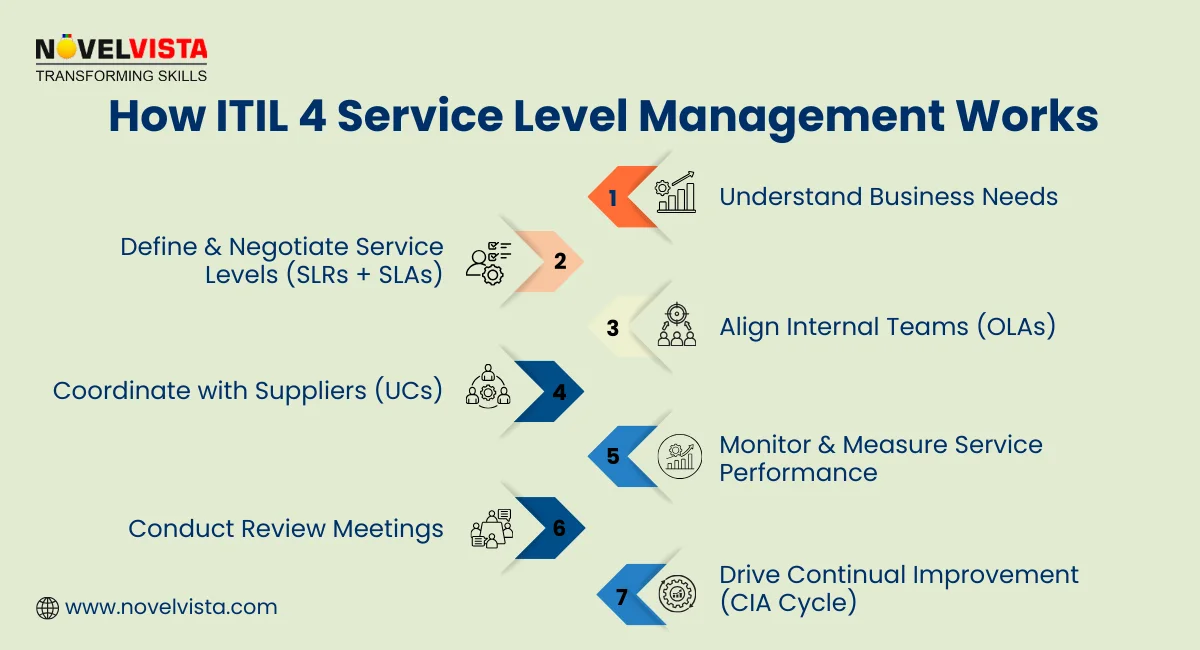
Even though ITIL 4 focuses on the “practice,” the ITIL Service Level Management Process still gives a simple way to understand the flow. Here’s the clean, practical version of how the work actually happens:
Teams collect business needs, user expectations, and technical feasibility to create solid Service Level Requirements. This step sets the stage for every agreement that follows.
Clear targets are defined for availability, uptime, response time, resolution time, and service hours. Both customers and teams agree on what success looks like.
Internal teams sign OLAs, and suppliers sign UCs, ensuring everyone involved supports the SLA commitments.
Daily and weekly tracking happens through dashboards, ITSM tools, and automated measurements. Any breach or trend is flagged early.
Teams walk through monthly or quarterly reports with customers or business leaders. This increases trust and avoids last-minute surprises.
Based on performance, teams update targets, fix root causes, and raise service maturity. This keeps SLAs realistic and services healthy over time.
These process steps reflect globally accepted ITIL guidelines that many organizations follow to keep service performance stable. Industry research consistently shows that teams using structured SLM frameworks reduce breaches and improve customer communication. Our training programs include these same methods, so learners work with practices recognized worldwide.
To make SLM work, a few agreements must stay aligned:
These agreements keep teams aligned and prevent confusion about who owns what.
A strong SLM setup doesn’t work alone. It works well only when the surrounding ITIL practices support it. This is where teams often see real improvement because every practice contributes to better service performance.
We often guide teams through practical simulations that show how Incident, Problem, Change, and Capacity Management impact SLAs together. Most learners are surprised by how quickly SLA stability improves when these practices coordinate. This hands-on understanding helps them manage service outcomes with more accuracy.
Understand Incident, Change, Problem, and Capacity Management in one clean, practical guide. Improve service stability, reduce downtime,
and manage IT operations with total clarity.
Teams that want consistent SLA performance usually follow a handful of simple habits. These best practices help keep the SLM cycle smooth, predictable, and aligned with customer needs.
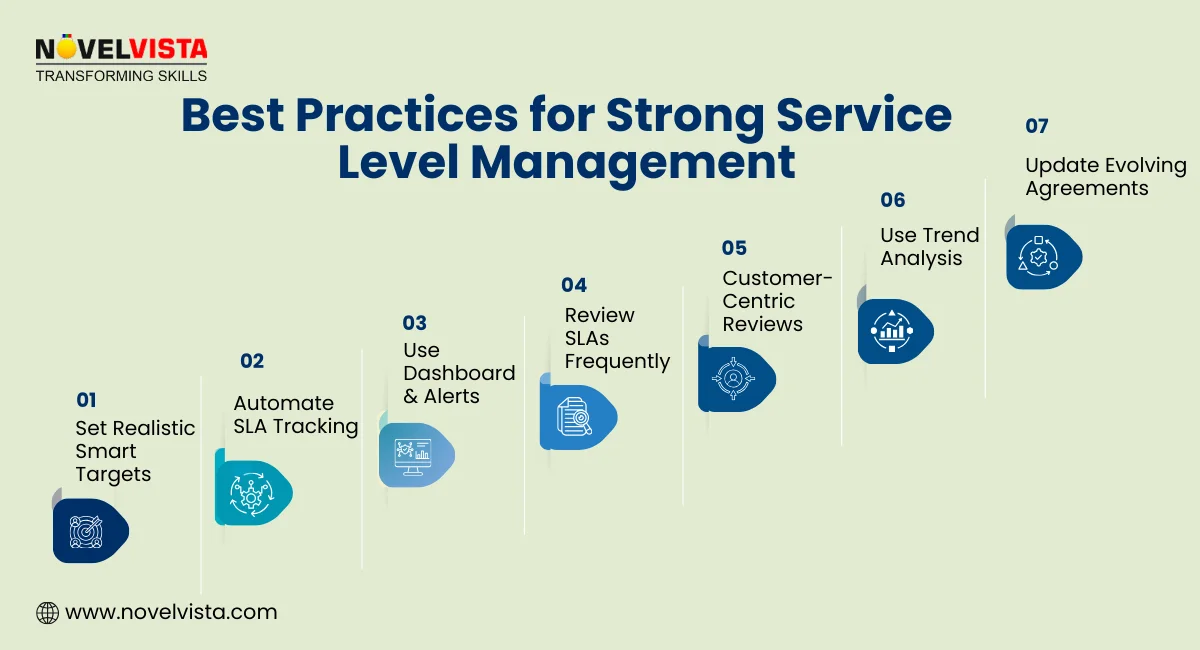
Clear and measurable targets make life easier for both customers and IT teams. They define what success looks like and help avoid confusion during reviews.
Modern tools can send alerts, show trends, and display dashboards automatically. This reduces manual work and helps teams react faster when something goes wrong.
Instead of only talking about numbers, good Service Level Managers discuss how users feel, what frustrates them, and what they want next.
SLA breaches often have patterns behind them. Trends help IT leaders make smarter decisions and reduce repeated issues.
Business needs change, and so should SLAs. Regular updates keep everyone aligned and prevent outdated targets from causing unnecessary stress.
Many professionals attending our ITIL sessions often share how unclear SLAs led to misunderstandings, repeated escalations, and frustrated users. These real stories show that service expectations are rising faster than processes. When teams learn structured SLM practices, they finally understand how to manage commitments clearly and avoid daily service confusion.
Tracking the right numbers helps teams understand whether services are running the way they should. These ITIL KPIs are often used because they show a clear picture of service performance.
The KPIs listed here come from widely used ITSM measurement standards and are part of our certification-aligned curriculum. Learners often appreciate how these metrics simplify reporting and reduce dashboard confusion. Sharing proven, widely accepted indicators ensures the guidance you follow is reliable and practical.
Even mature teams face difficulties with SLM. The good thing? Most issues can be fixed with simple adjustments.
1. Unrealistic targets: Often caused by poor requirement gathering.
Solution: Build SLRs (Service Level Requirements) with customers and technical teams together.
2. Low visibility of performance: This happens when teams use multiple disconnected tools.
Solution: Move to unified ITSM platforms that track SLA status and breaches in one place.
3. Supplier dependency: When a vendor fails to meet commitments, the customer-facing SLA takes the hit.
Solution: Strengthen UCs (Underpinning Contracts) and hold suppliers accountable.
4. Irregular or unclear reporting: Messy reporting creates confusion.
Solution: Standardize dashboards, review cycles, and meeting formats.
Fixing these challenges improves the overall flow and trust within ITIL Service Level Management.
Service Level Management is evolving fast. New expectations and technologies are changing how teams plan, measure, and improve service outcomes.
These trends show how ITIL 4 Service Level Management is becoming smarter, faster, and more aligned with customer expectations.
SLM has become one of the most important parts of modern ITSM because it keeps service expectations clear and performance aligned with what customers want. When teams understand how SLM works, follow strong processes, build clear agreements, track useful metrics, and stay aware of new trends, they deliver better service with fewer surprises.
This blog is shaped by globally recognized ITIL guidance, industry insights, and practical experiences from training thousands of ITSM professionals. By combining real learner scenarios with ITIL best practices, the goal is to offer reliable, actionable knowledge you can use immediately in your service management journey.

If you want to build solid SLM skills and understand ITIL 4 in a practical way, NovelVista’s ITIL 4 Foundation Certification is a great place to start. The training helps you learn how ITIL works, how SLM fits into the framework, and how different practices connect during daily operations. It’s designed for professionals who want confidence, clarity, and real-world application in their ITSM journey.
Author Details

Course Related To This blog
ITIL4 Specialist Monitor Support and Fulfil Certification
ITIL4 Specialist Acquiring & Managing Cloud Services
ITIL 4 Specialist Sustainability in Digital & IT
ITIL® 4 Strategic Leader Digital And IT Strategy (DITS)
ITIL® 4 Specialist Drive Stakeholder Value
ITIL® 4 Specialist High Velocity IT
ITIL® 4 Strategist Direct, Plan & Improve
ITIL® 4 Specialist Create Deliver & Support
ITIL® 4 Foundation Certification
Confused About Certification?
Get Free Consultation Call
Stay ahead of the curve by tapping into the latest emerging trends and transforming your subscription into a powerful resource. Maximize every feature, unlock exclusive benefits, and ensure you're always one step ahead in your journey to success.