Category | IT Service Management
Last Updated On 13/01/2026
A surprising reality of modern IT is that over 70% of IT services today depend on third-party suppliers, cloud providers, software vendors, telecom partners, MSPs, and SaaS platforms. While organizations invest heavily in internal processes and tools, service disruptions often originate outside their direct control. A single vendor outage, missed SLA, or compliance failure can ripple across the entire service landscape.
This growing dependency raises an important question: How well are suppliers actually being managed?
This is where What is Supplier Management in ITIL becomes highly relevant.
Supplier relationships are no longer just procurement concerns; they directly affect service availability, customer satisfaction, regulatory compliance, and business continuity. ITIL recognizes this reality and treats supplier management as a core practice rather than an administrative afterthought.
Before we go deeper, let’s address a few simple questions:
If your IT services rely on external providers, and most do, this guide will help you understand why poor supplier control leads to service disruption and how ITIL provides a structured, practical solution.
Whether you manage cloud vendors, application providers, or infrastructure partners, supplier management impacts your day-to-day service performance.
At its core, What is Supplier Management in ITIL refers to the practice of ensuring that all suppliers and their services are managed effectively to support service delivery and business outcomes.
ITIL Supplier Management focuses on maintaining the right balance between value, cost, quality, and risk when working with third-party suppliers. Its purpose is not just to control contracts but to ensure suppliers consistently meet agreed service levels and contribute positively to the service value chain.
Supplier Management ITIL helps organizations to:
In ITIL, suppliers are considered essential contributors to value creation, not external entities operating in isolation.
Think of IT services like a restaurant. Even if the chef is excellent, the quality of food depends on ingredient suppliers. If vegetables arrive late or ingredients are substandard, the final dish suffers, regardless of internal effort.
Similarly, unmanaged suppliers can quietly become major risks. A vendor may miss response times, fail compliance audits, or change service terms unexpectedly. Without structured oversight, IT teams often react only after services are impacted.
It’s also important to understand the difference:
Supplier Management ITIL brings structure to these relationships, reducing dependency risks and ensuring suppliers support, not hinder, service outcomes.
In ITIL v3, supplier management existed but was often treated as a siloed process focused mainly on contracts and vendor lists. It lacked flexibility and integration with broader service management activities.
ITIL 4 Supplier Management represents a significant evolution. Instead of rigid processes, ITIL 4 emphasizes:
Supplier management in ITIL 4 aligns with the Service Value System (SVS) and supports continual improvement. Suppliers are now integrated into service design, delivery, and improvement activities rather than managed separately.
This makes ITIL 4 more practical and better suited for modern digital environments where cloud and managed services dominate.
The primary objectives of Supplier Management ITIL include:
Rather than reacting to failures, ITIL encourages proactive supplier governance.
Effective ITIL 4 Supplier Management involves several key activities:
Supplier evaluation and selection focus on choosing suppliers that can reliably support IT service goals. This involves assessing technical capabilities, financial stability, security controls, and compliance with regulatory requirements. IT teams also evaluate how well a supplier aligns with business needs and long-term service strategies. Selecting the right supplier early reduces future risks, rework, and service disruptions.
Contract and SLA management ensure that all supplier agreements clearly define service expectations and performance standards. This includes response times, availability targets, security obligations, and escalation procedures. Well-defined contracts help prevent misunderstandings and provide a clear framework for accountability. Effective SLA management also enables faster issue resolution when service levels are not met.
Performance monitoring involves regularly measuring supplier performance against agreed KPIs and SLAs. Reviews help identify trends, recurring issues, and opportunities for improvement before they impact services. Structured performance discussions encourage transparency and continuous improvement. This proactive approach ensures suppliers remain aligned with evolving service and business requirements.
Risk assessment focuses on understanding how supplier-related risks can affect IT services. This includes identifying critical dependencies, single points of failure, and potential security or compliance gaps. Mitigation strategies such as backup suppliers, contract clauses, and contingency plans help reduce exposure. Managing supplier risk proactively supports service continuity and resilience.
Effective relationship management builds trust and collaboration between IT teams and suppliers. Regular communication ensures that expectations, changes, and issues are addressed early. Structured engagement also helps suppliers understand business priorities and service goals. Strong relationships enable quicker problem resolution and encourage suppliers to contribute proactively to service improvement.
The Supplier Manager is the primary role responsible for managing supplier relationships in ITIL. This role ensures that supplier performance aligns with agreed requirements.
Responsibilities include:
Supplier management is not isolated; it requires collaboration across multiple functions to be effective. Understanding Supplier Management ITIL is not only essential for real-world service delivery, but also a key concept covered in the ITIL 4 Exam.
Organizations that implement ITIL Supplier Management effectively experience tangible benefits:
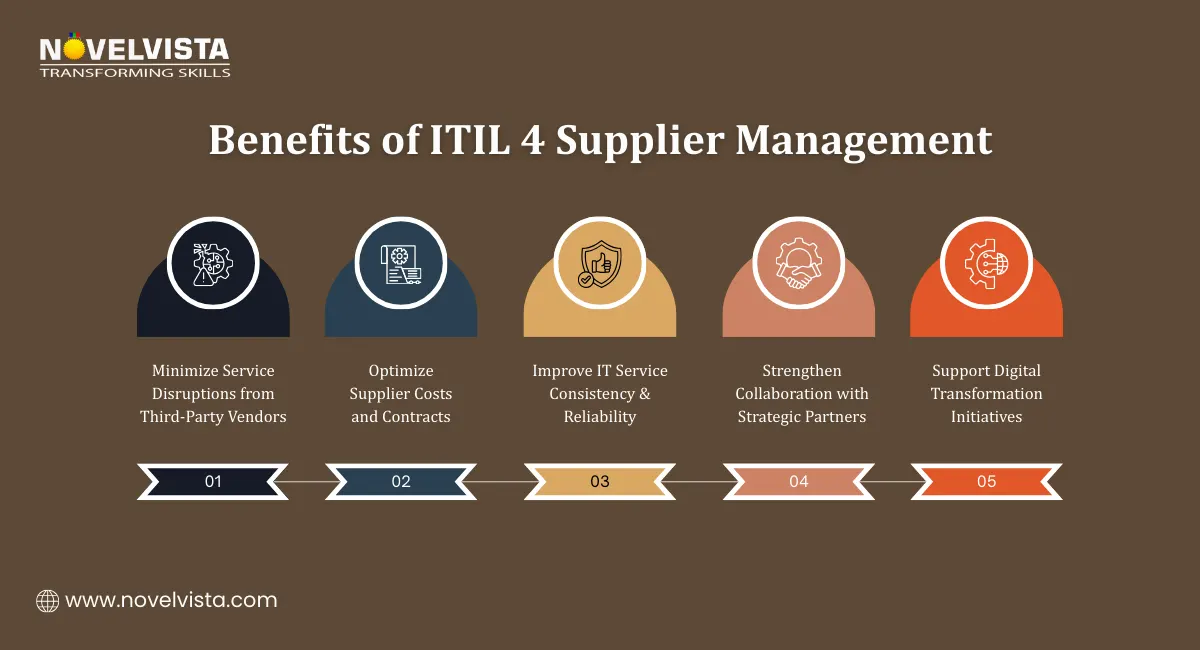
These benefits directly translate into more stable and reliable IT services.
Many organizations struggle with:
ITIL 4 Supplier Management addresses these challenges by providing structured governance, clear accountability, and continual performance monitoring. Instead of firefighting issues, IT teams gain control and predictability.
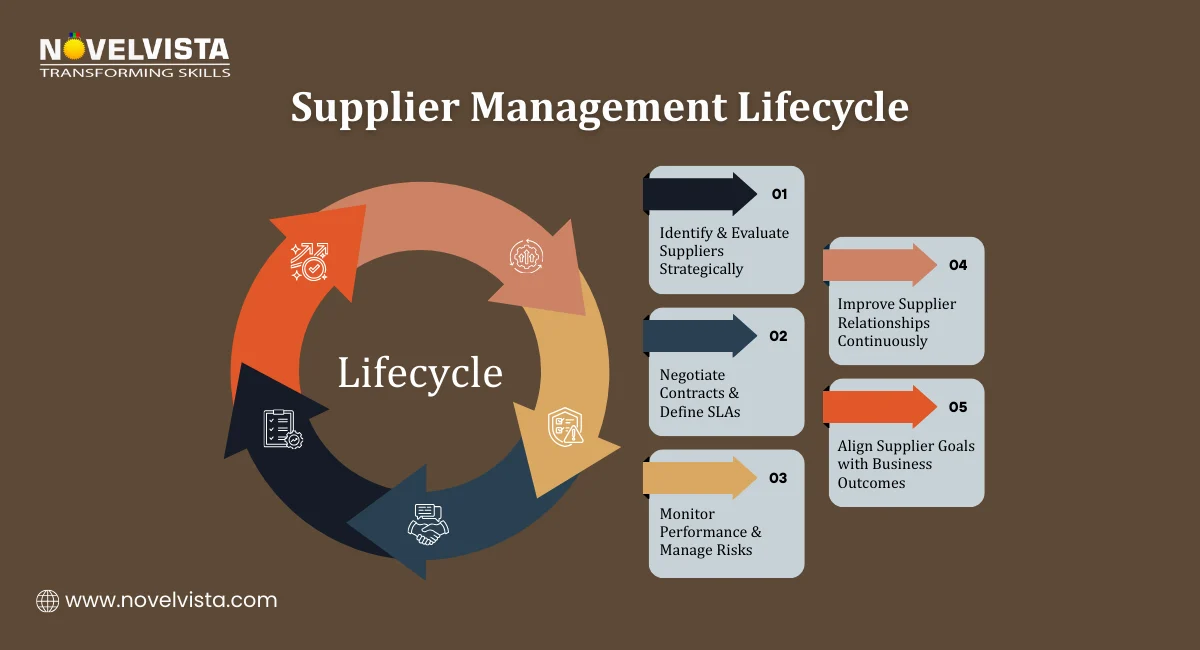
Some proven best practices include:
These practices help organizations move from reactive vendor handling to proactive supplier governance.
Supplier Management ITIL plays a vital role across multiple stages of the ITIL service value chain by ensuring that suppliers actively support service outcomes rather than operate in isolation. During service design, Supplier Management ITIL ensures that suppliers meet required technical, architectural, and security standards before services are built or changed. In service delivery, it supports service availability, performance, and continuity by managing supplier commitments, SLAs, and operational dependencies. Through continual improvement, Supplier Management ITIL leverages supplier performance data and insights to identify improvement opportunities and drive service enhancements. By integrating suppliers into value creation activities, Supplier Management ITIL enables effective value co-creation, which is especially critical in digital transformation initiatives where external expertise and managed services are essential. A strong understanding of Supplier Management ITIL helps you answer practical ITIL Interview Questions with confidence.
In a supplier-driven IT ecosystem, clearly understanding what is Supplier Management in ITIL has become a fundamental requirement rather than a nice-to-have practice. As organizations rely more heavily on cloud services, managed providers, and external partners, even a single poorly managed supplier can disrupt services, increase risk, and impact customer trust—regardless of how strong internal processes may be. ITIL 4 Supplier Management moves organizations beyond reactive contract oversight toward proactive relationship, performance, and value management. By implementing structured supplier governance, IT teams gain better control over service quality, reduce third-party risks, and ensure suppliers remain aligned with evolving business goals.
For IT professionals, developing strong Supplier Management ITIL capabilities is not just about managing vendors, it is about enabling resilient, reliable, and business-focused IT services that can adapt and thrive in a rapidly changing digital landscape.

If you want to apply practices like Supplier Management ITIL more effectively and understand how modern IT services create value, the ITIL® 4 Foundation Certification Training by NovelVista is an excellent next step. This course provides a clear understanding of ITIL 4 principles, the Service Value System, and key practices that support reliable, business-aligned IT services. Designed for IT professionals and ITSM aspirants, it combines practical insights with globally recognized certification to help you confidently manage suppliers, services, and stakeholders in today’s digital environments.
Start your ITIL 4 journey today!
Author Details

Course Related To This blog
ITIL4 Specialist Monitor Support and Fulfil Certification
ITIL4 Specialist Acquiring & Managing Cloud Services
ITIL 4 Specialist Sustainability in Digital & IT
ITIL® 4 Strategic Leader Digital And IT Strategy (DITS)
ITIL® 4 Specialist Drive Stakeholder Value
ITIL® 4 Specialist High Velocity IT
ITIL® 4 Strategist Direct, Plan & Improve
ITIL® 4 Specialist Create Deliver & Support
ITIL® 4 Foundation Certification
Confused About Certification?
Get Free Consultation Call
Stay ahead of the curve by tapping into the latest emerging trends and transforming your subscription into a powerful resource. Maximize every feature, unlock exclusive benefits, and ensure you're always one step ahead in your journey to success.