Category | IT Service Management
Last Updated On 09/09/2026
IT downtime is no longer just an IT problem; it’s a business risk. Industry reports show that the average cost of IT downtime can range from thousands of dollars per minute for mid-sized organizations to millions per hour for large enterprises. Yet, despite advanced tools and skilled teams, many organizations still struggle with delayed incident resolution. One of the biggest reasons? Poor prioritization.
Not every incident deserves the same level of attention, but without a structured approach, service desks often rely on gut feeling, user pressure, or incomplete information. This is where the ITIL Incident Priority Matrix becomes critical. It provides a practical, repeatable way to decide what needs immediate action and what can wait without confusion or conflict.
If you are an IT service desk analyst, incident manager, ITSM professional, team lead, or someone preparing for ITIL certification, this guide is for you. By the end, you’ll clearly understand how the ITIL Priority Matrix works, how impact and urgency drive decisions, and why mastering this concept leads to faster resolution and better service outcomes.
The ITIL Incident Priority Matrix is a decision-making framework used in IT service management to determine the priority of incidents. It ensures incidents are handled based on their business impact and urgency, rather than emotions or noise.
In ITIL, priority is not assigned randomly. It is calculated by evaluating:
This structured approach allows teams to focus their time and resources where they matter most. When used correctly, the Priority Matrix ITIL reduces resolution delays, improves SLA compliance, and creates consistency across teams.
The ITIL Priority Matrix is essentially a structured grid where impact and urgency intersect to define incident priority. Rather than asking who is shouting the loudest, teams focus on how severely the issue affects the business and how quickly it must be resolved. Within ITIL Incident Management, the priority assigned through the ITIL Incident Priority Matrix directly influences response time, determines the escalation path, guides effective resource allocation, and sets the level of communication urgency. By consistently applying the ITIL Priority Matrix, organizations move away from reactive firefighting and adopt a more controlled, predictable, and business-aligned approach to incident handling.
Understanding the difference between impact and urgency is the backbone of the ITIL Impact Urgency Priority Matrix.
In ITIL, impact measures the extent of business disruption caused by an incident and reflects how widely the issue affects the organization. It helps teams assess how many users are impacted, whether a critical business service is unavailable, and if there is any risk to revenue, regulatory compliance, or organizational reputation. Within the ITIL Impact Urgency Priority Matrix, impact is typically categorized as high, medium, or low based on overall business reach, ensuring incidents are evaluated objectively rather than emotionally.
In ITIL, urgency reflects how quickly an incident must be resolved and focuses on the time sensitivity of the situation rather than its scale. It takes into account factors such as business deadlines, operational cycles, and customer commitments that may be impacted if the issue is delayed. For example, an incident affecting only a few users can still be highly urgent, such as a payroll system problem just before salary processing. By clearly distinguishing urgency from impact, the ITIL Impact Urgency Priority Matrix assigns incident priorities logically and consistently, rather than based on pressure or emotions.
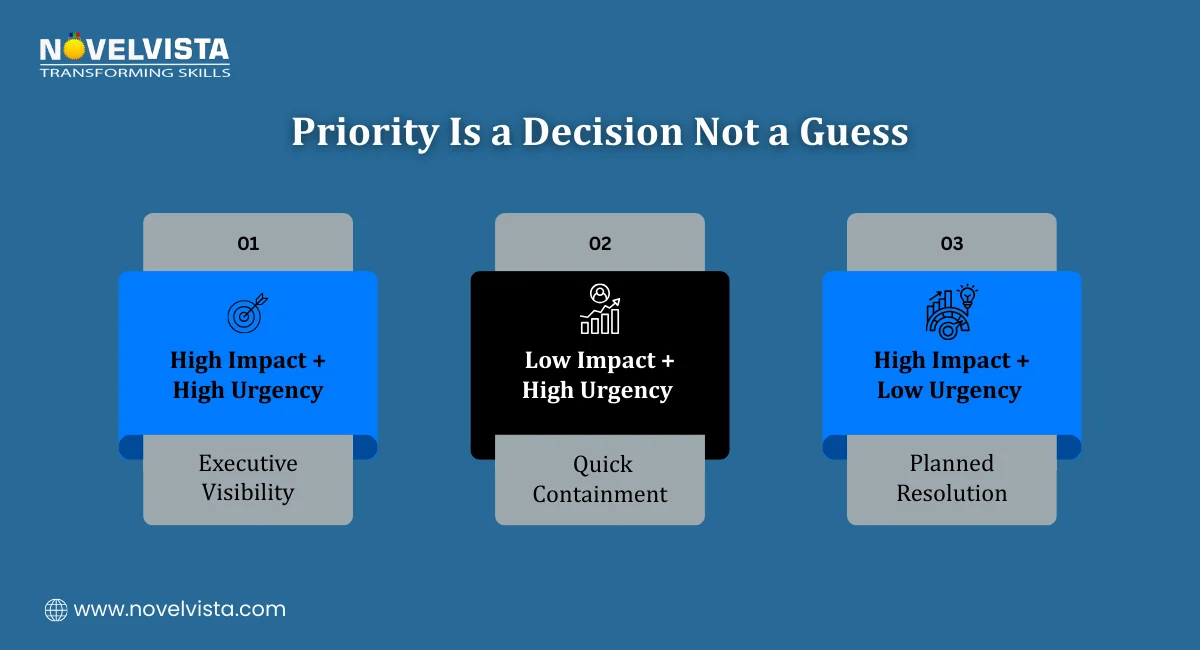
The ITIL Incident Priority Matrix typically results in four main priority levels:
For example:
By mapping impact and urgency together, the Priority Matrix ITIL removes ambiguity and standardizes decision-making. This approach fits seamlessly within the ITIL 4 framework, which emphasizes value-driven service management and faster, business-aligned incident resolution.
Let’s look at how the ITIL Incident Priority Matrix works in real-life situations.
A core ERP system used by all departments is unavailable during peak hours.
Immediate response and executive-level communication are required.
A CRM system used by the sales team is slow but still operational.
Resolution is important but does not require emergency escalation.
One employee cannot access a reporting dashboard used occasionally.
Handled through standard service desk workflows.
These examples show how the ITIL Impact Urgency Priority Matrix keeps teams focused on what truly matters.
Organizations that apply the ITIL Priority Matrix consistently see measurable improvements in incident handling.
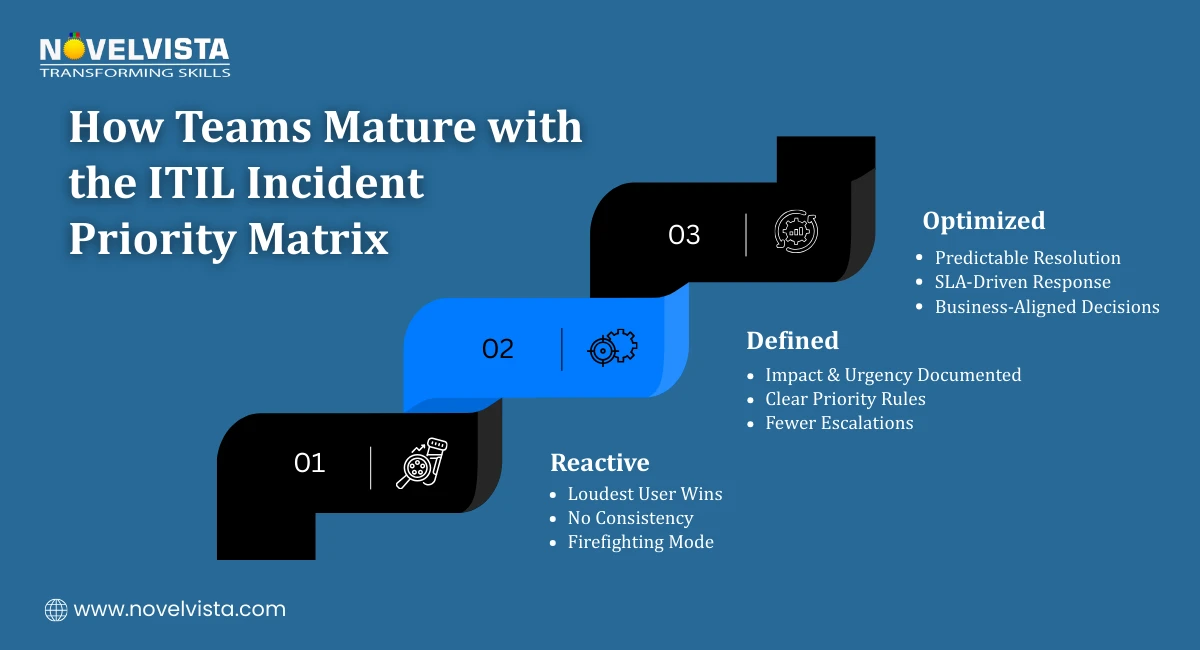
Despite its simplicity, many organizations misuse the ITIL Incident Priority Matrix. One common mistake is confusing urgency with impact. A loud or frustrated user does not automatically mean high impact. Another issue is over-prioritization. When everything becomes P1, nothing truly is. This leads to burnout and SLA breaches. Lack of clear definitions is also a problem. Without documented criteria, teams interpret impact and urgency differently, weakening the effectiveness of the Priority Matrix ITIL. When considering the costs of ITIL 4 Certification, it’s important to see how practical frameworks like the ITIL Incident Priority Matrix directly improve incident handling and business outcomes.
To get real value from the ITIL Priority Matrix, organizations should follow a few best practices. Start by clearly defining impact and urgency levels in business terms, not technical jargon. Align each priority level with SLAs so expectations are transparent. Train service desk teams regularly using real incident examples. This helps build confidence and consistency. Finally, review the ITIL Incident Priority Matrix periodically. As business priorities change, your impact and urgency definitions should evolve too.
The ITIL Incident Priority Matrix is not just a triage tool it’s a source of insight.
By analyzing incident data, organizations can identify patterns such as recurring high-impact incidents or frequent urgent requests. This supports root cause analysis and problem management.
Over time, the ITIL Impact Urgency Priority Matrix helps refine SLAs, improve reporting, and strengthen continual service improvement initiatives.
The ITIL Incident Priority Matrix stands out as one of the most effective tools in ITIL Incident Management because it brings clarity where chaos often exists. By clearly separating impact and urgency, it removes guesswork from decision-making and ensures incidents are addressed in a way that is logical, fair, and aligned with real business priorities. Organizations that consistently apply the ITIL Priority Matrix achieve faster resolution times, stronger SLA compliance, and better use of critical resources. More importantly, it builds trust between IT teams and the business by ensuring the right issues receive attention at the right time. In an environment where downtime is expensive and service expectations are constantly rising, adopting the Priority Matrix ITIL is not just a best practice—it is a necessity for sustainable IT service excellence.

Enroll in NovelVista’s ITIL 4 Foundation Certification Training and build a solid understanding of ITIL principles, practices, and real-world incident management scenarios. Designed for IT professionals, service desk teams, and aspiring ITSM leaders, this course helps you connect theory with practical application, improve decision-making, and deliver faster, business-aligned service outcomes. Gain globally recognized ITIL credentials and take the next step toward IT service excellence.
Start your ITIL 4 Foundation journey today.
Author Details

Course Related To This blog
ITIL4 Specialist Monitor Support and Fulfil Certification
ITIL4 Specialist Acquiring & Managing Cloud Services
ITIL 4 Specialist Sustainability in Digital & IT
ITIL® 4 Strategic Leader Digital And IT Strategy (DITS)
ITIL® 4 Specialist Drive Stakeholder Value
ITIL® 4 Specialist High Velocity IT
ITIL® 4 Strategist Direct, Plan & Improve
ITIL® 4 Specialist Create Deliver & Support
ITIL® 4 Foundation Certification
ITIL V5 Foundation
Confused About Certification?
Get Free Consultation Call
Stay ahead of the curve by tapping into the latest emerging trends and transforming your subscription into a powerful resource. Maximize every feature, unlock exclusive benefits, and ensure you're always one step ahead in your journey to success.