Category | IT Service Management
Last Updated On 18/05/2026
ITIL often feels confusing at first. Too many terms. Too many diagrams. And not enough clarity on how it actually helps day-to-day IT work. That’s exactly why understanding ITIL Concepts matters. They are not rules to memorize. They are ideas that help IT teams deliver services that actually work for the business.
From our experience training ITIL professionals across industries, most confusion around ITIL comes from trying to memorize terms instead of understanding intent. When learners relate ITIL concepts to real service scenarios, decision-making becomes clearer, and ITIL starts making sense in daily work.
This guide breaks down ITIL Concepts in plain language. You’ll understand what they mean, why they exist, and how ITIL 4 focuses on value creation instead of rigid processes. If ITIL ever felt abstract, this article will make it practical.
Many people ask, what are ITIL Concepts really about? The answer is simple: ITIL is built around value co-creation.
The Key Concepts of ITIL explain how service providers and customers work together to create value. Value is not something IT delivers alone. It emerges when services are used effectively.
The backbone of this thinking is the Service Value System (SVS). The SVS shows how all ITIL components work together to turn demand into value. It connects people, processes, practices, and technology in a flexible way.
Rather than strict steps, the Key Concepts of ITIL act like guiding ideas. They shape how services are designed, delivered, and improved over time.
To really understand ITIL 4, it helps to look at the ITIL Core Concepts that define how the framework works in practice.
The Service Value System ensures that all parts of ITIL work together to create value. It connects:
The SVS is one of the most important ITIL Core Concepts because it replaces rigid lifecycles with a flexible system. When we break down the Service Value System during training, learners quickly see how ITIL 4 replaces rigid lifecycle thinking with flexibility. This is especially helpful for teams working in Agile, DevOps, or hybrid service environments.
Another key part of ITIL Core Concepts is the Four Dimensions. They ensure balance when designing and managing services.
Ignoring any one dimension creates gaps. Together, they help teams see the full picture.
ITIL also explains value through two simple ideas:
Many exam scenarios and real-world service failures revolve around misunderstanding utility and warranty. This concept is emphasized heavily in training because it helps professionals balance functionality with reliability, security, and availability.
The Service Value Chain is a core part of ITIL Concepts and shows how value is created through activities rather than stages.
It includes six flexible activities:
These activities can be combined in different ways depending on the situation. This flexibility is what makes ITIL practical in modern IT environments.
The Service Value Chain supports ITIL Core Concepts by allowing teams to adapt instead of following a fixed lifecycle.
Learn how value truly flows through IT services. Explore our guide on the Service Value Chain to gain deeper insight into how activities connect and deliver consistent outcomes.
The ITIL 4 Key Concepts become most visible through the seven guiding principles. These principles are practical reminders that help teams make better decisions, even in complex situations.
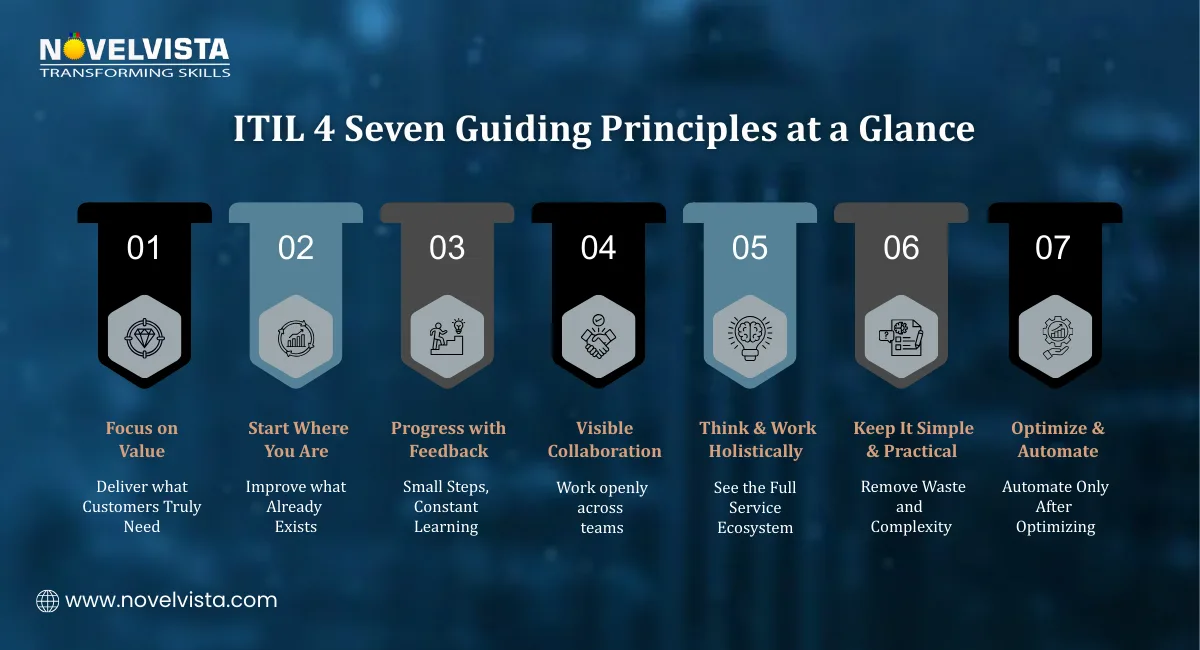
These guiding principles turn ITIL Concepts into daily habits instead of abstract ideas. During training discussions, guiding principles often spark the most engagement because learners recognize them from real workplace situations. These principles help professionals make better decisions even when processes are unclear or changing.
Practices are how ITIL Concepts are applied in real work. ITIL 4 includes practices that support service delivery, improvement, and governance.
Some commonly used practices include:
Governance plays a supporting role. It ensures direction, oversight, and accountability across the Service Value System. Good governance helps organizations apply ITIL 4 Key Concepts consistently, without turning ITIL into bureaucracy. When learning ITIL concepts, it is also important to understand the difference between ITIL Output vs Outcome, as both play a major role in measuring service value and business impact.
Organizations that apply ITIL Concepts effectively often see clear benefits over time.
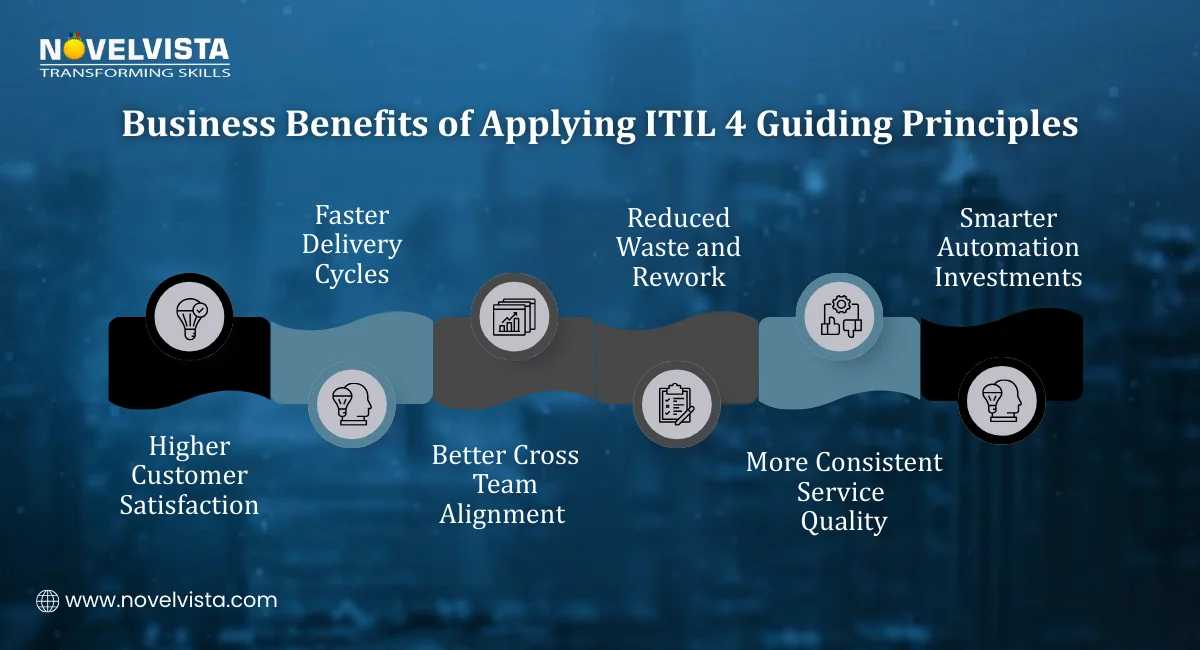
Key benefits include:
By using ITIL Core Concepts, teams stop working in isolation and start contributing directly to outcomes that matter.
Getting started with ITIL doesn’t require a full transformation on day one. The best approach is gradual and practical.
Helpful starting points include:
This approach keeps ITIL flexible and relevant, especially in fast-changing environments.
Discover how ITIL works in real teams. Explore our guide on implementing ITIL to learn practical steps that turn frameworks into everyday service improvements.
ITIL Concepts offer a practical and flexible way to manage IT services in modern organizations. They focus on value, collaboration, and continual improvement rather than rigid processes. The Key Concepts of ITIL help teams design, deliver, and improve services in a way that supports real business outcomes.
More than a framework, ITIL 4 represents a mindset shift, one that encourages learning, adaptability, and shared responsibility for value creation.
The explanations in this guide reflect how ITIL concepts are taught, applied, and assessed in real environments. The goal is clarity and confidence, so readers can use ITIL concepts responsibly, consistently, and effectively at work.

If you want to understand ITIL concepts in a structured and practical way, NovelVista’s ITIL 4 Foundation Certification Training is a great next step. The course explains ITIL concepts in simple language, links them to real ITSM scenarios, and prepares you confidently for the ITIL 4 Foundation exam. It’s ideal for professionals who want clarity, confidence, and a strong base in modern IT service management.
Author Details

Course Related To This blog
ITIL4 Specialist Monitor Support and Fulfil Certification
ITIL4 Specialist Acquiring & Managing Cloud Services
ITIL 4 Specialist Sustainability in Digital & IT
ITIL® 4 Strategic Leader Digital And IT Strategy (DITS)
ITIL® 4 Specialist Drive Stakeholder Value
ITIL® 4 Specialist High Velocity IT
ITIL® 4 Strategist Direct, Plan & Improve
ITIL® 4 Specialist Create Deliver & Support
ITIL® 4 Foundation Certification
Confused About Certification?
Get Free Consultation Call
Stay ahead of the curve by tapping into the latest emerging trends and transforming your subscription into a powerful resource. Maximize every feature, unlock exclusive benefits, and ensure you're always one step ahead in your journey to success.