Category | IT Service Management
Last Updated On 30/07/2026
Imagine your most critical business application crashing at peak hours. Customers are locked out, transactions fail, support tickets flood in and with every passing minute, revenue slips away.
The reality? Over 80% of enterprises experience unplanned downtime each year, and the financial impact can run into thousands of dollars per minute. In today’s always-on digital economy, even a brief disruption can damage both profits and reputation.
So, what ensures that modern IT environments stay stable, responsive, and resilient under pressure?
The answer is ITIL Service Operation, the powerhouse behind consistent, reliable, and high-performance IT service delivery.
Whether you’re:
…understanding Service Operation ITIL is no longer optional, it's essential.
With the evolution to ITIL (Version 5), the traditional approach to operations has transformed. What was once a defined lifecycle stage is now a dynamic, value-driven capability embedded across modern IT ecosystems. Today, ITIL Service Operation Processes play a critical role in ensuring agility, resilience, and seamless user experiences.
In this blog, we’ll break down how ITIL Service Operation fits into ITIL (Version 5) and explore how Service Operation in ITIL continues to power uninterrupted business operations in an increasingly complex digital world.
ITIL Service Operation refers to the set of activities and practices responsible for managing IT services in real time, ensuring they are delivered efficiently and consistently.
In ITIL (Version 5), Service Operation in ITIL is no longer confined to a single stage. Instead, it is embedded across three key lifecycle activities:
Ensures systems run smoothly in real-time
Focuses on consistent service delivery to users
Handles incidents, requests, and user interactions
Together, these form the modern execution layer of Service Operation ITIL.
The purpose of ITIL Service Operation in ITIL 5 goes beyond maintaining systems it focuses on delivering continuous value.
Modern Service Operation ITIL also emphasizes experience-level agreements (XLAs), shifting focus from SLAs to user satisfaction.
To execute ITIL Service Operation Processes, organizations rely on key operational capabilities:
The frontline of IT services.
Responsible for:
This ensures smooth Service Operation in ITIL.
These capabilities ensure that Service Operation ITIL delivers value continuously while also supporting broader organizational goals. Businesses are increasingly recognizing how ITIL Service Management contributes to social responsibilities through improved governance, service quality, and customer-centric IT practices.
Although ITIL 5 emphasizes practices, the foundational ITIL Service Operation Processes remain essential.
The goal is to restore normal service as quickly as possible.
A core pillar of ITIL Service Operation.
Focuses on identifying and eliminating root causes.
This strengthens Service Operation ITIL.
Provides real-time visibility into IT systems.
Critical for modern Service Operation in ITIL.
Handles standard user requests:
Efficient request handling improves productivity.
Ensures secure and controlled access.
An essential part of ITIL Service Operation Processes.
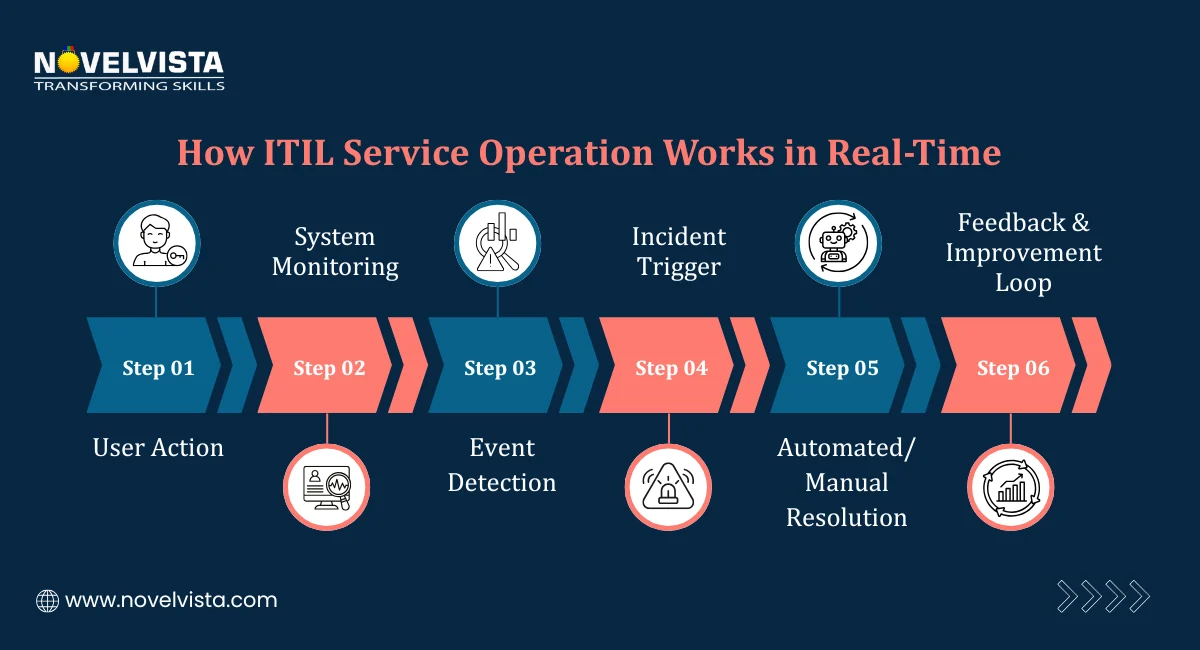
Let’s understand this with a practical example.
Here’s how ITIL Service Operation works:
Meanwhile:
This integrated approach defines modern Service Operation ITIL. ITIL Root Cause Analysis helps organizations identify the underlying causes of incidents to prevent recurrence and improve overall service reliability.
Even with ITIL 5, organizations face challenges:
Hybrid and multi-cloud environments are harder to manage.
Many teams still focus on fixing instead of preventing.
Not all organizations leverage AI effectively.
Lack of expertise in modern ITIL practices.
Multiple tools without integration reduce efficiency.
Addressing these is critical for optimizing Service Operation in ITIL.
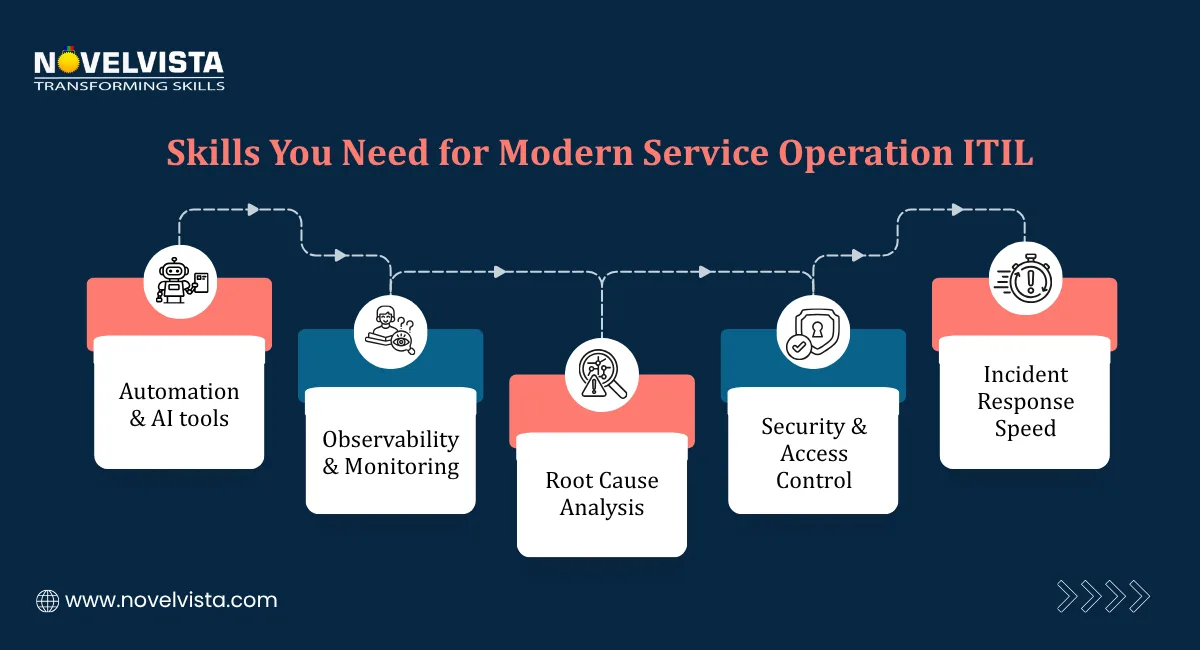
To maximize ITIL Service Operation, organizations should adopt modern strategies:
4. Align with DevOps and SRE
These practices enhance ITIL Service Operation Processes significantly. ITIL (Version 5) Product and Service Lifecycle Explained provides a clear understanding of how modern IT services are designed, delivered, operated, and continuously improved in a value-driven ecosystem.
In a world where downtime equals lost revenue, and poor experiences mean lost customers, ITIL Service Operation stands as the foundation of reliable IT service delivery even as frameworks evolve into ITIL 5.
By integrating Service Operation ITIL across the Operate, Deliver, and Support lifecycle, organizations move beyond basic service management to achieve true operational excellence. The result?
More importantly, mastering ITIL Service Operation Processes in the context of ITIL 5 empowers organizations to shift from reactive firefighting to proactive, intelligent operations.
As digital ecosystems become more complex and user expectations continue to rise, Service Operation in ITIL will not just support IT it will define how efficiently and competitively businesses operate.
Simply put: strong operations are no longer a support function, they are a strategic advantage.
Join NovelVista’s ITIL (Version 5) Foundation Certification Training and gain practical insights into modern Service Operation ITIL, real-world ITIL Service Operation Processes, and the latest Operate–Deliver–Support lifecycle approach. Designed for IT professionals, service managers, and DevOps engineers, this course equips you with the skills to manage Service Operation in ITIL effectively and drive high-performing IT services in today’s digital landscape.
Start your ITIL 5 journey today!

Author Details

Course Related To This blog
ITIL® 4 Foundation Certification
ITIL V5 Foundation
Confused About Certification?
Get Free Consultation Call
Stay ahead of the curve by tapping into the latest emerging trends and transforming your subscription into a powerful resource. Maximize every feature, unlock exclusive benefits, and ensure you're always one step ahead in your journey to success.