Category | IT Service Management
Last Updated On 28/01/2026
Modern organizations run on applications. From customer portals and mobile apps to ERP systems and internal tools, applications sit at the heart of digital business. According to industry reports, over 70% of business outages today are caused by application failures rather than infrastructure issues, and poor application performance can reduce user productivity by up to 40%.
So the real question is no longer whether you manage applications, but how well you manage them.
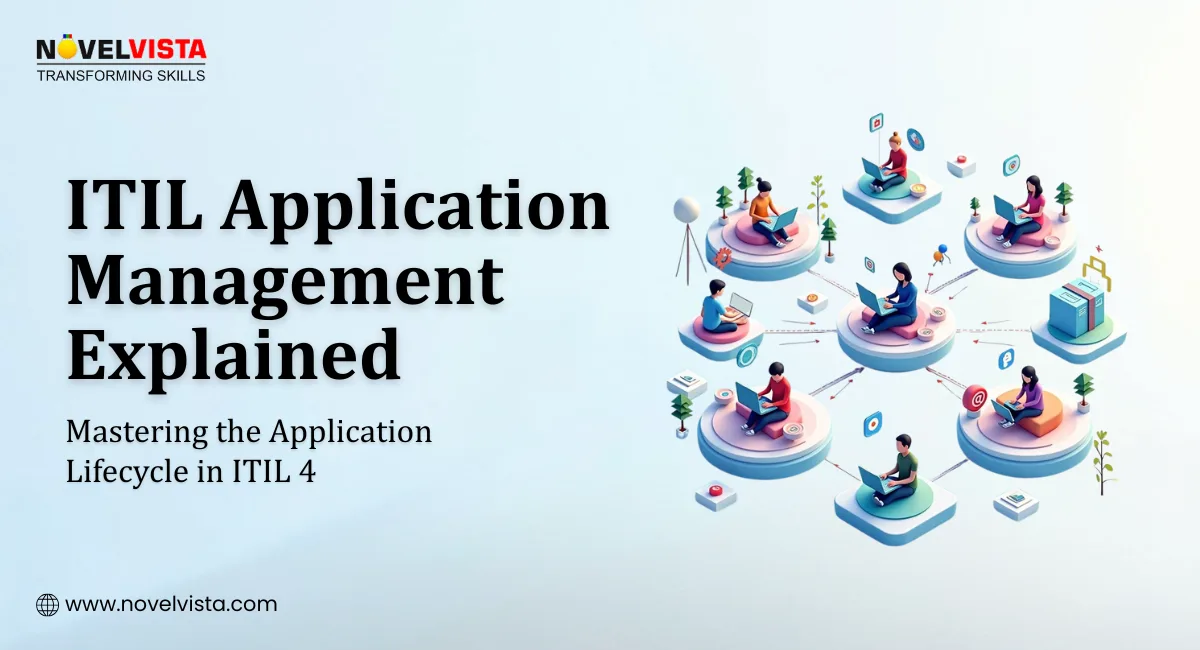
This is where ITIL Application Management becomes critical. In the era of cloud, Agile, DevOps, and continuous delivery, organizations need a structured yet flexible way to manage applications across their entire lifecycle. ITIL 4 Application Management provides exactly that, an approach that aligns applications with business value, service reliability, and continual improvement.
If you’ve ever wondered why applications break despite strong infrastructure, or how IT can keep applications stable while still innovating fast, this guide will help you understand how Application Management ITIL fits into the bigger picture.
It focuses on managing applications across their entire lifecycle, so they consistently deliver business value. Instead of treating software as a one-time development project, ITIL views applications as long-term service assets that must be supported, improved, and eventually retired in a controlled way.
Unlike infrastructure management, which deals with servers and networks, application management is concerned with software functionality, performance, maintainability, and user experience. It ensures that applications are designed with supportability in mind, making them easier to operate and maintain once they go live.
Within ITIL, application management helps identify risks early, manage changes without slowing innovation, and keep applications aligned with evolving business needs. This shift from a “build and forget” mindset to “manage for value” is a core principle of ITIL 4.
ITIL 4 reflects the realities of modern IT environments. Applications are no longer static; they evolve continuously. Cloud-native services, microservices, APIs, and SaaS platforms require tighter coordination between development and operations.
ITIL 4 supports this by:
Rather than slowing teams down, ITIL 4 helps organizations balance speed, stability, and governance, a challenge most IT teams face today.
The Lifecycle provides a structured way to manage applications from idea to retirement. While ITIL 4 is flexible, lifecycle thinking remains essential.
By following the ITIL Application Management Lifecycle, organizations reduce technical debt, avoid service disruptions, and extend application value.
Traditional application lifecycle management often focuses only on development stages such as requirements, coding, and testing. Application Lifecycle Management ITIL, however, takes a broader service-oriented view.
Traditional ALM |
Application Lifecycle Management ITIL |
Development-centric |
Service and Value-centric |
Limited post-deployment Focus |
Full Lifecycle Ownership |
Separate from Operations |
Integrated with Service Management |
Project-based Thinking |
Continuous Lifecycle Thinking |
This makes Application Lifecycle Management ITIL particularly effective in environments where reliability, compliance, and user experience matter as much as speed.
Once applications go live, Application Management ITIL becomes a core part of day-to-day service operations. Application teams collaborate closely with service desks, infrastructure, and development teams to keep services running smoothly. They support incident management by resolving application-related issues, contribute to problem management through root cause analysis, and enable change management by assessing application impacts. By proactively reducing recurring incidents and improving performance, application management ensures applications remain stable, secure, and reliable in real-world use. Behind every stable, high-performing application lies a set of ITIL concepts that guide how services are designed, operated, and improved over time.
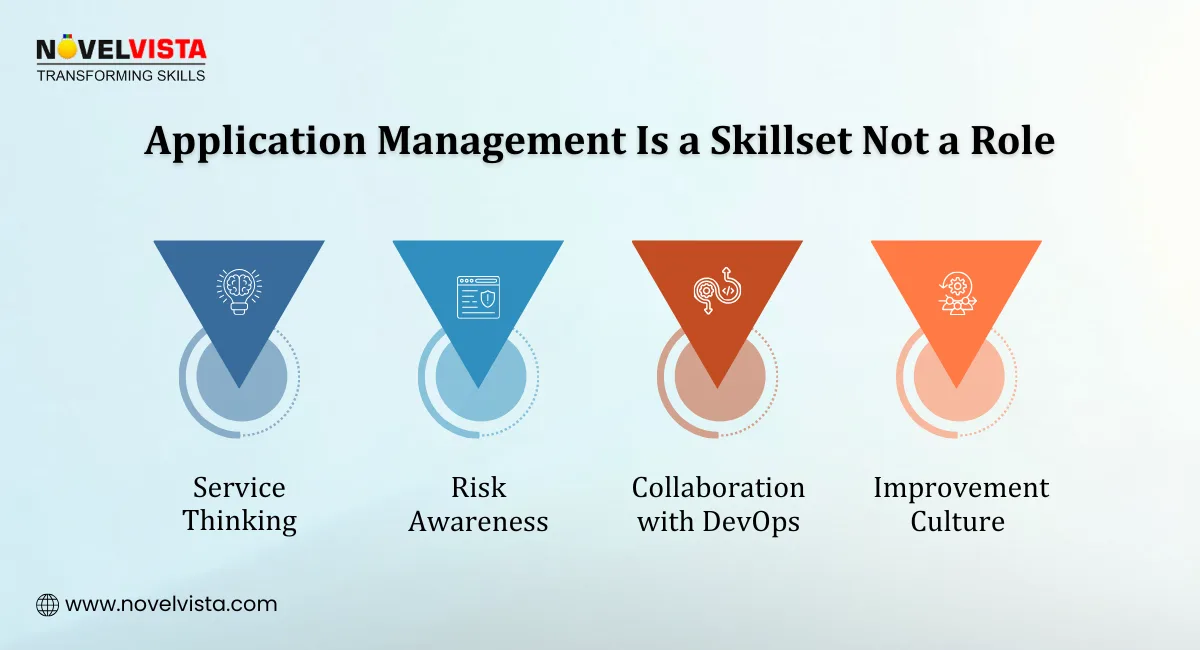
Most organizations have more applications than they realize. Without visibility, costs rise, risks increase, and innovation slows. ITIL Application Portfolio Management addresses this challenge.
An application portfolio provides insight into:
Through ITIL Application Portfolio Management, organizations can decide:
This strategic view is essential for digital transformation and long-term sustainability.
Effective ITIL relies on clear roles and responsibilities. These typically include:
ITIL 4 promotes collaboration rather than rigid silos, allowing teams to move fast while maintaining control.
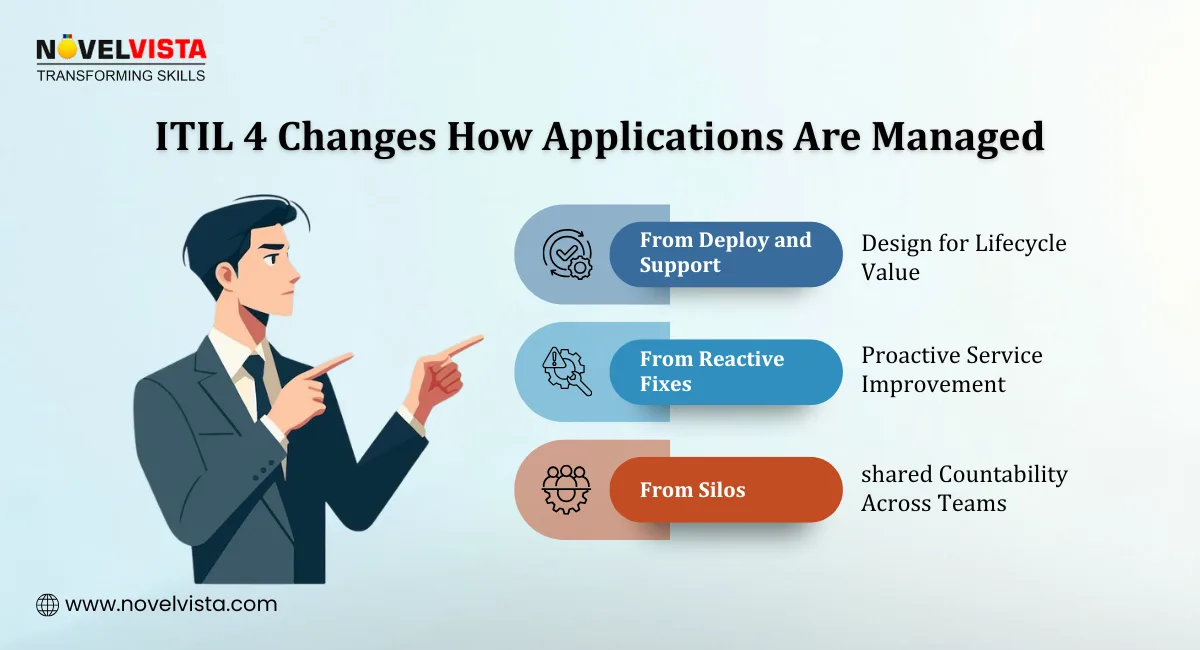
Organizations often struggle with:
ITIL 4 Application Management addresses these issues through lifecycle visibility, governance, and continual improvement without adding unnecessary bureaucracy. Once these concepts are clear, reviewing common ITIL interview questions becomes a practical way to test understanding and apply ITIL principles to real service management scenarios.
When implemented effectively, ITIL delivers measurable benefits:
These benefits make ITIL 4 Application Management a core capability for modern IT organizations.
Applications are no longer just technical components; they are critical business enablers. ITIL Application Management provides the structure organizations need to manage applications responsibly while still enabling innovation.
By adopting lifecycle thinking, leveraging Application Lifecycle Management ITIL, and using ITIL Application Portfolio Management strategically, organizations can reduce risk, improve service quality, and maximize application value.
Mastering ITIL 4 Application Management is not about control; it’s about clarity, collaboration, and continuous value delivery.

If you want to move beyond theory and truly understand how ITIL 4 principles apply to real-world application and service management, the ITIL 4 Foundation course by NovelVista is a strong next step. The course builds a solid grounding in the ITIL 4 Service Value System, lifecycle thinking, and modern practices that support stable, high-performing applications in Agile and DevOps environments. Designed for IT professionals and service managers, it helps you confidently apply ITIL concepts to improve service quality, reduce risk, and deliver consistent business value.
Start your ITIL 4 journey!
Author Details

Course Related To This blog
ITIL4 Specialist Monitor Support and Fulfil Certification
ITIL4 Specialist Acquiring & Managing Cloud Services
ITIL 4 Specialist Sustainability in Digital & IT
ITIL® 4 Strategic Leader Digital And IT Strategy (DITS)
ITIL® 4 Specialist Drive Stakeholder Value
ITIL® 4 Specialist High Velocity IT
ITIL® 4 Strategist Direct, Plan & Improve
ITIL® 4 Specialist Create Deliver & Support
ITIL® 4 Foundation Certification
Confused About Certification?
Get Free Consultation Call
Stay ahead of the curve by tapping into the latest emerging trends and transforming your subscription into a powerful resource. Maximize every feature, unlock exclusive benefits, and ensure you're always one step ahead in your journey to success.