Category | IT Service Management
Last Updated On 16/05/2026
Someone raises a ticket. The issue gets fixed. Everyone moves on.
But then the same issue comes back. And again. And again.
That’s usually where the confusion starts — and where the difference between Help Desk and Service Desk really begins to matter.
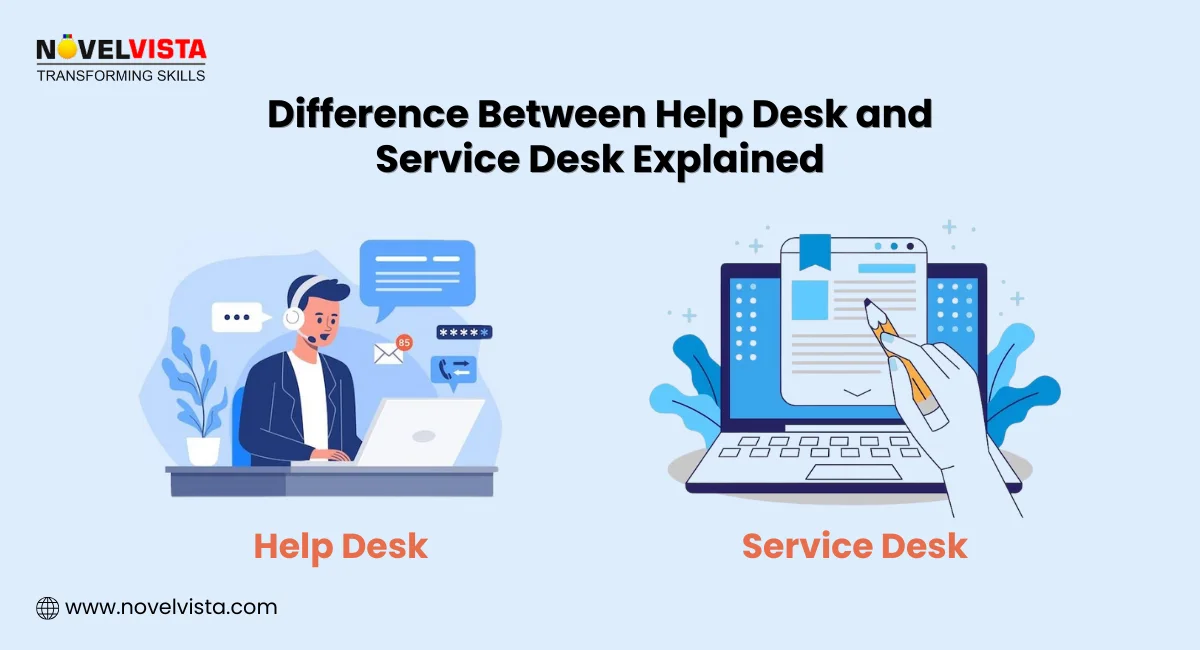
Most teams use these terms as if they mean the same thing. They don’t. And when businesses don’t understand what is the difference between Help Desk and Service Desk, IT support slowly turns reactive, users stay frustrated, and IT teams feel stuck just “putting out fires”.
This blog clears that confusion. You’ll understand what each model actually does, how they work, and how choosing the right one improves efficiency, service quality, and user experience without overcomplicating IT.
A help desk is the most familiar form of IT support. It’s usually the first place users go when something breaks, and they need quick help.
At its core, a help desk focuses on fixing problems after they happen. The goal is simple: resolve the issue and get the user back to work as fast as possible.
Here’s what a typical help desk handles:
Because of this structure, help desks work best for:
This analysis of Help Desk operations comes from working with multiple SMB IT teams and observing recurring patterns in incident resolution, ticketing workflows, and user satisfaction metrics. This allows us to highlight the practical limitations of reactive IT support.
Understand how a help desk really works, what it handles daily, and why it still matters in modern IT. Read the complete blog which explains everything you need to know about ITIL 4 help desk to get the full picture.
As businesses grow, cracks start to show. Repeated issues, no visibility into service quality, and rising user complaints signal the need for something more structured. That’s where the service desk comes into play.
A service desk changes how IT support is viewed. Instead of being a repair shop, it becomes a central hub for managing IT services as a whole.
A service desk acts as a Single Point of Contact (SPOC) for users. But its role goes far beyond logging and fixing incidents.
Here’s what defines a service desk:
This shift in mindset is what separates support from service. And once this difference becomes clear, the Difference between Help Desk and Service Desk starts to feel less about tools and more about purpose.
Curious about how a service desk goes beyond support and enables IT service management? Explore our blog explaining about the Service Desk to understand its role and impact.
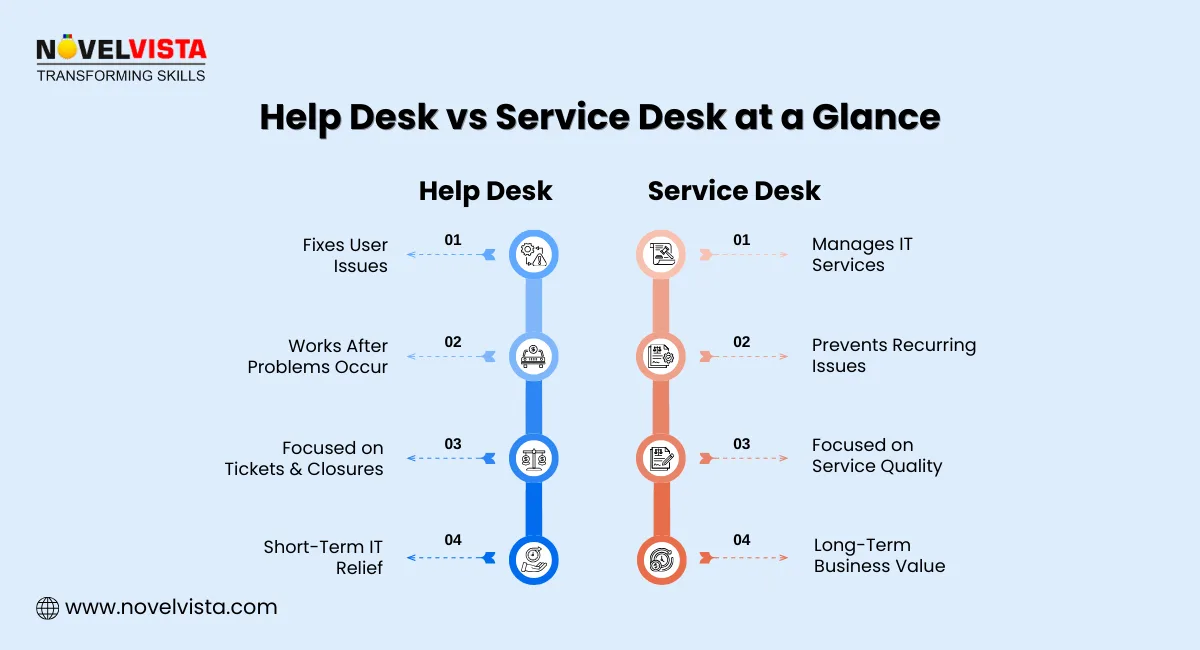
To clearly understand what is the difference between Help Desk and Service Desk, seeing them side by side makes things easier.
Aspect | Help Desk | Service Desk |
Primary Focus | Fixing User Issues Quickly | Managing IT Services End-to-End |
Approach | Reactive, Issue-Based | Proactive and Service-Focused |
Scope | Incidents Only | Incidents, Requests, Changes, Problems |
ITIL Alignment | Limited (Mostly Incident Management) | Full ITSM and ITIL Alignment |
Tools Used | Basic Ticketing Systems | Automation, Self-service, Analytics |
| Business Impact | Short-term Problem Resolution | Long-term Service Improvement |
This table captures the core Difference between Help Desk and Service Desk — not just in tasks, but in how IT contributes to business success. This comparison is based on ITIL-aligned standards and our observations of operational differences in organizations of varying sizes. The distinctions reflect both process maturity and measurable impact on service delivery efficiency.
The distinctions reflect both process maturity and measurable impact on service delivery efficiency. Understanding these differences can also help professionals prepare for real-world support scenarios and common IT Help Desk Interview Questions often asked in IT service management and support roles.
Processes define how consistently and effectively IT support works. This is another area where the gap between the two models becomes very clear.
These processes are fast, but shallow. They solve today’s issue, not tomorrow’s risk.
This depth directly improves service quality, response times, and user satisfaction. Over time, fewer issues occur because services are designed to be stable, not just repaired.
The process differences highlighted are drawn from real IT audits and workflow assessments. We’ve analyzed how reactive versus proactive IT support affects metrics like ticket resolution time, incident recurrence, and user satisfaction, reinforcing why proper ITSM implementation matters.
Sometimes, analogies make IT concepts stick better. Think of it this way:
This analogy helps teams remember the difference between Help Desk and Service Desk in a simple, practical way.
Understand the real differences between a help desk and a service desk. Use clear signals and checklists to see what fits
your organization’s current needs and growth stage.
Help Desks work perfectly in small setups with limited IT demands:
If your company is expanding, relying solely on a Help Desk can lead to bottlenecks and frustration.
A Service Desk shines when IT complexity increases:
Enterprises that care about user satisfaction and operational efficiency typically move toward a Service Desk as their core IT support model.
Many organizations start small with a Help Desk, but maturity naturally leads to a Service Desk:
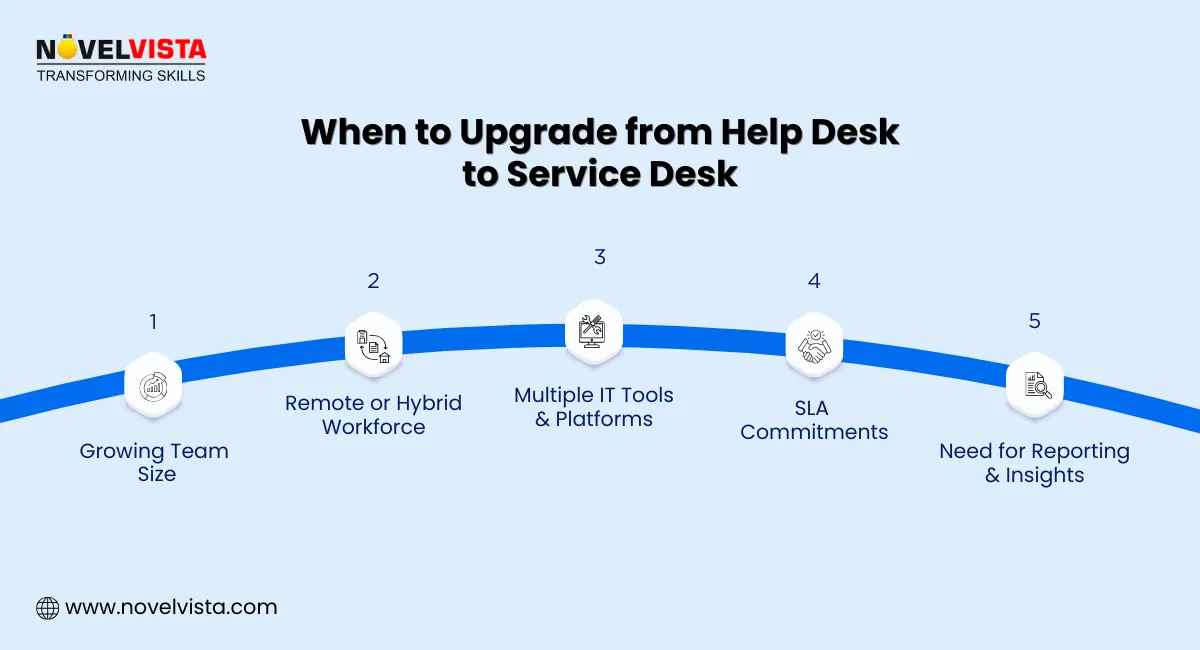
Moving from Help Desk to Service Desk is about evolving from reactive troubleshooting to proactive, business-aligned IT service management.
The Difference between Help Desk and Service Desk is clear: one is reactive and solves immediate issues, while the other is proactive, strategic, and aligned with business goals. Choosing the right IT support model depends on your organization’s size, IT maturity, and long-term vision. Start with a Help Desk if your IT needs are simple, but aim for a Service Desk as complexity grows to maximize efficiency, service quality, and user satisfaction.
The guidance in this blog reflects accumulated expertise from ITIL-certified professionals, structured ITSM programs, and observed transformations in enterprises. Following these best practices ensures IT support evolves from reactive firefighting to strategic, service-driven operations.

Take your IT service knowledge to the next level with NovelVista’s ITIL 4 Foundation Certification. Learn how to implement ITSM best practices, manage services strategically, and improve business outcomes. This course equips you with the practical skills to evolve your IT support, streamline processes, and prepare for advanced ITIL certifications. Start your journey today to transform IT operations into a service-driven powerhouse.
Author Details

Course Related To This blog
ITIL4 Specialist Monitor Support and Fulfil Certification
ITIL4 Specialist Acquiring & Managing Cloud Services
ITIL 4 Specialist Sustainability in Digital & IT
ITIL® 4 Strategic Leader Digital And IT Strategy (DITS)
ITIL® 4 Specialist Drive Stakeholder Value
ITIL® 4 Specialist High Velocity IT
ITIL® 4 Strategist Direct, Plan & Improve
ITIL® 4 Specialist Create Deliver & Support
ITIL® 4 Foundation Certification
Confused About Certification?
Get Free Consultation Call
Stay ahead of the curve by tapping into the latest emerging trends and transforming your subscription into a powerful resource. Maximize every feature, unlock exclusive benefits, and ensure you're always one step ahead in your journey to success.