Category | IT Service Management
Last Updated On 16/05/2026
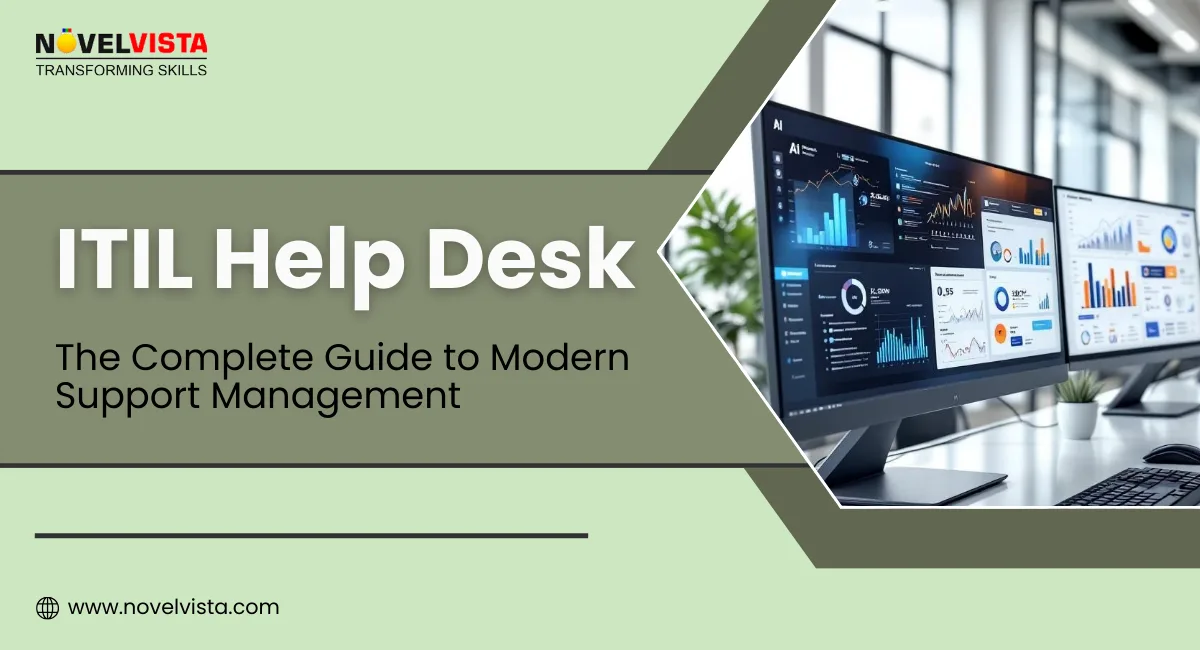
In today’s digital-first world, support teams face more pressure than ever. According to global service management studies, over 70% of users expect faster resolutions, while nearly 60% say poor help desk experiences push them to switch providers. With ticket volumes rising and technology evolving faster than internal processes, traditional support models simply fall short.
This raises important questions:
Who is an ITIL Help Desk really for? Do only large enterprises need ITIL-aligned support operations? Is it too complex for small teams?
And most importantly, why does support still break down even when companies invest heavily in tools?
The answer lies in the absence of standardized processes. This is where the it becomes a game-changer. It brings structure, clarity, and consistency to support operations using proven ITIL practices. Whether you're part of a growing startup, a mid-sized enterprise, or a global organization, adopting ITIL standards for help desk management can significantly improve user experience and service quality.
Let’s explore this in detail.
At its core, it is the single point of contact where users seek help for IT issues, requests, and service-related questions. It aligns with the ITIL (Information Technology Infrastructure Library) framework—a globally recognized set of best practices for IT service management.
Unlike traditional support desks, an ITIL Help Desk doesn’t just log tickets. It focuses on structured processes, repeatable workflows, and continual improvement. It ensures that incidents, service requests, and problems are handled in a standardized, predictable way.
LSI keywords added: IT service management, service desk operations, ITIL framework basics.
Organizations often face operational chaos without a defined support structure. Issues get lost, SLAs are missed, response times increase, and users lose confidence in IT.
Here’s why it is essential:
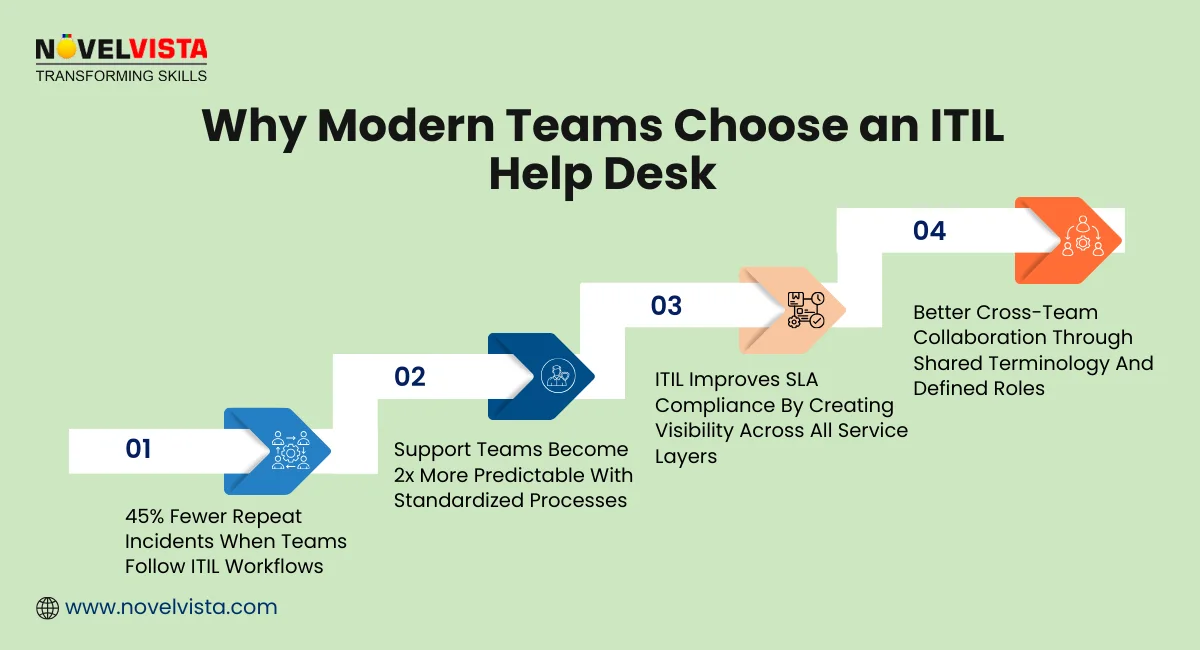
With ITIL standards for help desk operations, every request follows a predefined workflow that eliminates confusion and guesswork. This ensures uniform handling of incidents and requests, regardless of who is assigned. Teams deliver predictable, high-quality support every time.
Proper categorization, routing, and prioritization built into the ITIL Help Desk approach help reduce the overall incident backlog. Tickets reach the right agents faster, improving resolution time. This structured flow prevents delays and keeps operations running smoothly.
Modern users expect real-time updates, accurate information, and quick solutions—capabilities strengthened through the ITIL Help Desk Process. Standardized communication and transparent ticket tracking enhance trust and satisfaction. Users feel supported and informed at every step.
With a well-defined Help Desk ITIL structure, teams understand their responsibilities and performance expectations. Every ticket has an accountable owner supported by clear escalation paths. This clarity reduces confusion and improves service quality across the board.
Using ITIL-based dashboards, support teams gain instant visibility into ticket trends, recurring issues, and SLA performance. Data-driven insights make it easier to spot bottlenecks and plan improvements. Reporting becomes a strategic tool for continual service enhancement.
This combination of structure and predictability is what makes a Help Desk ITIL approach ideal for all organizations.
To operate successfully, it relies on several core components:
Incident Management focuses on restoring normal service as quickly as possible to minimize business disruption. It ensures issues like password lockouts or network outages are resolved efficiently. This keeps operations stable and reduces downtime for users.
Service Request Fulfillment handles routine user needs such as software access, hardware upgrades, or general IT assistance. By standardizing these requests, support teams can respond faster and more consistently. This improves workflow efficiency and user satisfaction.
Knowledge Management involves creating and maintaining reusable information that helps resolve issues faster. A strong knowledge base empowers both agents and users with quick answers. It reduces repetitive tickets and improves first-contact resolution rates.
Problem Management identifies root causes behind recurring incidents and prevents them from happening again. By analyzing trends and implementing long-term fixes, it reduces repeat tickets. This contributes to better system reliability and overall service improvement.
Asset & Configuration Management tracks IT assets, their relationships, and dependencies. This visibility helps support teams troubleshoot issues more accurately and make better decisions. It ensures smoother operations during changes, upgrades, and incident handling.
Reporting & Communication ensures users receive timely notifications and updates throughout the ticket lifecycle. Real-time dashboards offer transparency into performance, trends, and SLA status. This builds trust and supports continual service improvement.
These components work together to make the ITIL Help Desk Process predictable, scalable, and user-friendly, while also helping IT professionals prepare for real-world support scenarios and common Information Technology challenges. Exploring frequently asked IT Help Desk Interview Questions can further improve practical understanding and boost confidence for support-related job roles.
It follows a structured, end-to-end workflow:
1. Ticket Logging
Users create a ticket through email, portal, chat, or phone.
2. Categorization & Prioritization
Helps identify urgency, impact, and ticket type.
3. Assignment
Tickets route automatically to the right agent or department using predefined rules.
4. Investigation & Resolution
Agents troubleshoot using knowledge articles and ITIL guidelines.
5. User Confirmation
Ensures the issue is resolved to customer satisfaction.
6. Ticket Closure
Completed with proper documentation for audit and reporting.
By following this systematic flow, the ITIL Help Desk Process reduces resolution times, brings consistency, and ensures continuous improvement.
KPIs like MTTR (Mean Time to Resolve), FCR (First Contact Resolution), ticket backlog, and SLA compliance help teams refine and optimize performance.
Choosing the right ITIL Help Desk Software is crucial to scaling support operations. Not every tool is ITIL-compliant, and not every platform supports the depth of processes required.
Here are features every Help Desk Software ITIL should include:
Automated Ticket Routing uses intelligent workflows to assign tickets to the right agent instantly. This reduces delays and ensures each issue reaches a qualified responder. It improves efficiency and speeds up the overall resolution process.
A Self-Service Portal empowers users to submit requests, track updates, and find solutions quickly—all without waiting for an agent. It reduces ticket volume and boosts user satisfaction. This creates a more streamlined and responsive support experience.
Knowledge Base Integration speeds up resolutions by giving agents and users instant access to helpful articles and guides. It reduces repetitive work by providing answers to common issues. This leads to faster resolutions and higher productivity.
Service Catalog Management standardizes request types, approval workflows, and delivery expectations. Users get clarity on available services, while support teams work with consistent processes. This brings structure and predictability to service fulfillment.
Asset & CMDB (Configuration Database) links incidents to infrastructure components, making troubleshooting more accurate and efficient. Teams can see dependencies and relationships at a glance. This improves root cause analysis and service reliability.
Reporting & Analytics provide real-time dashboards that help leaders make informed decisions quickly. They highlight trends, common issues, and SLA performance. These insights drive continual service improvement across the help desk.
AI & Automation enhance support quality through chatbots, automated responses, and predictive suggestions. Routine tasks are handled instantly, freeing agents for complex issues. This leads to faster resolutions and a smarter support environment.
Cloud-based ITIL Help Desk Software offers scalability, faster updates, and lower upfront costs, while on-premise options suit organizations with strict data security requirements.
Avoid these pitfalls:
1. Over-Customization of Workflows
Makes the system difficult to maintain and scale.
2. Ignoring Metrics
Leads to poor visibility and ineffective decision-making.
3. Lack of ITIL Training
Processes fail when teams don’t understand ITIL principles.
4. Weak Categorization
Results in misrouted tickets and longer resolution times.
5. Poor Communication
Users lose trust when updates are delayed or unclear.
Avoiding these ensures your ITIL Help Desk performs at its best.
As digital transformation accelerates, organizations need support systems that are scalable, intelligent, and user-centric. An ITIL Help Desk offers exactly that—a structured approach to handling service requests, incidents, and problems with precision and consistency.
By adopting ITIL Help Desk Software, following ITIL Standards for Help Desk, and optimizing your ITIL Help Desk Process, your support operations become more predictable, efficient, and resilient. Whether you're a small team or a global enterprise, ITIL ensures your help desk evolves with changing technology and user expectations.

Join NovelVista’s ITIL 4 Foundation Certification Training and build a solid understanding of ITIL principles, modern support workflows, and best practices used by top organizations worldwide. Designed for IT professionals, support engineers, and service desk leaders, this course gives you the knowledge and confidence to manage high-performing ITIL Help Desk operations.
Start your ITIL 4 journey today and elevate your support career!
Author Details

Course Related To This blog
ITIL4 Specialist Monitor Support and Fulfil Certification
ITIL4 Specialist Acquiring & Managing Cloud Services
ITIL 4 Specialist Sustainability in Digital & IT
ITIL® 4 Strategic Leader Digital And IT Strategy (DITS)
ITIL® 4 Specialist Drive Stakeholder Value
ITIL® 4 Specialist High Velocity IT
ITIL® 4 Strategist Direct, Plan & Improve
ITIL® 4 Specialist Create Deliver & Support
ITIL® 4 Foundation Certification
Confused About Certification?
Get Free Consultation Call
Stay ahead of the curve by tapping into the latest emerging trends and transforming your subscription into a powerful resource. Maximize every feature, unlock exclusive benefits, and ensure you're always one step ahead in your journey to success.