ITIL Service Desk – Structure, Processes & Best Practices Explained

Category | IT Service Management

Last Updated On

ITIL Service Desk – Structure, Processes & Best Practices Explained | Novelvista

Every IT team knows the challenge: users need help, tickets pile up, and resolving issues quickly can feel overwhelming. This is where the ITIL Service Desk becomes vital — a centralized point for IT support and service requests that keeps operations smooth.

The ITIL Service Desk serves as the frontline of IT service management, connecting users with solutions while maintaining consistent service quality. This guide explores its structure, processes, tools, and best practices so organizations can streamline IT support efficiently and improve user satisfaction.

Core Functions of a Service Desk ITIL

A Service Desk ITIL is far more than a basic help desk; it’s the backbone of IT support. Its core functions include:

  • Single Point of Contact (SPOC): The service desk provides a single, organized channel for users to report incidents or request services, preventing confusion and ensuring all queries are captured accurately.
     
  • Logging and Classification: Every request or incident is logged, categorized, and prioritized, allowing the IT team to focus on urgent matters first and maintain a structured workflow.
     
  • Incident Resolution and Escalation: Simple incidents are resolved immediately, while more complex issues are escalated according to predefined rules, ensuring no problem goes unresolved or unattended.
     
  • Service Request Management: Routine requests such as password resets, software installations, or access permissions are processed efficiently, reducing wait times and freeing up IT resources for critical tasks.
     
  • Communication and Feedback: The service desk maintains continuous updates with users, collecting feedback and ensuring they feel informed, supported, and confident in IT service reliability.

Inputs and Outputs in ITIL Service Desk Interaction

The efficiency of a Service Desk ITIL depends on effectively managing both inputs and outputs:

Inputs:

  • Users submit tickets via phone, email, chat, or self-service portals, allowing flexibility in communication and ensuring that issues are captured in a timely and organized manner.
  • Internal inputs such as configuration records, historical incident data, and service catalogs provide context for faster, accurate, and informed resolutions.

Outputs:

  • Tickets are logged with detailed updates, resolutions, and closure notes, ensuring that all information is documented for reference.
  • Complex issues are escalated to the appropriate tier, ensuring timely resolution without overloading frontline staff.
  • Completed requests are communicated back to the users, and feedback is collected to improve future service quality.

Clear and continuous communication at every stage helps reduce repeated issues, enhances user satisfaction, and ensures IT services remain reliable and efficient.

ITIL Service Desk Structure and Roles

Understanding the ITIL Service Desk Structure ensures efficient team organization and accountability:

  • Frontline Agents: These are the first responders who handle incoming tickets, troubleshoot common issues, and provide immediate assistance, creating a positive experience for users.
     
  • Support Tiers: Tier 2 and Tier 3 specialists manage more complex incidents requiring deeper technical knowledge, ensuring that critical issues are resolved efficiently without delays.
     
  • Management: Supervisors and managers monitor operations, track performance against SLAs, and ensure compliance with ITIL processes, guiding continuous improvement initiatives for overall IT service quality.

Integration with ITIL processes like Incident Management, Change Management, and Problem Management ensures systematic handling of all issues. A well-defined ITIL Service Desk Structure prevents confusion, speeds up responses, and maintains consistency across the organization.

Case Study: We researchers noticed a multinational IT firm restructured its Service Desk following ITIL principles. By implementing tiered support and integrating knowledge management, the team reduced ticket resolution times by 25% and improved first-call resolution rates from 60% to 85%, improving overall user satisfaction significantly.

ITIL Service Desk Process Explained

A clear ITIL Service Desk Process is crucial for delivering reliable, high-quality IT support:

  • Incident Workflow: From logging to resolution, each step is defined and structured, ensuring tickets are addressed promptly and systematically without unnecessary delays.
     
  • Service Request Workflow: Routine requests follow pre-approved procedures to guarantee timely processing, prevent bottlenecks, and maintain consistent service delivery.
     
  • SLA Monitoring: Service Level Agreements are tracked to ensure response and resolution times are met, creating accountability and maintaining user trust in IT support.
     
  • Performance Metrics: KPIs like response times, resolution rates, and user satisfaction scores are continuously measured, providing insights to improve efficiency and service quality.

Following a structured ITIL Service Desk Process ensures that support is consistent, predictable, and aligned with organizational goals, improving both user satisfaction and IT team performance.

Pro Tip from ITIL Experts: Regularly review and refine incident workflows based on ticket trends. Minor adjustments, such as reclassifying recurring incidents or updating knowledge base articles, can dramatically reduce resolution times and improve Service Desk efficiency.

Download: ITIL Service Desk KPIs Cheat Sheet

Track the KPIs that actually matter. Get a clean, one-page
guide to measure and improve Service Desk performance. 

Key KPIs for Service Desk ITIL

Measuring performance is crucial for any ITIL Service Desk. KPIs provide insights into efficiency, user satisfaction, and areas needing improvement:
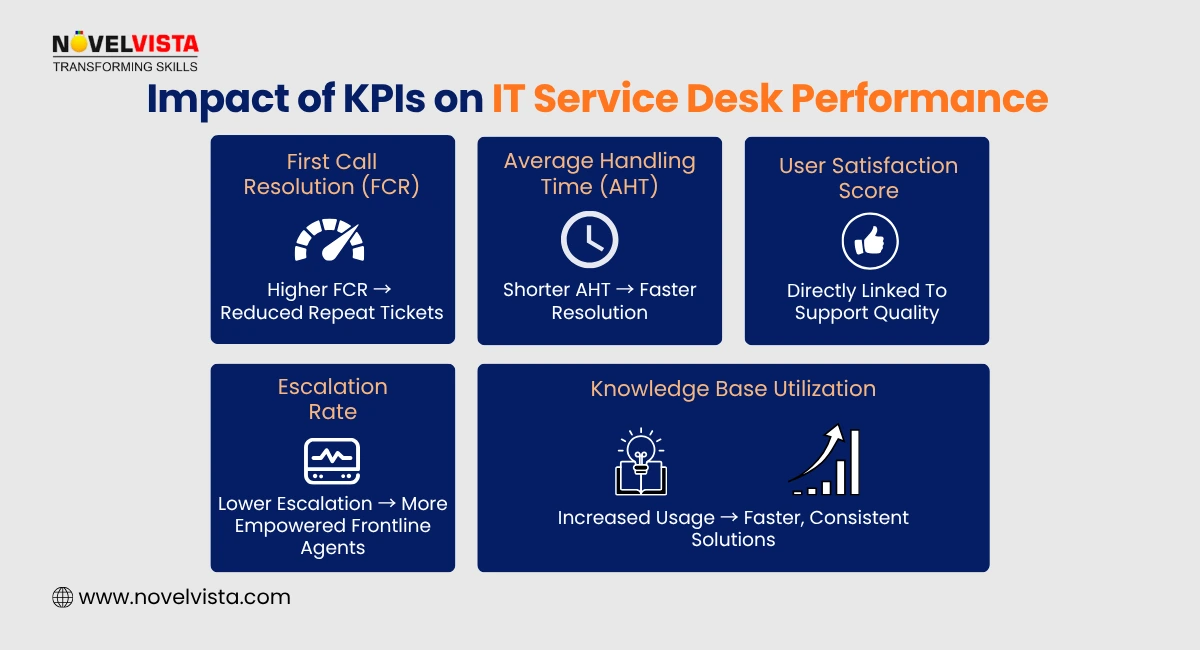
  • First Call Resolution (FCR): Tracks how many issues are resolved on the first contact. Higher FCR means faster resolution, reduced workload, and happier users.
     
  • Average Handling Time: Measures the average time taken to close tickets. Efficient handling ensures issues don’t linger, improving productivity and resource management.
     
  • Ticket Backlog: Shows the number of pending tickets at any time. Keeping this low ensures timely responses and prevents user frustration or SLA breaches.
     
  • User Satisfaction: Collected through surveys, this metric evaluates how well users feel supported, helping teams improve communication, responsiveness, and overall service quality.
     
  • Escalation Rate: Measures how often tickets are escalated to higher tiers. A lower rate indicates effective initial support and better knowledge management among frontline agents.

Impact of KPIs on IT Service Desk Performance

These KPIs help managers monitor performance, identify bottlenecks, and make informed decisions for continuous improvement in Service Desk ITIL operations.

ITIL Service Desk vs. ITIL Help Desk

Though often used interchangeably, a Service Desk ITIL has a broader role than a help desk:

  • Service Desk ITIL: Goes beyond reactive support, focusing on proactive problem prevention, communication, user engagement, and fulfilling service requests. It ensures IT aligns with business goals.
     
  • Help Desk: Primarily reactive, handling basic troubleshooting, incident management, and immediate issue resolution. It may not provide strategic insights or manage service requests comprehensively.

Understand the complete differences with the help of the following table:


Critical Aspect

ITIL 4 Service Desk

Help Desk

Scope
 

Comprehensive IT service management, including incident, problem, change, and service request management aligned with ITIL best practices


Focused mainly on incident management and reactive technical support for specific issues

Approach

Proactive, with emphasis on preventing issues and improving service delivery
 

Reactive, responding to issues as they arise ("break/fix")


Functionality

Manages end-to-end service lifecycle, including request fulfilment, problem management, change coordination, and integration with business processes

Primarily handles incident resolution and basic user requests

Integration with ITIL/ITSM

Fully aligned and integrated with ITIL and IT Service Management frameworks

May implement some ITIL practices, but with less comprehensive integration

Business Alignment

Strategic role with focus on business outcomes, service quality, and long-term service improvement

Tactical focus on quick resolution to minimize disruption

Tools and Automation

Uses advanced ITSM tools for workflow automation, knowledge management, self-service portals, and proactive monitoring

Basic ticketing systems with limited automation

Staffing and Expertise

ITIL-trained professionals with specialized roles, enabling comprehensive service delivery

General front-line support agents focused on immediate issue resolution

User Experience

Enhanced experience with consistent communication, proactive updates, and service level management

Focus on fast, first-level help with limited proactive communication.


ITIL-trained service desk managers show that the Service Desk is not just a help desk—it acts as a strategic enabler. It aligns IT operations with business outcomes, supports compliance, and proactively prevents service disruptions, highlighting its critical role in IT service management.

ITIL Best Practices for Service Desk

Implementing ITIL Best Practices for Service Desk ensures support is efficient, user-friendly, and consistent:

  • User-Centric Communication: Engage users empathetically, providing updates, guidance, and clear instructions to ensure they feel supported and informed.
     
  • Knowledge Management and Self-Service: Maintain a centralized knowledge base and self-service portals so users can quickly resolve common issues, reducing tickets and saving IT time.
     
  • Staff Training and Skills Development: Regularly train service desk agents on technical skills, soft skills, and process adherence to improve resolution quality and service consistency.
     
  • Process Automation: Automate routine tasks like ticket routing, notifications, and standard request handling to reduce human error, improve efficiency, and allow agents to focus on complex issues.

Following these ITIL Best Practices for Service Desk boosts productivity, increases satisfaction, and strengthens overall IT service delivery.

ITIL Service Desk Software and Tools

Modern IT operations rely heavily on ITIL Service Desk Software to streamline workflows:
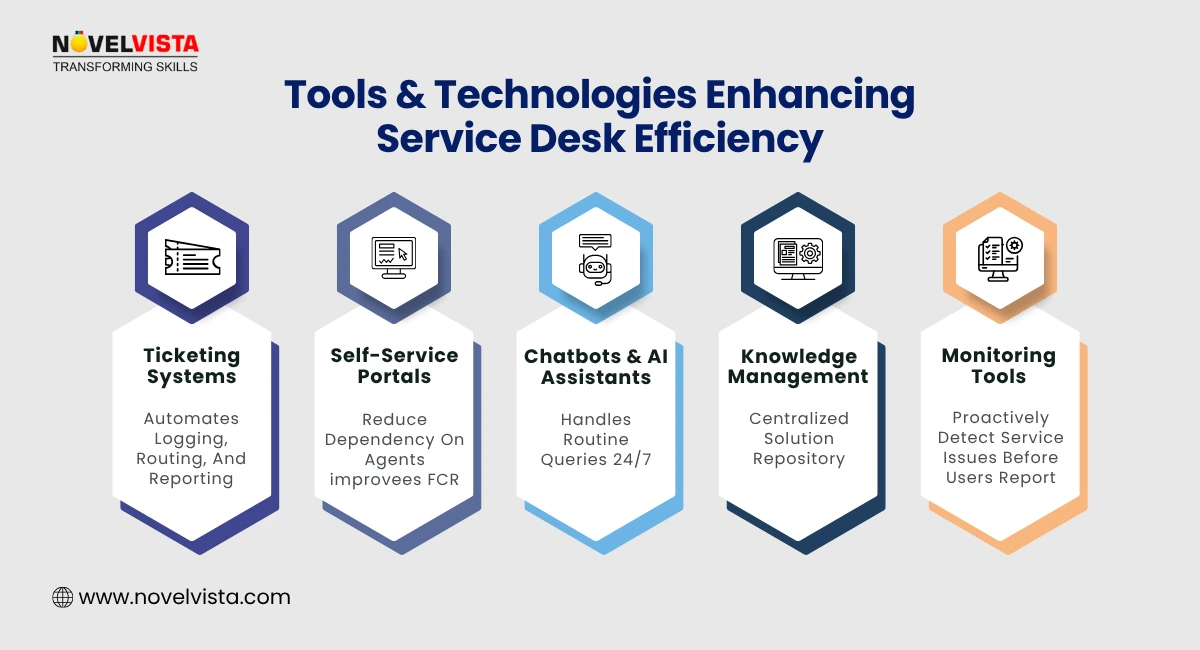
  • Ticketing Systems: Automate ticket creation, tracking, and reporting, ensuring no issue is lost or delayed.
     
  • Automation Features: Handle repetitive tasks such as notifications, SLA tracking, and task assignment to save time and improve accuracy.
     
  • Self-Service Portals: Allow users to submit requests, check status, and access solutions independently, reducing load on service desk staff.
     
  • Reporting and Analytics: Track KPIs, monitor trends, and identify areas for improvement to ensure continuous service quality enhancement.

Service Desk Efficiency Tools

Examples of leading ITIL Service Desk Software include ServiceNow, Freshservice, and Jira Service Management, all designed to support ITIL processes efficiently and effectively.

Related Read: Want to cut costs without compromising service quality? Check out How to Optimize ITIL Service Desk Cost for practical tips and strategies to make your IT operations more efficient.

Conclusion

The ITIL Service Desk is the backbone of effective IT service management, acting as the central point for incident handling, service requests, and user engagement.

By implementing structured ITIL Service Desk Processes, monitoring KPIs, following ITIL Best Practices for Service Desk, and leveraging modern ITIL Service Desk Software, organizations can deliver faster, consistent, and user-focused IT support.

A well-organized service desk not only resolves issues efficiently but also aligns IT services with business objectives, supports continuous improvement, and ensures a seamless experience for end users.

ITIL 4 Foundation

Next Step: 

Elevate your IT service management career with NovelVista’s ITIL 4 Foundation and Service Desk Professional Certification courses!

Gain practical skills, industry-recognized knowledge, and strategies that set you apart in ITSM. Whether you’re starting your ITIL journey or aiming to master service desk operations, these certifications open doors to growth, credibility, and higher-impact roles. 

Take the step today and transform your career!

Frequently Asked Questions

An ITIL service desk is the primary point of contact between users and the IT team. It handles incidents, service requests, and communication to ensure smooth and efficient IT service delivery.
Yes. In ITIL 4, Service Desk is an official practice focused on providing user support, resolving issues quickly, and improving customer experience.
Yes. Service desk roles are one of the best IT entry points. They help you build technical, communication, troubleshooting, and ITIL-based service management skills—opening pathways to roles like incident manager, ITSM analyst, system admin, cloud engineer, and more.
Absolutely. ITIL 4 continues to be one of the most used IT service management frameworks in 2025. Companies in IT, telecom, banking, and government rely on ITIL for stability, efficiency, and improved service quality, keeping ITIL-certified professionals in high demand.
Most service desk roles require basic IT knowledge, good communication skills, problem-solving ability, and familiarity with tools like ServiceNow or Jira. While not mandatory, ITIL 4 Foundation certification significantly boosts your chances of getting hired.

Author Details

Mr.Vikas Sharma

Mr.Vikas Sharma

Principal Consultant

I am an Accredited ITIL, ITIL 4, ITIL 4 DITS, ITIL® 4 Strategic Leader, Certified SAFe Practice Consultant , SIAM Professional, PRINCE2 AGILE, Six Sigma Black Belt Trainer with more than 20 years of Industry experience. Working as SIAM consultant managing end-to-end accountability for the performance and delivery of IT services to the users and coordinating delivery, integration, and interoperability across multiple services and suppliers. Trained more than 10000+ participants under various ITSM, Agile & Project Management frameworks like ITIL, SAFe, SIAM, VeriSM, and PRINCE2, Scrum, DevOps, Cloud, etc.

Enjoyed this blog? Share this with someone who'd find this useful

Sign Up To Get Latest Updates on Our Blogs

Stay ahead of the curve by tapping into the latest emerging trends and transforming your subscription into a powerful resource. Maximize every feature, unlock exclusive benefits, and ensure you're always one step ahead in your journey to success.

Topic Related Blogs