NovelVista logo

ITIL Service Transition: A Complete Guide to Definition, Processes, and Checklist

Category | IT Service Management

Last Updated On 15/01/2026

ITIL Service Transition: A Complete Guide to Definition, Processes, and Checklist | Novelvista

A service looks perfect on paper. The design is approved. The build is complete. Then it goes live, and suddenly users are unhappy, incidents spike, and operations teams are firefighting. This is where many IT services quietly fail.

This gap between design and live operations is exactly why ITIL Service Transition exists. It acts as the control point that turns ideas into stable, usable services. When done right, transitions reduce risk, manage change, and protect business value. When skipped or rushed, even well-designed services struggle to survive in production.

In real ITSM implementations, many post-go-live incidents trace back to rushed transitions rather than poor design. Teams often confirm this only after repeated outages highlight gaps in testing, knowledge transfer, or change coordination.

This guide explains what ITIL Service Transition really means, how its processes work, and how a practical checklist helps teams move services into operations with confidence.

ITIL Service Transition Definition

The ITIL Service Transition Definition describes it as the third stage of the ITIL service lifecycle. Its purpose is to build, test, and deploy new or changed services into the live environment while meeting design and business requirements.

In simple terms, ITIL Service Transition ensures that what was planned and designed is delivered exactly as expected, without surprises. It focuses on controlled change, reduced disruption, and predictable outcomes. Instead of pushing services into production and hoping for the best, teams follow structured steps to verify readiness.

A strong ITIL Service Transition Definition always emphasizes consistency. Services should behave the same way every time they are deployed, regardless of complexity or urgency. This consistency is what protects users, operations teams, and the business.

Core Objectives of ITIL Service Transition

Every activity in ITIL Service Transition supports a clear set of objectives. These objectives explain why the stage exists and what success looks like.

  • Control changes end-to-end: All changes are assessed, authorized, implemented, and reviewed in a structured way. This prevents uncontrolled updates from disrupting live services.
     
  • Reduce risk during service introduction: By testing and validating services before release, teams catch issues early and avoid costly production failures.
     
  • Deliver expected service value: Services must meet agreed utility and warranty levels so customers receive what was promised during design.
     
  • Maintain reliable service information: Accurate configuration and knowledge data ensure operations teams can support services effectively from day one.

These objectives make ITIL Service Transition a protective layer between innovation and daily operations. 

Key Principles That Guide ITIL Service Transition

Successful transitions don’t rely on heroics. They rely on principles that keep activities consistent and repeatable.

  • Clear policies and governance: Defined standards guide how changes, releases, and deployments are handled across the organization.
     
  • Standard models and templates: Using repeatable approaches reduces errors and speeds up future transitions.
     
  • Knowledge capture and reuse: Lessons learned during transitions are documented so teams don’t repeat the same mistakes.
     
  • Planned responsibilities and coordination: Everyone involved knows their role, decision points, and escalation paths.

Industry ITSM assessments repeatedly show that standardized transition models reduce failure rates. Governance, templates, and defined responsibilities are recognized best practices for controlling change in complex environments.

Download: A Practical ITIL Service Transition Checklist

Ensure smooth, confident go-lives with zero surprises. Use this checklist to confirm readiness, approvals, and rollback plans ahead of every release.

ITIL Service Transition Processes Explained

ITIL Service Transition Processes form the operational backbone of this lifecycle stage. Each process has a clear role, and together they ensure services move safely into production.
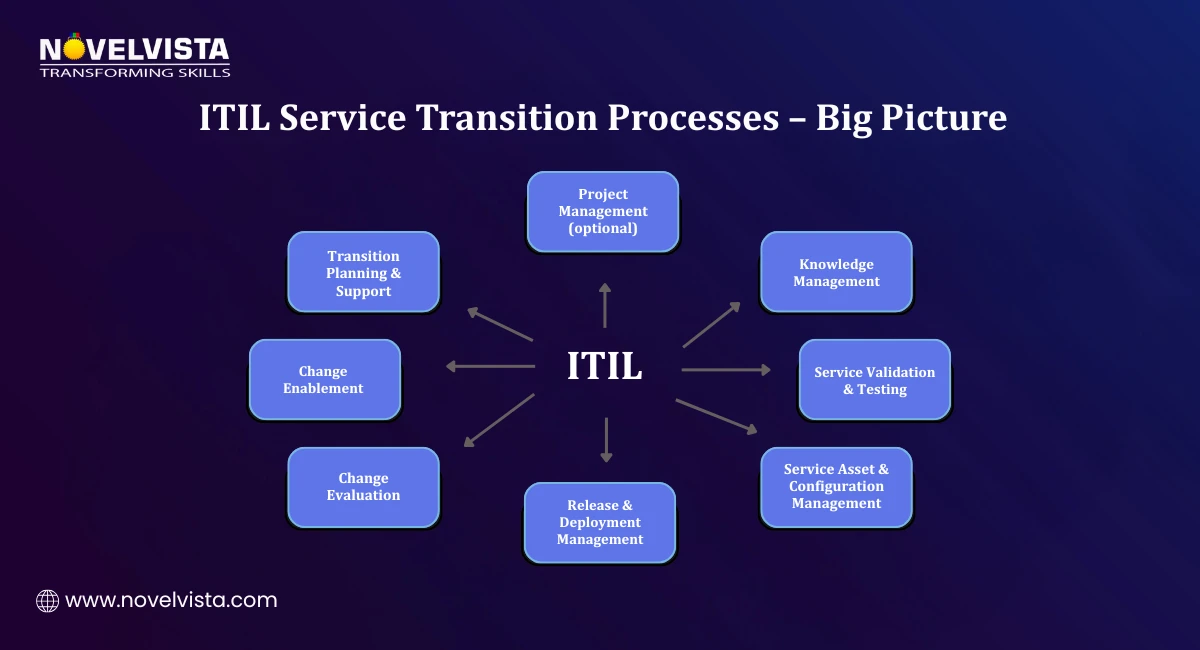
  • Transition Planning and Support: This process coordinates resources, timelines, and activities across multiple changes and releases. It ensures transitions are planned realistically and aligned with service design outputs.
     
  • Change Management / Change Enablement: Controls the full lifecycle of changes, from request through approval, implementation, and closure. It balances speed with risk control.
     
  • Change Evaluation: Used mainly for major or high-risk changes. It evaluates readiness, expected benefits, risks, and whether the change should proceed.
     
  • Release and Deployment Management: Plans, builds, tests, and deploys releases into live environments. It ensures releases are delivered as planned and can be supported.
     
  • Service Asset and Configuration Management (SACM): Maintains accurate information about Configuration Items and their relationships. This data supports impact analysis and incident resolution.
     
  • Service Validation and Testing: Confirms that services meet functional and quality requirements before going live. This protects users and operations teams.
     
  • Knowledge Management: Captures operational knowledge in the Service Knowledge Management System so support teams are prepared from day one.

ITIL Service Transition Processes

Together, these ITIL Service Transition Processes ensure that services are not just deployed, but deployable, supportable, and stable. During service reviews, most early-life incidents are linked to missing configuration data or incomplete knowledge articles. This reinforces why SACM and Knowledge Management are critical, not optional, during transition.

Roles and Responsibilities in ITIL Service Transition

Clear roles prevent confusion during high-pressure transitions.

  • Service Transition Manager: Oversees the entire transition stage and ensures alignment with service strategy and design.
     
  • Change Manager: Reviews and authorizes changes, balancing urgency, risk, and business impact.
     
  • Release Manager: Coordinates builds, testing, and deployments to ensure smooth releases.
     
  • Configuration Manager: Maintains accuracy and integrity of configuration data within SACM.

Each role supports ITIL Service Transition by ensuring accountability and clarity.

Benefits and Challenges of ITIL Service Transition

When organizations apply ITIL Service Transition correctly, the difference is visible almost immediately. Services go live with fewer surprises, teams know what to expect, and customers experience smoother handovers.
Key Benefits

  • Better control over change volumes: Structured transition activities help teams handle frequent changes without losing stability or visibility.
     
  • Reduced downtime and operational risk: Testing, validation, and approvals prevent unstable services from reaching production.
     
  • Stronger alignment with business expectations: Services delivered through ITIL Service Transition meet agreed performance, availability, and support requirements.
     
  • Improved customer confidence: Predictable releases and smoother handovers lead to higher trust and satisfaction.

ITIL Service Transition Practical Checklist

Common Challenges

  • High complexity during large transitions: Multiple concurrent changes and releases can strain coordination if planning is weak.
     
  • Knowledge loss during handover: Poor documentation or rushed transitions leave operations teams unprepared.

Recognizing these challenges helps teams apply ITIL Service Transition with realism rather than theory. Operations teams tend to trust new services more when they are involved early in testing and knowledge reviews. This shared ownership reduces resistance and shortens stabilization periods after deployment.

ITIL Service Transition Checklist for Practical Implementation

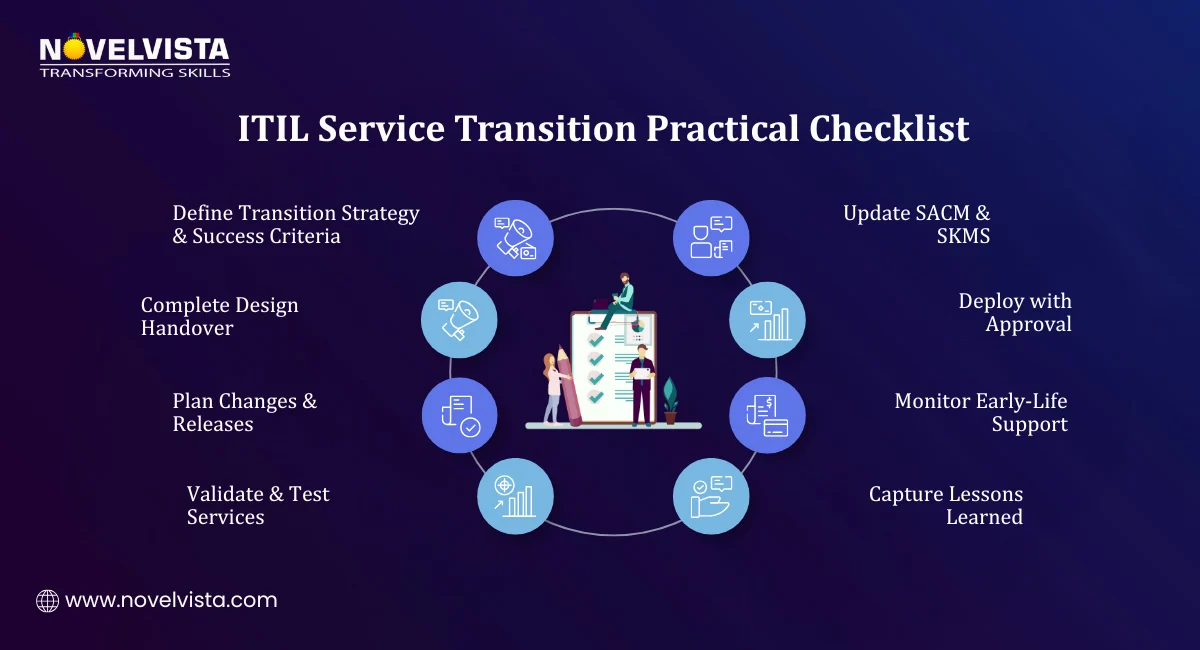
A clear ITIL Service Transition Checklist helps teams turn guidance into action. This checklist can be used for both small changes and major service introductions.

  • Define transition strategy and governance: Establish clear objectives, roles, standards, and success criteria for all transition activities.
     
  • Confirm complete handover from Service Design: Ensure specifications, architectures, and acceptance criteria are available and understood.
     
  • Plan resources, timelines, and dependencies: Schedule people, tools, environments, and approvals before execution begins.
     
  • Record and validate Configuration Items: Capture all relevant CIs and relationships within SACM for accurate impact analysis.
     
  • Perform service validation and testing: Test services against functional, performance, and support requirements.
     
  • Authorize and deploy releases: Use Release and Deployment Management to move changes into production safely.
     
  • Update knowledge systems: Populate the SKMS with operational guides, known errors, and support instructions.
     
  • Monitor post-deployment performance: Track early indicators and resolve issues quickly after go-live.
     
  • Review outcomes and capture lessons learned: Feed results into continual improvement activities.

Using an ITIL Service Transition Checklist ensures nothing important is missed during high-pressure transitions.

Conclusion

Designing a service is only half the journey. Without strong ITIL Service Transition, even the best designs struggle once they meet real users and real workloads.

By applying structured processes, clear roles, and a practical ITIL Service Transition Checklist, organizations reduce risk and protect business value. Strong transitions turn plans into reliable live services and create a stable foundation for Service Operations and continual improvement.

Consistent Service Transition practices build confidence not only within IT teams but also with business stakeholders. Predictable releases and transparent readiness decisions reduce uncertainty and support long-term service credibility.

When teams treat ITIL Service Transition as a core capability, not a formality, services move from concept to operation with confidence.

ITIL 4 Foundation Certification
 

Next Step: Strengthen Your ITIL Foundation

If you want to understand ITIL Service Transition and the full ITIL lifecycle with confidence, structured learning helps. NovelVista’s ITIL 4 Foundation Certification Training builds strong knowledge of ITIL concepts, practices, and value delivery. It’s ideal for professionals looking to manage change, reduce risk, and support reliable service operations in real-world IT environments.

Frequently Asked Questions

The primary goal is to build, test, and deploy new or modified services into the live environment while managing risks and ensuring that the business receives the intended value.

Change Management is a specific process for assessing and authorizing changes, while Service Transition is the broader lifecycle stage that oversees the entire movement of services into production.

ITIL 4 replaces the rigid transition lifecycle stage with the more flexible Service Value Chain, specifically the "Design and Transition" activity, and redefines transition processes as integrated management practices.

Core processes include Change Management, Release and Deployment Management, Service Validation and Testing, Service Asset and Configuration Management, Transition Planning and Support, Change Evaluation, and Knowledge Management to support decision-making.

Knowledge Management ensures that vital information regarding new services is captured and shared, empowering support teams and users to handle the transition efficiently while reducing the need for rediscovering information.

Author Details

Mr.Vikas Sharma

Mr.Vikas Sharma

Principal Consultant

I am an Accredited ITIL, ITIL 4, ITIL 4 DITS, ITIL® 4 Strategic Leader, Certified SAFe Practice Consultant , SIAM Professional, PRINCE2 AGILE, Six Sigma Black Belt Trainer with more than 20 years of Industry experience. Working as SIAM consultant managing end-to-end accountability for the performance and delivery of IT services to the users and coordinating delivery, integration, and interoperability across multiple services and suppliers. Trained more than 10000+ participants under various ITSM, Agile & Project Management frameworks like ITIL, SAFe, SIAM, VeriSM, and PRINCE2, Scrum, DevOps, Cloud, etc.

Sign Up To Get Latest Updates on Our Blogs

Stay ahead of the curve by tapping into the latest emerging trends and transforming your subscription into a powerful resource. Maximize every feature, unlock exclusive benefits, and ensure you're always one step ahead in your journey to success.
Topic Related Blogs