Category | IT Service Management
Last Updated On 16/01/2026
Systems go down. Alerts fire at odd hours. SLAs don’t wait. This is the daily reality for operations teams. IT Operations Management in ITIL exists to handle exactly this reality, keeping services stable, available, and reliable while the business moves fast.
In our ITIL training sessions, operations professionals often say this is the first ITIL topic that truly reflects their daily work. The concepts discussed here are based on real operational challenges shared by NOC teams, system administrators, and service desk leaders handling live environments.
This guide explains what IT Operations Management really means in ITIL, why it matters, how control is maintained, and which core practices support smooth day-to-day operations.
IT Operations Management in ITIL refers to the function responsible for running and maintaining IT services on a daily basis. It ensures that infrastructure, applications, and platforms work as expected, consistently and securely.
In traditional ITIL, this function sits within the Service Operation stage. Its focus is clear:
What makes ITIL IT Operations Management important is its position between planning and reality. Strategies are designed, services are built, but operations teams make sure everything actually works, meeting SLAs and supporting users without interruption.
At its core, IT Operations Management in ITIL is about ownership of the live environment.
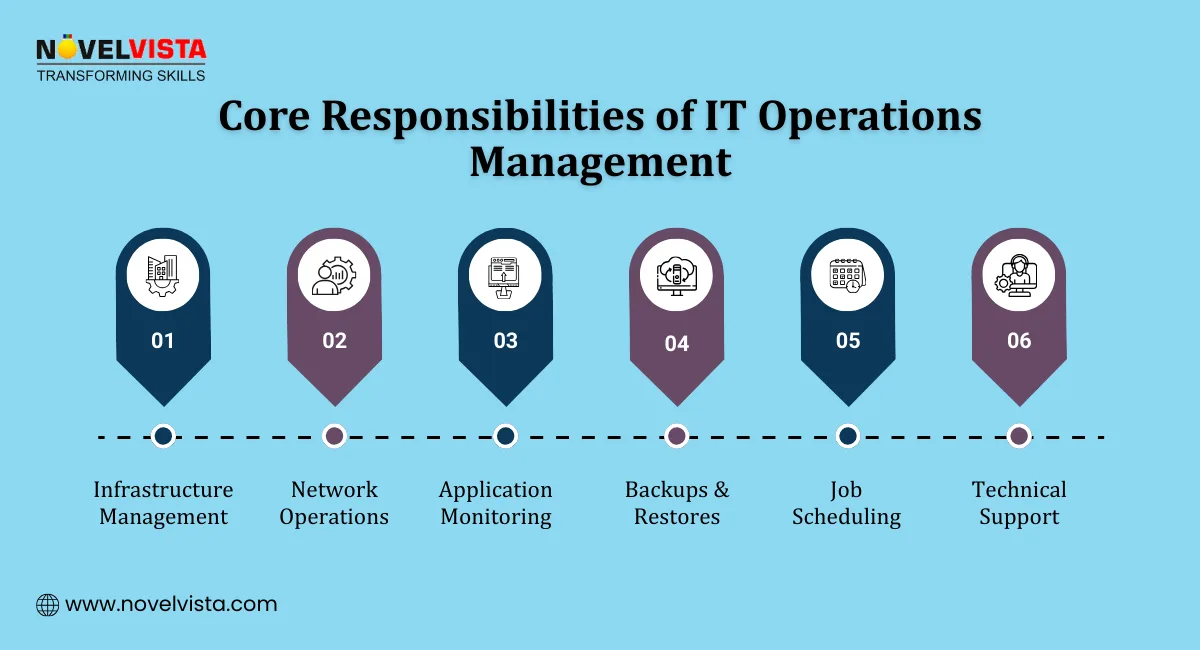
Key responsibilities include:
Daily operational activities typically involve:
Modern ITIL IT Operations Management also relies heavily on proactive monitoring. Instead of waiting for users to complain, teams track system health continuously to spot early warning signs and act before impact.
Operations teams we train often recognise that proactive monitoring is the turning point between firefighting and control. Once teams learn how to interpret alerts early, incident volumes and after-hours escalations reduce noticeably.
IT Operations Control in ITIL focuses on the routine activities that keep services running smoothly and securely. It is about discipline, consistency, and visibility.
Key control areas include:
IT Operations Control in ITIL also includes 24/7 shift management. Teams work across regions and time zones, using clear handovers and risk-based controls to avoid gaps.
Without strong control, even well-designed services become unstable. This is why IT Operations Control in ITIL is essential for service reliability.
Operations do not work in isolation. Several ITIL practices directly support IT Operations Management in ITIL.
These practices are consistently highlighted in ITIL certification exams, audits, and real ITSM implementations. Their close link with operations explains why strong operational teams rarely work in isolation from incident, problem, and event management. Together, these practices strengthen ITIL IT Operations Management by combining speed, control, and consistency.
Clear roles keep operations predictable, especially when incidents happen under pressure. ITIL IT Operations Management relies on defined ownership, so decisions are quick and accountable.
Strong role clarity strengthens IT Operations Management in ITIL by reducing confusion and speeding up response during incidents.
End role confusion in day-to-day IT operations. Understand who owns incidents, monitoring, change, automation, and improvement, so work doesn’t fall through the cracks.
Tools and controls turn intent into action. IT Operations Control in ITIL depends on repeatable mechanisms that reduce risk and manual effort.
Common control mechanisms include:
This alignment with the Service Value System is a key reason ITIL 4 treats operations as a value contributor, not just a support function. It reinforces the idea that operational feedback shapes better planning and improvement decisions.
Operations teams also apply the PDCA cycle to review incidents, refine controls, and reduce recurring issues. This disciplined approach keeps IT Operations Control in ITIL effective as environments grow.
Within ITIL, operations are not isolated. IT Operations Management in ITIL is a core part of Service Operation and closely aligned with ITIL 4’s Service Value System (SVS).
Operations support key value chain activities:
By standardizing how work is done, ITIL IT Operations Management helps organizations apply ITSM practices consistently across teams and locations.
When operations are well-managed, the impact is visible across the business.
Key benefits include:
Organizations with mature IT Operations Management in ITIL move from reactive firefighting to controlled, predictable service delivery.
Small improvements in operations create big results over time. Proven best practices include:
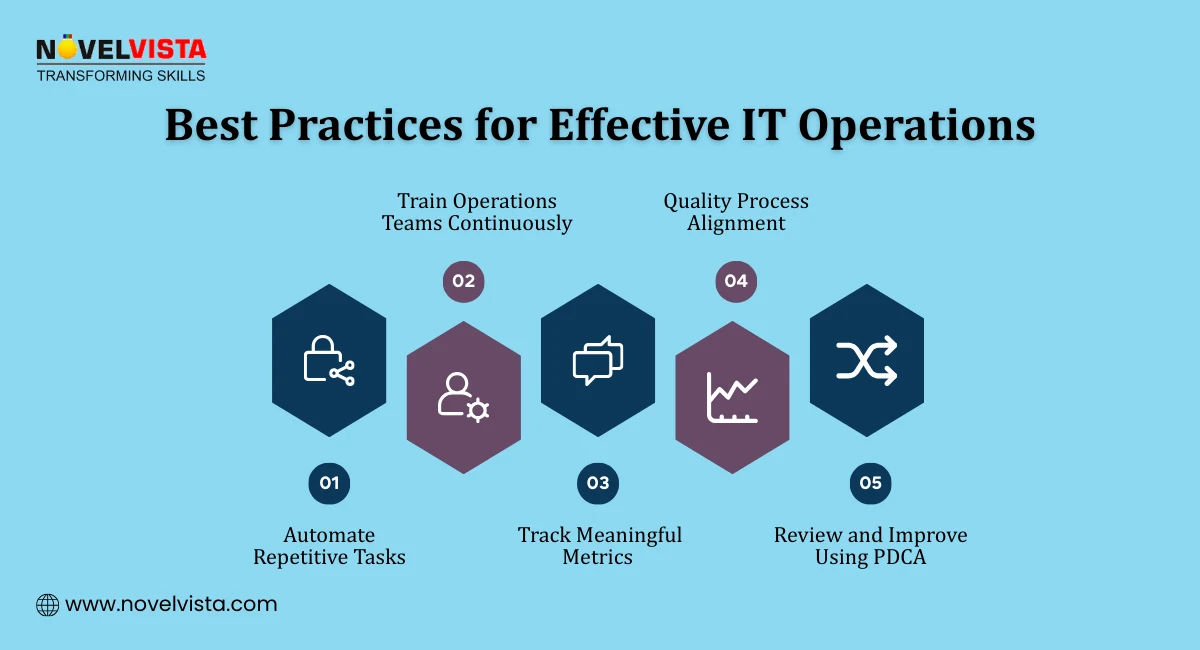
Applying these practices keeps IT Operations Control in ITIL efficient, scalable, and resilient.
IT Operations Management in ITIL is the engine that keeps IT services stable day after day. Clear controls, defined roles, and disciplined practices turn strategy into dependable execution. When operations are strong, services stay reliable, risks are controlled, and trust in the business grows. Over time, mature operations become a key driver of ITSM success and long-term service confidence.
The operational insights shared here reflect common patterns observed during ITIL training, exam preparation, and ITSM maturity discussions. The focus is on realistic, day-to-day execution rather than theory-heavy explanations.

If you want to understand how operations, controls, and practices fit together in ITIL, NovelVista’s ITIL 4 Foundation Certification Training is a strong next step. The course explains core ITIL concepts in simple terms, connects theory with real operations scenarios, and prepares you confidently for the exam. It’s ideal for professionals who want clarity, structure, and a solid base in modern IT service management.
Author Details

Course Related To This blog
ITIL4 Specialist Monitor Support and Fulfil Certification
ITIL4 Specialist Acquiring & Managing Cloud Services
ITIL 4 Specialist Sustainability in Digital & IT
ITIL® 4 Strategic Leader Digital And IT Strategy (DITS)
ITIL® 4 Specialist Drive Stakeholder Value
ITIL® 4 Specialist High Velocity IT
ITIL® 4 Strategist Direct, Plan & Improve
ITIL® 4 Specialist Create Deliver & Support
ITIL® 4 Foundation Certification
Confused About Certification?
Get Free Consultation Call
Stay ahead of the curve by tapping into the latest emerging trends and transforming your subscription into a powerful resource. Maximize every feature, unlock exclusive benefits, and ensure you're always one step ahead in your journey to success.