Category | IT Service Management
Last Updated On 18/08/2026
Incidents keep getting resolved, yet the same problems keep coming back. That’s the frustration many IT teams live with every day. ITIL Root Cause Analysis exists to break this cycle by fixing what’s underneath, not just what’s visible. Instead of rushing from one outage to the next, RCA helps teams slow down just enough to stop repeat failures for good.
In our ITIL training and Problem Management workshops, we consistently see teams resolving incidents quickly but reopening the same issues weeks later. The shift only happens when Root Cause Analysis is treated as a routine discipline, not a post-incident formality.
This article explains how ITIL Root Cause Analysis actually works in practice, how the ITIL Root Cause Analysis Process fits into Problem Management, the exact RCA steps teams follow, and how organizations use it to move from firefighting to long-term stability.
TL;DR – Quick Summary
Area |
Key Takeaway |
Core purpose |
RCA prevents repeat incidents by fixing root causes |
ITIL alignment |
RCA sits within Problem Management |
Process |
Detect → Analyze → Resolve → Prevent |
Techniques |
5 Whys, Fishbone, Pareto, Kepner–Tregoe |
Business impact |
30–50% reduction in recurring incidents |
Outcome |
Lower MTTR, higher reliability, stronger services |
Many people ask, What is Root Cause Analysis in ITIL, and how is it different from troubleshooting? In simple terms, it is a structured approach to identify the real reason behind one or more incidents.
In ITIL language:
Once the root cause is identified, the problem can be converted into a Known Error, supported by a workaround or a permanent fix. This allows teams to reduce impact immediately while working toward full resolution.
So when people ask again, What is Root Cause Analysis in ITIL, the answer is clear: it is the bridge between recurring incidents and lasting service improvement.
The ITIL Root Cause Analysis Process follows the full lifecycle of problem handling. It is not a single meeting or a one-time report. It is a structured flow that ensures findings are reliable, repeatable, and audit-ready.
In real service environments, RCA fails most often when teams rush analysis under operational pressure. Successful teams protect RCA time just as they protect change windows.
At a high level, the ITIL Root Cause Analysis Process includes:
This process works closely with Change Management, Configuration Management, and Release Management. That integration ensures fixes are controlled, documented, and do not create new risks elsewhere in the environment.
Learn when to trigger RCA, follow an ITIL-aligned workflow, validate real root causes with evidence, and prevent repeat incidents through structured Problem Management practices.
A consistent step-by-step flow keeps RCA practical and defensible. These steps form the working core of ITIL Root Cause Analysis RCA and support evidence-based decision-making.
RCA begins when incidents show a pattern or cause major disruption. Not every incident needs RCA, but high-impact or repeating ones do.
Teams clearly define the problem by documenting:
A clear problem definition prevents teams from chasing the wrong cause later.
Good RCA depends on facts, not assumptions. Teams collect data from multiple sources to build an accurate picture.
Typical inputs include:
This step grounds the ITIL Root Cause Analysis Process in evidence, making conclusions reliable.
This is where symptoms are traced back to their true origin. Teams apply proven techniques to identify what actually failed and why.
Root causes are then prioritized based on:
This ensures effort is focused on the causes that matter most.
Once causes are confirmed, teams design corrective actions. These fixes are tested, reviewed, and implemented through formal Requests for Change.
After implementation:
This final step closes the loop, ensuring problems do not quietly return later.
ITIL does not force teams to use a single analysis method. The choice depends on the type of problem, available data, and business impact. What matters is consistency and logic, not complexity. These techniques are commonly used within the ITIL Root Cause Analysis Process.
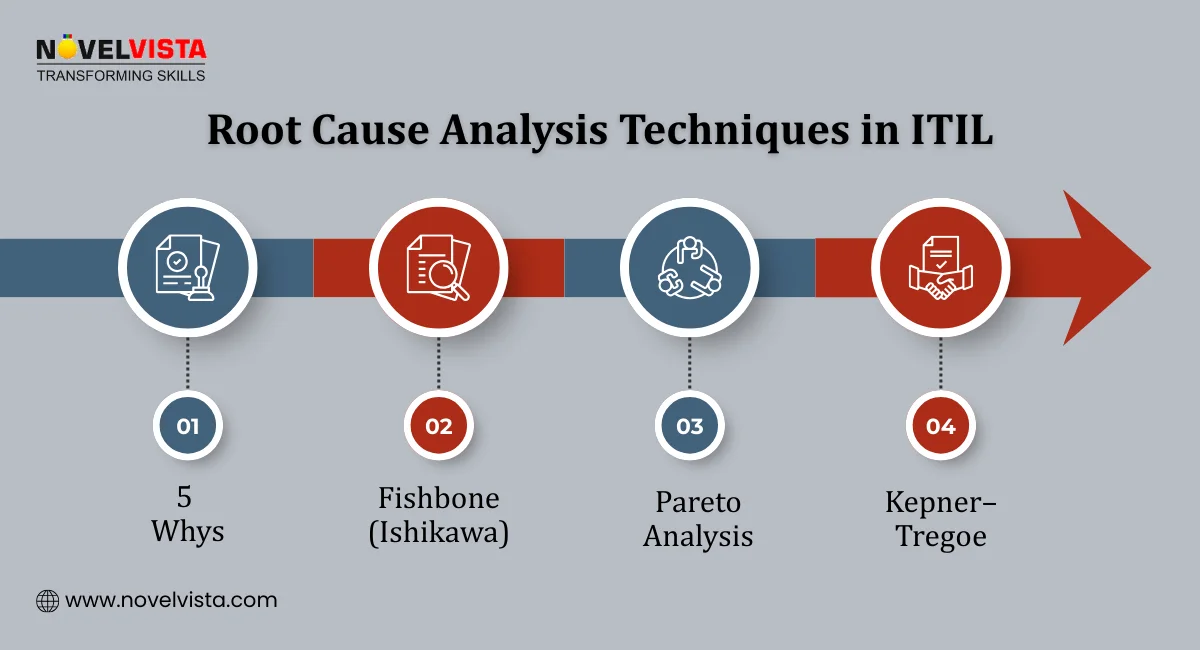
This method works well for simple or moderately complex issues. Teams repeatedly ask “why” until they reach a cause that is controllable and actionable. It helps avoid stopping at surface-level symptoms.
This technique organizes possible causes into categories such as people, process, tools, and environment. It is especially useful during group RCA sessions where multiple factors may contribute to a problem.
Pareto helps teams focus on the few causes that create most of the issues. In practice, this often shows that a small number of failures are responsible for repeated incidents.
This is a more structured approach that separates problem analysis, decision making, and risk assessment. It works well for high-impact incidents where decisions must be well-documented and defensible.
In facilitated RCA sessions, simpler techniques like 5 Whys often outperform complex models, provided they are applied rigorously and supported by evidence. Using the right technique strengthens Root Cause Analysis ITIL and improves confidence in the outcome.
Theory alone does not show the real value of RCA. Practical use is where ITIL Root Cause Analysis proves its worth.
Many organizations report a 30–50% reduction in recurring incidents once RCA becomes part of regular Problem Management.
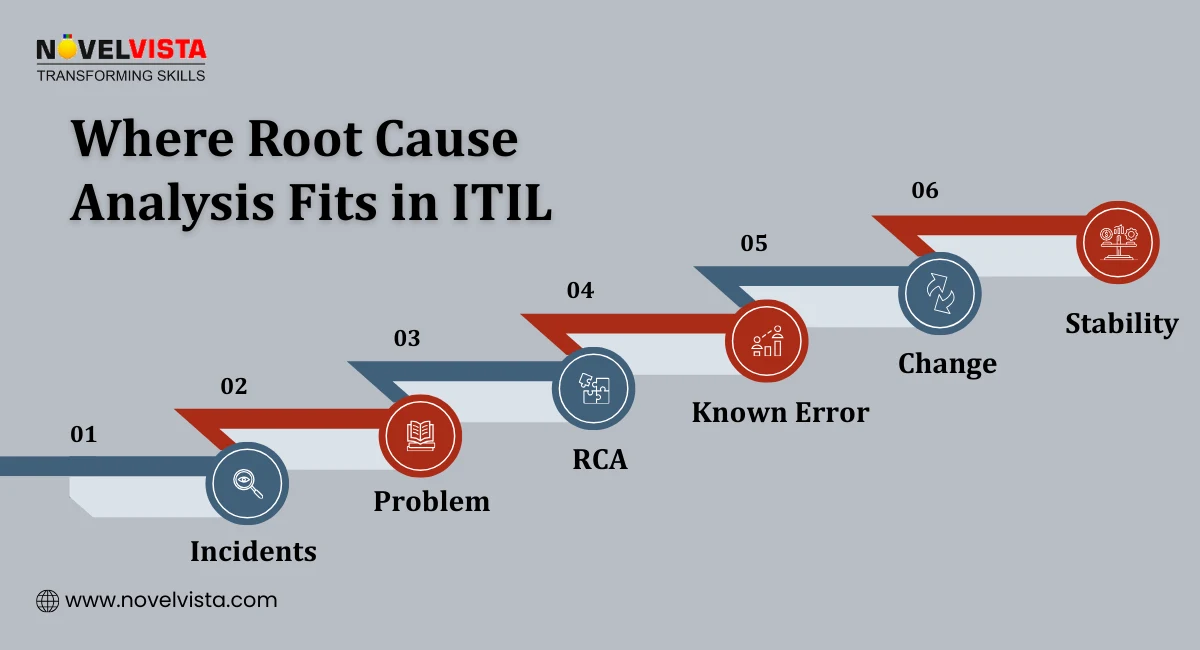
This example shows how RCA moves teams from constant recovery to long-term prevention, which is the real goal of the ITIL Root Cause Analysis Process.
When done consistently, ITIL Root Cause Analysis delivers benefits that go beyond fewer incidents.
Sustainable RCA results depend on leadership support, cross-team participation, and follow-up verification, not on documentation volume.
ITIL Root Cause Analysis is not a one-time activity performed after major outages. It is a continuous discipline that helps IT teams learn from incidents and prevent them from recurring.
When embedded correctly within the ITIL Root Cause Analysis Process, it shifts operations from reactive firefighting to controlled, preventive service management. Mature organizations treat Root Cause Analysis ITIL as a strategic capability, turning incidents into insight and stability into a real business advantage.
These observations reflect common findings across ITIL-aligned organizations operating in cloud, hybrid, and regulated environments.

If you want to understand ITIL practices like Root Cause Analysis in a practical, structured way, NovelVista’s ITIL (Version 5) Foundation Certification Training is a strong next step. The course helps you connect Incident, Problem, Change, and Continuous Improvement practices clearly. You’ll gain the confidence to apply ITIL concepts in real environments and build a solid base for advanced ITSM roles.
Author Details

Course Related To This blog
ITIL4 Specialist Monitor Support and Fulfil Certification
ITIL4 Specialist Acquiring & Managing Cloud Services
ITIL® 4 Strategic Leader Digital And IT Strategy (DITS)
ITIL® 4 Specialist Drive Stakeholder Value
ITIL® 4 Specialist High Velocity IT
ITIL® 4 Foundation Certification
ITIL V5 Foundation
Confused About Certification?
Get Free Consultation Call
Stay ahead of the curve by tapping into the latest emerging trends and transforming your subscription into a powerful resource. Maximize every feature, unlock exclusive benefits, and ensure you're always one step ahead in your journey to success.