Category | IT Service Management
Last Updated On 02/02/2026
Every minute of unplanned IT downtime costs enterprises between $5,600 and $9,000, and in industries like banking, e-commerce, and healthcare, this number can exceed $15,000 per minute. At the same time, Gartner reports that 40% of IT incidents are detected by end users before monitoring tools catch them, a clear sign that traditional reactive IT operations are no longer enough.
Now imagine an IT environment where failures are detected before users even notice them. Systems self-report issues. Alerts are filtered intelligently. Critical problems escalate automatically. Noise is reduced. Response times shrink from hours to minutes.
With that context in place, let’s now smoothly move into the core concept of ITIL Event Management.
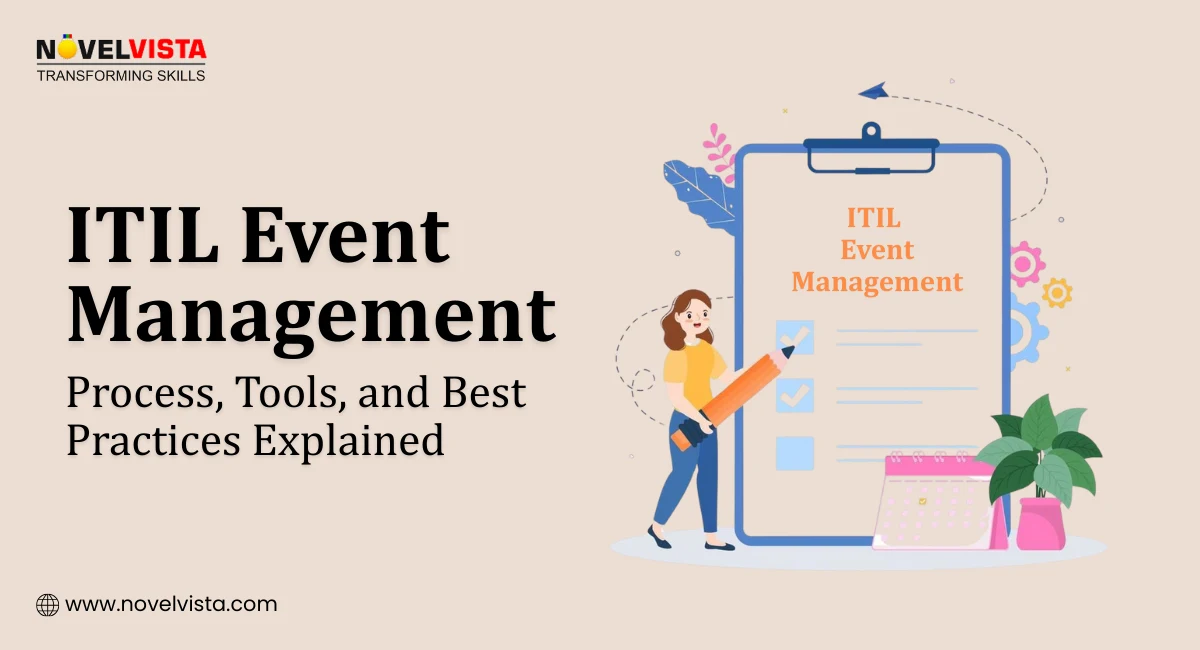
It is a key process within the ITIL Service Operation lifecycle that focuses on detecting, interpreting, and responding to events generated by IT services, systems, and infrastructure. In simple terms, Event Management ITIL helps IT teams monitor in real time what is happening across their IT environment by capturing and analyzing notifications from servers, applications, networks, and security systems. These events can include situations such as a server reaching high CPU usage, a failed login attempt, a database running out of storage, a security breach alert, or even the successful completion of a scheduled system backup. However, not every event indicates a problem, some are purely informational, while others require immediate attention and action.
A common misconception is that ITIL Event Management is the same as Incident Management, but they are different:
Concept |
Meaning |
Event |
A Change in State Detected by a System |
Alert |
A Warning that Something Needs Attention |
Incident |
An Actual Disruption to Service |
ITIL Event Management comes first; it detects issues before they become incidents.
It follows a structured lifecycle:
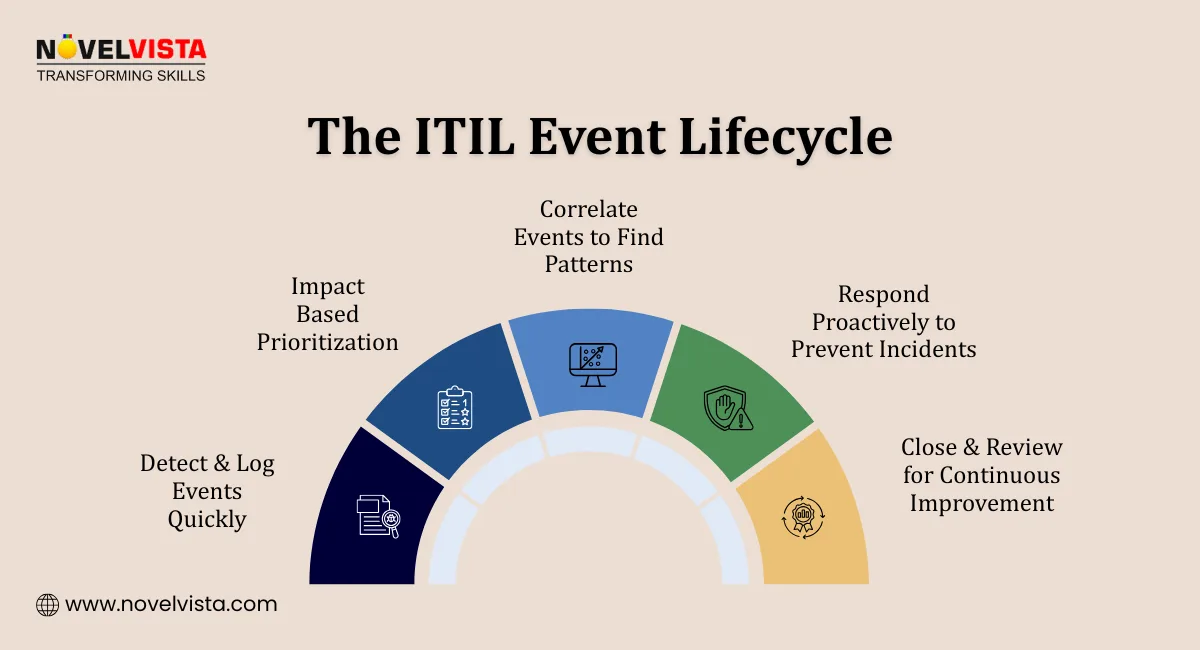
Event Detection is the first step in the ITIL Event Management process, where events are automatically generated by monitoring tools, applications, networks, servers, and cloud platforms that continuously track system behavior. For example, AWS CloudWatch may detect a sudden spike in response time, indicating performance degradation, while Splunk may log an unusual access pattern that could signal a potential security risk or system anomaly.
Event Filtering and categorization ensure that not all events are treated the same, as not every event requires action. In this step, the system classifies events into informational events, warning events, and exception events based on their severity and impact, which helps reduce unnecessary alerts, prevents alert overload, and support more effective IT Event Management ITIL.
Event Correlation involves grouping multiple related events together to identify underlying root causes rather than treating each alert in isolation. For example, instead of handling 100 separate server alerts individually, the system correlates them as a single network outage, making analysis and response faster and more effective.
Triggering Actions is the stage where appropriate responses are initiated based on the event type. Depending on the nature and severity of the event, ITIL may trigger an Incident, raise a Change Request, start a Problem Investigation, or take no action at all if the event is purely informational and does not impact services.
All events are recorded for audit, analysis, and continuous improvement.
This structured approach makes the process reliable, repeatable, and scalable.
With the rise of cloud computing, DevOps, and microservices, IT environments have become highly dynamic and complex.
This is where IT Event Management ITIL becomes even more powerful.
Modern organizations use:
Instead of waiting for failures, systems can now predict issues before they happen.
For example:
This proactive capability is what makes ITIL a foundation of high-performing IT organizations. With this understanding of modern IT service practices, you are now ready to prepare for the ITIL 4 Exam.
Organizations rely on specialized ITIL Event Management Tools and ITIL Event Management Software to implement this process effectively.
Some widely used tools include:
These tools help:
The best ITIL Event Management Software integrates seamlessly with ITSM platforms like ServiceNow, Jira, and BMC Remedy.
To get maximum value, organizations should follow these best practices:
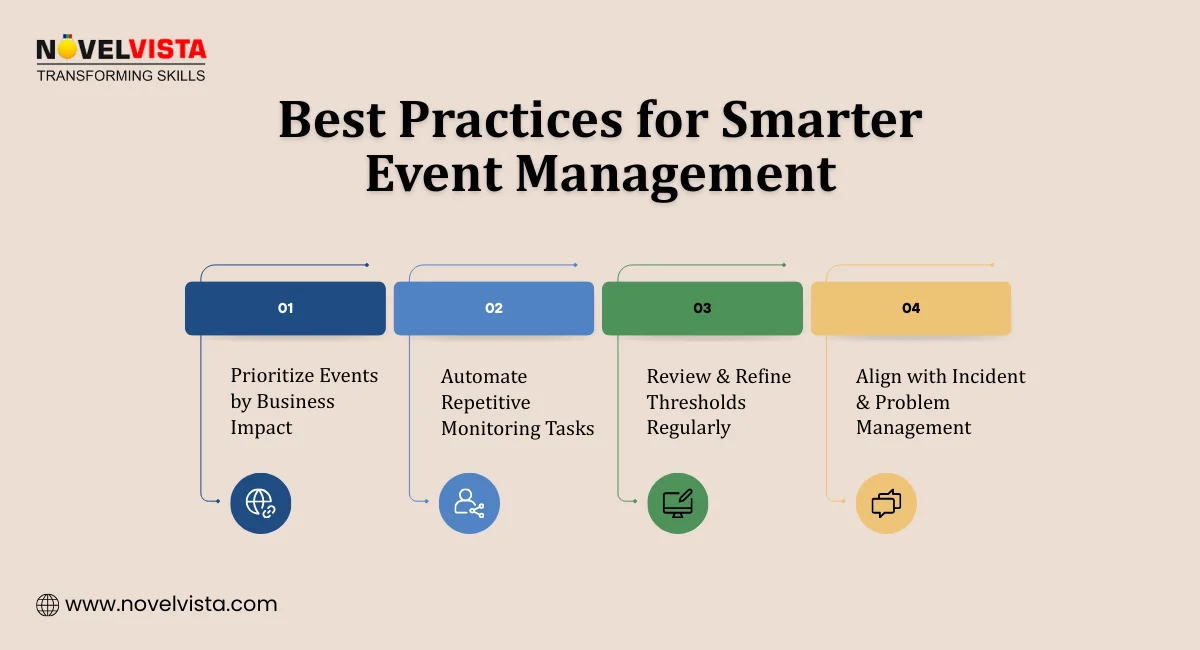
Not every event should wake up your IT team at 2 AM, so it is important to configure smart thresholds based on business impact and service criticality. This helps filter out low-priority alerts, minimizes alert fatigue, and ensures that teams focus only on events that truly require immediate attention.
Use automation for routine responses such as restarting services, clearing logs, or scaling resources based on demand. This reduces manual effort, speeds up resolution, and allows IT teams to focus on more complex issues that require human judgment.
Make sure your teams know exactly when and how to escalate critical events by defining clear roles, responsibilities, and escalation timelines. This ensures faster decision-making, avoids confusion during incidents, and helps prevent minor issues from turning into major service disruptions.
Regularly review event data to refine monitoring rules, thresholds, and alerting policies based on real operational patterns. This helps eliminate false alarms over time, improves detection accuracy, and ensures your Event Management process remains aligned with changing IT environments.
Focus on events that directly affect users, revenue, and overall service quality rather than reacting to every technical alert. Prioritizing high-impact events ensures better resource utilization, improved customer experience, and stronger service reliability. Following these ITIL Event Management Best Practices helps organizations operate more efficiently and consistently. With this understanding of ITIL Event Management, the next step is learning How to Register for ITIL V4 Exam.
In today’s digital-first world, IT is not just a support function; it is the backbone of business success. Organizations that master it gain a competitive edge through faster detection, smarter response, and improved service reliability.
From structured processes to intelligent tools, from reduced downtime to audit compliance, ITIL Event Management is no longer optional; it is essential.
By implementing the ITIL Event Management Process, adopting the right ITIL Event Management Tools, and following ITIL Event Management Best Practices, organizations can move from reactive firefighting to proactive service excellence.
Ready to deepen your understanding of ITIL and build a strong foundation in modern IT service management? Join NovelVista’s ITIL 4 Foundation Certification Training and gain a clear, practical understanding of ITIL concepts, service value systems, and best practices for managing IT services effectively in today’s digital-driven organizations. Designed for IT professionals, service desk teams, ITSM practitioners, and aspiring IT leaders, this course equips you with globally recognized knowledge to align IT services with business needs, improve service delivery, and support continual improvement initiatives.
Start your ITIL 4 journey today and take the next step toward IT service excellence!
Author Details

Course Related To This blog
ITIL4 Specialist Monitor Support and Fulfil Certification
ITIL4 Specialist Acquiring & Managing Cloud Services
ITIL 4 Specialist Sustainability in Digital & IT
ITIL® 4 Strategic Leader Digital And IT Strategy (DITS)
ITIL® 4 Specialist Drive Stakeholder Value
ITIL® 4 Specialist High Velocity IT
ITIL® 4 Strategist Direct, Plan & Improve
ITIL® 4 Specialist Create Deliver & Support
ITIL® 4 Foundation Certification
Confused About Certification?
Get Free Consultation Call
Stay ahead of the curve by tapping into the latest emerging trends and transforming your subscription into a powerful resource. Maximize every feature, unlock exclusive benefits, and ensure you're always one step ahead in your journey to success.