Category | Quality Management
Last Updated On 13/05/2026
Global cloud infrastructure spending reached $330 billion in 2024, confirming it surpassed the $300 billion mark you mentioned. By Q3 2025, quarterly spending hit a record $102.6 billion, reflecting 25% year-over-year growth driven by AI production deployments. And yet, a significant portion of those organizations have no structured, internationally recognized mechanism to verify that their cloud-based IT services are actually being managed to a consistent standard.
That is not a technology problem. It is a governance problem.
Consider a few questions that IT leaders and compliance managers face every day: If a critical incident occurs in your cloud environment, do you have documented processes that meet international service management standards? If a regulator or enterprise customer asks for evidence that your cloud operations are well-governed, what do you hand them? And if your cloud service provider makes an infrastructure change at 2 AM, who is accountable for how that change is managed within your service framework?
These are precisely the kinds of questions that ISO 20000 cloud auditing is built to answer. For organizations running workloads on IaaS, PaaS, or SaaS platforms, the audit is not a formality. It is the structured process that confirms whether IT service management is working as it should, or whether the gaps are simply waiting for the wrong moment to surface.
This guide walks through everything you need to know about ISO 20000 cloud auditing, from its foundational standards to common challenges, key focus areas, and the tangible benefits of getting certified.
ISO 20000 cloud auditing verifies that a cloud service provider (CSP) or its customer manages IT services, whether IaaS, PaaS, or SaaS, in accordance with international best practices for IT service management (ITSM). The governing standard is ISO/IEC 20000-1:2018, which defines the requirements for establishing, implementing, operating, monitoring, reviewing, maintaining, and improving a service management system (SMS).
Complementing this is ISO/IEC TR 20000-9:2015, a technical report that provides specific guidance on how ISO 20000-1 applies to cloud services. Together, these documents form the authoritative framework for auditing cloud-based IT services across public, private, and hybrid cloud models.
The audit confirms that an organization's cloud operations are not just technically functional but are also secure, reliable, and consistently compliant with agreed service requirements. For organizations operating under regulatory scrutiny, this distinction matters enormously. If you are preparing for certification alongside understanding audit frameworks, this detailed ISO 20000 Exam Guide can help you understand the exam structure, preparation strategy, and key concepts required for success.
When auditors assess cloud environments against the ISO 20000-1 standard, they concentrate on several specific process domains. Each of these areas presents unique challenges in cloud contexts.
Process Area | What Auditors Examine | Cloud-Specific Consideration |
| Incident Management | Categorization, escalation, resolution timelines, SLA adherence | Incidents may originate from CSP infrastructure outside direct control |
| Problem Management | Root cause analysis, known error records, trend analysis | Multi-vendor environments complicate cause attribution |
| Change Management | Approval workflows, testing procedures, rollback plans | Cloud platforms may trigger automated or provider-initiated changes |
| Service Continuity | Uptime commitments, failover procedures, recovery testing | Shared infrastructure affects RTO/RPO guarantees |
| Supplier Management | Contract terms, performance monitoring, audit rights | CSPs may serve as tier-1 suppliers with limited transparency |
| Configuration Management | CMDB accuracy, asset tracking, configuration baselines | Cloud-native assets are dynamic and may auto-scale |
Each of these areas demands that organizations have documented policies, measurable processes, and verifiable evidence. In cloud environments, gathering that evidence often requires contractual rights to access data held by the CSP.
One of the most practically important concepts in ISO 20000 cloud auditing is control inheritance. When an organization uses a cloud service provider that already holds ISO 20000 certification, it can inherit certain controls from that provider rather than demonstrating those controls independently.
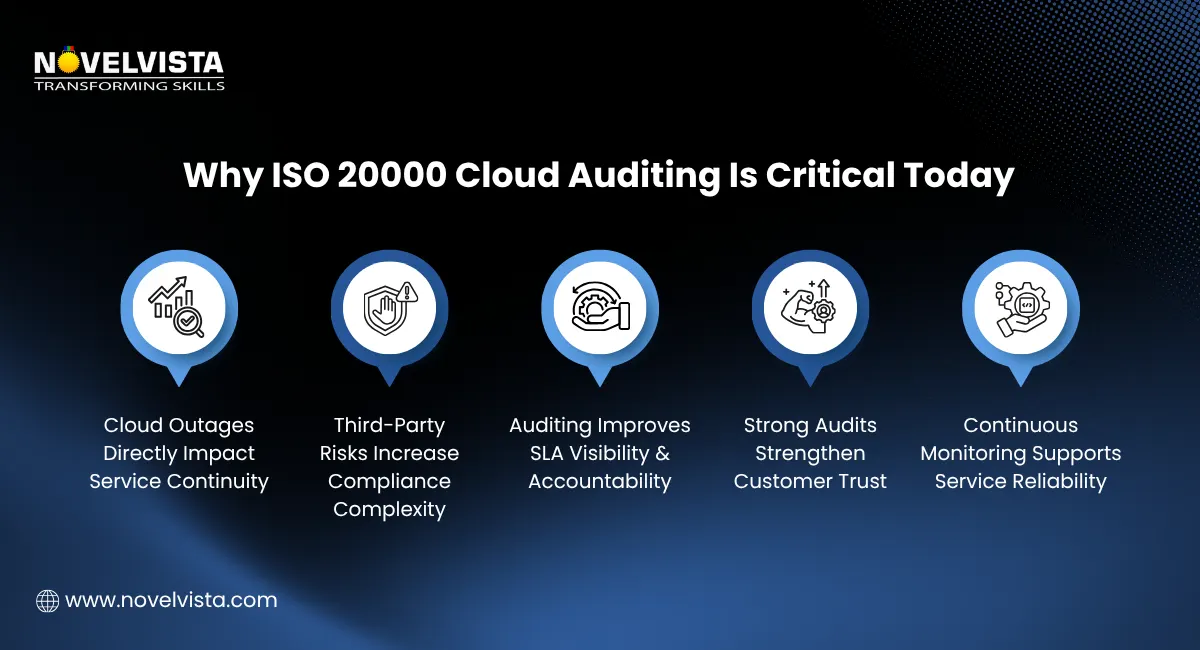
This is significant because it reduces the scope of an organization's own internal audit. If an IaaS provider like Microsoft Azure is certified and maintains incident management and change management processes at the infrastructure layer, the organization consuming those services can reference the provider's certification as evidence for those specific control areas.
However, inheritance is not automatic or unlimited. The organization must still demonstrate that it governs the inherited controls appropriately, that it monitors the CSP's performance against agreed SLAs, and that it has contractual mechanisms to obtain evidence when auditors require it. The shared responsibility model must be explicitly documented, with clear delineation of which controls sit with the provider and which remain with the customer.
This is where many organizations encounter their first significant gap during the ISO 20000 audit process. They assume that because their CSP is certified, their own obligations are reduced. In reality, the obligation to govern, monitor, and document that inherited relationship remains firmly with the organization. Clearly defining Roles and Responsibilities is essential in cloud governance, especially when managing shared responsibility models between organizations and cloud service providers.
The cloud environment introduces audit challenges that simply do not exist in traditional on-premises ITSM. Understanding these challenges in advance is the difference between a well-prepared organization and one that scrambles through audit preparation.
Clearly distinguishing between what the provider manages and what the customer manages is foundational to auditing cloud-based IT services. Without explicit documentation of this boundary, auditors cannot assess conformance accurately, and organizations cannot demonstrate accountability for the portions of the SMS they own.
Ensuring that the CSP provides sufficient information for service performance monitoring and review is a recurring challenge. Not all providers offer the granularity of logging, reporting, and access that an ISO 20000 audit requires. Organizations must negotiate these terms before committing to a provider, not after audit preparation begins.
Cloud platforms are designed for rapid change. Configuration updates, auto-scaling events, and provider-side maintenance windows can all affect service delivery in ways that are difficult to track within a traditional change management framework. Managing these dynamic environments within the structured requirements of the ISO 20000 audit process requires purpose-built tooling and adapted procedures.
Auditors assessing cloud environments must understand more than ITSM theory. They need practical knowledge of multi-cloud and hybrid architectures, API-driven workflows, cloud-native management technologies, and the commercial structures that govern CSP relationships. Organizations should verify that their chosen certification body has auditors with genuine cloud expertise before engaging.
Challenge | Root Cause | Recommended Action |
| Shared responsibility ambiguity | Poorly defined contractual boundaries | Document a RACI matrix aligned to ISO 20000-1 clauses |
| Limited CSP transparency | Standard provider contracts lack audit provisions | Include audit rights and reporting obligations in all CSP agreements |
| Dynamic change tracking | Cloud-native change velocity exceeds manual processes | Implement automated change logging with SMS integration |
| Evidence retrieval delays | Evidence held by CSP, not organization | Establish scheduled evidence collection procedures pre-audit |
| Hybrid environment inconsistency | On-premises processes not adapted for cloud | Develop cloud-specific addendums for all core ITSM procedures |
Organizations that successfully complete the ISO 20000 audit process and achieve certification realize benefits that extend well beyond the compliance checkbox.
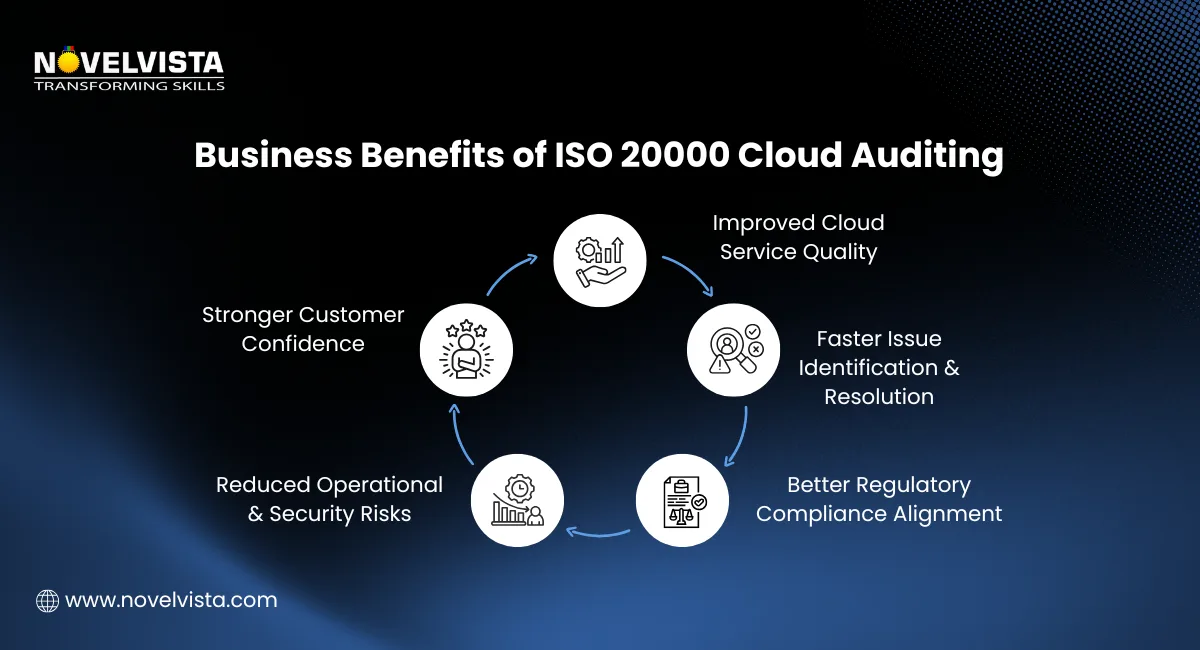
Enhances Accountability
Establishes clearer roles, responsibilities, and governance across cloud operations teams.
ISO 20000 cloud auditing is the mechanism by which organizations move from assuming their cloud-based IT services are well-managed to proving it. The ISO 20000 audit process provides an objective, evidence-based assessment of whether service management systems are functioning as intended across complex, multi-vendor cloud environments.
For organizations at the beginning of this journey, the priority is understanding what auditing cloud-based IT services genuinely requires: clear scope documentation, adapted ITSM processes, contractual transparency with CSPs, and the organizational discipline to maintain evidence continuously rather than scrambling before an audit window.
For those already certified, the challenge is sustaining that standard in environments that evolve faster than most governance frameworks are naturally equipped to handle. The organizations that do this well do not just earn a certificate. They build a cloud operation that reliably delivers on its promises, absorbs disruption without service failure, and earns the sustained confidence of customers, regulators, and partners who depend on it.
Ready to strengthen your IT service management auditing expertise?
Join NovelVista’s ISO/IEC 20000:2018 Lead Auditor Certification Training and develop practical ITSM auditing skills, real-world service management knowledge, and globally recognized certification credentials. Designed for IT professionals, auditors, compliance managers, and service leaders, this course helps you confidently conduct audits, improve service quality, and drive continual improvement across modern cloud and digital environments.
Start your ISO 20000 Lead Auditor certification journey today!
Author Details

Course Related To This blog
ISO 20000:2018 Lead Auditor
Confused About Certification?
Get Free Consultation Call
Stay ahead of the curve by tapping into the latest emerging trends and transforming your subscription into a powerful resource. Maximize every feature, unlock exclusive benefits, and ensure you're always one step ahead in your journey to success.