Category | Quality Management
Last Updated On 07/05/2026
Artificial Intelligence is no longer experimental it is operational, decision-making, and increasingly autonomous. According to industry reports, over 70% of organizations are now using AI in at least one business function, yet less than 30% have formal mechanisms to monitor and measure AI performance effectively. This gap creates serious risks bias, model drift, security vulnerabilities, and compliance failures.
As the world’s first AI Management System (AIMS) standard, ISO/IEC 42001 provides a structured approach to governing AI responsibly. At the heart of this standard lies Clause 9: Performance Evaluation, which ensures that AI systems are not just deployed but continuously monitored, measured, and improved.
Understanding Clause 9 of ISO/IEC 42001: AI Performance Monitoring and Measurement is critical because it connects technical performance with ethical responsibility, governance, and risk management. Without proper performance monitoring, even the most advanced AI systems can fail silently causing reputational, legal, and operational damage.
This blog explains Understanding Clause 9 of ISO/IEC 42001: AI Performance Monitoring and Measurement and why it is critical for governing modern AI systems. You’ll learn how to define KPIs, implement continuous monitoring, and align AI performance with business, ethical, and compliance goals. It also breaks down the evaluation process, key metrics, and common pitfalls organizations face. Finally, it shows how Clause 9 helps build trustworthy, risk-aware, and future-ready AI systems.
| Area | Key Insight |
| Purpose | Monitor, measure, and evaluate AI system performance continuously |
| Core Focus | Align AI with business goals, ethics, and risk management |
| Key Components | KPIs, continuous monitoring, audits, and improvement cycles |
| Metrics | Performance, data quality, bias, security, and compliance |
| Process | Define KPIs → Monitor → Evaluate → Audit → Improve |
| Common Risks | Model drift, bias, poor data quality, lack of governance |
| Outcome | Reliable, transparent, and compliant AI systems |
Understanding Clause 9 of ISO/IEC 42001: AI Performance Monitoring and Measurement begins with its core requirement: organizations must systematically monitor, measure, analyze, and evaluate AI system performance.
Clause 9 is not isolated it is deeply connected to other clauses:
Clause 9 Relationship with Other Clauses
| Clause | Role in AI Performance |
| Clause 4 (Context) | Defines environment and stakeholders |
| Clause 5 (Leadership) | Establishes accountability and oversight |
| Clause 6 (Planning) | Aligns KPIs with risks and objectives |
| Clause 8 (Operations) | Supports AI lifecycle execution |
| Clause 10 (Improvement) | Drives corrective and preventive actions |
This interconnected structure ensures that performance evaluation is not just technical it is strategic and governance-driven. Understanding ISO 42001 Clauses is essential for building a structured, compliant, and responsible AI management system that aligns with global governance standards.
A key expectation under Clause 9 is that AI performance must align with:
This makes Understanding Clause 9 of ISO/IEC 42001: AI Performance Monitoring and Measurement essential for building trustworthy AI systems.
Simplify Clause 9 performance monitoring & evaluation
Understand ISO 42001 syllabus, clauses & core concepts clearly
Learn practical strategies to pass the ISO 42001 certification exam faster
To effectively implement Understanding Clause 9 of ISO/IEC 42001: AI Performance Monitoring and Measurement, organizations must translate objectives into measurable KPIs.
Examples include:
KPIs must go beyond performance they should also measure fairness, explainability, and security.
One of the biggest mistakes organizations make is treating AI evaluation as a one-time activity.
Clause 9 emphasizes continuous monitoring, because AI systems evolve over time.
Key risks to monitor:
Understanding Clause 9 of ISO/IEC 42001: AI Performance Monitoring and Measurement means recognizing that AI systems are dynamic and require constant oversight.
Organizations need structured frameworks such as:
These frameworks help balance:
Without structured metrics, performance evaluation becomes inconsistent and unreliable.
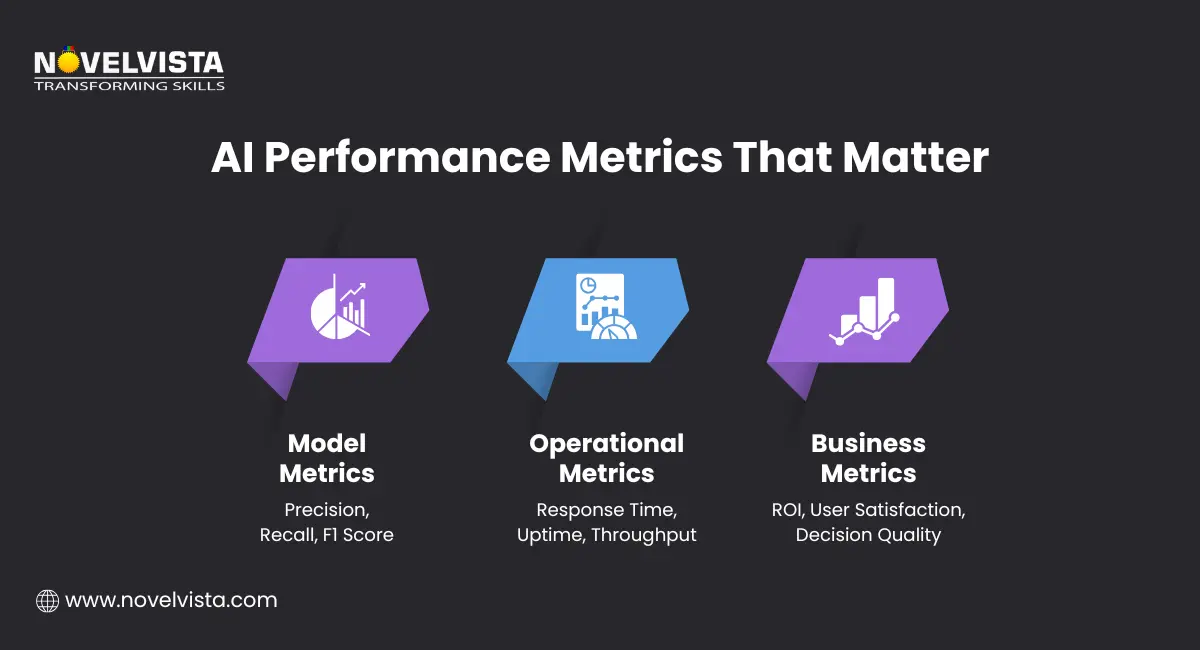
A strong implementation of Understanding Clause 9 of ISO/IEC 42001: AI Performance Monitoring and Measurement includes tracking:
| Category | Metrics | Why It Matters |
| Model Performance | Accuracy, Precision, Recall, F1 Score | Ensures the AI system delivers correct and reliable outputs |
| Reliability | Consistency, uptime, failure rate | Measures stability and dependability over time |
| Data Governance | Data quality, completeness, lineage | Ensures inputs are trustworthy and traceable |
| Bias & Fairness | Vulnerability detection, breach incidents | Protects AI systems from attacks and misuse |
| Security | Vulnerability detection, breach incidents | Protects AI systems from attacks and misuse |
| Compliance | SLA adherence, regulatory alignment | Ensures adherence to legal and organizational standards |
Model Performance
Data Governance
Risk and Compliance
Performance data must not sit idle. It should feed into:
Clause 9 directly connects to Clause 10 (Improvement), ensuring that insights lead to corrective and preventive actions.
Start by setting SMART KPIs aligned with objectives and risk appetite.
Examples:
This step is foundational in Understanding Clause 9 of ISO/IEC 42001: AI Performance Monitoring and Measurement.
Use:
Ensure:
Compare results against:
Example:
This structured evaluation is central to Understanding Clause 9 of ISO/IEC 42001: AI Performance Monitoring and Measurement.
Clause 9 requires internal audits focused on:
Unlike traditional IT audits, these are:
Use insights for:
This closes the loop between performance evaluation and governance.
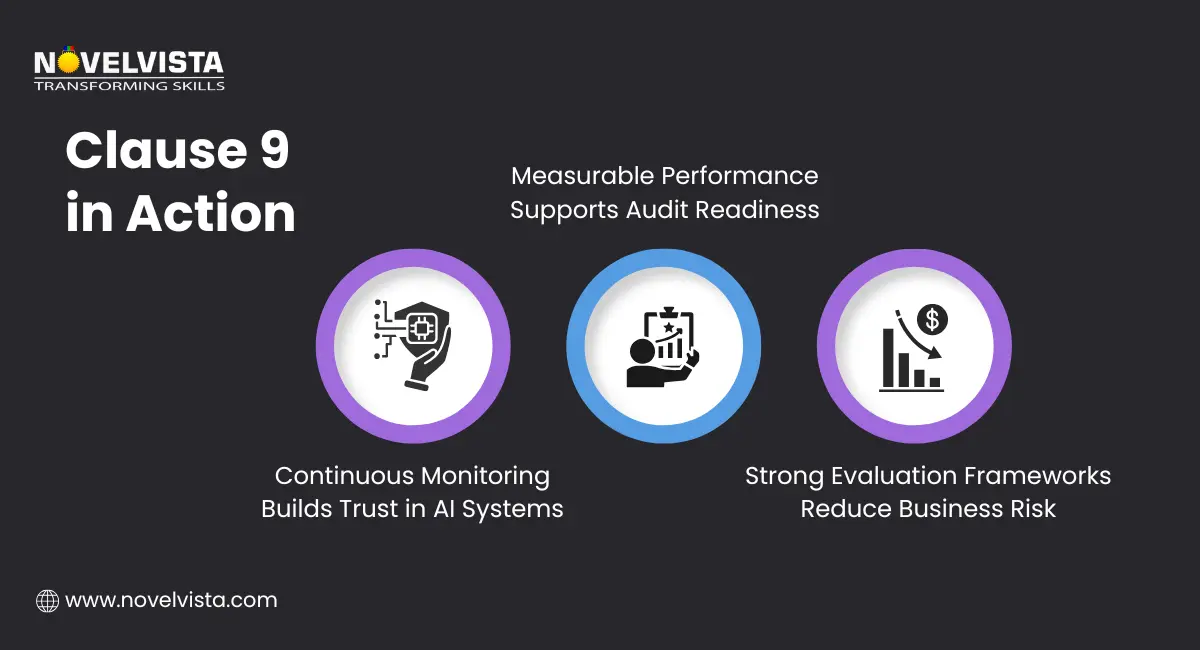
To effectively implement Understanding Clause 9 of ISO/IEC 42001: AI Performance Monitoring and Measurement:
This collaborative approach ensures comprehensive performance evaluation.
Pitfall 1: Focusing only on accuracy
Solution: Include fairness, robustness, and security metrics
Pitfall 2: One-time evaluation
Solution: Implement continuous monitoring systems
Pitfall 3: Siloed reporting
Solution: Ensure performance data reaches top management
Understanding Clause 9 of ISO/IEC 42001: AI Performance Monitoring and Measurement helps organizations avoid these common mistakes.
Understanding Clause 9 of ISO/IEC 42001: AI Performance Monitoring and Measurement goes far beyond tracking technical metrics it establishes a foundation of accountability, transparency, and governance across the entire AI lifecycle. It ensures that AI systems are not only accurate, but also ethical, reliable, and aligned with business and regulatory expectations. The ISO 42001 Syllabus provides a structured roadmap to understand AI governance, risk management, and compliance requirements aligned with the standard.
By embedding continuous monitoring, structured evaluation, and feedback-driven improvement, Clause 9 transforms performance management into a strategic capability. It enables organizations to proactively detect risks like bias, model drift, and security vulnerabilities before they impact outcomes.
In an era where AI decisions directly influence customers, operations, and compliance, performance evaluation is no longer optional it is a critical governance function. Organizations that effectively implement Understanding Clause 9 of ISO/IEC 42001: AI Performance Monitoring and Measurement will gain a decisive advantage by building AI systems that are trustworthy, resilient, and ready for the future.

Ready to strengthen your expertise in AI governance and auditing?
Join NovelVista’s ISO/IEC 42001 Lead Auditor Certification Training and gain hands-on experience in auditing AI management systems, understanding Clause 9 performance evaluation, and implementing responsible AI practices aligned with global standards. Designed for AI, risk, and compliance professionals, this course equips you with practical audit skills, real-world insights, and a globally recognized credential to lead AI governance initiatives with confidence.
Start your ISO 42001 auditor journey today!
Author Details

Confused About Certification?
Get Free Consultation Call
Stay ahead of the curve by tapping into the latest emerging trends and transforming your subscription into a powerful resource. Maximize every feature, unlock exclusive benefits, and ensure you're always one step ahead in your journey to success.