Category | Quality Management
Last Updated On 07/05/2026
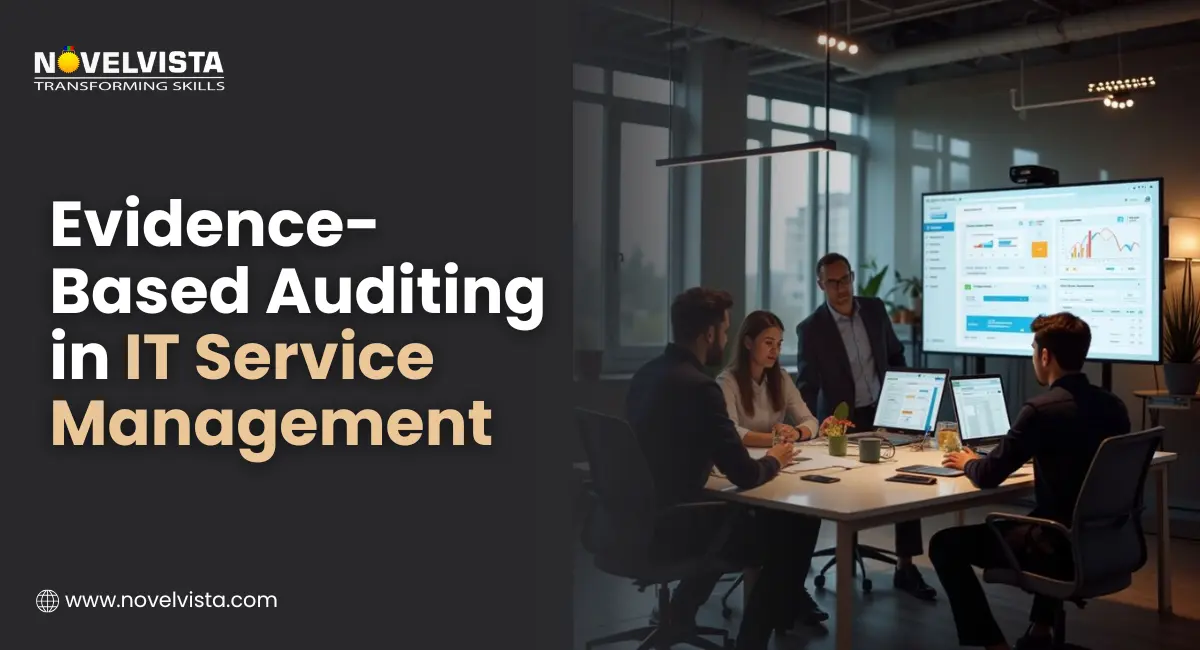
Picture this: it’s audit season, and your IT team is scrambling. Spreadsheets are flying around, emails are being dug out of archives, and engineers are pulled away from critical work just to gather proof that processes were followed months ago. This “audit fire-drill” is all too common in organizations relying on traditional compliance methods. It’s manual, stressful, error-prone and often leads to burnout and missed risks.
According to industry reports, organizations spend up to 30–40% of audit time just collecting and validating evidence. That’s not compliance it’s chaos.
Now, the landscape is changing.
Evidence-based auditing is emerging as a smarter, more efficient approach. Instead of scrambling for retrospective proof, organizations are moving toward continuous, automated collection of digital evidence logs, configurations, and system-generated records that exist in real time.
The value is clear: evidence-based auditing transforms compliance from a reactive burden into a proactive, strategic function within IT Service Management (ITSM). It not only reduces stress but also improves accuracy, transparency, and decision-making.
This blog explores how evidence-based auditing is transforming IT Service Management from reactive, manual audits to continuous, automated compliance. You’ll understand the core principles behind modern auditing, the key sources of reliable audit evidence, and how to implement a scalable framework within your organization. It also covers common challenges like data quality and system integration and practical strategies to overcome them. By the end, you’ll see how evidence-based auditing can reduce audit fatigue while strengthening governance and service performance.
| Section | Key Takeaway |
| Problem | Traditional audits are manual, time-consuming, and prone to errors, leading to audit fatigue |
| Shift | Evidence-based auditing enables continuous, automated collection of real-time audit data |
| Core Principles | Focus on continuous compliance, automation, single source of truth, and traceability |
| Evidence Sources | Change logs, incident records, CMDB data, and access/security controls form the backbone |
| Implementation | Build CMDB → Map controls → Automate monitoring and reporting using GRC tools |
| Challenges | Data quality issues, cultural resistance, and complex system integrations |
| Success Factors | Executive support, pilot programs, training, and the right ITSM/GRC tools |
| Outcome | Reduced audit stress, improved accuracy, stronger governance, and better service quality |

Traditional audits operate on a periodic basis quarterly, biannually, or annually. But risks don’t follow schedules.
With evidence-based auditing, organizations adopt continuous compliance. Automated monitoring tools track configurations, system logs, and user activities in real time. Instead of waiting for an audit to identify issues, teams can detect and address non-compliance as it happens.
This shift ensures:
Continuous compliance is especially critical in environments dealing with regulatory requirements like GDPR, ISO standards, or financial controls.
Audit fatigue is real. IT teams often spend countless hours manually collecting change records, access logs, and system reports.
Evidence-based auditing eliminates this burden by automating evidence collection. Tools integrated with ITSM platforms automatically gather:
This reduces manual effort, minimizes human error, and allows teams to focus on innovation rather than documentation.
One of the biggest challenges in traditional audits is inconsistent or incomplete data.
With evidence-based auditing, data is extracted directly from primary ITSM tools such as service desks, monitoring systems, and CMDBs. This creates a single source of truth, ensuring:
When auditors rely on system-generated data rather than manually compiled reports, the integrity of the audit process improves significantly.
Traceability is at the heart of strong compliance.
Evidence-based auditing ensures that every control, action, and decision is linked to specific Configuration Items (CIs). This creates a transparent, tamper-proof chain of evidence.
For example:
This level of traceability not only satisfies auditors but also strengthens internal governance.
Change management is a cornerstone of ITSM and a critical component of evidence-based auditing.
Audit teams need proof that changes were:
Automated change logs provide this evidence in real time, reducing the need for manual verification.
Incident management records show how issues are handled, resolved, and prevented from recurring.
In evidence-based auditing, incident logs serve as proof of:
Equally important is the Configuration Management Database (CMDB). A well-maintained CMDB reflects the current state of infrastructure, enabling accurate mapping between services and assets. In my experience consulting with organizations on SOC 2 and GDPR readiness, relying on a single source of truth such as an accurate CMDB is the single most reliable method for passing rigorous audits without friction.
Without a reliable CMDB, audit evidence becomes fragmented and unreliable. Learn the core ISO 20000 Principles that help organizations deliver consistent, efficient, and high-quality IT service management aligned with global standards.
Security compliance is a major focus of modern audits.
Evidence-based auditing relies on:
These records demonstrate that:
This is especially critical for frameworks like ISO 27001, SOC 2, and other cybersecurity standards.
Learn the step-by-step path to ISO 20000 certification
Learn how to build practical IT service management & auditing skills
Get a clear roadmap to advance your ITSM career
Implementing the Framework: Evidence-Based Auditing
| Phase | Focus Area | Key Activities | Outcomes |
| Phase 1: Foundation | Build a reliable data base | - Implement discovery tools to identify assets - Establish service mapping to understand dependencies - Maintain an accurate CMDB | - Strong data integrity - Up to 40% faster audit resolution - Reliable base for automation |
| Phase 2: Mapping & Controls | Align compliance with operations | - Map GDPR, SOX, and other regulations to internal policies - Embed validation into ITSM workflows - Enforce approvals for changes and access | - Built-in compliance - Reduced manual intervention - Consistent policy enforcement |
| Phase 3: Monitoring & Reporting | Enable continuous compliance visibility | - Use GRC tools to centralize audit trails - Create real-time dashboards - Set automated alerts for non-compliance | - Proactive risk management - Real-time insights - Actionable audit reporting |
The first step in implementing evidence-based auditing is building a strong foundation.
This starts with an accurate CMDB. Organizations must invest in:
Based on proven IT asset management (ITAM) and discovery practices, organizations that prioritize a clean, verified CMDB observe a 40% reduction in audit resolution times. Without a reliable data foundation, automation cannot deliver accurate results.
Next, organizations must align regulatory requirements with internal policies.
For example:
In evidence-based auditing, validation is embedded directly into ITSM workflows. This means:
This ensures that compliance is built into daily operations not treated as a separate activity.
The final phase involves continuous monitoring and centralized reporting.
Governance, Risk, and Compliance (GRC) tools play a key role here. They:
With evidence-based auditing, reporting becomes dynamic and actionable rather than static and retrospective.
Pro Tip: Explore our comprehensive ISO 20000 Exam guide to understand certification pathways, exam preparation strategies, and best practices for modern IT service management success.
Automation is powerful but only if the underlying data is accurate.
In evidence-based auditing, poor data quality can lead to misleading insights. The principle of “garbage in, garbage out” applies strongly here.
Organizations must:
Transitioning to evidence-based auditing requires a cultural shift.
Teams used to manual processes may resist automation. There may be concerns about:
Leadership must emphasize the benefits:
Training and communication are essential to drive adoption.
Modern IT environments are complex, often involving:
Integrating these into a unified audit ecosystem is a challenge.
Evidence-based auditing requires seamless data flow across systems. Organizations may need:

To successfully implement evidence-based auditing, organizations should focus on:
The days of last-minute audit scrambles and reactive compliance are quickly becoming obsolete. Evidence-based auditing is not just an operational upgrade it’s a fundamental shift in how organizations build trust, ensure accountability, and manage IT services at scale.
By embedding evidence-based auditing into everyday ITSM practices, organizations move beyond simply “passing audits” to continuously proving performance, security, and reliability in real time. What was once a disruptive, resource-draining activity becomes a seamless, automated process that runs in the background accurate, transparent, and always audit-ready.
The impact is significant:
In an era where digital ecosystems are complex and constantly evolving, compliance must evolve with them. Evidence-based auditing ensures that governance is no longer reactive or fragmented, but proactive, integrated, and aligned with business objectives.
Organizations that embrace this approach don’t just reduce audit fatigue they build stronger, more resilient IT operations. And in doing so, they turn compliance into a competitive advantage rather than a constraint.

Join NovelVista’s ISO/IEC 20000:2018 Lead Auditor Certification Training and build practical auditing capabilities aligned with modern, data-driven compliance practices. This course equips you with real-world ITSM audit techniques, hands-on insights into service management frameworks, and globally recognized credentials that validate your expertise.
Start your ISO 20000 auditor journey today!
Author Details

Confused About Certification?
Get Free Consultation Call
Stay ahead of the curve by tapping into the latest emerging trends and transforming your subscription into a powerful resource. Maximize every feature, unlock exclusive benefits, and ensure you're always one step ahead in your journey to success.