Category | Quality Management
Last Updated On 23/02/2026
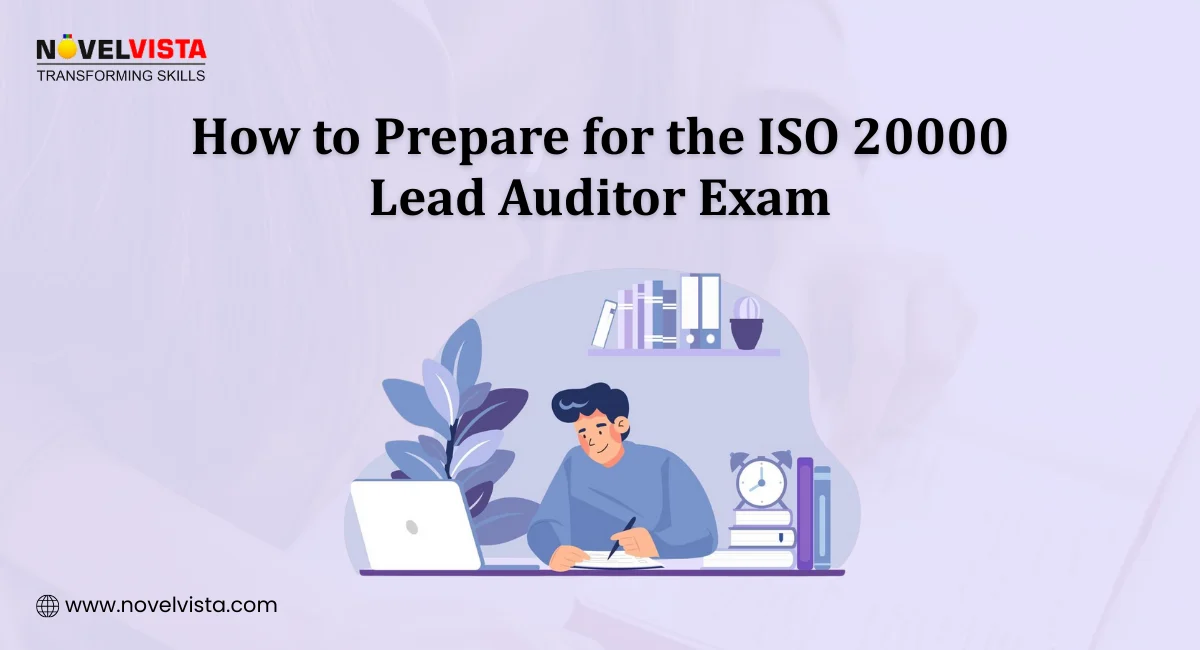
The ISO 20000 Lead Auditor exam is not about memorizing clauses or ticking answers fast. Many capable professionals fail simply because they underestimate what the exam is really testing. It checks whether you can think like an auditor, apply ISO/IEC 20000-1 requirements in real situations, and make sound audit decisions under time pressure.
In Lead Auditor training sessions, many participants initially approach the exam like a theory test. During mock exams, the same participants often struggle with scenario questions until they shift their thinking from “what does the clause say” to “what would an auditor do.” This pattern appears consistently across batches.
This guide breaks down how the Lead Auditor exam works, what it assesses, and how to prepare in a structured way. You’ll understand the exam format, core topics, preparation approach, and practical techniques that experienced auditors actually use.
The exam is designed for professionals responsible for auditing IT Service Management Systems (SMS). It goes far beyond basic ITSM knowledge.
The exam mainly tests:
Your understanding of ISO/IEC 20000-1 requirements
Your ability to apply audit principles in realistic scenarios
Your judgment when identifying nonconformities, risks, and improvement opportunities
Most questions are scenario-based. Instead of asking for definitions, the exam places you in an audit situation and asks what the best auditor response should be. That is why preparation focused only on reading the standard often falls short.
Understanding the exam structure early helps reduce stress and avoid poor time management.
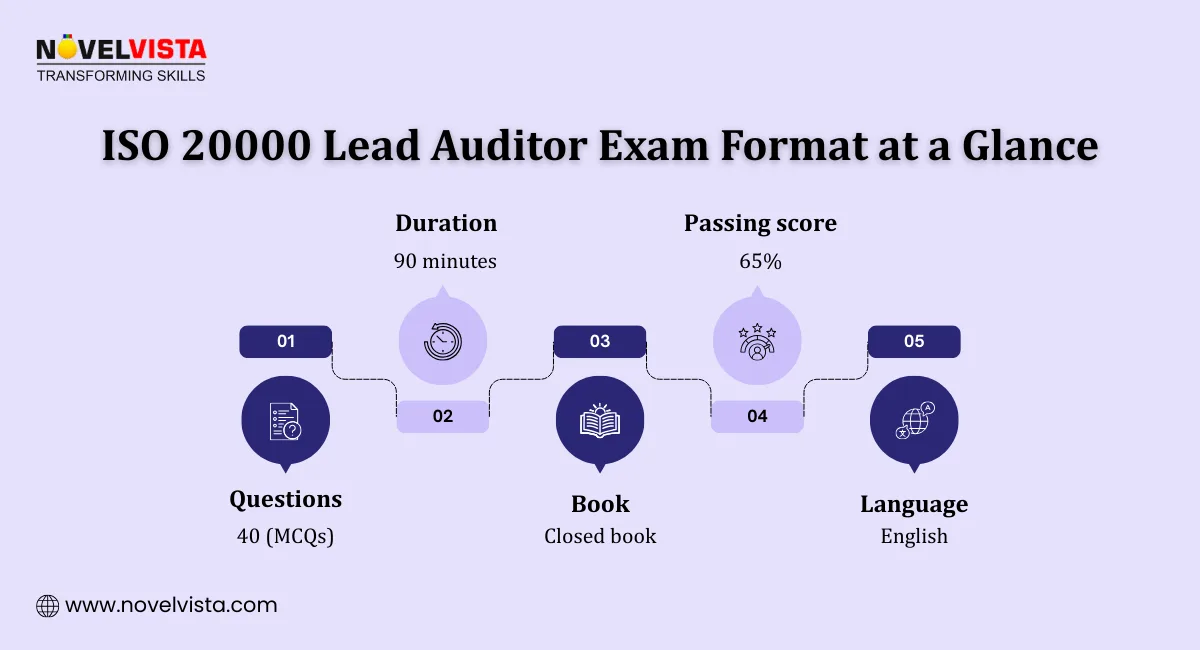
Here’s how the exam is structured:
Total questions: 40 multiple-choice questions
Duration: 90 minutes
Language: English
Passing score: 65%
Exam type: Closed book (no reference materials allowed)
Because the exam is closed-book, concept clarity is far more important than memory tricks. From an exam coaching perspective, time pressure is one of the biggest hidden challenges. Training exercises show that candidates who practice decision-making under timed conditions develop better clause recall and audit reasoning. This skill is critical in a closed-book exam environment.
You get just over two minutes per question, which means hesitation can cost valuable marks.
Strong preparation starts with the right foundation. Jumping directly into mock exams without understanding ITSM fundamentals usually creates confusion.
Before serious exam practice, you should be comfortable with:
Core IT Service Management concepts
Purpose and structure of ISO/IEC 20000-1
How services are planned, delivered, monitored, and improved
Basic audit thinking: evidence, objectivity, and risk-based decisions
This foundation helps you understand why a particular answer is correct, not just which option looks familiar. Effective preparation is always built on understanding, not memorization.
Clearing the exam requires discipline more than intensity. Studying randomly or cramming in the final days rarely works.
A practical preparation approach includes:
Structured Lead Auditor training: Training provides guided learning, exam-focused explanations, and real audit examples that self-study often misses.
Focused self-study: Study ISO/IEC 20000-1 clauses with an auditor’s lens. Ask how each requirement would be verified during an audit.
Scenario-based thinking: Practice applying clauses to realistic audit situations instead of memorizing text.
Balanced preparation builds confidence gradually and avoids last-minute panic. Professionals who follow a structured preparation approach combining guided training, clause review, and scenario practice show steady improvement across mock exams. This progression is commonly seen during Lead Auditor programs, where preparation focuses on audit logic rather than speed or shortcuts.
Certain topics appear repeatedly in the exam, either directly or within scenarios.
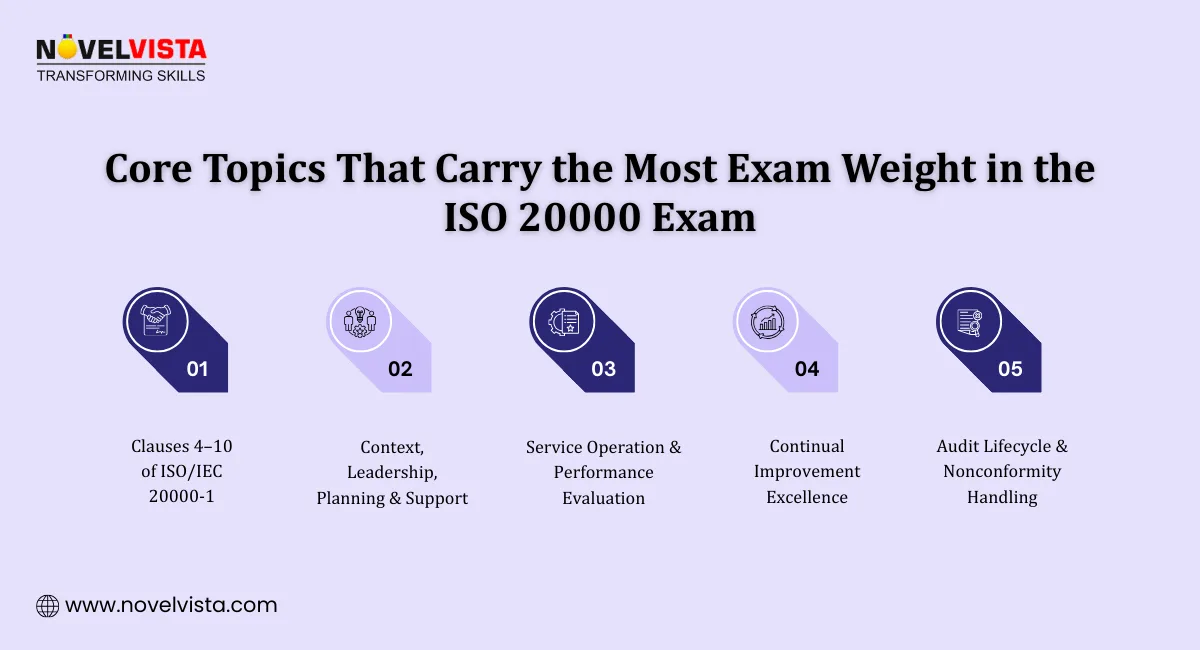
High-priority areas include:
ISO/IEC 20000-1 Clauses 4–10: Context, leadership, planning, support, service operation, performance evaluation, and continual improvement.
Audit fundamentals: Audit planning, execution, reporting, follow-up, and auditor responsibilities.
Risk-based auditing: Understanding risks, opportunities, and their impact on SMS effectiveness.
Nonconformity classification: Distinguishing between minor, major, and improvement observations.
These areas form the backbone of most exam questions and should receive consistent attention during preparation.
(Check Out the Complete Official Syllabus)
One reason candidates struggle with the exam is a misunderstanding of how questions are framed. These are not recall-based questions. They are decision-based.
Most questions test:
Your understanding of ISO/IEC 20000-1 clauses
Your ability to interpret audit situations
Your judgment as a Lead Auditor
You’ll often see four very similar answer options. Two may look correct, but only one reflects the best auditor action. In the exam, reading the full question carefully matters more than speed.
Always ask yourself:
What is the auditor’s role here?
Which option aligns best with audit principles?
Which choice addresses risk and evidence, not opinion?
Test your understanding and see how questions are actually framed. Explore our blog on Top ISO 20000 Exam Questions to strengthen your preparation and confidence.
For a closed-book exam, ISO 20000 practice tests are not optional; they are essential.
Practice tests help you:
Improve recall under time pressure
Get comfortable with scenario-style questions
Identify weak topic areas early
Build confidence before exam day
The right way to use practice tests is to review every incorrect answer. Link it back to the relevant clause or audit principle. This turns mistakes into learning points instead of frustration.
These preparation techniques are based on repeated exam patterns, supervised mock tests, and feedback collected from certified Lead Auditors after real exam attempts. They reflect how the exam is actually evaluated, not theoretical assumptions.
See if the exam effort is worth it. Understand study time, preparation intensity, and the real career return before you commit to the certification journey.
Here are field-tested ISO 20000 exam preparation tips that consistently help candidates improve their scores:
Revise key clauses daily: Especially Clauses 4–10, with extra focus on operations and continual improvement.
Use flashcards for audit concepts: Terms like nonconformity, corrective action, audit scope, and evidence should feel natural.
Practice mock audits: This strengthens judgment and helps you think like a Lead Auditor.
Simulate full exams: Take at least one full 90-minute test to improve pacing and concentration.
These ISO 20000 exam preparation tips improve both accuracy and confidence.
Successful candidates usually rely on a focused set of resources rather than too many references.
Recommended materials include:
ISO/IEC 20000-1 standard – Primary reference
ISO 19011 – For audit principles and guidance
Lead Auditor training material – Scenario-based explanations
Mock exams and revision notes – For practice and recall
Using these consistently strengthens your preparation without overwhelming you.
The final day before the exam should be calm and controlled.
Do this instead of last-minute cramming:
Quick revision of high-weight topics
One final timed practice test
Avoid new or unfamiliar topics
Rest well and reset mentally
A clear mind performs better than an overloaded one.
Once you clear the exam, your certification remains valid for 5 years.
You can then:
Conduct internal and external SMS audits
Support certification and surveillance audits
Guide organizations on compliance and improvement
Build credibility as an ITSM audit professional
Maintaining professional development helps you stay current with evolving ITSM practices.
Clearing the ISO 20000 exam is not about shortcuts. It’s about structured preparation, clear concepts, and steady practice. When you understand how the exam works, the pressure reduces automatically.
Consistent revision, disciplined ISO 20000 preparation, and smart use of practice tests are what separate confident passes from repeated attempts. Stay focused, trust the process, and approach the exam with a calm, auditor’s mindset.
The guidance in this preparation framework aligns with certification expectations and professional audit practices used globally. It reflects how competent Lead Auditors are trained to assess Service Management Systems in both examination and real audit environments.
If you want to clear the ISO 20000 exam with confidence, NovelVista’s ISO 20000 Lead Auditor Certification Training offers structured learning, real audit scenarios, and exam-focused guidance. The program helps you understand ISO/IEC 20000-1 requirements, audit decision-making, and nonconformity handling, so you don’t just pass the exam, but become a capable Lead Auditor in real ITSM environments.
Author Details

Course Related To This blog
ISO 20000:2018 Lead Auditor
Confused About Certification?
Get Free Consultation Call
Stay ahead of the curve by tapping into the latest emerging trends and transforming your subscription into a powerful resource. Maximize every feature, unlock exclusive benefits, and ensure you're always one step ahead in your journey to success.