Category | Quality Management
Last Updated On 23/04/2026
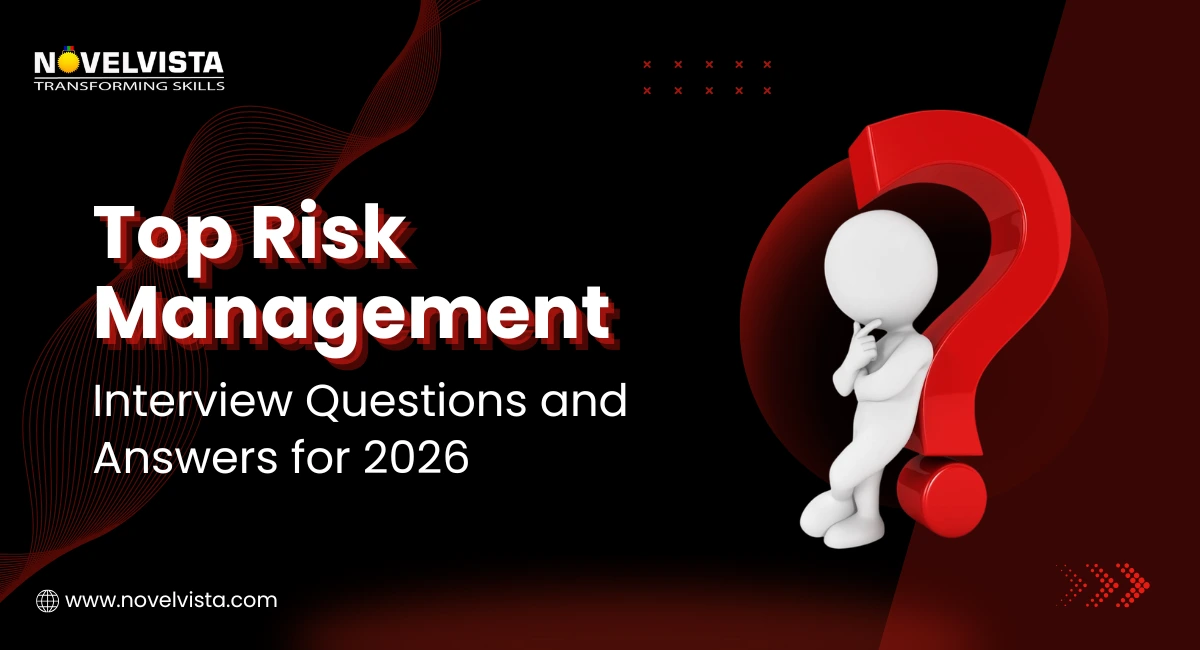
Risk is no longer something organizations react to it is something they actively predict, model, and integrate into decision-making. In fact, recent industry data suggests that over 80% of enterprises are investing in advanced risk analytics and enterprise risk frameworks to stay resilient in an increasingly volatile environment. From cyberattacks and AI-related uncertainties to global supply chain disruptions, risk management has become one of the most critical business functions in 2026.
This shift has also transformed how interviews are conducted. If you're preparing for risk management interview questions, you’ll quickly realize that interviewers expect more than textbook definitions. They want professionals who can interpret data, apply frameworks, and make strategic decisions under uncertainty.
If you’ve ever wondered how to confidently answer complex risk management questions, or how to tackle real-world scenarios during interviews, this blog will give you the clarity and depth you need.
Modern risk management interview questions are designed to evaluate how you think, not just what you know. Let’s explore the most relevant technical and scenario-based questions.
1. How do you implement an Enterprise Risk Management (ERM) framework in a complex organization?
Implementing ERM requires a structured approach that begins with defining risk governance and aligning it with organizational objectives. It involves creating a centralized risk register, establishing risk ownership across departments, and integrating risk reporting into executive decision-making. A mature ERM framework also includes continuous monitoring and periodic audits.
2. How do you define and operationalize risk appetite across business units?
Risk appetite must be translated into measurable thresholds such as financial limits, operational tolerances, or compliance boundaries. This requires collaboration between leadership and operational teams to ensure that risk-taking aligns with strategic goals.
3. Explain Value at Risk (VaR) and its practical applications.
VaR is a statistical technique used to estimate the potential loss of an asset or portfolio over a defined period at a given confidence level. While widely used in financial risk management, its limitations include assumptions about market behavior and inability to predict extreme events.
4. How do you conduct stress testing and scenario analysis?
Stress testing involves simulating extreme conditions to evaluate resilience, while scenario analysis explores different possible futures. Both are essential for understanding vulnerabilities and preparing contingency plans.
These risk management questions and answers are designed to test your ability to work with enterprise-level frameworks and quantitative concepts.

Technical risk analyst interview questions require strong analytical and modeling skills.
5. How is Monte Carlo simulation used in risk analysis?
Monte Carlo simulation generates thousands of possible outcomes by applying probability distributions to uncertain variables. This helps in understanding risk variability and making informed decisions.
6. How do you design a risk scoring model?
A risk scoring model combines multiple risk factors, assigns weights, and calculates a composite score. The model should be validated regularly to ensure accuracy and relevance.
7. What statistical methods are commonly used in risk forecasting?
Regression analysis, time-series forecasting, and machine learning models are widely used to predict trends and identify emerging risks.
8. How do you validate and back-test a risk model?
Model validation involves comparing predicted results with actual outcomes, performing sensitivity analysis, and ensuring the model performs well under different scenarios.
9. How do you handle data quality issues in risk analysis?
Data quality is addressed through validation checks, cleansing processes, and ensuring data integrity before analysis.
These risk analyst interview questions focus heavily on your ability to work with data, tools, and predictive models.
Pro Tip: A well-structured ISO 31000 Certification Exam guide can complement your preparation by helping you connect theoretical frameworks with the practical risk management interview questions discussed in this blog.
At a leadership level, risk manager interview questions evaluate your ability to align risk management with business strategy.
10. How do you integrate risk management into organizational strategy?
Risk management should be embedded into strategic planning by ensuring that all major decisions are evaluated through a risk lens. This includes investment decisions, product launches, and operational changes.
11. How do you manage interdependent risks across departments?
Interdependencies are managed by mapping risk relationships and using integrated dashboards that provide a holistic view of organizational risk exposure.
12. How do you assess the effectiveness of risk controls?
Control effectiveness is evaluated through audits, performance metrics, and continuous monitoring. Ineffective controls must be redesigned or replaced.
13. How do you approach third-party risk management?
This involves conducting due diligence, assessing vendor risk exposure, implementing contractual safeguards, and monitoring vendor performance.
14. How do you communicate complex risks to senior stakeholders?
Effective communication requires simplifying technical information into business-relevant insights using dashboards, visualizations, and concise reports.
These risk manager interview questions test your leadership, governance, and decision-making capabilities.
Access 50+ practical interview questions with clear, structured answers
Strengthen your confidence with real-world scenarios and expert insights
Practical risk assessment interview questions focus on applying knowledge in real-world scenarios.
15. How would you conduct a risk assessment for a large-scale digital transformation project?
This involves identifying risks related to technology integration, data security, change management, and operational disruption. Each risk is then evaluated and mitigated through structured planning.
16. How do you prioritize risks in a dynamic environment?
Risk prioritization requires continuous monitoring and updating based on real-time data and changing business conditions.
17. How do you manage residual risk in critical operations?
Residual risk must be monitored and accepted only if it falls within defined risk tolerance levels. Otherwise, additional controls are required.
18. How do you assess cybersecurity risks within an organization?
This involves identifying vulnerabilities, evaluating threat likelihood, and assessing potential impact using structured frameworks.
19. How do you handle conflicting priorities between risk mitigation and business growth?
Balancing risk and growth requires data-driven decision-making and stakeholder alignment to ensure optimal outcomes.
These risk assessment interview questions emphasize your ability to apply frameworks in practical situations.

Preparing for risk management interview questions requires a strategic approach.
Interviewers expect examples from your experience. Be ready to explain how you identified and mitigated risks in actual scenarios.
Understanding quantitative methods, frameworks, and tools is essential for answering advanced risk management questions and answers.
Use frameworks like STAR (Situation, Task, Action, Result) to present your answers clearly and effectively.
Emerging risks such as AI, cybersecurity, and ESG compliance are frequently discussed in interviews.
In 2026, preparing for risk management interview questions means going beyond basic knowledge and demonstrating expertise in technical, analytical, and strategic areas. Organizations are looking for professionals who can not only identify risks but also quantify, prioritize, and manage them effectively.
Whether you're tackling risk analyst interview questions, risk manager interview questions, or risk assessment interview questions, your success depends on how well you connect theory with real-world application. Understanding the ISO 31000 Price Explained can help you evaluate the investment value of certification while preparing for advanced risk management interview questions and career growth.
By mastering these advanced risk management interview questions and answers, you can confidently position yourself as a skilled professional ready to handle the complexities of modern risk environments.

Join NovelVista’s ISO 31000 Risk Manager Certification Training and gain practical risk management skills, real-world insights, and globally recognized credentials. Designed for aspiring and experienced professionals, this course equips you to confidently manage enterprise risks and align them with business strategy in today’s dynamic environment.
Start your risk management journey today!
Author Details

Confused About Certification?
Get Free Consultation Call
Stay ahead of the curve by tapping into the latest emerging trends and transforming your subscription into a powerful resource. Maximize every feature, unlock exclusive benefits, and ensure you're always one step ahead in your journey to success.