Category | IT Service Management
Last Updated On 28/07/2026
Modern organizations rarely collapse because they lack frameworks. They struggle because value disappears in the space between teams.
Despite mature ITSM practices and digital transformation roadmaps, industry reports show that nearly 60% of IT transformation initiatives fail to achieve their intended outcomes. The issue isn’t poor intent or weak strategy. It’s fragmented execution. Even more concerning, studies estimate that up to 30% of operational capacity is consumed by rework, excessive handoffs, and unclear accountability.
That’s not a tooling problem.
It’s a value flow problem.
In today’s hyper-connected enterprise, customers don’t experience your processes they experience outcomes. And when value moves slowly, inconsistently, or invisibly across departments, performance suffers.
So pause for a moment and ask:
If you’re an IT leader, service manager, ITSM practitioner, or digital transformation decision-maker, mastering the ITIL (Version 5) Value Stream is no longer a competitive advantage it’s a necessity.
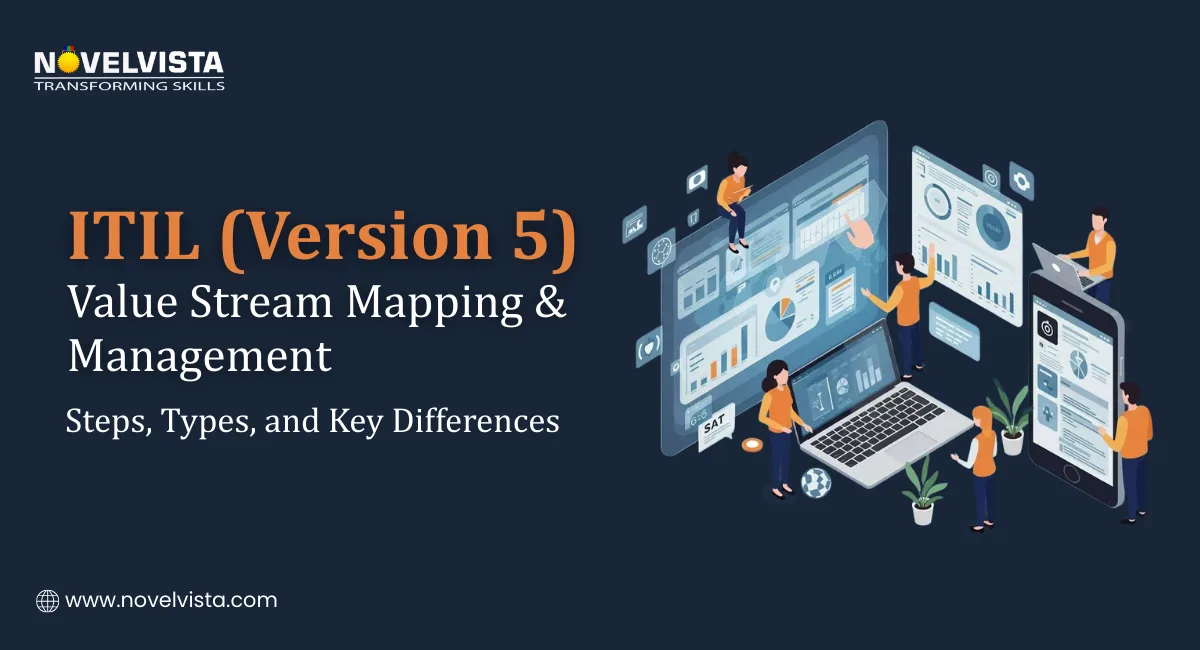
This blog explores ITIL (Version 5) Value Stream Mapping, explains the practical ITIL (Version 5) Value Stream Steps, and clarifies the difference between Value Stream Mapping vs Value Stream Management helping you shift from managing activities to orchestrating value.
At its core, the ITIL 5 Value Stream represents the end-to-end series of activities that convert demand into measurable value.
Unlike isolated processes, a value stream connects:
It aligns directly with the Service Value System (SVS), ensuring that every action contributes to customer value, not just task completion. Think of it like a relay race. If one runner hesitates during the baton handoff, the entire team slows down. Similarly, in IT service management, poor coordination between practices creates bottlenecks. The Service Value Stream ITIL 5 approach eliminates those blind spots by visualizing the complete journey from idea to value.
Before you improve something, you need to see it clearly.
That’s where ITIL 5 Value Stream Mapping comes in.
Value stream mapping is the practice of visually documenting:
It answers critical operational questions:
Without ITIL 5 Value Stream Mapping, organizations optimize isolated processes rather than the complete service journey.
Mapping creates clarity. Clarity enables improvement.
Every ITIL 5 Value Stream Steps sequence may vary depending on the service, but generally, they follow a structured flow aligned with the Service Value Chain.
Here’s a simplified breakdown:
Demand Capture marks the beginning of every value stream. Whether it’s an incident, a service request, a new feature proposal, or a compliance requirement, everything starts with clearly identifying the demand. At this stage, inputs are documented, expectations are aligned with stakeholders, and prioritization is established based on business impact. A structured intake process ensures clarity from the outset and prevents confusion, rework, or delays later in the value stream.
Design and Transition is the phase where the proposed solution is carefully designed, assessed, and validated before it moves forward. This stage includes critical activities such as risk assessment, resource planning, change enablement, and thorough testing and quality checks. By addressing potential risks and confirming readiness early, organizations ensure that the service or solution is stable, compliant, and fully prepared for successful delivery.
Obtain/Build is the stage where the service or solution is built or configured to meet the defined requirements. This phase typically involves development teams, infrastructure provisioning, and vendor coordination working in alignment. Effective collaboration across these functions minimizes delays, reduces friction, and ensures the solution is developed efficiently and according to agreed standards.
Deliver and Support is the stage where the service goes live and begins delivering real value to users. This phase includes deployment, monitoring, incident management, and ongoing user support to ensure stability and performance. Since customers directly experience the service at this point, the effectiveness of Deliver and Support has a significant impact on customer satisfaction and overall service perception.
Continuous Improvement ensures that no value stream remains static in a changing business environment. Through structured feedback loops, organizations regularly measure performance metrics, customer satisfaction, SLA compliance, and process efficiency to identify gaps and opportunities. This ongoing evaluation helps refine services, eliminate inefficiencies, and sustain long-term value delivery.
Continuous improvement ensures the ITIL 5 Value Stream evolves with business needs.
Not all value streams look the same.
Within the ITIL 5 Value Stream framework, organizations typically operate two main types:
These focus on delivering ongoing services.
Examples:
These streams prioritize stability and responsiveness.
These focus on creating or modifying services.
Examples:
They emphasize agility and innovation.
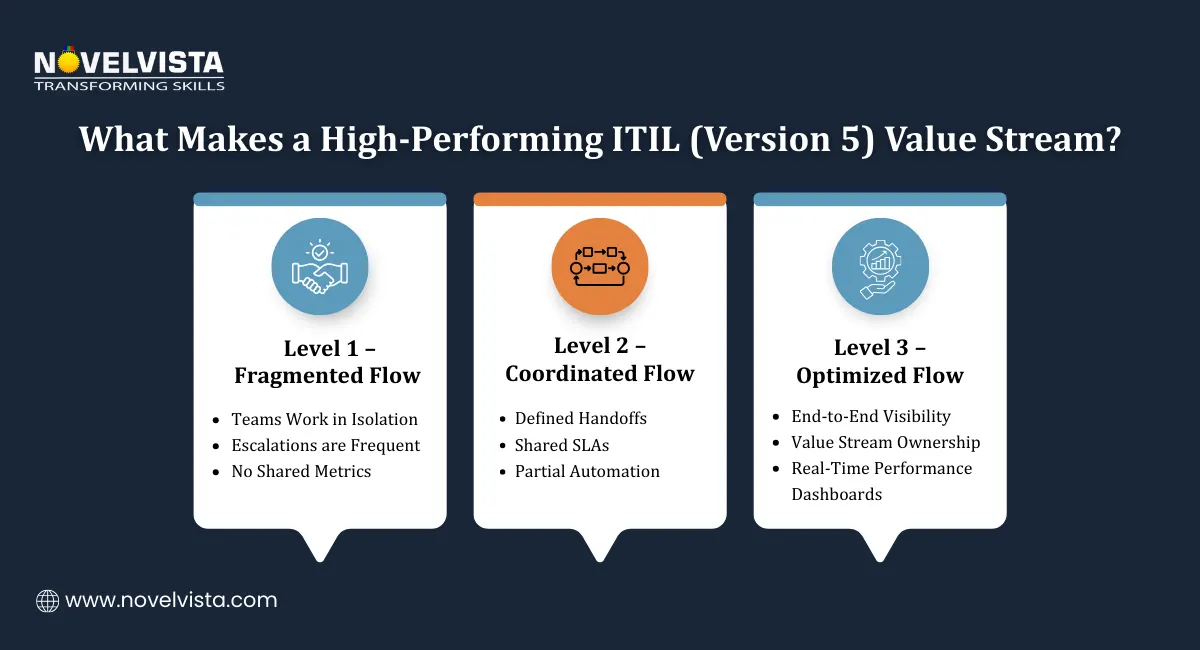
The Service Value Stream ITIL 5 model integrates both operational and development flows into a unified system. The ITIL Foundation (Version 5) Exam Syllabus outlines the core concepts, service value system components, and key practices required to build a strong foundation in modern IT service management.
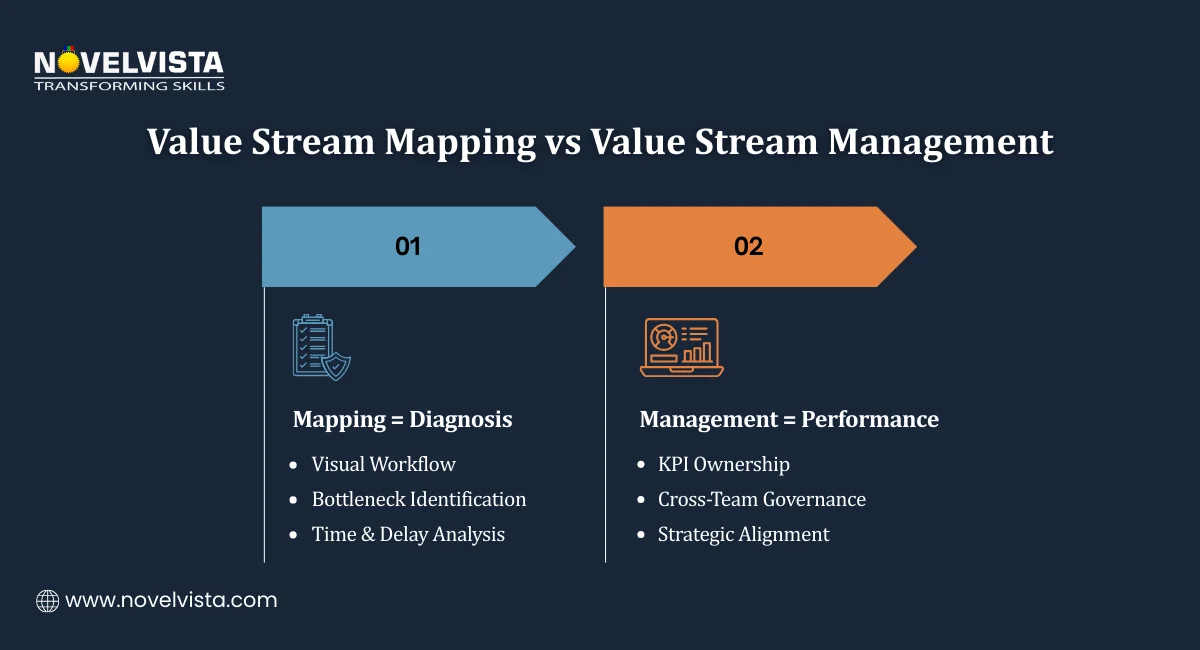
Mapping shows you the journey.
Management ensures the journey delivers results.
ITIL 5 Value Stream Management focuses on:
It goes beyond visualization and introduces accountability.
Effective management includes:
Without management, mapping becomes a static diagram.
With management, it becomes a strategic driver.
Many professionals confuse these two.
Here’s a simple comparison:
Aspect |
Value Stream Mapping |
Value Stream Management |
Focus |
Visualization |
Optimization & Governance |
Purpose |
Identify Bottlenecks |
Improve Performance |
Output |
Process Diagrams |
KPIs & Performance Improvements |
Timeframe |
One-time or Periodic |
Continuous |
Scope |
Operational Insight |
Strategic Alignment |
In short:
Value Stream Mapping vs Value Stream Management is the difference between seeing the road and actively driving the car.
Both are essential. But mapping without management limits impact.
When properly implemented, the ITIL 5 Value Stream approach delivers measurable advantages:
✔ Reduced Waste
Eliminates redundant approvals and unnecessary handoffs.
✔ Faster Time-to-Market
Shortens lead times by addressing delays holistically.
✔ Improved Customer Satisfaction
Fewer service disruptions and faster resolution.
✔ Better Risk Management
Integrated controls reduce compliance gaps.
✔ Stronger Business Alignment
Ensures services directly support business outcomes.
Organizations adopting ITIL 5 Value Stream Mapping report improved transparency across teams and better collaboration between IT and business stakeholders.
Digital transformation is no longer about simply deploying tools it is about delivering measurable value consistently and predictably. The ITIL 5 Value Stream Management approach enables end-to-end accountability, reduces silos, accelerates innovation, and provides strategic visibility across the organization. In complex enterprise environments, optimizing isolated processes is no longer sufficient. Only an integrated Service Value Stream ITIL 5 model ensures that every team aligns their efforts toward shared business outcomes and sustained value delivery. The ITIL (Version 5) Transition Guide helps organizations smoothly evolve their service management practices while maintaining stability, alignment, and measurable business value.
If your organization is facing recurring delays, blurred ownership, or inconsistent service outcomes, the answer isn’t layering more processes on top of existing complexity. The real shift lies in rethinking how value flows across your enterprise.
The ITIL 5 Value Stream framework provides the clarity, structure, and governance needed to transform fragmented activities into seamless, outcome-driven service delivery. When you combine ITIL 5 Value Stream Mapping with disciplined Value Stream Management, you move beyond reactive firefighting and step into proactive, measurable value optimization.
In a competitive digital economy, visibility is no longer optional it is strategic leverage. Organizations that understand and manage their value streams don’t just deliver services faster; they deliver outcomes with precision, accountability, and confidence. The conversation is no longer about improving isolated processes. It’s about orchestrating value end-to-end.
The only real question left is:
Will you let value drift between teams or will you design how it flows?
Ready to strengthen your expertise in ITIL 5 Value Stream, mapping techniques, and modern service management practices?
Join NovelVista’s ITIL 5 Foundation Certification Training and build practical knowledge of value stream design, service value system alignment, and end-to-end service optimization. This program is designed for IT leaders, service managers, and ITSM professionals who want to move beyond theory and confidently implement ITIL 5 Value Stream Management in real-world environments.
Gain structured insights, industry-recognized credentials, and the confidence to orchestrate value across your organization.
Start your ITIL 5 journey today!
Author Details

Confused About Certification?
Get Free Consultation Call
Stay ahead of the curve by tapping into the latest emerging trends and transforming your subscription into a powerful resource. Maximize every feature, unlock exclusive benefits, and ensure you're always one step ahead in your journey to success.