Category | DevOps
Last Updated On 04/04/2026
In a world where modern applications serve millions of users across distributed, cloud-native architectures, reliability is no longer optional it’s mission-critical. Today’s systems span microservices, multi-cloud environments, containers, and real-time data pipelines, operating at a scale where even a few seconds of downtime can trigger a ripple effect lost revenue, frustrated customers, and damaged brand trust. In fact, studies show that system failures don’t just impact IT teams they directly hit business outcomes.
This growing complexity and scale have pushed organizations to rethink how they approach reliability. And that’s exactly where the SRE Mindset becomes a game-changer.
But here’s the real question:
Are tools, dashboards, and alerts enough to ensure reliability in such complex, high-scale environments?
Or is there something deeper that separates resilient systems from fragile ones?
In an era of agentic AI systems making autonomous decisions and ephemeral infrastructure that constantly spins up and down, reliability now demands a fundamentally different, mindset-driven approach.
Whether you're a DevOps engineer, system administrator, IT leader, or simply exploring modern infrastructure practices, this blog is designed for you. Because mastering The SRE Mindset isn’t about adding more tools, it’s about transforming how you think, operate, and build systems that scale without breaking.
At its core, The SRE Mindset is a way of thinking that prioritizes reliability, automation, and continuous improvement over manual intervention and guesswork. Unlike traditional IT operations, which often focus on fixing issues after they occur, The SRE Mindset emphasizes preventing problems before they impact users. It combines software engineering principles with IT operations to build scalable and resilient systems. Rather than simply asking, “How do we fix this issue quickly?”, teams adopting The SRE Mindset focus on a deeper question: “Why did this happen, and how can we ensure it never happens again?” This proactive and analytical shift is what truly defines The SRE Mindset.
Modern systems are no longer simple. With microservices, cloud-native architectures, and distributed systems, complexity has skyrocketed.
Users expect:
Even minor disruptions can damage brand reputation and revenue.
This is why organizations are investing heavily in SRE practices and clearly defined sre objectives. These objectives help teams balance system reliability with innovation, ensuring that development speed doesn’t compromise stability.
Adopting The SRE Mindset allows businesses to:
Deliver consistent performance
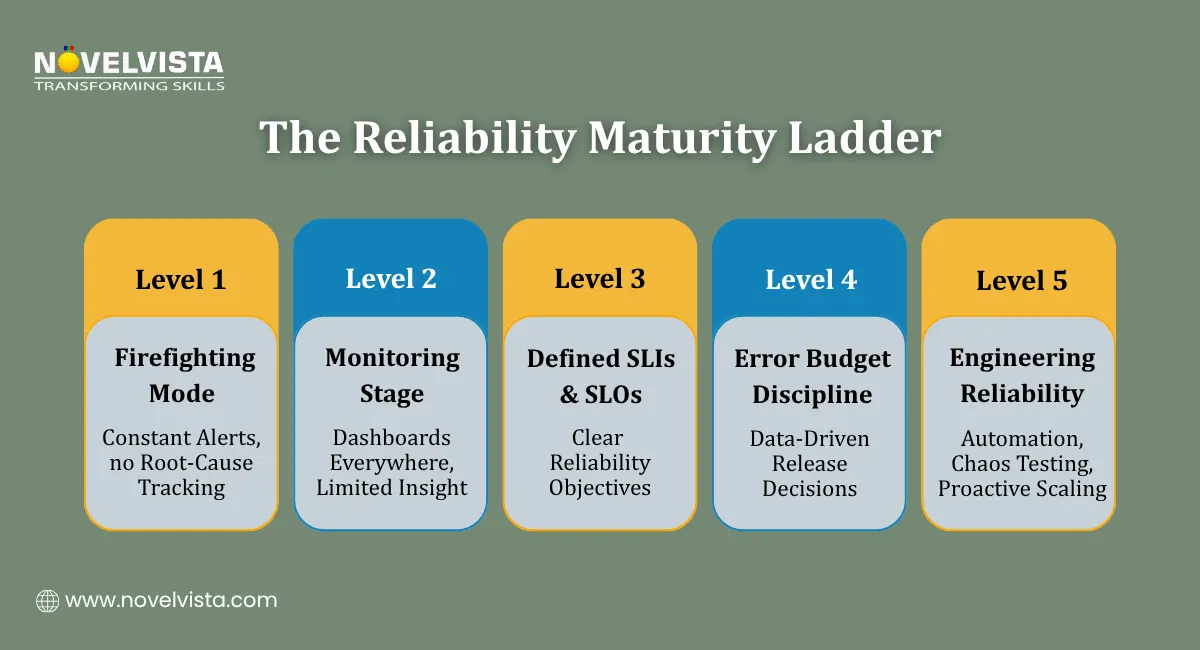
Failures are inevitable in complex systems. Instead of fearing them, the SRE Mindset treats failures as opportunities to learn and improve.
Post-incident reviews (blameless retrospectives) focus on:
Reliability isn’t vague it’s measurable.
SRE teams use:
A common exam question: how are SLOs and SLAs connected?
SLOs should always be stricter than SLAs.
The internal buffer is the gap between SLO and SLA.
Example:
In short:
SLO = target, SLA = promise, Internal Buffer = safety cushion.
Manual work (toil) is one of the biggest bottlenecks in operations.
The SRE approach promotes:
Reducing toil allows engineers to focus on innovation rather than repetitive tasks.
In Google SRE terms, toil is defined as:
Manual, repetitive, automatable, tactical work that scales linearly with service growth.
Toil consumes valuable engineering time without improving system reliability. Reducing it is a core SRE objective, enabling teams to focus on automation, scalability, and innovation.
Speed vs reliability is a constant challenge.
The concept of error budgets helps teams strike this balance:
This balance is a cornerstone of the SRE mindset.
When the error budget is fully consumed, it signals that the system has reached its acceptable limit for unreliability. This is where the true SRE mindset shift comes into play.
Instead of continuing to push new features, the priority immediately shifts to stability and reliability.
This is enforced through what’s commonly known as the freeze policy:
Master SRE mindset with real-world strategies
Align SRE with proven reliability practices
Achieve results with clear SRE objectives
The SRE function acts as a bridge between development and operations teams.
It includes responsibilities such as:
Unlike traditional roles, the SRE function is deeply rooted in engineering. SREs write code to solve operational problems, making systems more scalable and efficient.
They collaborate closely with:
This cross-functional approach ensures alignment between system performance and business needs.
Today, AI is transforming the SRE role by making operations more proactive and intelligent. Instead of only reacting to incidents, SRE teams can now predict and prevent issues using advanced analytics.
A key driver of this shift is AIOps (Artificial Intelligence for IT Operations), which leverages machine learning to:
In short: AI-powered AIOps is evolving SRE from reactive support to predictive, data-driven reliability engineering.
Clearly defined SRE objectives are essential for measuring success.
Some common objectives include:
These objectives are not just technical they directly impact user experience and business outcomes.
For example:
By aligning SRE objectives with business KPIs, organizations can make smarter decisions about resource allocation and priorities.
Many organizations make the mistake of equating SRE with tools, assuming that implementing monitoring platforms and observability stacks alone will ensure reliability. While these tools are important, they are not enough. The SRE Mindset goes beyond tooling and focuses on strong decision-making frameworks, proactive problem-solving, and a culture of continuous improvement. It’s not about how many tools you use it’s about how effectively you use them. In fact, a team that truly embraces The SRE Mindset with fewer tools can often outperform a tool-heavy team that lacks strategic thinking and a reliability-first approach. Accelerate your career growth by following a structured SRE certification path designed to build real-world reliability engineering expertise.
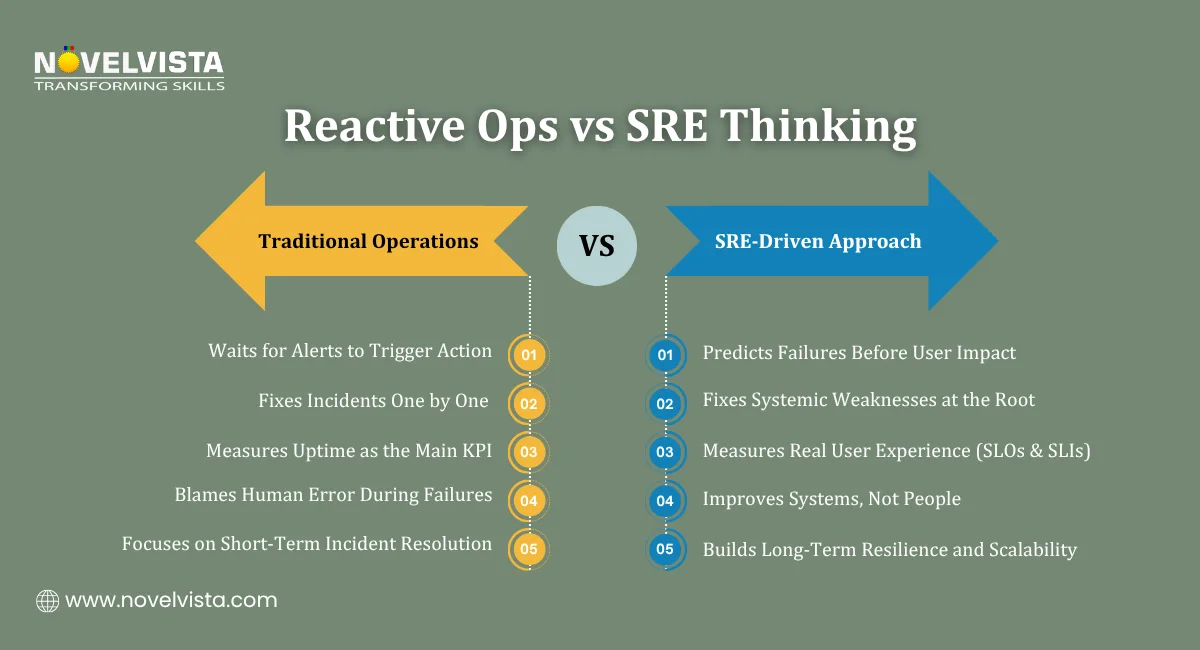
Organizations that embrace the SRE mindset experience tangible benefits:
Proactive monitoring and automation reduce downtime significantly.
Well-defined processes ensure quicker resolution of issues.
Consistent performance leads to higher user satisfaction.
Automation minimizes manual effort and resource wastage. Boost your confidence and get exam-ready faster with focused SRE Test Preparation tailored for real-world success.
Adopting the SRE mindset requires both cultural and technical transformation.
Define your SRE objectives and align them with business outcomes.
Upskill teams in:
Engineers should take responsibility for the systems they build and maintain.
Regular reviews, feedback loops, and iterative enhancements are essential.
Identify repetitive tasks and automate them wherever possible.
In a world driven by digital experiences, reliability has become the foundation of success, and this is where The SRE mindset plays a critical role. The SRE Mindset goes far beyond tools, alerts, and metrics it’s about thinking differently, acting proactively, and continuously improving systems to meet evolving demands. By redefining the SRE function and aligning it with clear and measurable SRE objectives, organizations can build systems that are not only resilient but also scalable and high-performing. Ultimately, the future of IT operations belongs to those who fully embrace The SRE Mindset not just as a set of practices, but as a deeply embedded culture.
Ready to take your understanding of the SRE Mindset to the next level?
Join NovelVista’s SRE Foundation Certification Training and gain hands-on experience in automation, monitoring, incident management, and real-world reliability engineering practices. This course is designed for DevOps engineers, system administrators, and IT professionals who want to strengthen their SRE function and achieve measurable SRE objectives in modern digital environments. With expert-led sessions, practical case studies, and globally recognized certification, you’ll be equipped to build scalable, resilient systems and drive operational excellence.
Start your SRE journey today and transform the way you approach reliability!

Author Details

Course Related To This blog
SRE Foundation and Practitioner Combo
SRE Certification Course
SRE Foundation and SRE Practitioner combo
SRE Practitioner
SRE Foundation
Confused About Certification?
Get Free Consultation Call
Stay ahead of the curve by tapping into the latest emerging trends and transforming your subscription into a powerful resource. Maximize every feature, unlock exclusive benefits, and ensure you're always one step ahead in your journey to success.