Category | DevOps
Last Updated On 26/02/2026

Every minute a system goes down, businesses lose money, credibility, and customer trust. According to reports from organizations like Gartner, the average cost of IT downtime can reach thousands of dollars per minute for mid-sized enterprises and significantly more for large organizations. Meanwhile, studies from IBM show that infrastructure failures and misconfigurations remain among the top causes of service disruptions worldwide.
So here’s the real question:
Who ensures your apps don’t crash during peak traffic?
Who prevents outages during product launches?
Who automates recovery before customers even notice an issue?
The answer increasingly lies in the SRE position.
If you’re an IT professional, DevOps engineer, cloud specialist, or someone exploring reliability engineering careers, this guide is for you. In this blog, we’ll break down the SRE position meaning, explain the SRE position description, and answer the most common question: what is SRE position in today’s technology-driven enterprises?
Let’s dive in.
Before we explore responsibilities, let’s clarify the fundamentals.
The SRE position stands for Site Reliability Engineer, an engineering-focused role responsible for maintaining system reliability, availability, scalability, and performance.
The concept originated at Google, where engineering teams applied software development practices to IT operations. Instead of manually fixing issues, they automated solutions. Instead of reacting to outages, they designed systems to prevent them.
If DevOps focuses on collaboration between development and operations, SRE focuses on engineering reliability into the system.
In simple words:
An SRE is a software engineer who solves operations problems using code.
The core objectives of an SRE position include:
Reducing downtime
Increasing system resilience
Automating repetitive operational tasks
Managing scalability and performance
Implementing monitoring and observability
This is not a traditional IT support role. It’s a high-impact engineering function that directly influences business continuity.
Understanding the SRE position description helps clarify how strategic this role really is.
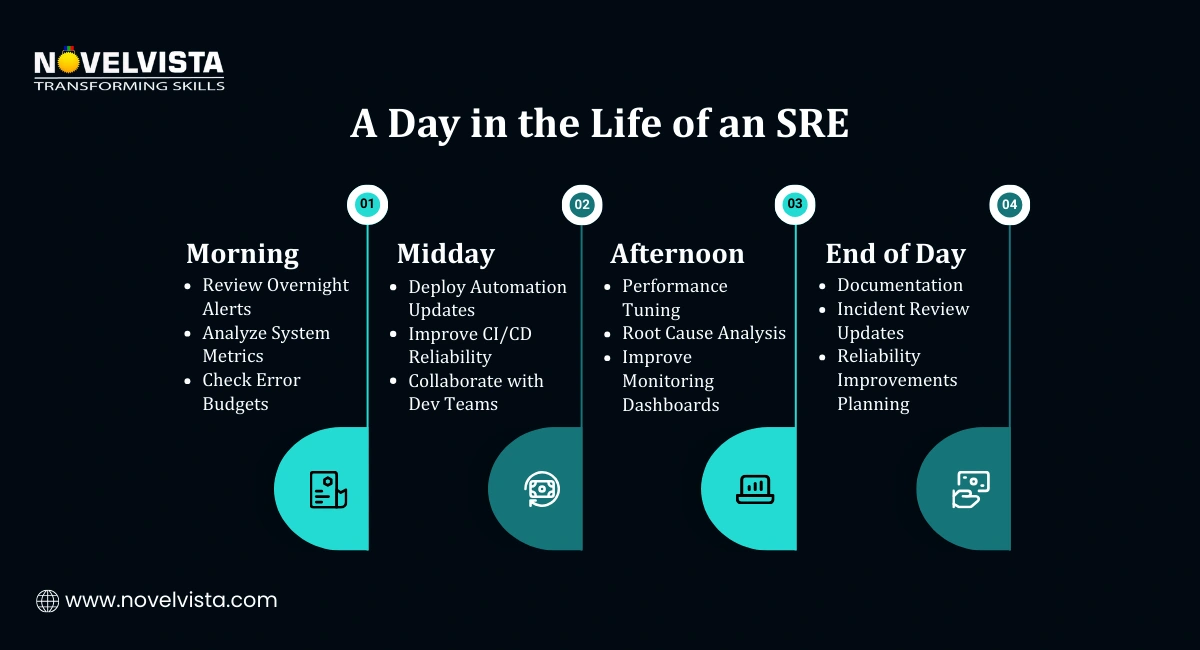
An SRE professional typically works at the intersection of:
Cloud infrastructure
Automation
Incident response
Performance engineering
Capacity planning
Let’s break it down.
SREs define measurable reliability targets:
Service Level Indicators (SLIs)
Service Level Objectives (SLOs)
Service Level Agreements (SLAs)
These metrics determine acceptable downtime and performance thresholds.
Instead of chasing 100% uptime (which is unrealistic and costly), SREs manage error budgets balancing innovation with stability.
A key part of the SRE position description includes building monitoring systems that detect problems early.
This involves:
Log management
Metrics collection
Distributed tracing
Alert engineering
Tools like Prometheus, Grafana, Datadog, and ELK stack are commonly used.
The goal?
Move from reactive firefighting to proactive prevention.
When systems fail, SREs:
Coordinate incident response
Minimize Mean Time to Recovery (MTTR)
Conduct post-incident reviews
Implement preventive automation
Unlike traditional IT operations, the SRE position emphasizes blameless postmortems and continuous improvement.
Repetitive manual tasks create risk.
SRE engineers eliminate them through:
Infrastructure as Code (Terraform, CloudFormation)
CI/CD pipelines
Configuration management
Auto-scaling systems
If something needs to be done more than twice, automate it.
That’s the SRE mindset.
SRE professionals forecast system growth and optimize resources.
They answer questions like:
Can our system handle 5x traffic?
Are we overpaying for unused cloud capacity?
Where are performance bottlenecks?
This makes the SRE position critical for cost optimization as well.
If you're considering an SRE position, here are the must-have competencies.
Strong programming (Python, Go, Java)
Cloud platforms (AWS, Azure, GCP)
Kubernetes & containerization
CI/CD pipelines
Monitoring & observability tools
Linux system administration
Networking fundamentals
The difference between DevOps and SRE?
| DEVOPS | SRE |
| Cultural Approach | Engineering Implementation |
| Collaboration Focus | Reliability Focus |
| Toolchain Enablement | Sla/Slo Ownership |
SRE is more metrics-driven and reliability-focused. Explore our comprehensive SRE roles and salary guide to understand career paths, responsibilities, and earning potential in today’s high-demand reliability engineering landscape.
Digital businesses cannot afford downtime. When e-commerce platforms crash during high-traffic sales, banking apps fail at peak transaction hours, or streaming services buffer during major live events, the impact goes far beyond technical inconvenience each failure damages customer trust and brand credibility. This is where the SRE position becomes critical. An SRE position helps organizations reduce operational risk by proactively identifying system weaknesses, improve customer satisfaction through consistent uptime, accelerate deployments safely using automation and error budgets, scale infrastructure efficiently to handle unpredictable demand, and strengthen cybersecurity posture through resilient architecture. In today’s cloud-native environments, where microservices, containers, and APIs create interconnected complexity, everything depends on reliability engineering. Without a dedicated SRE position, systems gradually become fragile, reactive, and vulnerable to costly disruptions.
The demand for SRE professionals has grown significantly over the last decade.
Organizations across industries — fintech, SaaS, healthcare, retail — are investing in reliability engineering.
Typical career path:
Junior Site Reliability Engineer
SRE
Senior SRE
Principal Reliability Engineer
Reliability Engineering Manager
The SRE position is often one of the highest-paid roles in cloud engineering because it directly impacts uptime and revenue.
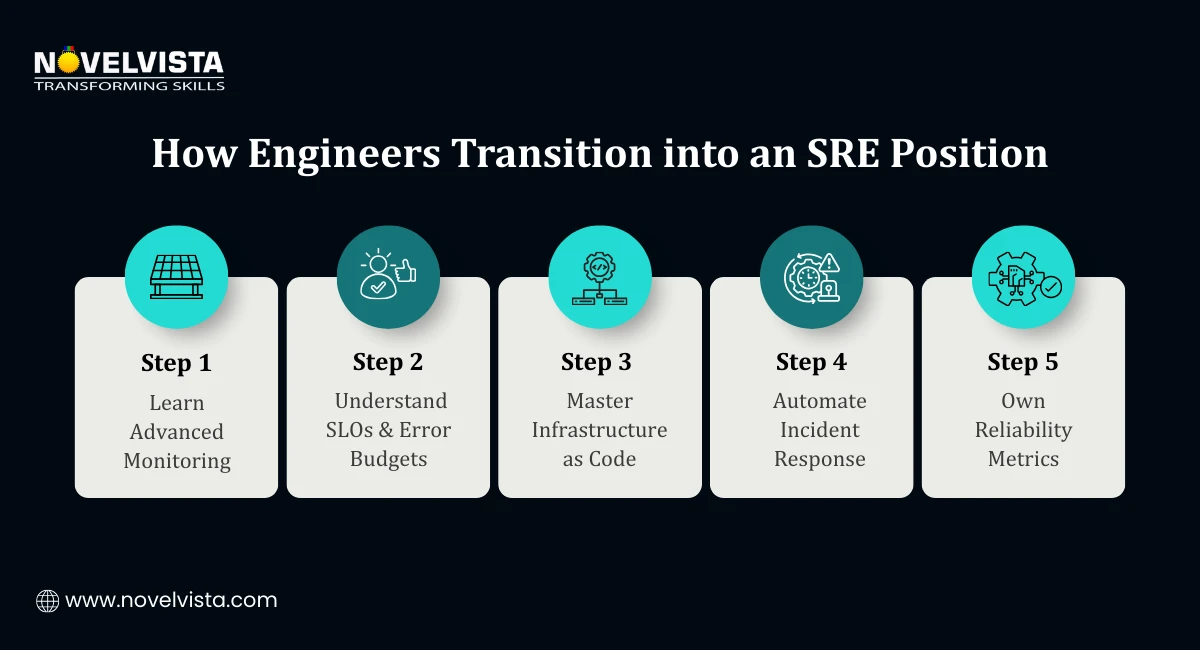
If you're asking what is SRE position and how do I enter this field? — here’s your roadmap.
Focus on automation and scripting.
Hands-on practice with Kubernetes and public cloud platforms is essential.
Understand metrics, logs, tracing, and alert tuning.
Learn about SLOs, SLIs, SLAs, error budgets, and incident response.
Deploy scalable applications.
Simulate failures.
Implement recovery automation.
As businesses shift toward AI-driven infrastructure, edge computing, and distributed architectures, reliability becomes even more critical than ever before. Automation is increasing across cloud environments, systems are becoming more complex with interconnected services and real-time data flows, and customer expectations are rising for seamless, uninterrupted digital experiences. In this rapidly evolving landscape, the SRE position will continue transforming beyond a purely technical role into a strategic leadership function responsible not just for uptime, but for overall business resilience, scalability, and long-term operational stability.
The SRE position is no longer a “nice-to-have” in modern enterprises it is a business-critical necessity. In a digital economy where milliseconds impact user experience and minutes of downtime translate into significant revenue loss, reliability is a competitive advantage. From defining measurable reliability metrics and managing error budgets to automating infrastructure, leading incident response, and optimizing system performance, the SRE function sits at the heart of operational excellence.
For professionals aiming to future-proof their IT careers, understanding the SRE position meaning, exploring the full SRE position description, and clearly answering what SRE position is more than career research it’s a strategic move. Organizations are no longer just hiring engineers who can build systems; they need engineers who can keep them resilient, scalable, and secure under pressure.
In a world powered by cloud-native architectures, AI-driven platforms, and always-on customer expectations, SRE professionals are not just maintaining uptime they are safeguarding business continuity. They are the quiet force behind seamless digital experiences, ensuring that innovation never comes at the cost of reliability.

If you're ready to move beyond theory and step confidently into a high-impact SRE position, now is the time to invest in structured, hands-on learning. Join NovelVista’s SRE Foundation Training & Certification and build the practical reliability engineering skills modern enterprises demand. This program is designed for DevOps engineers, cloud professionals, system administrators, and IT leaders who want to master SLOs, SLIs, Golden Signals, automation strategies, and real-world incident management practices.
Start your SRE journey today!
Author Details

Course Related To This blog
SRE Foundation
Confused About Certification?
Get Free Consultation Call
Stay ahead of the curve by tapping into the latest emerging trends and transforming your subscription into a powerful resource. Maximize every feature, unlock exclusive benefits, and ensure you're always one step ahead in your journey to success.