Category | DevOps
Last Updated On 13/02/2026
Are you confident that your SRE test preparation truly prepares you for real-world reliability challenges — or are you just memorizing concepts for the exam?
Recent industry studies show that a significant percentage of organizations face at least one critical outage each year and many acknowledge gaps in their preparedness, response speed, and recovery strategy. This is exactly why Site Reliability Engineering (SRE) has become one of the most in-demand roles in IT. If you're preparing for your SRE certification, you're not just studying theory — you're building the mindset and problem-solving skills needed to design, operate, and maintain highly reliable systems under real pressure.
But here’s the real question:
If you’re a DevOps engineer, cloud professional, system administrator, or IT student aiming to move into reliability engineering, this guide is for you. In this blog, we’ll break down SRE test preparation using real-world scenarios and practical solutions, not just textbook definitions.
Let’s begin.
Before diving deep into SRE preparation, it’s important to understand what the SRE test evaluates.
Unlike traditional exams, SRE certification exams focus heavily on scenario-based questions. You are often given real production issues and asked how you would respond.
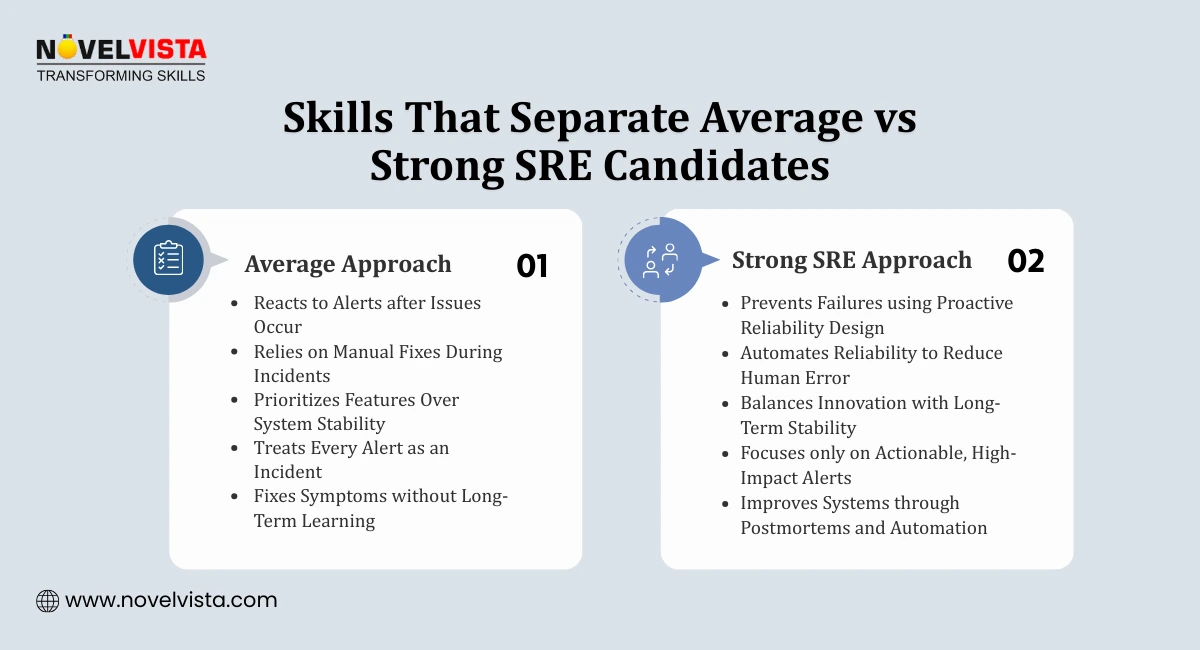
Effective SRE preparation revolves around mastering foundational reliability concepts.
When preparing for the SRE test, understanding SLIs, SLOs, and SLAs is essential because they form the foundation of measuring system reliability. An SLI (Service Level Indicator) represents a specific metric, such as request latency under 200ms, that helps track system performance. An SLO (Service Level Objective) defines the target for that metric, for example, maintaining 99.9% uptime per month to ensure consistent service availability. An SLA (Service Level Agreement) is a formal financial agreement with customers that outlines the consequences if reliability targets are not met. In most exams, candidates are tested not only on definitions but also on how to balance reliability and innovation while managing SLIs, SLOs, and SLAs effectively.
Expect questions on:
In SRE, understanding Monitoring and Observability is crucial for maintaining system reliability. Monitoring focuses on tracking predefined metrics and detecting known issues, such as CPU spikes or memory usage crossing thresholds. In contrast, Observability goes deeper by helping teams investigate unknown issues through logs, metrics, and traces, even when problems were not anticipated. While monitoring alerts you to expected failures, observability enables you to explore and diagnose unexpected system behavior effectively.
Automation plays a vital role in Site Reliability Engineering because it reduces human error and increases operational efficiency. By automating repetitive tasks such as deployments, scaling, and configuration management, teams can maintain consistency across environments. Infrastructure as Code (IaC) is especially critical for scalable systems, as it allows infrastructure to be provisioned and managed through code, ensuring reliability, repeatability, and faster recovery during failures.
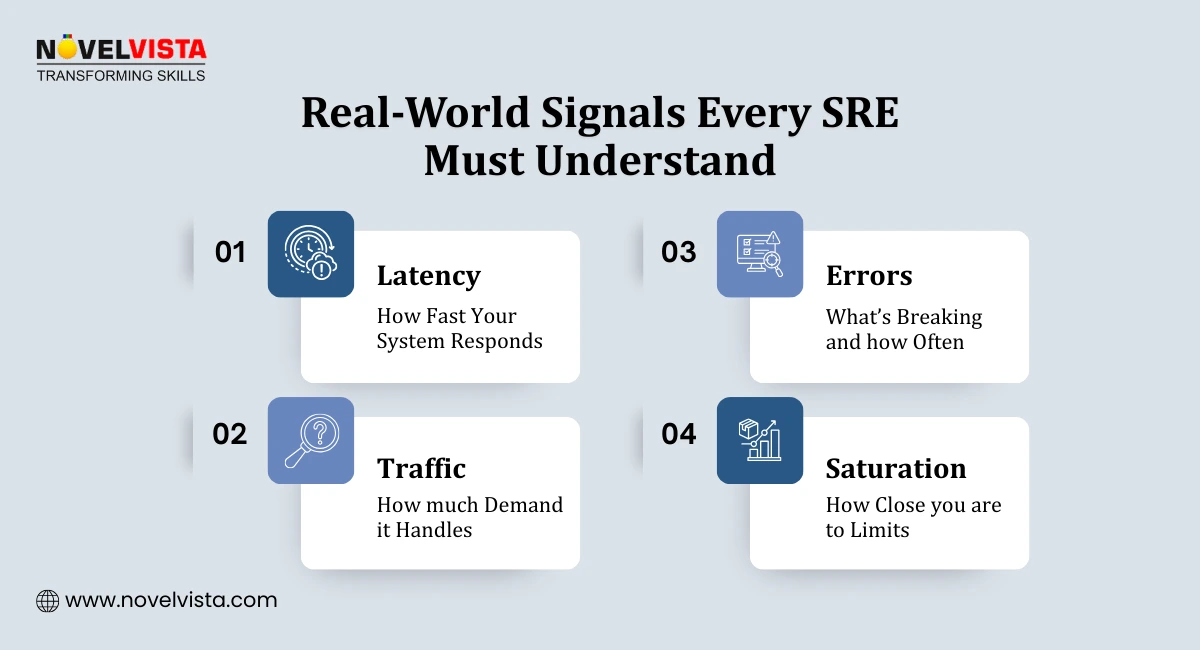
Understanding traffic patterns and scaling decisions is essential for production reliability.
Strong SRE test preparation requires combining all these domains into practical problem-solving.
Situation:
An e-commerce website crashes during a festive sale due to unexpected traffic spikes.
Step 1: Identify the bottleneck
Step 2: Scale horizontally
Step 3: Stabilize the system
Step 4: Conduct postmortem
In an SRE test, you may be asked which metric to check first or which scaling strategy to apply.
Key lesson: Reliability planning must happen before traffic spikes. Effective SRE Practices focus on automation, proactive monitoring, incident response, and continuous improvement to ensure high system reliability and performance.
Situation:
Error rate jumps to 15% after a new deployment.
Often, distributed systems fail because of misconfigured APIs or database latency.
In SRE test preparation, you must think like an engineer:
Exams test your ability to systematically troubleshoot rather than panic.
Situation:
The operations team receives 500 alerts daily, most of them false positives.
This leads to alert fatigue one of the biggest reliability risks.
For example, alert only when user experience is impacted not when CPU hits 60%.
During SRE preparation, understand that good monitoring reduces noise and increases clarity.
Learn core SRE principles with real-world examples
Understand monitoring, automation, and incident management clearly
Get actionable insights to build reliable and scalable systems
Now let’s talk strategy.
Successful SRE preparation is not about memorizing definitions. It’s about applying concepts.
Use Kubernetes clusters, deploy sample apps, and simulate failures.
Create mock outages and resolve them.
Study public outage reports from major companies.
Practice scenario-based questions regularly.
Create runbooks and reliability checklists.
The more practical exposure you gain, the more confident you’ll feel during the actual SRE test.
Even experienced professionals make mistakes while preparing.
Your SRE preparation should be hands-on, analytical, and structured.
In today’s cloud-driven world, reliability is a business necessity, not just a technical goal. Even brief outages can impact revenue and customer trust, which is why companies rely on skilled SRE professionals to maintain uptime, performance, and scalability.
Effective SRE preparation goes beyond theory. It requires building a reliability mindset, understanding SLIs and SLOs, mastering automation, strengthening observability, and handling incidents with confidence. The SRE test evaluates how well you apply these skills in real-world scenarios.
Prepare with intention. Practice consistently. Think like an SRE.
Ready to strengthen your reliability engineering expertise?
Join NovelVista’s SRE Foundation Training and Certification, or advance further with the SRE Practitioner Training and Certification. These industry-aligned programs provide hands-on learning, real-world reliability scenarios, expert guidance, and globally recognized credentials to help you excel in modern digital environments.
Whether you're starting your SRE journey or aiming to deepen your practical knowledge, these courses are designed to help you confidently tackle production challenges and succeed in your SRE test preparation.
Start your SRE certification journey today!
Author Details

Confused About Certification?
Get Free Consultation Call
Stay ahead of the curve by tapping into the latest emerging trends and transforming your subscription into a powerful resource. Maximize every feature, unlock exclusive benefits, and ensure you're always one step ahead in your journey to success.